| linguae |
|
QUESTIONS ARISING FROM 126th. MEETING – 27/8/21
(the record of earlier meetings can be downloaded from the main Circulus page as can the version of Ciceronis Filius with illustrations added. The illustrated text of Genesis is available on the Genesis page, of Kepler's Somnium on the Somnium page and of Nutting's Ad Alpes on the Ad Alpes page)
Food consumed at the Basmati included cicera arōmatica (chana masala, spiced chick peas), agnīna acerrima (lamb Vindaloo), brassica Pompēiāna cum pisīs (gobi matar, cauliflower with peas), caseus fervēns (sizzling paneer), okrum arōmaticum (bhindi masala, `lady’s fingers’, okra with spices), spīnāchia cum caseō (palak paneer), carō concīsa cum pīsīs (keema matar, mincemeat with peas), gallīnācea cum aliō (garlic chicken), and carō ruber (rogan josh) plus the usual orȳza,pānis Persicus (naan), vīnum rubrum and oxygalactīnam
Before continuing with Ad Alpes, we looked at a brief passage from chapter 8 of Paul the Deacon’s Historia Longabordorum, written in the late 8th century A.D., which Luisa had selected and which Chris enthusiastically presented:
8. Refert hoc loco antiquitas ridiculam fabulam: quod accedentes Wandali ad Godan victoriam de Winilis postulaverint, illeque responderit se illis victoriam daturum quos primum oriente sole conspexisset. Tunc accessisse Gambaram ad Fream, uxorem Godan, et Winilis victoriam postulasse, Freamque consilium dedisse, ut Winilorum mulieres solutos crines erga faciem ad barbae similitudinem componerent maneque primo cum viris adessent seseque a Godan videndas pariter e regione, qua ille per fenestram orientem versus erat solitus aspicere, collocarent. Atque ita factum fuisse. Quas cum Godan oriente sole conspiceret, dixisse: "Qui sunt isti longibarbi?". Tunc Fream subiunxisse, ut quibus nomen tribuerat victoriam condonaret. Sicque Winilis Godan victoriam concessisse. Haec risu digna sunt et pro nihilo habenda. Victoria enim non potestati est adtributa hominum, sed de caelo potius ministratur.
Before continuing with Ad Alpes, we looked at a brief passage from chapter 8 of Paul the Deacon’s Historia Longabordorum, written in the late 8th century A.D., which Luisa had selected and which Chris enthusiastically presented:
8. Refert hoc loco antiquitas ridiculam fabulam: quod accedentes Wandali ad Godan victoriam de Winilis postulaverint, illeque responderit se illis victoriam daturum quos primum oriente sole conspexisset. Tunc accessisse Gambaram ad Fream, uxorem Godan, et Winilis victoriam postulasse, Freamque consilium dedisse, ut Winilorum mulieres solutos crines erga faciem ad barbae similitudinem componerent maneque primo cum viris adessent seseque a Godan videndas pariter e regione, qua ille per fenestram orientem versus erat solitus aspicere, collocarent. Atque ita factum fuisse. Quas cum Godan oriente sole conspiceret, dixisse: "Qui sunt isti longibarbi?". Tunc Fream subiunxisse, ut quibus nomen tribuerat victoriam condonaret. Sicque Winilis Godan victoriam concessisse. Haec risu digna sunt et pro nihilo habenda. Victoria enim non potestati est adtributa hominum, sed de caelo potius ministratur.
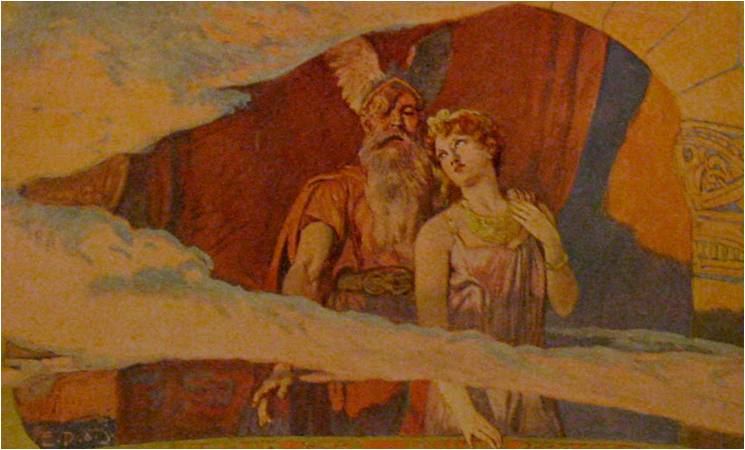
Godan/Wodin and Freia viewing the `bearded’ Wenili/Lombard women, as depicted by Emil Doepler
( Walhall, die Götterwelt der Germanen. Martin Oldenbourg, Berlin, 1905).
https://en.wikipedia.org/wiki/Lombards
As a good Christian, Paul dismissed a story involving the old Norse gods as nonsense but nevertheless included in his work as it was in one of his main sources, the anonymous 7th centuryOrigo gentis Langobardorum.. Both the Winili (as the Lombards were originally known) and their Vandal enemies begged Godan (Wodin) for victory in an impending battle and Godan announced that he would favour whichever group he saw first in the morning. Godan’s wife Frea arranged for the Winili to turn up early, with the women tying their hair in front of their faces to resemble beards. On seeing them, Godan asked `Who are these long-bearded ones (longibarbi)?’ and, with a slight shift in pronunciation, the tribe were henceforth known as the Langobardī in Latin (Lombards in English).
Chris, who saw Paul the deacon was a kind of medieval Pliny, saw Gotan/Wodin as a Norse equivalent to both Zeus/Jupiter and Apollo. John mentioned the problem of establishing equivalences since Wodan, unlike Jupiter was not a thunder god, that role being taken by Thor. We also noted that while a number of ancient cultures conceived of the sky as masculine and the earth feminine, the Egyptians apparently had things the other way round.
Eugene later circulated a link (https://www.e-codices.unifr.ch/en/csg/0635/1) to an on-line facsimile of a very early copy of Paul’s text, possibly produced in Verona around 800.
( Walhall, die Götterwelt der Germanen. Martin Oldenbourg, Berlin, 1905).
https://en.wikipedia.org/wiki/Lombards
As a good Christian, Paul dismissed a story involving the old Norse gods as nonsense but nevertheless included in his work as it was in one of his main sources, the anonymous 7th centuryOrigo gentis Langobardorum.. Both the Winili (as the Lombards were originally known) and their Vandal enemies begged Godan (Wodin) for victory in an impending battle and Godan announced that he would favour whichever group he saw first in the morning. Godan’s wife Frea arranged for the Winili to turn up early, with the women tying their hair in front of their faces to resemble beards. On seeing them, Godan asked `Who are these long-bearded ones (longibarbi)?’ and, with a slight shift in pronunciation, the tribe were henceforth known as the Langobardī in Latin (Lombards in English).
Chris, who saw Paul the deacon was a kind of medieval Pliny, saw Gotan/Wodin as a Norse equivalent to both Zeus/Jupiter and Apollo. John mentioned the problem of establishing equivalences since Wodan, unlike Jupiter was not a thunder god, that role being taken by Thor. We also noted that while a number of ancient cultures conceived of the sky as masculine and the earth feminine, the Egyptians apparently had things the other way round.
Eugene later circulated a link (https://www.e-codices.unifr.ch/en/csg/0635/1) to an on-line facsimile of a very early copy of Paul’s text, possibly produced in Verona around 800.
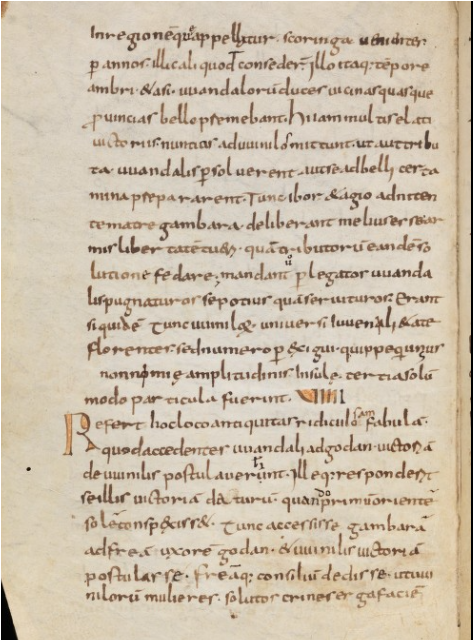
Early copy (c.800) of the Historia Langobardorum, with the start of chapter 8 at the bottom
Originating in Scandinavia, the Lombards migrated southwards, settling for a time in Hungary and then entering Italy in 568, under threat from their erstwhile allies, the Caucasian Avars. They soon gained control of northern Italy, giving their name to the Lombardy region, and were the predominant power in the peninsula until conquered by Charlemagne in 774. The author of the Historia Langabardorum, Paul the Deacon, was himself a Lombard
Originating in Scandinavia, the Lombards migrated southwards, settling for a time in Hungary and then entering Italy in 568, under threat from their erstwhile allies, the Caucasian Avars. They soon gained control of northern Italy, giving their name to the Lombardy region, and were the predominant power in the peninsula until conquered by Charlemagne in 774. The author of the Historia Langabardorum, Paul the Deacon, was himself a Lombard
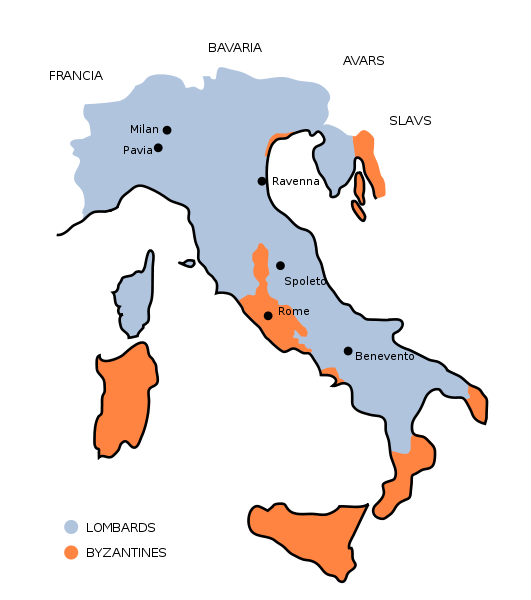
Italy under the Lombards c.570-774 A.D.
https://en.wikipedia.org/wiki/Kingdom_of_the_Lombards#/media/File:Aistulf's_Italy-en.png
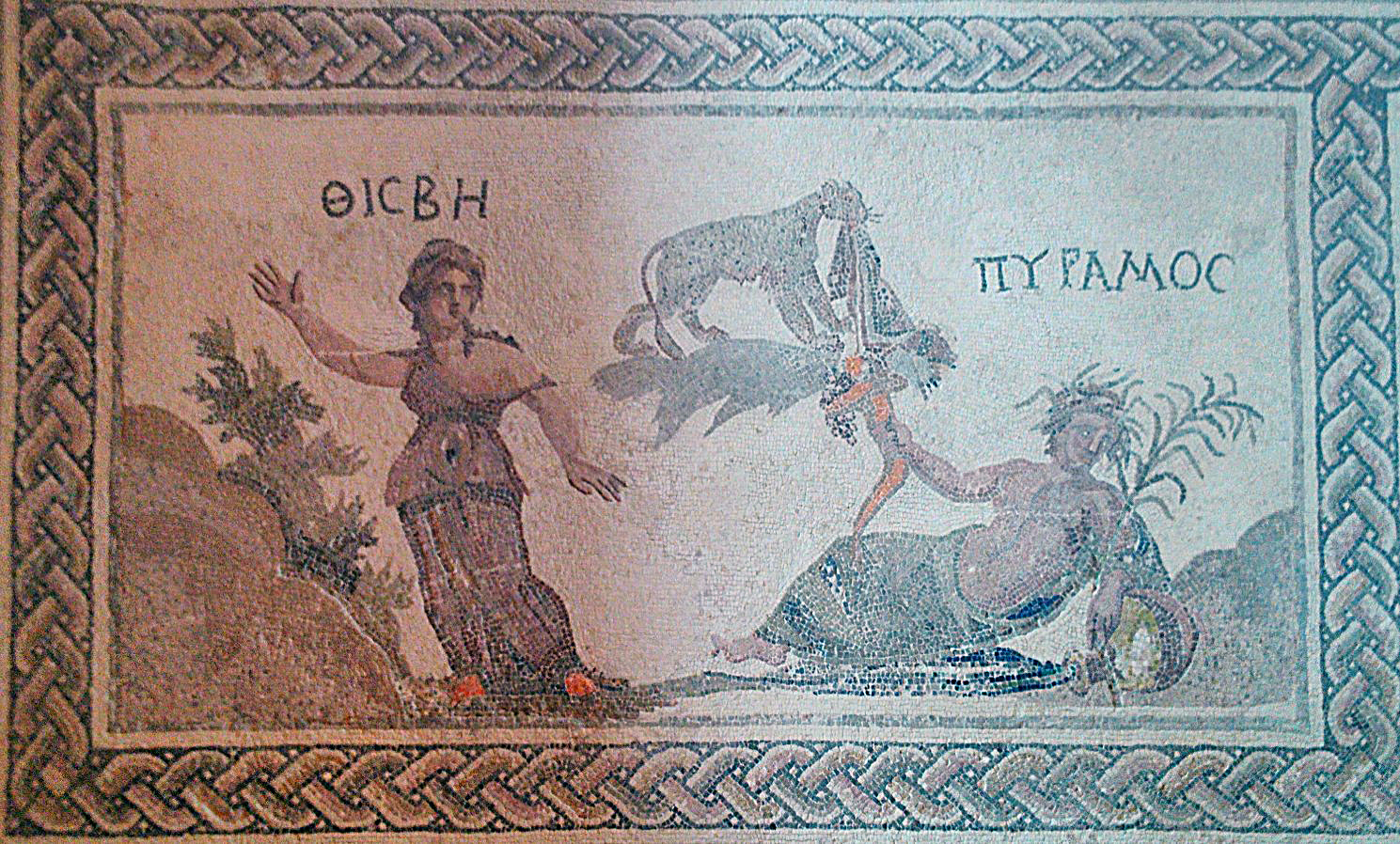
We then read from line 11 to line 69 in chapter XXXVII of Ad Alpes (see text below), which included the start of the story of Pyramus and Thisbe. This is a very well-known myth, partly because the `rustics’ in Shakespeare’s Midsummer Night’s Dream are performing a dramatisation of it. Although the standard version ends with the suicide of both lovers, there is evidence of an earlier alternative in which Pyramus is transformed into a river god and Thisbe into a spring.
We then read from line 11 to line 69 in chapter XXXVII of Ad Alpes (see text below), which included the start of the story of Pyramus and Thisbe. This is a very well-known myth, partly because the `rustics’ in Shakespeare’s Midsummer Night’s Dream are performing a dramatisation of it. Although the standard version ends with the suicide of both lovers, there is evidence of an earlier alternative in which Pyramus is transformed into a river god and Thisbe into a spring.
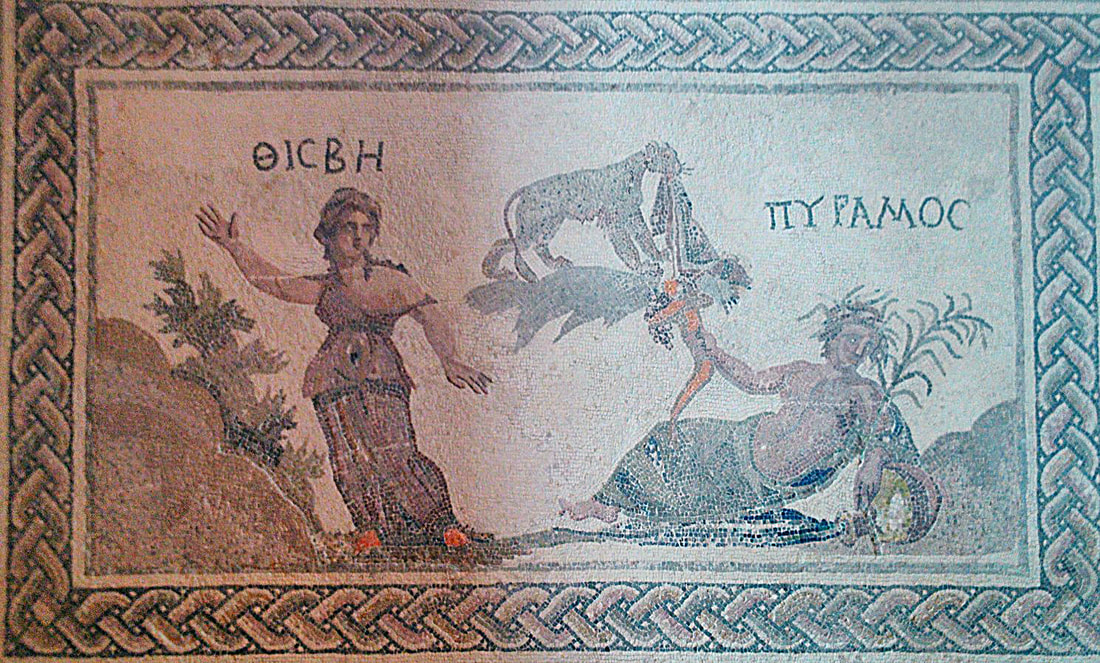
Mosaic from Nea Paphos, Cyprus, with Pyramus as river god (2nd or 3rd cent. A.D.)
https://upload.wikimedia.org/wikipedia/commons/9/9f/Thisbe_and_Pyramus-House-of-Dionysos.jpg
In addition to the link to the Historia Langobardorum manuscript mentioned. Eugene brought two other interesting documents to our attention. The first was Nancy Llewellyn’s draft translation of Ordinationes ad Constitutionem Apostolicam “Veterum Sapientia” rite Exsequendam (`Ordinances for the Correct Implementation of the Apostolic Constitution `Veterum Sapientia’. This is the detailed instructions promulgated by Pope John XXIII in 1962 for continuing and extending the central role of Latin in the education of the clergy, an aim, which was de facto abandoned after the pope’s death a few months later. The draft is at https://veterumsapientia.org/this-is-what-was-supposed-to-happen/
The second was the article `De Pronuntiatu Latino’ by Caelestis Eichenseer, a prominent advocate of commuinicative Latin and founder of the journal Vox Latina, who argued for increased use in the church of the `restored’ or `classical’ pronunciation. This was published in the 1963 volume ofl Palaestra, downloadable from http://www.culturaclasica.com/palaestra/palaestra_latina-181.pdf
Closer to home, we bemoaned the continuing problem of vaccine hesitancy in Hong Kong and the danger of infections soaring in –or perhaps when – the delta variant takes a hold here. We are relying on an elaborate quarantine system – from which Valerie had just emerged – but, even if we were prepared to continue this indefinitely, the virus is certain to slip through eventually,.
Lily raised the topic of the `Evil Eye’, the malevolent gaze supposedly able to harm the person looked at. She thought this was a Western belief that had subsequently spread eastwards and John remarked this would be the reverse of the westwards transmission from China of the notion of a dragon as a massive, winged creature rather than a snake, the animal originally denoted by Latin dracō. The earliest clear reference to the `Evil Eye’ appears to be in texts from the city of Ugarit in Syria, which was destroyed in 1250 B.C. and belief in it has been widespread both in Western Eurasia, Africa and the Americas, The ancient Romans and some other cultures believed in the power of phallic talismans to protect against the malign influence. See details at https://en.wikipedia.org/wiki/Evil_eye
https://upload.wikimedia.org/wikipedia/commons/9/9f/Thisbe_and_Pyramus-House-of-Dionysos.jpg
In addition to the link to the Historia Langobardorum manuscript mentioned. Eugene brought two other interesting documents to our attention. The first was Nancy Llewellyn’s draft translation of Ordinationes ad Constitutionem Apostolicam “Veterum Sapientia” rite Exsequendam (`Ordinances for the Correct Implementation of the Apostolic Constitution `Veterum Sapientia’. This is the detailed instructions promulgated by Pope John XXIII in 1962 for continuing and extending the central role of Latin in the education of the clergy, an aim, which was de facto abandoned after the pope’s death a few months later. The draft is at https://veterumsapientia.org/this-is-what-was-supposed-to-happen/
The second was the article `De Pronuntiatu Latino’ by Caelestis Eichenseer, a prominent advocate of commuinicative Latin and founder of the journal Vox Latina, who argued for increased use in the church of the `restored’ or `classical’ pronunciation. This was published in the 1963 volume ofl Palaestra, downloadable from http://www.culturaclasica.com/palaestra/palaestra_latina-181.pdf
Closer to home, we bemoaned the continuing problem of vaccine hesitancy in Hong Kong and the danger of infections soaring in –or perhaps when – the delta variant takes a hold here. We are relying on an elaborate quarantine system – from which Valerie had just emerged – but, even if we were prepared to continue this indefinitely, the virus is certain to slip through eventually,.
Lily raised the topic of the `Evil Eye’, the malevolent gaze supposedly able to harm the person looked at. She thought this was a Western belief that had subsequently spread eastwards and John remarked this would be the reverse of the westwards transmission from China of the notion of a dragon as a massive, winged creature rather than a snake, the animal originally denoted by Latin dracō. The earliest clear reference to the `Evil Eye’ appears to be in texts from the city of Ugarit in Syria, which was destroyed in 1250 B.C. and belief in it has been widespread both in Western Eurasia, Africa and the Americas, The ancient Romans and some other cultures believed in the power of phallic talismans to protect against the malign influence. See details at https://en.wikipedia.org/wiki/Evil_eye
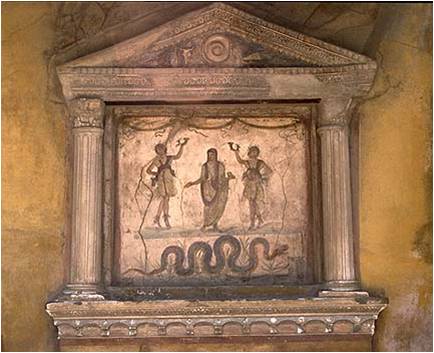
A Lararium from the House of the Vettii at Pompeii
http://vroma.org/vromans/bmcmanus/lararium2.html
Chris was puzzled why a regenerative animal like the snake could become a symbol of evil and he and Lily suggested the inclusion of snakes in the decoration of a Roman Lararium (shrine to the household gods) indicates they were creatures of good rather than bad omen. John thought this was more a case of evil being used to ward off evil. Snakes may also have been associated with the fertility of the land and therefore with the prosperity of the household (see https://en.wikipedia.org/wiki/Lares). There is, nevertheless, the important fact that snakes, as an often unseen enemy lurking in the vegetation around us, quite naturally became an object of fear to ancient peoples.
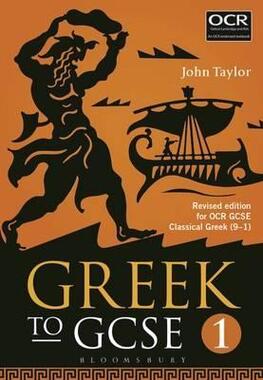
John thought the phrase千古罪人 (`guilty for a thousand ages’, `eternal villain’) was applicable to John Taylor, whose GCSE Latin and Greek to GCSE textbooks are widely used in the UK. His failure to use macrons makes it much more difficult for students to give vowels their correct length and, consequently makes them liable to stress words on the wrong syllable – a problem which plagued John himself for many years. In Taylor’s Greek course he does explain the two rival pronunciation systems in use in the UK: the strange Anglo-Dutch practice of stressing words as if they were in Latin (ἄνθρωπος – anTHROpos) and the alternative of stressing the syllable with the written accent (ἄνθρωπος – ANthropos) as in modern Greek which has changed the spoken pitch accent of ancient Greek to a stress one but still emphasises the same syllables. Taylor tells readers they are free to adopt whichever pronunciation they prefer yet he only explains the situation half-way through the first book and does not print the accents on the text in the first half. Those who wish to follow the more rational system are thus deprived of the opportunity to learn the stress of the commonest words as they encounter them.
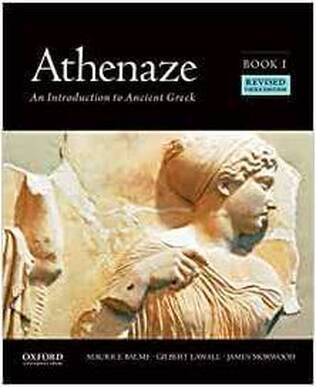
John also remains resentful that Greek to GCSE has supplanted Athenaze as the standard text in Britain. The older course, though admittedly more demanding than Taylor, not only takes the accents seriously but, more importantly, provides a continuous story line in its reading passages (as is done in the Cambridge Latin Course), has a much more readable type-face and gives a far better introduction to ancient Greek history and culture.
http://vroma.org/vromans/bmcmanus/lararium2.html
Chris was puzzled why a regenerative animal like the snake could become a symbol of evil and he and Lily suggested the inclusion of snakes in the decoration of a Roman Lararium (shrine to the household gods) indicates they were creatures of good rather than bad omen. John thought this was more a case of evil being used to ward off evil. Snakes may also have been associated with the fertility of the land and therefore with the prosperity of the household (see https://en.wikipedia.org/wiki/Lares). There is, nevertheless, the important fact that snakes, as an often unseen enemy lurking in the vegetation around us, quite naturally became an object of fear to ancient peoples.
John thought the phrase千古罪人 (`guilty for a thousand ages’, `eternal villain’) was applicable to John Taylor, whose GCSE Latin and Greek to GCSE textbooks are widely used in the UK. His failure to use macrons makes it much more difficult for students to give vowels their correct length and, consequently makes them liable to stress words on the wrong syllable – a problem which plagued John himself for many years. In Taylor’s Greek course he does explain the two rival pronunciation systems in use in the UK: the strange Anglo-Dutch practice of stressing words as if they were in Latin (ἄνθρωπος – anTHROpos) and the alternative of stressing the syllable with the written accent (ἄνθρωπος – ANthropos) as in modern Greek which has changed the spoken pitch accent of ancient Greek to a stress one but still emphasises the same syllables. Taylor tells readers they are free to adopt whichever pronunciation they prefer yet he only explains the situation half-way through the first book and does not print the accents on the text in the first half. Those who wish to follow the more rational system are thus deprived of the opportunity to learn the stress of the commonest words as they encounter them.
John also remains resentful that Greek to GCSE has supplanted Athenaze as the standard text in Britain. The older course, though admittedly more demanding than Taylor, not only takes the accents seriously but, more importantly, provides a continuous story line in its reading passages (as is done in the Cambridge Latin Course), has a much more readable type-face and gives a far better introduction to ancient Greek history and culture.
|
|
Chris’s own education included a course in ancient Greek but he bemoaned the fact that this was the New Testament rather than the classical variety. John agreed that the former, based on the Koine dialect serving as a lingua franca in the eastern Mediterranean several centuries after the Golden Age of Athens, was somewhat simplified, particularly with the near elimination of the optative mood. Nevertheless, it remained recognisably the same language and did allow access to the older texts..
Still on the Greek front, Eugene recommended John James’ 2008 edition of Homer’s Iliad , with inter-linear parsing and translation of each word. The text of Book I can be downloaded from https://dokumen.tips/download/link/iliad-interlinear-book-1 Language learning through the use of bilingual texts seems indeed to have been the standard method in the ancient world, as explained at length in Eleanor Dicey’s Learning Latin the Ancient Way, which was discussed in our October 2019 session (see https://linguae.weebly.com/conventus-oct-2019.html). It is also worth remembering that Schliemann, the pioneering German archaeologist who excavated Troy in the 19th century, learned an array of languages this way, including both modern and ancient Greek. He himself described the process as follows:
“In order to acquire quickly the Greek vocabulary, I procured a modern Greek translation of ‘Paul et Virginie’ [a French novel; Schliemann already knew French], and read it through, comparing every word with its equivalent in the French original. When I had finished this task I knew at least one half the Greek words the book contained; and after repeating the operation I knew them all, or nearly so, without having lost a single minute by being obliged to use a dictionary. Of the Greek grammar I learned only the declensions and the verbs, and never lost my precious time in studying its rules; for as I saw that boys, after being troubled and tormented for eight years and more in school with the tedious rules of grammar, can nevertheless none of them write a letter in
ancient Greek without making hundreds of atrocious blunders, I thought the method pursued by the schoolmasters must be altogether wrong… I learned ancient Greek as I would have learned a living language.”
(quoted at https://booko.medium.com/heinrich-schliemann-learning-method-5b0708fb3a8f)
We also gave some attention to music., Chris, who is himself an accomplished musician and the author of introductory guides to playing the piano, violin and saxophone and clarinet (see https://www.amazon.com/Chris-Coetzee/e/B0034PUKOY/ref=dp_byline_cont_pop_book_1), strongly recommended the `Lamentations of Jeremiah’ by Orlando di Lasso (c.1530-1594), which can be sampled at https://www.youtube.com/watch?v=syRy7e62fF4 A very different style is found in the Latin heavy metal genre, exemplified by the group In Extremis’ interpretations of two songs from the Carmina Burana embedded on John’s site at https://linguae.weebly.com/corvus-corax.html. The same page also features somewhat gentler performances by other groups, particularly Corvus Corax.
Still on the Greek front, Eugene recommended John James’ 2008 edition of Homer’s Iliad , with inter-linear parsing and translation of each word. The text of Book I can be downloaded from https://dokumen.tips/download/link/iliad-interlinear-book-1 Language learning through the use of bilingual texts seems indeed to have been the standard method in the ancient world, as explained at length in Eleanor Dicey’s Learning Latin the Ancient Way, which was discussed in our October 2019 session (see https://linguae.weebly.com/conventus-oct-2019.html). It is also worth remembering that Schliemann, the pioneering German archaeologist who excavated Troy in the 19th century, learned an array of languages this way, including both modern and ancient Greek. He himself described the process as follows:
“In order to acquire quickly the Greek vocabulary, I procured a modern Greek translation of ‘Paul et Virginie’ [a French novel; Schliemann already knew French], and read it through, comparing every word with its equivalent in the French original. When I had finished this task I knew at least one half the Greek words the book contained; and after repeating the operation I knew them all, or nearly so, without having lost a single minute by being obliged to use a dictionary. Of the Greek grammar I learned only the declensions and the verbs, and never lost my precious time in studying its rules; for as I saw that boys, after being troubled and tormented for eight years and more in school with the tedious rules of grammar, can nevertheless none of them write a letter in
ancient Greek without making hundreds of atrocious blunders, I thought the method pursued by the schoolmasters must be altogether wrong… I learned ancient Greek as I would have learned a living language.”
(quoted at https://booko.medium.com/heinrich-schliemann-learning-method-5b0708fb3a8f)
We also gave some attention to music., Chris, who is himself an accomplished musician and the author of introductory guides to playing the piano, violin and saxophone and clarinet (see https://www.amazon.com/Chris-Coetzee/e/B0034PUKOY/ref=dp_byline_cont_pop_book_1), strongly recommended the `Lamentations of Jeremiah’ by Orlando di Lasso (c.1530-1594), which can be sampled at https://www.youtube.com/watch?v=syRy7e62fF4 A very different style is found in the Latin heavy metal genre, exemplified by the group In Extremis’ interpretations of two songs from the Carmina Burana embedded on John’s site at https://linguae.weebly.com/corvus-corax.html. The same page also features somewhat gentler performances by other groups, particularly Corvus Corax.
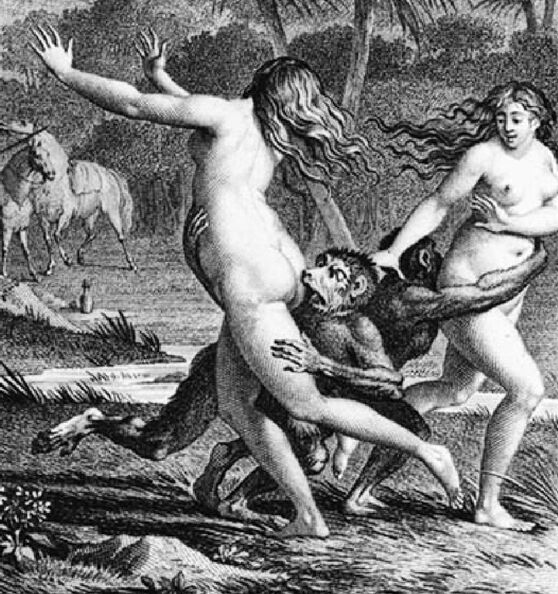
The monkey lovers in Candide (Jean-Michel Moreau, 1803[1]
https://en.wikipedia.org/wiki/Candide#/media/File:Moreau_Monkeys_crop.jpg
The original is in the Bibliothèque nationale de France and the reproduction is taken from Mary L. Bellhouse, "Candide Shoots the Monkey Lovers: Representing Black Men in Eighteenth-Century French Visual Culture". Political Theory 34 (2006): 773. DOI 10.1177/0090591706293020.
Chris recommended Votaire’s Candide as the best thing written in French. This satirical novel, whose plot is summarised at https://en.wikipedia.org/wiki/Candide, is aimed particularly at the Enlightenment doctrine that `all is for the best in the best of all possible worlds’, but it also targets many aspects of contemporary religion and politics. Chris joked that the book was the only major work of French literature not about sex. Candide does, indeed, not have a central focus on sex but the topic is not entirely neglected as in one incident the hero shoots two monkeys because he mistakenly thought they were attacking their human lovers.
https://en.wikipedia.org/wiki/Candide#/media/File:Moreau_Monkeys_crop.jpg
The original is in the Bibliothèque nationale de France and the reproduction is taken from Mary L. Bellhouse, "Candide Shoots the Monkey Lovers: Representing Black Men in Eighteenth-Century French Visual Culture". Political Theory 34 (2006): 773. DOI 10.1177/0090591706293020.
Chris recommended Votaire’s Candide as the best thing written in French. This satirical novel, whose plot is summarised at https://en.wikipedia.org/wiki/Candide, is aimed particularly at the Enlightenment doctrine that `all is for the best in the best of all possible worlds’, but it also targets many aspects of contemporary religion and politics. Chris joked that the book was the only major work of French literature not about sex. Candide does, indeed, not have a central focus on sex but the topic is not entirely neglected as in one incident the hero shoots two monkeys because he mistakenly thought they were attacking their human lovers.
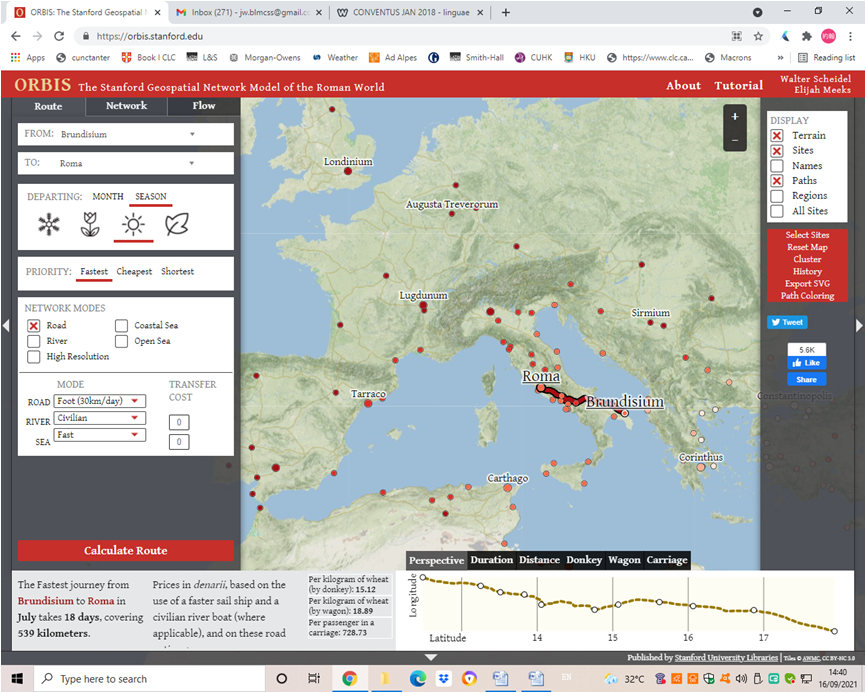
Details of the journey from Brundisium to Rome on Stanford University’s Orbis site
Lily mentioned the fascinating ORBIS site at https://orbis.stanford.edu/, which allows you to generate routes, travel times, distance and cost for journeys between different cities of the Roman empire. Travelling from Brundisium along the Appian Way to Rome, for example, would have taken around 18 days. This site needs to be distinguished from the digitalisation of the 1909 edition of Grässe’s Orbis Latinus (http://www.columbia.edu/acis/ets/Graesse/contents.html0 a glossary of Latin placenames (the bulk of them medieval or early-modern) with their vernacular equivalents. A recent addition to these topographical resources is Tabula Orbis Terrarum (http://www.tabulaorbisterrarum.org/), which adds Latin place-names to a global map base with variable scale, somewhat similar to Google maps. Anyone is free to add additional names but these must be well-established ones so, unfortunately, recent coinages like Novendracōnēs are apparently inadmissible!
Someone mentioned the linguistic and cultural links between Persia/Iran and India. These are multiple and exist at different levels. Most fundamentally Persian/Farsi, the national language of Iran, is, like most of the languages of Pakistan, North India, Nepal and Bangladesh, a member of the Indo-Iranian branch of the Indo-European language family. In addition, the Muslim conquerors who entered South Asia from around 1000 A.D. onwards used Persian, itself written in the Arabic script and containing many Arabic loan words, as their language of administration. The legacy of this persisted long into the period of British colonial rule, with Persian one of the subjects that recruits to the East India Company’s service were required to study. Even though English took its place at the top level of Indian administration, Persian remained important at the lower level of revenue management and it was stil in use for formal correspondence between the British government of India and Nepal as late as the 1890s.
Hindustani, a somewhat outdated term but still useful as a label for the common colloquial core of spoken Hindi and Urdu, contains many Persian words (e.g. hamesha (always), dil (heart) and hoshiyar (clever, careful)). At the literary level, Urdu, the national language of Pakistan, draws much more heavily on Persian, but Hindi prefers to borrow from Sanskrit, the classical language of India. The complex relationship between Hindi and Urdu has been discussed before, for example in our December 2016 meeting (see https://linguae.weebly.com/conventus-december.html). They share a basic grammatical structure and vocabulary but differ both in their `higher’ registers and, most conspicuously in Hindi’s use of the Devanagari and Urdu’s of the Persi-Arabic script. Thus the simple question aapka nam kya hai? (`what is your name?’) is written आपका नाम क्या है in Hindi but in Urduآپ کا نام کیا ہے
We also touched on the paradox of Latin texts with sections that might be considered obscene having normally survived only because generations of medieval monks though they were worth copying. Perhaps the most notorious text in this category is Catullus 16, which opens with references to anal and oral sex and even featured some years ago in a UK court case, on the grounds that a boss’s quoting from it constituted sexual harassment of a subordinate. We discussed this in detail at our January 2018 meeting (see https://linguae.weebly.com/conventus-jan-2018.html)
AD ALPES XXXVII, lines 11-69
At Pūblius: "Sī omnia prōsperē prōcēdent," inquit, "hodiē Mediolānum[1] usque iter
And Publius if all-things well will-go said today Mediolanum up-to journey
faciēmus. Crās spērō nōs ad fīnem itineris perventūrōs esse."
we-will-make tomorrow I-hope us to end of-journey going-to-get to-be
"Mīror quam mox litterae ā patre adferantur," inquit Cornēlia.15 "Lacrimīs vix teneō,
I-wonder how soon letter from father will-be-brought said Cornelia from-tears scarcely I-hold
dum cōgitō eum fortasse multōs mēnsēs āfutūrum .”
while I-think him perhaps many months going-to-be-away
"Bonō es animō," inquit Drūsilla, quae vultū laetitiam simulābat, cum dolōrem magnum
With-good be heart said Drusilla who with-face happiness was-feigning although sorrow great
mente sentīret. "Pollicitus est sē certīs intervāllīs missūrum tabellāriōs, et litterās aliās quoque
in-mind felt he-promised himself ar-fixed intervals going-to-send couriers and letters other also
20 datūrum, quotiēnscumque occurrisset aliquis, quī in Ītaliam iter faceret. Cum dēmum
going-to-give whenever had-met-up ntone who into Italy journey was-making when at-last
Lugdūnum pervēnerit, tum dēnique ille coniectūram facere poterit, quam mox ad nōs redīre
Lugdunum [Lyon] he-will-have-reached finally he estimate to-make will-be-able how soon to us to-return
possit."
He-will-be-able
Tum Sextus: "Pūblius," inquit, "onere officī susceptī tam 25 occupātus esse vidētur, ut
Then Sextus Publius said with-burden of-duty undertaken so busy to-be seems that
nōbīscum vix colloquī velit. Quārē necessāriō ad tē, māter, spectāmus, ut aliquid nārrēs,
with-us hardly to-talk wants so necessarily to you mother we-look so-that something you-can-relate
NOTE
[1] Said to have been founded by the Celtic Insubres at the end of the 7th century B.C. Mediolanum (modern Milan), whose name was probably a Latinisation of the Gallic `Mediolanon’ (`in the middle of the plain’) was conquered by Rome in 222 B.C. In 286 A.D. it became the capital of the Western half of the Roman Empire. See https://en.wikipedia.org/wiki/Mediolanum
quō iūcundius diēs trānseat."
in-order-that more-pleasantly day may-pass
Ac Drūsilla, quae mentēs līberōrum ā discessū patris āvertere volēbat: "Meminī," inquit,
And Drusilla who minds of-children from departure of-father divert wanted I-remember said
"mē saepe audīre fābulam dē iuvene et puellā, quī Babylōne abhinc multōs annōs inīquō fātō
me often to-hear story bout youth and girl who in-Babyon ago many years by-unfair fate
periērunt. 30 Dē hīs audīre vultis?"
perished about these-things to-hear do-you-wish?
"Ego audīre volō," inquit Cornēlia, "nisi fābula nimis trīstis est."
I to-hear want said Cornelia if-not story too sad is
"Exitum certē haud laetum habet," inquit māter; "sed rēs ipsa memorātū dignissima
Ending certainly not happy it-has said mother but story itself of-relating most-worthy
est."35
is
"Ecquid inest," inquit Sextus, "dē elephantīs aut aliīs bēluīs, quae in illīs regiōnibus
There-anything is-in said Sextus about elephants or other monsters which in those regions
longinquīs reperiuntur?"
far-off are-found
"Brevī sciēs," inquit Drūsilla, cum Lūcium Annae trāderet: "Pȳramus et Thisbē, dē
Soon you-will-know said Drusilla when Lucius toAnna she-was-handing-over Pyramus and Thisbe about
quibus haec fābula nārrātur, domōs habēbant vīcīnās. Diū inter sē amābant; cum autem
whom this story is-told houses had neighbouring for-long-time beteeen selves they-loved when however
Pȳramus 40 virginem in mātrimōnium dūcere[1] vellet, pater vetuit.
Pyramus maiden into marriage to-take wanted father forbade
"Prīmō amantēs, ab omnī spē destitūtī, quid facerent nōn habēbant. Tum forte
At-first lovers by all hope abandoned what they-could-do not had then by-chance
animadvertērunt parietem utrīque domuī commūnem fissum esse tenuī rīmā, quam dūxerat
they-noticed wall to-each house common split to-be by-narrow crack which it-had-acquired
multō ante, cum fieret.45
long before when it-was-being-built
"Quam rīmam verbōrum iter fēcērunt. Cumque cōnstiterant,[2] hinc Thisbē, illinc
This crack of-words route they-made and-whenever they-had-halted[there) on-this-side Thisbe on-that
Pȳramus, summissā vōce inter sē multa loquēbantur. Tum sub vesperum, postquam uterque
Pyramus in-subdued voice between selves many-things used-to-speak then towards-evening after each
suae partī parietis ōscula dederat, 'valē' maestī dīcēbant.
to-own part of-wall kisses had-given farewell sad used-to-say
"Postrēmō, huius morae tam longae impatientēs, silentiō 50 noctis cūstōdēs fallere
Finally of-this delay so long impatient in-silence of-night guards to-give-slip-to
cōnstituērunt et forās exīre, ut dēmum nūllō prohibente lībere colloquerentur. Atque in
they-decided and outside to-go-out so-that at-last with-nobody preventing freely they-could-talk-together and in
tenebrīs nē errārent, locus certus haud procul ā fonte gelidō cōnstitūtus est, quō convenīre
darkness lest they-went-astray place definite not far from cold spring fixed was at-which meet
possent.
they-could
NOTES
[1] [in matrimōnium] dūcere is used of a man marrying a woman and nūbere (with dative) of a woman marrying a man.
[2] cum is regularly used with the pluperfect indicative 9rathder than the sjubjunctive) in the sense of `whenever’.
55 "Thisbē prior ēgressa, incolumis ad locum dēstinātum pervēnit. Dum autem ibi sub
Thisbe first having-gone-out safe to place designated reached while however there under
arbore sedet, ecce leō, quī modo bovem dīlaniāverat, ut sitim dēpelleret, ad fontem accessit.
tree sits see! lion which just-before ox had-torn-apart so-that thirst it-might-quench to spring came-up
Quō vīsō, Thisbē pavida in spēluncam vīcīnam refūgit, vēlāmine relictō, quod ā tergō
With-which seen Thisbe frightened into cave nearby fled with-wrap abandoned which from back
dēlāpsum erat.
fallen-down had
60 "Leō, sitī dēpulsā, dum in silvās redit, vēlāmen forte inventum ōre cruentō discerpsit;
Lion with-thirst quenched while into woods was-returning wrap by-chance found eith-mouth bloody tore-up
quod sanguine tīnctum cum Pȳramus, sērius ēgressus, per lūnam animadvertisset, perterritus
which with-blood stained when Pyramus later having-gone-out through moon had-noticed terrified
sē circumspiciēns in altō pulvere ferae certa vestīgia vīdit.
self looking-around in deep dust of-wild-animal distinct tracks he-saw
"Tum iuvenis, vix compos mentis, Thisbēn sine dubiō 65 dīlaniātam esse ratus, sē
Then young-man scarcely in-possesion-of-mind Thisbe without doubt ripped-apart to-have-been thinking self
vehementer incūsāns, quod puellam teneram in loca tam perīculōsa sōlam prodīre passus
vehemently accusing because girl tender into places so dangerous alone to-poceed allowed
esset, vēlāmen sublātum ad arborem sēcum tulit; atque ibi, cum vestī notae lacrimās et ōscula
he-had wrap lifted-up to tree with-self carried and there when to-garment familiar tears and kisses
multa dedisset, in gladium suum incubuit.[1]
many had-given onto sword own fell
[1] incubo (-ere, incubuī, incubitum) normally means `lie down on’ but the meaning here is clear.
Lily mentioned the fascinating ORBIS site at https://orbis.stanford.edu/, which allows you to generate routes, travel times, distance and cost for journeys between different cities of the Roman empire. Travelling from Brundisium along the Appian Way to Rome, for example, would have taken around 18 days. This site needs to be distinguished from the digitalisation of the 1909 edition of Grässe’s Orbis Latinus (http://www.columbia.edu/acis/ets/Graesse/contents.html0 a glossary of Latin placenames (the bulk of them medieval or early-modern) with their vernacular equivalents. A recent addition to these topographical resources is Tabula Orbis Terrarum (http://www.tabulaorbisterrarum.org/), which adds Latin place-names to a global map base with variable scale, somewhat similar to Google maps. Anyone is free to add additional names but these must be well-established ones so, unfortunately, recent coinages like Novendracōnēs are apparently inadmissible!
Someone mentioned the linguistic and cultural links between Persia/Iran and India. These are multiple and exist at different levels. Most fundamentally Persian/Farsi, the national language of Iran, is, like most of the languages of Pakistan, North India, Nepal and Bangladesh, a member of the Indo-Iranian branch of the Indo-European language family. In addition, the Muslim conquerors who entered South Asia from around 1000 A.D. onwards used Persian, itself written in the Arabic script and containing many Arabic loan words, as their language of administration. The legacy of this persisted long into the period of British colonial rule, with Persian one of the subjects that recruits to the East India Company’s service were required to study. Even though English took its place at the top level of Indian administration, Persian remained important at the lower level of revenue management and it was stil in use for formal correspondence between the British government of India and Nepal as late as the 1890s.
Hindustani, a somewhat outdated term but still useful as a label for the common colloquial core of spoken Hindi and Urdu, contains many Persian words (e.g. hamesha (always), dil (heart) and hoshiyar (clever, careful)). At the literary level, Urdu, the national language of Pakistan, draws much more heavily on Persian, but Hindi prefers to borrow from Sanskrit, the classical language of India. The complex relationship between Hindi and Urdu has been discussed before, for example in our December 2016 meeting (see https://linguae.weebly.com/conventus-december.html). They share a basic grammatical structure and vocabulary but differ both in their `higher’ registers and, most conspicuously in Hindi’s use of the Devanagari and Urdu’s of the Persi-Arabic script. Thus the simple question aapka nam kya hai? (`what is your name?’) is written आपका नाम क्या है in Hindi but in Urduآپ کا نام کیا ہے
We also touched on the paradox of Latin texts with sections that might be considered obscene having normally survived only because generations of medieval monks though they were worth copying. Perhaps the most notorious text in this category is Catullus 16, which opens with references to anal and oral sex and even featured some years ago in a UK court case, on the grounds that a boss’s quoting from it constituted sexual harassment of a subordinate. We discussed this in detail at our January 2018 meeting (see https://linguae.weebly.com/conventus-jan-2018.html)
AD ALPES XXXVII, lines 11-69
At Pūblius: "Sī omnia prōsperē prōcēdent," inquit, "hodiē Mediolānum[1] usque iter
And Publius if all-things well will-go said today Mediolanum up-to journey
faciēmus. Crās spērō nōs ad fīnem itineris perventūrōs esse."
we-will-make tomorrow I-hope us to end of-journey going-to-get to-be
"Mīror quam mox litterae ā patre adferantur," inquit Cornēlia.15 "Lacrimīs vix teneō,
I-wonder how soon letter from father will-be-brought said Cornelia from-tears scarcely I-hold
dum cōgitō eum fortasse multōs mēnsēs āfutūrum .”
while I-think him perhaps many months going-to-be-away
"Bonō es animō," inquit Drūsilla, quae vultū laetitiam simulābat, cum dolōrem magnum
With-good be heart said Drusilla who with-face happiness was-feigning although sorrow great
mente sentīret. "Pollicitus est sē certīs intervāllīs missūrum tabellāriōs, et litterās aliās quoque
in-mind felt he-promised himself ar-fixed intervals going-to-send couriers and letters other also
20 datūrum, quotiēnscumque occurrisset aliquis, quī in Ītaliam iter faceret. Cum dēmum
going-to-give whenever had-met-up ntone who into Italy journey was-making when at-last
Lugdūnum pervēnerit, tum dēnique ille coniectūram facere poterit, quam mox ad nōs redīre
Lugdunum [Lyon] he-will-have-reached finally he estimate to-make will-be-able how soon to us to-return
possit."
He-will-be-able
Tum Sextus: "Pūblius," inquit, "onere officī susceptī tam 25 occupātus esse vidētur, ut
Then Sextus Publius said with-burden of-duty undertaken so busy to-be seems that
nōbīscum vix colloquī velit. Quārē necessāriō ad tē, māter, spectāmus, ut aliquid nārrēs,
with-us hardly to-talk wants so necessarily to you mother we-look so-that something you-can-relate
NOTE
[1] Said to have been founded by the Celtic Insubres at the end of the 7th century B.C. Mediolanum (modern Milan), whose name was probably a Latinisation of the Gallic `Mediolanon’ (`in the middle of the plain’) was conquered by Rome in 222 B.C. In 286 A.D. it became the capital of the Western half of the Roman Empire. See https://en.wikipedia.org/wiki/Mediolanum
quō iūcundius diēs trānseat."
in-order-that more-pleasantly day may-pass
Ac Drūsilla, quae mentēs līberōrum ā discessū patris āvertere volēbat: "Meminī," inquit,
And Drusilla who minds of-children from departure of-father divert wanted I-remember said
"mē saepe audīre fābulam dē iuvene et puellā, quī Babylōne abhinc multōs annōs inīquō fātō
me often to-hear story bout youth and girl who in-Babyon ago many years by-unfair fate
periērunt. 30 Dē hīs audīre vultis?"
perished about these-things to-hear do-you-wish?
"Ego audīre volō," inquit Cornēlia, "nisi fābula nimis trīstis est."
I to-hear want said Cornelia if-not story too sad is
"Exitum certē haud laetum habet," inquit māter; "sed rēs ipsa memorātū dignissima
Ending certainly not happy it-has said mother but story itself of-relating most-worthy
est."35
is
"Ecquid inest," inquit Sextus, "dē elephantīs aut aliīs bēluīs, quae in illīs regiōnibus
There-anything is-in said Sextus about elephants or other monsters which in those regions
longinquīs reperiuntur?"
far-off are-found
"Brevī sciēs," inquit Drūsilla, cum Lūcium Annae trāderet: "Pȳramus et Thisbē, dē
Soon you-will-know said Drusilla when Lucius toAnna she-was-handing-over Pyramus and Thisbe about
quibus haec fābula nārrātur, domōs habēbant vīcīnās. Diū inter sē amābant; cum autem
whom this story is-told houses had neighbouring for-long-time beteeen selves they-loved when however
Pȳramus 40 virginem in mātrimōnium dūcere[1] vellet, pater vetuit.
Pyramus maiden into marriage to-take wanted father forbade
"Prīmō amantēs, ab omnī spē destitūtī, quid facerent nōn habēbant. Tum forte
At-first lovers by all hope abandoned what they-could-do not had then by-chance
animadvertērunt parietem utrīque domuī commūnem fissum esse tenuī rīmā, quam dūxerat
they-noticed wall to-each house common split to-be by-narrow crack which it-had-acquired
multō ante, cum fieret.45
long before when it-was-being-built
"Quam rīmam verbōrum iter fēcērunt. Cumque cōnstiterant,[2] hinc Thisbē, illinc
This crack of-words route they-made and-whenever they-had-halted[there) on-this-side Thisbe on-that
Pȳramus, summissā vōce inter sē multa loquēbantur. Tum sub vesperum, postquam uterque
Pyramus in-subdued voice between selves many-things used-to-speak then towards-evening after each
suae partī parietis ōscula dederat, 'valē' maestī dīcēbant.
to-own part of-wall kisses had-given farewell sad used-to-say
"Postrēmō, huius morae tam longae impatientēs, silentiō 50 noctis cūstōdēs fallere
Finally of-this delay so long impatient in-silence of-night guards to-give-slip-to
cōnstituērunt et forās exīre, ut dēmum nūllō prohibente lībere colloquerentur. Atque in
they-decided and outside to-go-out so-that at-last with-nobody preventing freely they-could-talk-together and in
tenebrīs nē errārent, locus certus haud procul ā fonte gelidō cōnstitūtus est, quō convenīre
darkness lest they-went-astray place definite not far from cold spring fixed was at-which meet
possent.
they-could
NOTES
[1] [in matrimōnium] dūcere is used of a man marrying a woman and nūbere (with dative) of a woman marrying a man.
[2] cum is regularly used with the pluperfect indicative 9rathder than the sjubjunctive) in the sense of `whenever’.
55 "Thisbē prior ēgressa, incolumis ad locum dēstinātum pervēnit. Dum autem ibi sub
Thisbe first having-gone-out safe to place designated reached while however there under
arbore sedet, ecce leō, quī modo bovem dīlaniāverat, ut sitim dēpelleret, ad fontem accessit.
tree sits see! lion which just-before ox had-torn-apart so-that thirst it-might-quench to spring came-up
Quō vīsō, Thisbē pavida in spēluncam vīcīnam refūgit, vēlāmine relictō, quod ā tergō
With-which seen Thisbe frightened into cave nearby fled with-wrap abandoned which from back
dēlāpsum erat.
fallen-down had
60 "Leō, sitī dēpulsā, dum in silvās redit, vēlāmen forte inventum ōre cruentō discerpsit;
Lion with-thirst quenched while into woods was-returning wrap by-chance found eith-mouth bloody tore-up
quod sanguine tīnctum cum Pȳramus, sērius ēgressus, per lūnam animadvertisset, perterritus
which with-blood stained when Pyramus later having-gone-out through moon had-noticed terrified
sē circumspiciēns in altō pulvere ferae certa vestīgia vīdit.
self looking-around in deep dust of-wild-animal distinct tracks he-saw
"Tum iuvenis, vix compos mentis, Thisbēn sine dubiō 65 dīlaniātam esse ratus, sē
Then young-man scarcely in-possesion-of-mind Thisbe without doubt ripped-apart to-have-been thinking self
vehementer incūsāns, quod puellam teneram in loca tam perīculōsa sōlam prodīre passus
vehemently accusing because girl tender into places so dangerous alone to-poceed allowed
esset, vēlāmen sublātum ad arborem sēcum tulit; atque ibi, cum vestī notae lacrimās et ōscula
he-had wrap lifted-up to tree with-self carried and there when to-garment familiar tears and kisses
multa dedisset, in gladium suum incubuit.[1]
many had-given onto sword own fell
[1] incubo (-ere, incubuī, incubitum) normally means `lie down on’ but the meaning here is clear.