| linguae |
|
QUESTIONS ARISING FROM 141st. MEETING – 16/12/22
(the record of earlier meetings can be downloaded from the main Circulus page as can the version of Ciceronis Filius with illustrations added. The illustrated text of Genesis is available on the Genesis page, of Kepler's Somnium on the Somnium page, of Eutropius' Breviarium on the Eutropius page and of Nutting's Ad Alpes on the Ad Alpes page)
Dishes ordered included melanogēna contūsa (baingan bharta, mashed aubergine), carō ruber (rogan josh, Kashmiri-style lamb curry), cicera arōmatica (chana massala, spiced chickpeas), agnīna vindalensis (chicken vindaloo) pānis Persicus (nan), gallīnācea cum spīnāchiā (chicken saag) and orȳza, all washed down with the usual vīnum rubrum etc.
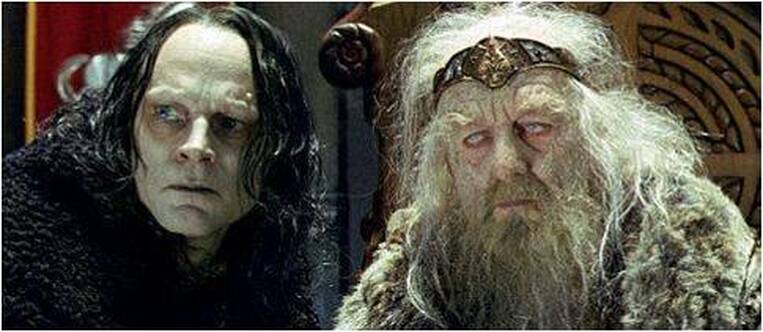
Grima Wormtongue (l.) with King Theoden in Peter Jackson’s `The Two Towers
https://en.wikipedia.org/wiki/Gr%C3%ADma_Wormtongue#/media/File:Grima_and_Th%C3%A9oden.jpg
Chris C. is fond of vindaloo, the hottest curry available in normal Indian restaurants, but someone rather less keen on the dish dubbed it `the Wormtongue of curries’, a reference to King Theoden’s villainous advisor in Lord of the Rings. It was also suggested that the same name was used in one of C.S, Lewis’ books but this was a confusion with Wormwood, the junior devil who receives letters from his uncle Screwtape in The Screwtape Letters. To make matters even more complicated, there is also Wormtail, the nickname of Peter Pettigrew, who is disguised as a pet rat in The Prisoner of Azkaban in the J.K.Rowling’s Harry Potter series.
https://en.wikipedia.org/wiki/Gr%C3%ADma_Wormtongue#/media/File:Grima_and_Th%C3%A9oden.jpg
Chris C. is fond of vindaloo, the hottest curry available in normal Indian restaurants, but someone rather less keen on the dish dubbed it `the Wormtongue of curries’, a reference to King Theoden’s villainous advisor in Lord of the Rings. It was also suggested that the same name was used in one of C.S, Lewis’ books but this was a confusion with Wormwood, the junior devil who receives letters from his uncle Screwtape in The Screwtape Letters. To make matters even more complicated, there is also Wormtail, the nickname of Peter Pettigrew, who is disguised as a pet rat in The Prisoner of Azkaban in the J.K.Rowling’s Harry Potter series.
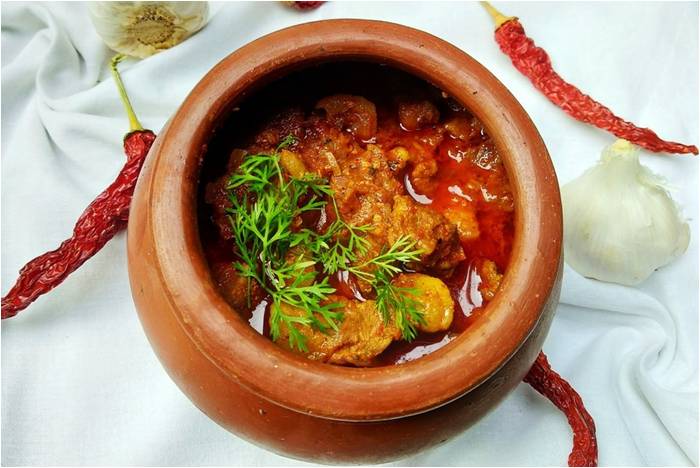
The original Goan vindaloo with pork
https://www.scmp.com/lifestyle/food-drink/article/3102843/history-vindaloo-loved-britain-why-india-has-portuguese
Although vindaloo is now notorious for its fieriness, it developed out of a milder dish made with pork in Goa, the former Portuguese enclave on the west coast of India. The name is a corruption of the Portuguese carne de vinha d’alhos (`meat marinated in wine and garlic’), the name of an even earlier dish from the Azores and Madeira, Portuguese islands in the Atlantic (discussed at https://en.wikipedia.org/wiki/Carne_de_vinha_d%27alhos ). The dish and its name were adapted in Goa after the Portuguese established themselves there in the 16th century, The Goan dish, which traditionally includes a sweet ingredient to balance the spices, is still served in Goa itself and Goan restaurants elsewhere. Vindaloo spread across India during British colonial times, partly because the British favoured Christian Goan cooks, who, unlike Hindus or Muslims, had no problem handling pork, beef and alcohol. Different varieties, using other meats evolved and ingredients were Indianised, with, in particular, the substitution of palm oil for vinegar. The vindaloo curries on the menus in Indian restaurants in the UK are simply stronger variations of a standard medium curry, For more details see a 2020 South China Morning Post article and also https://en.wikipedia.org/wiki/Vindaloo
Chris C. reported that, at least in his day hazing was practised in South African universities as it still is in the USA. As a new student, he was required to get drunk at a beach party, and then to swim naked to and from a promontory twenty metres away. This story reminded John of one about the distinguished Oxford classical scholar Maurice Bowra, who, like his father, was born in China, both father and grandfather having worked for the Imperial Chinese Customs. During his long Oxford career, Bowra used sometimes to bathe at Parson’s Pleasure, a spot on the River Cherwell earmarked for nude swimming and sun-bathing by males only. On one occasion, when a punt came by with one or two ladies in it, all the other dons quickly covered their genitals but Bowra instead put a towel over his head. When asked why he had done this, he replied `I don’t know about you, gentlemen, but in this university I am known by my face.’ More details at https://en.wikipedia.org/wiki/Maurice_Bowra
https://www.scmp.com/lifestyle/food-drink/article/3102843/history-vindaloo-loved-britain-why-india-has-portuguese
Although vindaloo is now notorious for its fieriness, it developed out of a milder dish made with pork in Goa, the former Portuguese enclave on the west coast of India. The name is a corruption of the Portuguese carne de vinha d’alhos (`meat marinated in wine and garlic’), the name of an even earlier dish from the Azores and Madeira, Portuguese islands in the Atlantic (discussed at https://en.wikipedia.org/wiki/Carne_de_vinha_d%27alhos ). The dish and its name were adapted in Goa after the Portuguese established themselves there in the 16th century, The Goan dish, which traditionally includes a sweet ingredient to balance the spices, is still served in Goa itself and Goan restaurants elsewhere. Vindaloo spread across India during British colonial times, partly because the British favoured Christian Goan cooks, who, unlike Hindus or Muslims, had no problem handling pork, beef and alcohol. Different varieties, using other meats evolved and ingredients were Indianised, with, in particular, the substitution of palm oil for vinegar. The vindaloo curries on the menus in Indian restaurants in the UK are simply stronger variations of a standard medium curry, For more details see a 2020 South China Morning Post article and also https://en.wikipedia.org/wiki/Vindaloo
Chris C. reported that, at least in his day hazing was practised in South African universities as it still is in the USA. As a new student, he was required to get drunk at a beach party, and then to swim naked to and from a promontory twenty metres away. This story reminded John of one about the distinguished Oxford classical scholar Maurice Bowra, who, like his father, was born in China, both father and grandfather having worked for the Imperial Chinese Customs. During his long Oxford career, Bowra used sometimes to bathe at Parson’s Pleasure, a spot on the River Cherwell earmarked for nude swimming and sun-bathing by males only. On one occasion, when a punt came by with one or two ladies in it, all the other dons quickly covered their genitals but Bowra instead put a towel over his head. When asked why he had done this, he replied `I don’t know about you, gentlemen, but in this university I am known by my face.’ More details at https://en.wikipedia.org/wiki/Maurice_Bowra
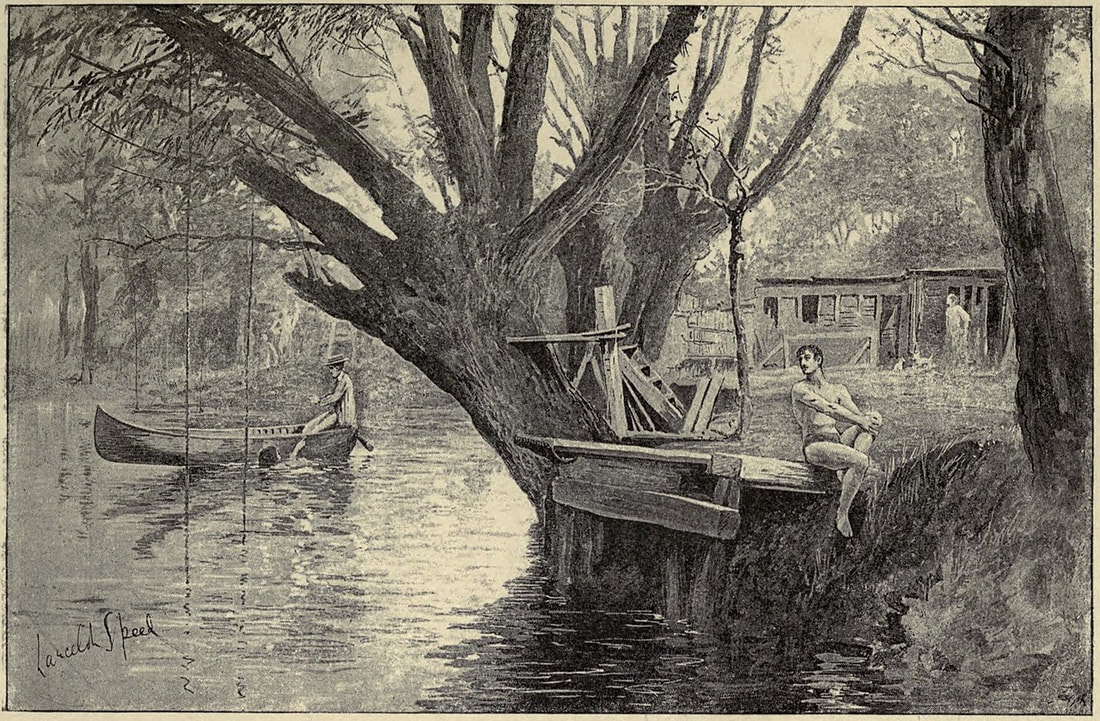
Parson’s Pleasure in the late 19th. century by Lancelot Speed (1860–1931) https://commons.wikimedia.org/w/index.php?curid=118016072
Chris C gave the sad news that he will be leaving Hong Kong in May to take up a job with an American school in Saudi Arabia. This will give him the opportunity to continue teaching Latin at an upper level and also to earn sufficient money before he relocates back to South Africa. He explained that he will be living in a compound for Westerners so he will not be subject to the kingdom’s ban on alcohol in other areas. He is looking forward to learning the Arabic language and its calligraphy.
Referring to his own experience teaching Korean to foreign learners, Chris also recommended that Tanya suggest to Keon, her Korean husband, asking him for guidance on how to do it. The question of non-native language teachers prompted mention of Cecilie Gamst-Berg, a one-time Hong Kong resident who established her People’s Democratic Happy Jellyfish Language Bureau with its truly inspired advertising slogan, `Learn Cantonese the natural way – from a Norwegian!’ She now lives in the Spanish Mediterranean island of Mallorca but is still energetically promoting Cantonese.
Hillary had recently achieved billing alongside Mary Beard and Stephen Fry in the on-line journal Antigone, which in November featured brief explanations from classics enthusiasts of why they particularly liked their own favourite work of Latin or Greek literature. Hillary’s choice was the Aeneid, with justification as follows:
Hillary Yip, Hong Kong (aged 17)
Despite being so unfashionably mainstream, the text that made me fall in love with Classics and Latin was Vergil’s Aeneid, which I have been fortunate enough to study in both Latin and English. What I love the most about the Aeneid is how the sheer beauty of the language truly stirs an emotional response to the text – a fact I discovered as early as Year 9 when my teacher read the end of Book 4 to me in Latin. Every time I read the Aeneid, there is something new that jumps out at me: whether it elicits a joke about Aeneas’ Dido-gifted glitter sword, or provokes a political echo from the striking similarities between Cicero and Drances. Vergil’s artistry and tight control over the story, creating such a magnificent world with a sense of purpose and destiny, awes me whenever I decide or am compelled to revisit it. It is out of true love for the Aeneid that I have been able to endure hours of translation, parsing, scansion, and so many exams on it, and still find myself cracking open a random book of the poem to enjoy, a mere few hours after putting down my pen.
Other contributors’ choices can be examined at https://antigonejournal.com/2022/11/favourite-classics/
Hillary had recently had her selection interview for Cambridge University, at which, among other things, she was asked to translate lines from the beginning of Book 12 of the Aeneid, which describes the return to the fray of Aeneas’s chief opponent, Turnus:
Turnus ut infrāctōs adversō Marte Latīnōs
dēfēcisse videt, sua nunc prōmissa reposcī,
sē signār(i) oculīs, ultr(ō) implācābilis ardet
attollitqu(e) animōs. Poenōrum quālis in arvīs
saucius ille gravī vēnantum vulnere pectus 5
tum dēmum movet arma leō, gaudetque comantīs
excutiens cervīce torōs fīxumque latrōnis
impavidus frangit tēl(um) et fremit ōre cruentō:
Turnus, when he saw that the Latins, with the tide of war against them, had lost heart, that fulfilment of his own promises was now demanded and that he himself was being singled out by their eyes, was filled without further prompting with implacable ardour and lifted their spirits. He was like the lion in the fields of Carthage, who, injured in the chest by the serious wound inflicted by the hunters, then finally starts the struggle and rejoices as he shakes the adorning muscles on his neck, breaks the ruffian’s missile fixed in him and roars with his bloody mouth.
Still on the poetic front, Tanya reported that she had recently been introducing her Band 3 students to the iambic pentameter, in which much of Shakespeare’s verse was written, and also the use of the archaic English second person singular pronoun `thou’.
Chris C gave the sad news that he will be leaving Hong Kong in May to take up a job with an American school in Saudi Arabia. This will give him the opportunity to continue teaching Latin at an upper level and also to earn sufficient money before he relocates back to South Africa. He explained that he will be living in a compound for Westerners so he will not be subject to the kingdom’s ban on alcohol in other areas. He is looking forward to learning the Arabic language and its calligraphy.
Referring to his own experience teaching Korean to foreign learners, Chris also recommended that Tanya suggest to Keon, her Korean husband, asking him for guidance on how to do it. The question of non-native language teachers prompted mention of Cecilie Gamst-Berg, a one-time Hong Kong resident who established her People’s Democratic Happy Jellyfish Language Bureau with its truly inspired advertising slogan, `Learn Cantonese the natural way – from a Norwegian!’ She now lives in the Spanish Mediterranean island of Mallorca but is still energetically promoting Cantonese.
Hillary had recently achieved billing alongside Mary Beard and Stephen Fry in the on-line journal Antigone, which in November featured brief explanations from classics enthusiasts of why they particularly liked their own favourite work of Latin or Greek literature. Hillary’s choice was the Aeneid, with justification as follows:
Hillary Yip, Hong Kong (aged 17)
Despite being so unfashionably mainstream, the text that made me fall in love with Classics and Latin was Vergil’s Aeneid, which I have been fortunate enough to study in both Latin and English. What I love the most about the Aeneid is how the sheer beauty of the language truly stirs an emotional response to the text – a fact I discovered as early as Year 9 when my teacher read the end of Book 4 to me in Latin. Every time I read the Aeneid, there is something new that jumps out at me: whether it elicits a joke about Aeneas’ Dido-gifted glitter sword, or provokes a political echo from the striking similarities between Cicero and Drances. Vergil’s artistry and tight control over the story, creating such a magnificent world with a sense of purpose and destiny, awes me whenever I decide or am compelled to revisit it. It is out of true love for the Aeneid that I have been able to endure hours of translation, parsing, scansion, and so many exams on it, and still find myself cracking open a random book of the poem to enjoy, a mere few hours after putting down my pen.
Other contributors’ choices can be examined at https://antigonejournal.com/2022/11/favourite-classics/
Hillary had recently had her selection interview for Cambridge University, at which, among other things, she was asked to translate lines from the beginning of Book 12 of the Aeneid, which describes the return to the fray of Aeneas’s chief opponent, Turnus:
Turnus ut infrāctōs adversō Marte Latīnōs
dēfēcisse videt, sua nunc prōmissa reposcī,
sē signār(i) oculīs, ultr(ō) implācābilis ardet
attollitqu(e) animōs. Poenōrum quālis in arvīs
saucius ille gravī vēnantum vulnere pectus 5
tum dēmum movet arma leō, gaudetque comantīs
excutiens cervīce torōs fīxumque latrōnis
impavidus frangit tēl(um) et fremit ōre cruentō:
Turnus, when he saw that the Latins, with the tide of war against them, had lost heart, that fulfilment of his own promises was now demanded and that he himself was being singled out by their eyes, was filled without further prompting with implacable ardour and lifted their spirits. He was like the lion in the fields of Carthage, who, injured in the chest by the serious wound inflicted by the hunters, then finally starts the struggle and rejoices as he shakes the adorning muscles on his neck, breaks the ruffian’s missile fixed in him and roars with his bloody mouth.
Still on the poetic front, Tanya reported that she had recently been introducing her Band 3 students to the iambic pentameter, in which much of Shakespeare’s verse was written, and also the use of the archaic English second person singular pronoun `thou’.
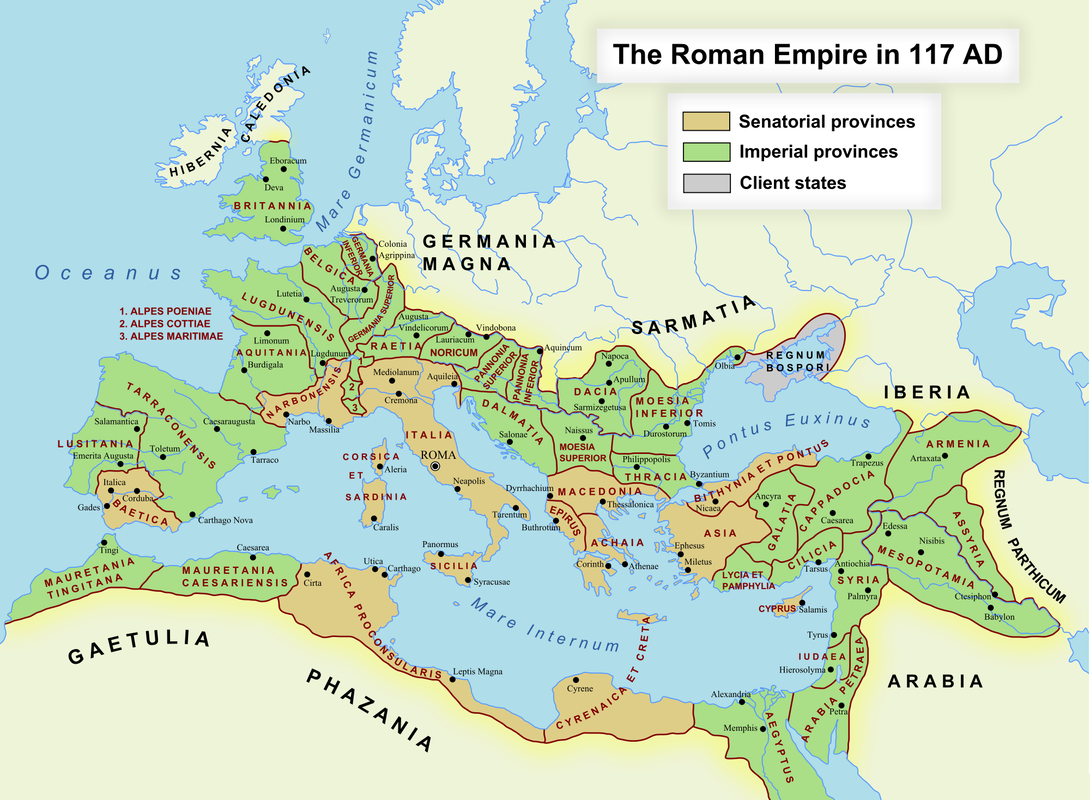
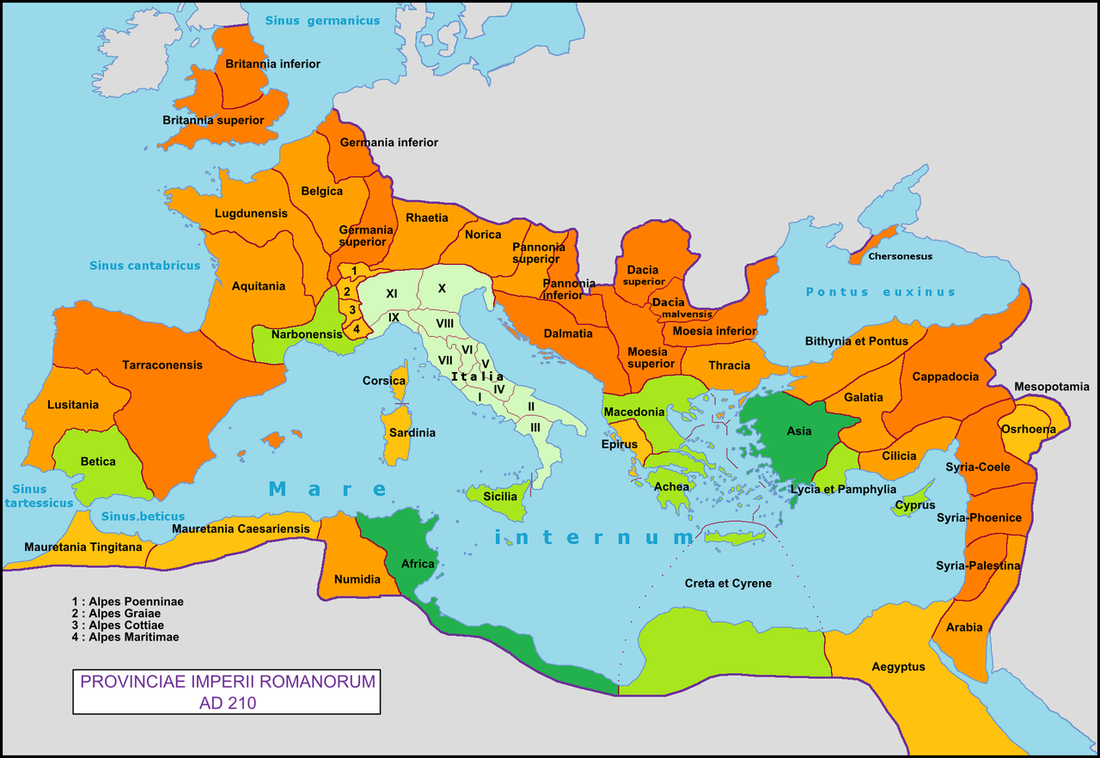
The Roman Empire under Septimius Severus
https://en.wikipedia.org/wiki/Septimius_Severus#/media/File:Roman_Empire_with_provinces_in_210_AD.png
Mention of Mary Beard, Britain’s best-known historian or ancient Rome, prompted John to recall his correspondence with her in 2019. This was the result of a query from Circulus member Malcolm, who wanted to know whether the Roman Empire reached its greatest extent under Trajan (reigned 98 -117) or Septimius Severus (193-211), an issue which had cropped up during a pub quiz. Most sources agree it was Trajan, mainly because he brought Mesopotamia briefly within the Empire (see the first map above), but the Wikipedia article on Severus states categorically that it was the later emperor. The claim seems to be contradicted with the map included in the article itself and reproduced above but it is supported by citation of two seemingly respectable sources: David L. Kennedy & Derrick Riley (2012), Rome's Desert Frontiers, and R.J. van der Spek &Lukas De Blois (2008), An Introduction to the Ancient World, page 272. John therefore sent Professor Beard an email combining some (well-justified) flattery with mention of his disagreement with her on the value of using Latin for actual communication today.
Dear Dame Mary
First, belated congratulations on your DBE, very well deserved recognition of your achievements both as a researcher and in popularising Classical studies.
I am writing in case you are able to resolve an argument between some of us in Hong Kong who take an amateur interest in ancient history. The question is whether the Roman Empire reached its maximum extent under Trajan (as I'd always understood myself) or Septimius Severus. My own hunch is that we can't know for sure because of uncertainty over the exact line of the frontier at specific times. and that's presumably one of the reasons why (unless I've missed something) you don't mention this issue in S.P.Q.R. Nevertheless I'm consulting both you and my own former tutor, John Richardson, as your best guesses will be worth a lot more than ours.
I should add that I work mainly as a Latin tutor and a researcher (on Nepalese history and politics rather than ancient history) and am the convenor of the Circulus Latinus Honcongensis. Our web page is at https://linguae.weebly.com/circulus-latinus-honcongensis.html You yourself figure in the section over controversy on the modern use of Latin, an issue where, despite my admiration for your work, I think we have to agree to differ.
With best regards
John Whelpton
To his pleasant surprise, she replied the next day: `I think you are right. We can’t know for sure .. and it depends on how we define the borders. So there are different ideas. M’
https://en.wikipedia.org/wiki/Septimius_Severus#/media/File:Roman_Empire_with_provinces_in_210_AD.png
Mention of Mary Beard, Britain’s best-known historian or ancient Rome, prompted John to recall his correspondence with her in 2019. This was the result of a query from Circulus member Malcolm, who wanted to know whether the Roman Empire reached its greatest extent under Trajan (reigned 98 -117) or Septimius Severus (193-211), an issue which had cropped up during a pub quiz. Most sources agree it was Trajan, mainly because he brought Mesopotamia briefly within the Empire (see the first map above), but the Wikipedia article on Severus states categorically that it was the later emperor. The claim seems to be contradicted with the map included in the article itself and reproduced above but it is supported by citation of two seemingly respectable sources: David L. Kennedy & Derrick Riley (2012), Rome's Desert Frontiers, and R.J. van der Spek &Lukas De Blois (2008), An Introduction to the Ancient World, page 272. John therefore sent Professor Beard an email combining some (well-justified) flattery with mention of his disagreement with her on the value of using Latin for actual communication today.
Dear Dame Mary
First, belated congratulations on your DBE, very well deserved recognition of your achievements both as a researcher and in popularising Classical studies.
I am writing in case you are able to resolve an argument between some of us in Hong Kong who take an amateur interest in ancient history. The question is whether the Roman Empire reached its maximum extent under Trajan (as I'd always understood myself) or Septimius Severus. My own hunch is that we can't know for sure because of uncertainty over the exact line of the frontier at specific times. and that's presumably one of the reasons why (unless I've missed something) you don't mention this issue in S.P.Q.R. Nevertheless I'm consulting both you and my own former tutor, John Richardson, as your best guesses will be worth a lot more than ours.
I should add that I work mainly as a Latin tutor and a researcher (on Nepalese history and politics rather than ancient history) and am the convenor of the Circulus Latinus Honcongensis. Our web page is at https://linguae.weebly.com/circulus-latinus-honcongensis.html You yourself figure in the section over controversy on the modern use of Latin, an issue where, despite my admiration for your work, I think we have to agree to differ.
With best regards
John Whelpton
To his pleasant surprise, she replied the next day: `I think you are right. We can’t know for sure .. and it depends on how we define the borders. So there are different ideas. M’
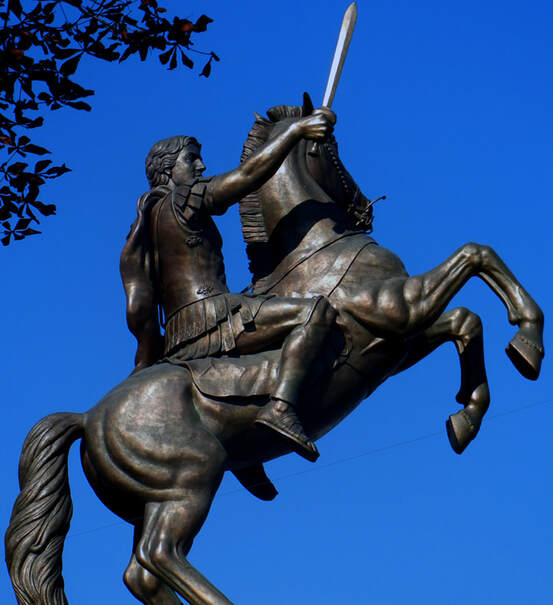
Statue of `A Greek Warrior’ in Skophe
http://www.alexanderthegreatfountain.com/AlexandertheGreatStatue.htm
Chris C. talked about his visit to Skophe, capital of Northern Macedonia, which now boasts a gigantic statue , officially named `A Greek Warrior’, but commonly understood to represent Alexander the Great. and his beloved horse, Bucephalus. Chris was particularly impressed by the horse’s prominent, rectangular penis, which unfortunately is not clearly visible in any of the photos so far found on the Internet!
The present territory of Northern Macedonia was part of the ancient kingdom and of the Roman province both known simply as Macedonia but the use of that name was prohibited in Yugoslavia between the two World Wars, as part of a Serbianisation drive. When Tito’s Communist state was set up, the region became `The Socialist Republic of Macedonia’ and then, on independence, simply `The Republic of Macedonia.’ This caused a long dispute with Greece, which objected to any other country challenging its own claim to be a name associated with such an important part of Greek history. The quarrel was settled in 2018 with an agreement to change the name to `Republic of Northern Macedonia’ but citizens and most local media continue to refer to their country simply as `Macedonia’. For further details, see thttps://en.wikipedia.org/wiki/North_Macedonia
A translation was requested of the sentences vōs mātrēs fēlīcēs pedicābitis and matres vobis felices pedicābitis. The context was unclear but John thought the former was probably equivalent to `You will sodomise the lucky mothers’ and `You, the lucky ones, will sodomise the mothers.’
Chris C. mentioned having at one stage been the boy friend of a South African doctor famous for once performing open heart surgery in the street, but John’s subsequent Internet search revealed only references to one such an operation taking place in Durham in the UK.
We had intended to read from Eutropius III:21 to I:7 but gave up half way through chapter 6 (at quamquam sorōrem Perseī uxōrem habēret, utrīsque sē aequum praebuit – see below), largely because of the difficult in outshouting the noisy, bow-tied gweilos in the main part of the restaurant, which had been curtained off for a private function. The restaurant proprietor told us they had brought along five barrels of Guinness with them.
We discussed briefly the grammatical peculiarity of names for cities and small islands, the two categories being lumped together presumably because usually a small island only had one city. Location at one of these places is expressed not with in plus the ablative but by the locative case, whilst motion towards them requires the accusative without ad and from them the ablative without ā/ab. Actual usage in classical authors varied a little, matters being also complicated by deciding exactly where the boundary between small and large islands lay. Rhodes, off the SW corner of Asia Minor, was sometimes said to be the smallest large island and the biggest small one.
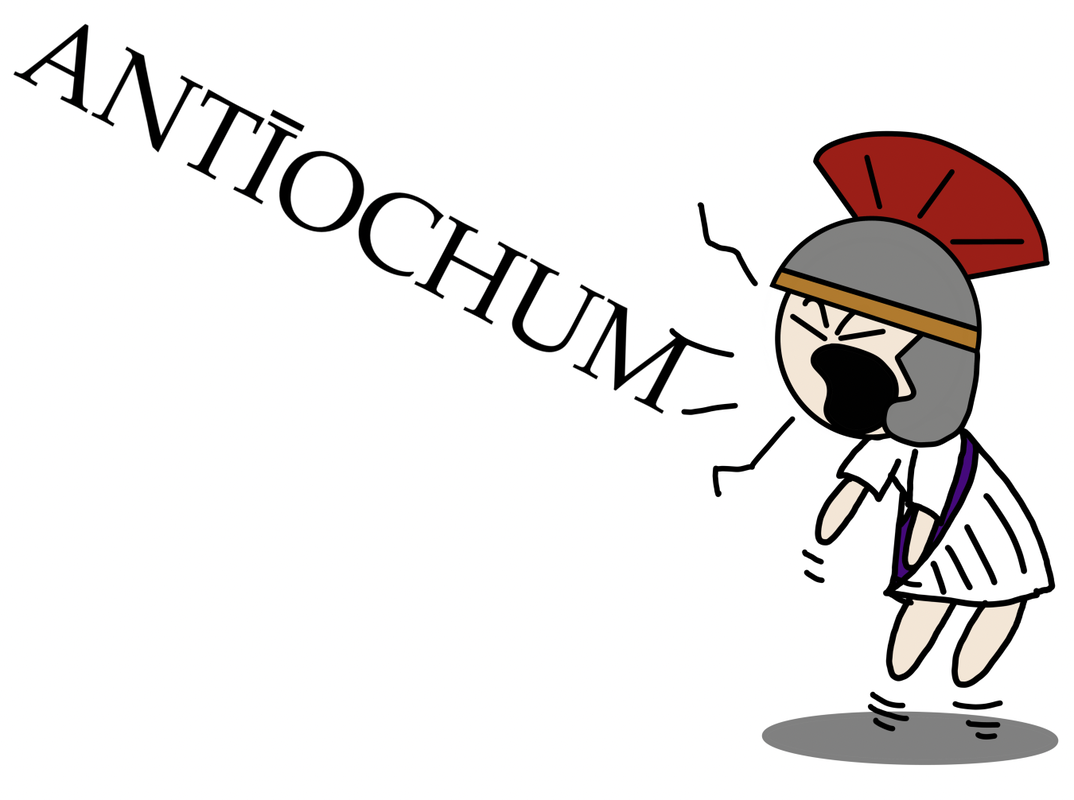
When reading aloud, people had particular difficult placing the stress on the ante-penultimate rather than the penultimate syllable of Antiochus, the name of several Greek kings of Syria.. It has to be AnTIochus because the penultimate is a short syllable and the Latin thus matches the accentuation of the original Greek Ἀντίοχος. John found himself constantly shouting the correction over the noise from the private party, a situation aptly illustrated in Hillary’s cartoon. Note that the macron there represents stress rather than vowel length as the `i’ is short.
http://www.alexanderthegreatfountain.com/AlexandertheGreatStatue.htm
Chris C. talked about his visit to Skophe, capital of Northern Macedonia, which now boasts a gigantic statue , officially named `A Greek Warrior’, but commonly understood to represent Alexander the Great. and his beloved horse, Bucephalus. Chris was particularly impressed by the horse’s prominent, rectangular penis, which unfortunately is not clearly visible in any of the photos so far found on the Internet!
The present territory of Northern Macedonia was part of the ancient kingdom and of the Roman province both known simply as Macedonia but the use of that name was prohibited in Yugoslavia between the two World Wars, as part of a Serbianisation drive. When Tito’s Communist state was set up, the region became `The Socialist Republic of Macedonia’ and then, on independence, simply `The Republic of Macedonia.’ This caused a long dispute with Greece, which objected to any other country challenging its own claim to be a name associated with such an important part of Greek history. The quarrel was settled in 2018 with an agreement to change the name to `Republic of Northern Macedonia’ but citizens and most local media continue to refer to their country simply as `Macedonia’. For further details, see thttps://en.wikipedia.org/wiki/North_Macedonia
A translation was requested of the sentences vōs mātrēs fēlīcēs pedicābitis and matres vobis felices pedicābitis. The context was unclear but John thought the former was probably equivalent to `You will sodomise the lucky mothers’ and `You, the lucky ones, will sodomise the mothers.’
Chris C. mentioned having at one stage been the boy friend of a South African doctor famous for once performing open heart surgery in the street, but John’s subsequent Internet search revealed only references to one such an operation taking place in Durham in the UK.
We had intended to read from Eutropius III:21 to I:7 but gave up half way through chapter 6 (at quamquam sorōrem Perseī uxōrem habēret, utrīsque sē aequum praebuit – see below), largely because of the difficult in outshouting the noisy, bow-tied gweilos in the main part of the restaurant, which had been curtained off for a private function. The restaurant proprietor told us they had brought along five barrels of Guinness with them.
We discussed briefly the grammatical peculiarity of names for cities and small islands, the two categories being lumped together presumably because usually a small island only had one city. Location at one of these places is expressed not with in plus the ablative but by the locative case, whilst motion towards them requires the accusative without ad and from them the ablative without ā/ab. Actual usage in classical authors varied a little, matters being also complicated by deciding exactly where the boundary between small and large islands lay. Rhodes, off the SW corner of Asia Minor, was sometimes said to be the smallest large island and the biggest small one.
When reading aloud, people had particular difficult placing the stress on the ante-penultimate rather than the penultimate syllable of Antiochus, the name of several Greek kings of Syria.. It has to be AnTIochus because the penultimate is a short syllable and the Latin thus matches the accentuation of the original Greek Ἀντίοχος. John found himself constantly shouting the correction over the noise from the private party, a situation aptly illustrated in Hillary’s cartoon. Note that the macron there represents stress rather than vowel length as the `i’ is short.
EUTROPIUS BREVIĀRIUM –LIBER III
21] Ita annō septimō decimō ab[1] Hannibale Ītalia līberāta est. Lēgātī Carthāginiēnsium
Thus in-year seventh tenth from Hannibal Italy freed was envoys of-Carthaginians
pācem ā Scīpiōne petīvērunt; ab eō ad senātum Rōmam missī sunt. Quadrāgintā et quīnque
peace from Scipio sought by him to senate to-Rome sent were for-forty and five
diēbus hīs indūtiae datae sunt, quousque īre Rōmam et regredī possent; et trīgintā mīlia pondō
days to-them truce given was until go to-Rome and return they-could and thirty thousands pounds
argentī ab hīs accepta sunt. Senātus ex arbitriō Scīpiōnis pācem iussit cum Carthāginiēnsibus
of-silver from them received were senate according-to judgment of-Scipio peace ordered with Carthaginians
fierī. Scīpiō hīs condiciōnibus dedit: nē amplius quam trīgintā nāvēs habērent, ut
to-be-made Scipio on-these conditions [peace]offered that-not more than thirty ships they-should-have that
quīngenta milia pondō argentī darent, captīvōs et perfugās redderent.
Five-hundred thousands pounds of-silver they-should-give captives and fugitives they-should-return
[22] Interim Hannibale veniente ad Āfricam pāx turbāta est, multa hostīlia ab Āfrīs facta sunt.
Meanwhile with-Hannibal coming to Africa peace disturbed was many hostile-things by Africans done were
Lēgātī tamen eōrum ex urbe venientēs ā Rōmānīs captī sunt, sed iubente Scīpiōne dīmissī.
Envoys however of-them from city coming by Romans captured were but with-ordering Scipio released
Hannibal quoque frequentibus proeliīs victus ā Scīpiōne petit etiam ipse pācem. Cum ventum
Hannibal also in-frequent battles defeated by Scipio sought also himself peace when came
esset ad colloquium, īsdem condiciōnibus data est, quibus prius, additīs quīngentīs mīlibus
it-had-been to conference on-same conditions [peace] offered was on-which before added to-five-hundred thousands
pondō[2] argentī centum mīlibus lībrārum propter novam perfidiam. Carthāginiēnsibus
pounds of-silver hundred thousand of-pounds because-of new treachery Carthaginians
condiciōnēs displicuērunt iussēruntque Hannibalem pugnāre. Īnfertur ā Scīpiōne et Masinissā,
conditions displeased and-they-ordered Hannibal to-fight is-waged by Scipio and Masinissa
aliō rēge Numidārum, quī amīcitiam cum Scīpiōne fēcerat, Carthāginī bellum. Hannibal trēs
another king of-Numidians who friendship with Scipio had-made against-Carthage war Hannibal three
explōrātōrēs ad Scīpiōnis castra mīsit, quōs captōs Scīpiō circumdūcī per castra iussit
scouts to Scipio’s camp sent whom captured Scipio to-be-led-round through camp ordered
ostendīque hīs tōtum exercitum, mox etiam prandium darī dīmittīque, ut renūntiārent
and-to-be-shown to-these whole army soon also luncheon to-be-given and-to-be-released so they-could-report
Hannibalī quae apud Rōmānōs vīdissent.
to-Hannibal what among Romans they-had-seen
[23] Intereā proelium ab utrōque duce īnstrūctum est, quāle vix ūllā memoriā fuit, cum
eanwhile battle[-formation] by each leader drawn-up was such-as scarcely in-any memory was since
perītissimī virī cōpiās suās ad bellum ēdūcerent. Scīpiō victor recēdit paene ipsō Hannibale
very-skilled men forces their to war were-leading-out Scipio victor came-away almost with-himself Hannibal
captō, quī prīmum cum multīs equitibus, deinde cum vīgintī, postrēmō cum quattuor ēvāsit.[3]
captured who first with many horsemen then with twenty finally with four escaped
Inventa in castrīs Hannibalis argentī pondō vīgintī mīlia, aurī octōgintā, cētera supellectilis
Found in camp of-Hannibal of-silver pound twenty thousand of-gold eighty other items
cōpiōsa. Post id certāmen pāx cum Carthāginiēnsibus facta est. Scīpiō Rōmam rediit, ingentī
in-abundance after that battle peace with Carthaginians made was Scipio to-Rome returned with-huge
glōriā triumphāvit atque Āfricānus ex eō appellārī coeptus est. Fīnem accēpit secundum
glory triumphed and Africanus from that [time] to-be-called began end received second
Pūnicum bellum post annum nōnum decimum, quam coeperat.[4]
Punic war after year nineteenth that it-had-begun
NOTES
[1] The preposition ā/ab in a sentence with a passive verb normally means `by’ but the sense here is obviously `from’. Eutropius wrongly places Hannibal’s departure from Italy in 201 rather than 203
[2] pondō (derived from pondus, ponderis n, weight, pound) was strictly speaking an adverb meaning `in weight’ . A Roman pondus (or libra, from which the English abbreviation `lb’ was approximately 330 grams as against 450 to a modern British pound.
[3] The battle was fought at Zama in 202.
[4] The peace agreement was reached in 201 B.C., the 19th year of the war if it is assumed to have begun with the attack on Saguntum in 219.
LIBER IV
[1] Trānsāctō Pūnicō bellō secūtum est Macedonicum contrā Philippum rēgem quīngentēsimō
Having-been-completed Punic war followed Macedonian-one against Philip king in-five-hundredth
quīnquāgēsimō et prīmō annō ab urbe conditā.[1]
fiftieth and first year from city founded
[2] T. Quīntius Flāminīnus[2] adversum Philippum missus rem prōsperē gessit. Pāx eī data est
Titus Quintius Flaminius against Philip sent affar successfully managed peace given was
hīs lēgibus: nē Graeciae cīvitātibus, quās Rōmānī contrā eum dēfenderant, bellum īnferret,
on-these conditions that-not of-Grreece on-cities which Romans against him had-defended war he-make
ut captīvōs et trānsfugās redderet, quīnquāgintā sōlās nāvēs habēret, reliquās Rōmānīs
that captives and fugitives he -return fifty alone ships he-have rest to-Romans
dēderet, per annōs decem quaterna mīlia pondō argentī praestāret[3] et obsidem daret fīlium
he-s-surrender for years ten four-each thousands in-weight of-silver he-should-provide and as-hostage give son
suum Dēmētrium. T. Quīntius etiam Lacedaemoniīs intulit bellum. Ducem eōrum Nabidem
his Demetrius Titus Quintius also on-Spartans made war leader of-them Nabis
vīcit et quibus voluit condiciōnibus in fidem accēpit.[4] Ingentī glōriā trimphāvit; dūxit ante
he-conquered and on-which he-wanted conditions into alliance received with-huge glory he-held-triumph he-led before
currum nōbilissimōs obsidēs, Dēmētrium, Philippī fīlium, et Armenēn Nabidis.
Chariot most-noble hostages Demetrius of-Philip son and Armenes [son]of-Nabis
[3] Trānsāctō bellō Macedonicō secūtum est Syriacum contrā Antiochum rēgem P. Cornēliō
Having-been-completed war Macedonian followed Syrian [one] against Antiochus king with-Publius Cornelius
Scīpiōne M. Acīliō Glabriōne cōnsulibus.[5]Huic Antiochō Hannibal sē iūnxerat, Carthāginem,
Scipio Marcus Acilius Glabrio consuls to-this Antiochus Hannibal self had-joined Carthage
patriam suam, metū, nē Rōmānīs trāderētur, relinquēns. M. Acīlius Glabriō in Achāiā bene
country his from-fear lest to-Roman he-be-handed-over leaving Marcus Acilius Glabrio om Achaia well
pugnāvit. Castra rēgis Antiochī nocturnā pugnā capta sunt, ipse fugātus. Philippō, quia contrā
fought camp of-king Atiochus in-night battle captured was -himself put-to-flight to-Philip because against
Antiochum Rōmānīs fuisset auxiliō, fīlius Dēmētrius redditus est.
Antiochus to-romans had-been of-help son Demetrius returned was
NOTES
[1] As Rome was supposedly founded in 753 B.C. this date corresponds to 203. The war, however, actually begun in the consulship of P. Sulpicius Galba and C. Aurelius Cotta in 200. Roman intervention had been requested by Pergamum and Rhodes who were resisting Philip’s attempt to conquer territory in Asia Minor and also by the Athenians. See map on page 10.
[2] Titus Quinctius Flamininus (the spelling `Quīntius’ was a later simplification) was elected consul in 198 and after prolongation of his command defeated Philip at the battle of Cynoscephalae (`Dog’s Heads’) in Thessaly in 197, reaching a peace agreement with him in 196. The Macedonians’ long spears made their phalanx very difficult to defeat in a frontal assault but the Romans seem to have prevailed through flank attacks and because their own formations were more manoeuvrable on hilly ground. See https://en.wikipedia.org/wiki/Battle_of_Cynoscephalae for further details.
[3] i.e. presumably 4,000 pounds of silver annually. Other sources give different figures.
[4] Flamininus and a Greek coalition, including Macedonia, defeated Nabis in 195, ending Spartan control of Argos in the NE Peloponnese and of the coastal states of Laconia further south. For details of this conflict, known as the Laconian War, see https://en.wikipedia.org/wiki/War_against_Nabise.
[5] Publius Cornelius Scipio Nasica, a cousin of Scipio Africanus, and Marcus Cornelius Glabrio were consuls in 191 B.C. Antiochus III of Syria had in 204 signed a secret agreement with Philip V of Macedon to attack the possessions of the infant King Ptolemy VI and during the 2nd Macedonian War had decisively defeated Ptolemy’s forces. After Rome’s defeat of Philip, Antiochus moved against the Ptolemaic possessions in Asia Minor which Philip had earlier hoped to annex, prompting the cities of Smyrna and Lampascus to appeal for Roman protection. Antoichus landed in mainland Greece in 192, invited by the Aetolian League, a confederacy of tribes and cities north of the Gulf of Corinth, who had first allied with Rome in 212 and then again in the 2nd. Macedonian War, but now felt Rome was seeking to dominate rather than liberate Greece. In 191 Glabrio defeated Antiochus and destroyed his army at Thermopylae, site of the famous battle between Greeks and the invading Persians in 480.
[4] L. Cornēliō Scīpiōne et C. Laeliō cōnsulibus Scīpiō Āfricānus frātrī suō L. Cornēliō
With Lucius Cornelius Scipio and Gaius Laelius consuls Scipio Africanus to-brother his Lucius Cornelius
Scīpiōnī cōnsulī lēgātus datus contrā Antiochum profectus est.[1] Hannibal, quī cum Antiochō
Scipio consul as-legate given against Antiochus set out Hannibal who with Antiochus
erat, nāvālī proeliō victus est.[2] Ipse posteā Antiochus circā Sipylum apud Magnēsiam, Asiae
was in-naval battle defeated was Himself afterwards Antiochus near Sipylus at Magnesis of-Asia
cīvitātem, ā cōnsule Cornēliō Scīpiōne ingentī proeliō fūsus est. Auxiliō fuit Rōmānīs in eā
city by consul Cornelius Scipio in-huge battle routed was of-help was to-Romans in this
pugnā Eumenēs, Attalī rēgis frāter, quī Eumēniam in Phrygiā condidit. Quīnquāgintā mīlia
battle Eumenes of-Attalus king brother who Eumenia in Phrygia founded fifty thousands
peditum, tria equitum eō certāmine ex parte rēgis occīsa sunt. Tum rēx pācem petit. Īsdem
of-infantry three of-cavalry in-that fight from side of-king killed were then king pace sought on-same
condiciōnibus data est ā senātū, quamquam victō, quibus ante offerēbātur: ut ex
conditions given it-was by sanate although to-defeated-man as-those-on-which before it-was-offered that from
Eurōpā et Asiā recēderet atque intrā Taurum sē continēret, decem mīlia talentōrum et vīgintī
Europe and Asia he-withdraw and within Taurus self keep ten thousands of-talents and twenty
obsidēs praebēret, Hannibalem, concitātōrem bellī, dēderet.[3] Eumenī rēgī dōnātae sunt ā
hostages he-provide Hannibal instigator of-war he-give-up to-Eumenes king awarded were by
senātū omnēs Asiae cīvitātēs, quās Antiochus bellō perdiderat, et Rhodiīs, quī auxilium
senate all of-Asia cities which Antiochus in-war had-lost and to-Rhodians who help
Rōmānīs contrā rēgem Antiochum tulerant, multae urbēs concessae sunt. Scīpiō Rōmam
To-Romans gainst king Antiochus had-brought many cities granted were Scipio to-Rome
rediit, ingentī glōriā triumphāvit. Nōmen et ipse ad imitātiōnem frātris Asiāgenis accēpit, quia
returned with-huge glory triumphed name also himself in imitation of-brother Asiāgenis he-received as
Asiam vīcerat, sīcuti frāter ipsīus propter Āfricam domitam Āfricānus appellābātur.
Asia he-had-conquered as brother of-self because-of Africa subdued Africanus was-called
[5] Sp. Postumiō Albīnō Q. Marciō Philippō cōnsulibus M. Fulvius dē Aetōlīs triumphāvit.[4]
With Spurius Postumius Albinus Quintus Marcius Philippus consuls Marcus Fulvius over Aetolians celebrated
Hannibal, quī victō Antiochō, nē Rōmānīs trāderētur, ad Prūsiam, Bīthȳniae rēgem,
Hannibal who having-been-defeated Antiochus lest to-Romans he-be-handed to Prusias of-Bithynia king
fūgerat, repetītus etiam ab eō est per T. Quīntium Flāminīnum.[5] Et, cum trādendus Rōmānīs
had-fled demanded-back also from him was by Titus Quintius Flamininus and since to-be-handed to-Romans
esset, venēnum bibit et apud Libyssam in fīnibus Nīcomēdēnsium sepultus est. [6]
he-was poison he-drank and at Libyssa on territory of-the-Nicomedians buried he-was
[6] Philippō, rēge Macedoniae, mortuō, quī et adversum Rōmānōs bellum gesserat et posteā
With-Philip king of-Macedonia dead who both against Romans war had-waged and later
NOTES
[1] L. Cornelius Scipio (later `Asiaticus’ or `Asiagenis’ (Ἀσιαγενής)) and Laelius were consuls in 190
[2] Hannibal took refuge at Antiochus’ court in 195 B.C. after his political enemies in Carthage had told the Romans (perhaps untruthfully) that he was already negotiating with the king, who was in dispute with Rome. Hannibal was commanding part of Antiochus’s fleet in 190 when he was defeated by Rome’s Lydian Rhodian allies off Aspendos, a city near the southern coast of Asia Minor. The Romans shortly afterwards obtained full control of the sea by defeating Antiochus’s main fleet at Myonnesus, a promontory and city near Ephesus on the western coast.
[3] After his defeat at Magnesia near Ephesus in 189 Antiochus was compelled to accept the loss of Thrace and almost all of Asia Minor,
[4] Albinus and Philippus were consuls in 186. Nobilis, consul for 189, began his campaign against the Aetolians that year and held his triumph in December 187.
[5] Flamininus, the victor in the 2nd. Macedonian War, had also been sent in 192 to negotiate with Antiochus III before the outbreak of war. According to Plutarch, after his mission to capture Hannibal resulted in the latter’ death, he was criticised by some senators for cruelty against a man who was no longer a threat.
[6] After the battle of Magnesia Hannibal took refuge first in Crete and then with King Prusias of Bithynia. For the stories of how he used snakes when fighting a naval battle on behalf of Prusias against Eumenes of Pergamum and how he kept his money safe from the Cretans, see chapters 1 and 3 of Ad Alpēs. Hannibal lived for some years in Nicomedia (modern İzmit), a city on the Black Sea coast which was later the capital of the Roman province of Bithynia and, briefly in the 4th century AD., the eastern capital of the whole empire (see https://en.wikipedia.org/wiki/Nicomedia). His funeral mound at nearby Libyssa, where he committed suicide in 183/2, long remained a local landmark.
Rōmānīs contrā Antiochum auxilium tulerat, fīlius eius Perseus in Macedoniā rebellāvit
To-Romans against Antiochus help had-given son his Perseus in Macedonia rebelled
ingentibus cōpiīs ad bellum parātīs. Nam adiūtōrēs habēbat Cotyn, Thrāciae rēgem, et rēgem
with-huge forces for war prepared for helpers he-had Cotys of-Thrace king and king
Illyricī, Gentium nōmine.[1] Rōmānīs autem in auxiliō erant Eumenēs, Asiae rēx, Ariarātus
Of-Illyria gentius by-name to-Romans on-other-hand of help were Eumenes of-Asia king Ariartus
Cappadociae, Antiochus Syriae, Ptolomaeus Aegyptī, Masinissa[2] Numidiae. Prūsiās autem
Of-Cappadocia Antiochus of-Syria Ptolemy of-Egypt Masinissa of-Numidia Prusia moreover
Bīthȳniae, quamquam sorōrem Perseī uxōrem habēret, utrīsque sē aequum praebuit.
NOTES
[1] Perseus, Philip’s son by a concubine, succeeded his father in 179, having earlier engineered the death of Demetrius, the legitimate heir and a former hostage in Rome. The Romans, encouraged by Eumenes, were suspicious of him from the start and declared war in 171, alleging he had attacked chieftains in Illyria under their protection. See https://en.wikipedia.org/wiki/Perseus_of_Macedon
[2] For Masinissa’s role in the 2nd. Punic War, see footnote 41 above.
21] Ita annō septimō decimō ab[1] Hannibale Ītalia līberāta est. Lēgātī Carthāginiēnsium
Thus in-year seventh tenth from Hannibal Italy freed was envoys of-Carthaginians
pācem ā Scīpiōne petīvērunt; ab eō ad senātum Rōmam missī sunt. Quadrāgintā et quīnque
peace from Scipio sought by him to senate to-Rome sent were for-forty and five
diēbus hīs indūtiae datae sunt, quousque īre Rōmam et regredī possent; et trīgintā mīlia pondō
days to-them truce given was until go to-Rome and return they-could and thirty thousands pounds
argentī ab hīs accepta sunt. Senātus ex arbitriō Scīpiōnis pācem iussit cum Carthāginiēnsibus
of-silver from them received were senate according-to judgment of-Scipio peace ordered with Carthaginians
fierī. Scīpiō hīs condiciōnibus dedit: nē amplius quam trīgintā nāvēs habērent, ut
to-be-made Scipio on-these conditions [peace]offered that-not more than thirty ships they-should-have that
quīngenta milia pondō argentī darent, captīvōs et perfugās redderent.
Five-hundred thousands pounds of-silver they-should-give captives and fugitives they-should-return
[22] Interim Hannibale veniente ad Āfricam pāx turbāta est, multa hostīlia ab Āfrīs facta sunt.
Meanwhile with-Hannibal coming to Africa peace disturbed was many hostile-things by Africans done were
Lēgātī tamen eōrum ex urbe venientēs ā Rōmānīs captī sunt, sed iubente Scīpiōne dīmissī.
Envoys however of-them from city coming by Romans captured were but with-ordering Scipio released
Hannibal quoque frequentibus proeliīs victus ā Scīpiōne petit etiam ipse pācem. Cum ventum
Hannibal also in-frequent battles defeated by Scipio sought also himself peace when came
esset ad colloquium, īsdem condiciōnibus data est, quibus prius, additīs quīngentīs mīlibus
it-had-been to conference on-same conditions [peace] offered was on-which before added to-five-hundred thousands
pondō[2] argentī centum mīlibus lībrārum propter novam perfidiam. Carthāginiēnsibus
pounds of-silver hundred thousand of-pounds because-of new treachery Carthaginians
condiciōnēs displicuērunt iussēruntque Hannibalem pugnāre. Īnfertur ā Scīpiōne et Masinissā,
conditions displeased and-they-ordered Hannibal to-fight is-waged by Scipio and Masinissa
aliō rēge Numidārum, quī amīcitiam cum Scīpiōne fēcerat, Carthāginī bellum. Hannibal trēs
another king of-Numidians who friendship with Scipio had-made against-Carthage war Hannibal three
explōrātōrēs ad Scīpiōnis castra mīsit, quōs captōs Scīpiō circumdūcī per castra iussit
scouts to Scipio’s camp sent whom captured Scipio to-be-led-round through camp ordered
ostendīque hīs tōtum exercitum, mox etiam prandium darī dīmittīque, ut renūntiārent
and-to-be-shown to-these whole army soon also luncheon to-be-given and-to-be-released so they-could-report
Hannibalī quae apud Rōmānōs vīdissent.
to-Hannibal what among Romans they-had-seen
[23] Intereā proelium ab utrōque duce īnstrūctum est, quāle vix ūllā memoriā fuit, cum
eanwhile battle[-formation] by each leader drawn-up was such-as scarcely in-any memory was since
perītissimī virī cōpiās suās ad bellum ēdūcerent. Scīpiō victor recēdit paene ipsō Hannibale
very-skilled men forces their to war were-leading-out Scipio victor came-away almost with-himself Hannibal
captō, quī prīmum cum multīs equitibus, deinde cum vīgintī, postrēmō cum quattuor ēvāsit.[3]
captured who first with many horsemen then with twenty finally with four escaped
Inventa in castrīs Hannibalis argentī pondō vīgintī mīlia, aurī octōgintā, cētera supellectilis
Found in camp of-Hannibal of-silver pound twenty thousand of-gold eighty other items
cōpiōsa. Post id certāmen pāx cum Carthāginiēnsibus facta est. Scīpiō Rōmam rediit, ingentī
in-abundance after that battle peace with Carthaginians made was Scipio to-Rome returned with-huge
glōriā triumphāvit atque Āfricānus ex eō appellārī coeptus est. Fīnem accēpit secundum
glory triumphed and Africanus from that [time] to-be-called began end received second
Pūnicum bellum post annum nōnum decimum, quam coeperat.[4]
Punic war after year nineteenth that it-had-begun
NOTES
[1] The preposition ā/ab in a sentence with a passive verb normally means `by’ but the sense here is obviously `from’. Eutropius wrongly places Hannibal’s departure from Italy in 201 rather than 203
[2] pondō (derived from pondus, ponderis n, weight, pound) was strictly speaking an adverb meaning `in weight’ . A Roman pondus (or libra, from which the English abbreviation `lb’ was approximately 330 grams as against 450 to a modern British pound.
[3] The battle was fought at Zama in 202.
[4] The peace agreement was reached in 201 B.C., the 19th year of the war if it is assumed to have begun with the attack on Saguntum in 219.
LIBER IV
[1] Trānsāctō Pūnicō bellō secūtum est Macedonicum contrā Philippum rēgem quīngentēsimō
Having-been-completed Punic war followed Macedonian-one against Philip king in-five-hundredth
quīnquāgēsimō et prīmō annō ab urbe conditā.[1]
fiftieth and first year from city founded
[2] T. Quīntius Flāminīnus[2] adversum Philippum missus rem prōsperē gessit. Pāx eī data est
Titus Quintius Flaminius against Philip sent affar successfully managed peace given was
hīs lēgibus: nē Graeciae cīvitātibus, quās Rōmānī contrā eum dēfenderant, bellum īnferret,
on-these conditions that-not of-Grreece on-cities which Romans against him had-defended war he-make
ut captīvōs et trānsfugās redderet, quīnquāgintā sōlās nāvēs habēret, reliquās Rōmānīs
that captives and fugitives he -return fifty alone ships he-have rest to-Romans
dēderet, per annōs decem quaterna mīlia pondō argentī praestāret[3] et obsidem daret fīlium
he-s-surrender for years ten four-each thousands in-weight of-silver he-should-provide and as-hostage give son
suum Dēmētrium. T. Quīntius etiam Lacedaemoniīs intulit bellum. Ducem eōrum Nabidem
his Demetrius Titus Quintius also on-Spartans made war leader of-them Nabis
vīcit et quibus voluit condiciōnibus in fidem accēpit.[4] Ingentī glōriā trimphāvit; dūxit ante
he-conquered and on-which he-wanted conditions into alliance received with-huge glory he-held-triumph he-led before
currum nōbilissimōs obsidēs, Dēmētrium, Philippī fīlium, et Armenēn Nabidis.
Chariot most-noble hostages Demetrius of-Philip son and Armenes [son]of-Nabis
[3] Trānsāctō bellō Macedonicō secūtum est Syriacum contrā Antiochum rēgem P. Cornēliō
Having-been-completed war Macedonian followed Syrian [one] against Antiochus king with-Publius Cornelius
Scīpiōne M. Acīliō Glabriōne cōnsulibus.[5]Huic Antiochō Hannibal sē iūnxerat, Carthāginem,
Scipio Marcus Acilius Glabrio consuls to-this Antiochus Hannibal self had-joined Carthage
patriam suam, metū, nē Rōmānīs trāderētur, relinquēns. M. Acīlius Glabriō in Achāiā bene
country his from-fear lest to-Roman he-be-handed-over leaving Marcus Acilius Glabrio om Achaia well
pugnāvit. Castra rēgis Antiochī nocturnā pugnā capta sunt, ipse fugātus. Philippō, quia contrā
fought camp of-king Atiochus in-night battle captured was -himself put-to-flight to-Philip because against
Antiochum Rōmānīs fuisset auxiliō, fīlius Dēmētrius redditus est.
Antiochus to-romans had-been of-help son Demetrius returned was
NOTES
[1] As Rome was supposedly founded in 753 B.C. this date corresponds to 203. The war, however, actually begun in the consulship of P. Sulpicius Galba and C. Aurelius Cotta in 200. Roman intervention had been requested by Pergamum and Rhodes who were resisting Philip’s attempt to conquer territory in Asia Minor and also by the Athenians. See map on page 10.
[2] Titus Quinctius Flamininus (the spelling `Quīntius’ was a later simplification) was elected consul in 198 and after prolongation of his command defeated Philip at the battle of Cynoscephalae (`Dog’s Heads’) in Thessaly in 197, reaching a peace agreement with him in 196. The Macedonians’ long spears made their phalanx very difficult to defeat in a frontal assault but the Romans seem to have prevailed through flank attacks and because their own formations were more manoeuvrable on hilly ground. See https://en.wikipedia.org/wiki/Battle_of_Cynoscephalae for further details.
[3] i.e. presumably 4,000 pounds of silver annually. Other sources give different figures.
[4] Flamininus and a Greek coalition, including Macedonia, defeated Nabis in 195, ending Spartan control of Argos in the NE Peloponnese and of the coastal states of Laconia further south. For details of this conflict, known as the Laconian War, see https://en.wikipedia.org/wiki/War_against_Nabise.
[5] Publius Cornelius Scipio Nasica, a cousin of Scipio Africanus, and Marcus Cornelius Glabrio were consuls in 191 B.C. Antiochus III of Syria had in 204 signed a secret agreement with Philip V of Macedon to attack the possessions of the infant King Ptolemy VI and during the 2nd Macedonian War had decisively defeated Ptolemy’s forces. After Rome’s defeat of Philip, Antiochus moved against the Ptolemaic possessions in Asia Minor which Philip had earlier hoped to annex, prompting the cities of Smyrna and Lampascus to appeal for Roman protection. Antoichus landed in mainland Greece in 192, invited by the Aetolian League, a confederacy of tribes and cities north of the Gulf of Corinth, who had first allied with Rome in 212 and then again in the 2nd. Macedonian War, but now felt Rome was seeking to dominate rather than liberate Greece. In 191 Glabrio defeated Antiochus and destroyed his army at Thermopylae, site of the famous battle between Greeks and the invading Persians in 480.
[4] L. Cornēliō Scīpiōne et C. Laeliō cōnsulibus Scīpiō Āfricānus frātrī suō L. Cornēliō
With Lucius Cornelius Scipio and Gaius Laelius consuls Scipio Africanus to-brother his Lucius Cornelius
Scīpiōnī cōnsulī lēgātus datus contrā Antiochum profectus est.[1] Hannibal, quī cum Antiochō
Scipio consul as-legate given against Antiochus set out Hannibal who with Antiochus
erat, nāvālī proeliō victus est.[2] Ipse posteā Antiochus circā Sipylum apud Magnēsiam, Asiae
was in-naval battle defeated was Himself afterwards Antiochus near Sipylus at Magnesis of-Asia
cīvitātem, ā cōnsule Cornēliō Scīpiōne ingentī proeliō fūsus est. Auxiliō fuit Rōmānīs in eā
city by consul Cornelius Scipio in-huge battle routed was of-help was to-Romans in this
pugnā Eumenēs, Attalī rēgis frāter, quī Eumēniam in Phrygiā condidit. Quīnquāgintā mīlia
battle Eumenes of-Attalus king brother who Eumenia in Phrygia founded fifty thousands
peditum, tria equitum eō certāmine ex parte rēgis occīsa sunt. Tum rēx pācem petit. Īsdem
of-infantry three of-cavalry in-that fight from side of-king killed were then king pace sought on-same
condiciōnibus data est ā senātū, quamquam victō, quibus ante offerēbātur: ut ex
conditions given it-was by sanate although to-defeated-man as-those-on-which before it-was-offered that from
Eurōpā et Asiā recēderet atque intrā Taurum sē continēret, decem mīlia talentōrum et vīgintī
Europe and Asia he-withdraw and within Taurus self keep ten thousands of-talents and twenty
obsidēs praebēret, Hannibalem, concitātōrem bellī, dēderet.[3] Eumenī rēgī dōnātae sunt ā
hostages he-provide Hannibal instigator of-war he-give-up to-Eumenes king awarded were by
senātū omnēs Asiae cīvitātēs, quās Antiochus bellō perdiderat, et Rhodiīs, quī auxilium
senate all of-Asia cities which Antiochus in-war had-lost and to-Rhodians who help
Rōmānīs contrā rēgem Antiochum tulerant, multae urbēs concessae sunt. Scīpiō Rōmam
To-Romans gainst king Antiochus had-brought many cities granted were Scipio to-Rome
rediit, ingentī glōriā triumphāvit. Nōmen et ipse ad imitātiōnem frātris Asiāgenis accēpit, quia
returned with-huge glory triumphed name also himself in imitation of-brother Asiāgenis he-received as
Asiam vīcerat, sīcuti frāter ipsīus propter Āfricam domitam Āfricānus appellābātur.
Asia he-had-conquered as brother of-self because-of Africa subdued Africanus was-called
[5] Sp. Postumiō Albīnō Q. Marciō Philippō cōnsulibus M. Fulvius dē Aetōlīs triumphāvit.[4]
With Spurius Postumius Albinus Quintus Marcius Philippus consuls Marcus Fulvius over Aetolians celebrated
Hannibal, quī victō Antiochō, nē Rōmānīs trāderētur, ad Prūsiam, Bīthȳniae rēgem,
Hannibal who having-been-defeated Antiochus lest to-Romans he-be-handed to Prusias of-Bithynia king
fūgerat, repetītus etiam ab eō est per T. Quīntium Flāminīnum.[5] Et, cum trādendus Rōmānīs
had-fled demanded-back also from him was by Titus Quintius Flamininus and since to-be-handed to-Romans
esset, venēnum bibit et apud Libyssam in fīnibus Nīcomēdēnsium sepultus est. [6]
he-was poison he-drank and at Libyssa on territory of-the-Nicomedians buried he-was
[6] Philippō, rēge Macedoniae, mortuō, quī et adversum Rōmānōs bellum gesserat et posteā
With-Philip king of-Macedonia dead who both against Romans war had-waged and later
NOTES
[1] L. Cornelius Scipio (later `Asiaticus’ or `Asiagenis’ (Ἀσιαγενής)) and Laelius were consuls in 190
[2] Hannibal took refuge at Antiochus’ court in 195 B.C. after his political enemies in Carthage had told the Romans (perhaps untruthfully) that he was already negotiating with the king, who was in dispute with Rome. Hannibal was commanding part of Antiochus’s fleet in 190 when he was defeated by Rome’s Lydian Rhodian allies off Aspendos, a city near the southern coast of Asia Minor. The Romans shortly afterwards obtained full control of the sea by defeating Antiochus’s main fleet at Myonnesus, a promontory and city near Ephesus on the western coast.
[3] After his defeat at Magnesia near Ephesus in 189 Antiochus was compelled to accept the loss of Thrace and almost all of Asia Minor,
[4] Albinus and Philippus were consuls in 186. Nobilis, consul for 189, began his campaign against the Aetolians that year and held his triumph in December 187.
[5] Flamininus, the victor in the 2nd. Macedonian War, had also been sent in 192 to negotiate with Antiochus III before the outbreak of war. According to Plutarch, after his mission to capture Hannibal resulted in the latter’ death, he was criticised by some senators for cruelty against a man who was no longer a threat.
[6] After the battle of Magnesia Hannibal took refuge first in Crete and then with King Prusias of Bithynia. For the stories of how he used snakes when fighting a naval battle on behalf of Prusias against Eumenes of Pergamum and how he kept his money safe from the Cretans, see chapters 1 and 3 of Ad Alpēs. Hannibal lived for some years in Nicomedia (modern İzmit), a city on the Black Sea coast which was later the capital of the Roman province of Bithynia and, briefly in the 4th century AD., the eastern capital of the whole empire (see https://en.wikipedia.org/wiki/Nicomedia). His funeral mound at nearby Libyssa, where he committed suicide in 183/2, long remained a local landmark.
Rōmānīs contrā Antiochum auxilium tulerat, fīlius eius Perseus in Macedoniā rebellāvit
To-Romans against Antiochus help had-given son his Perseus in Macedonia rebelled
ingentibus cōpiīs ad bellum parātīs. Nam adiūtōrēs habēbat Cotyn, Thrāciae rēgem, et rēgem
with-huge forces for war prepared for helpers he-had Cotys of-Thrace king and king
Illyricī, Gentium nōmine.[1] Rōmānīs autem in auxiliō erant Eumenēs, Asiae rēx, Ariarātus
Of-Illyria gentius by-name to-Romans on-other-hand of help were Eumenes of-Asia king Ariartus
Cappadociae, Antiochus Syriae, Ptolomaeus Aegyptī, Masinissa[2] Numidiae. Prūsiās autem
Of-Cappadocia Antiochus of-Syria Ptolemy of-Egypt Masinissa of-Numidia Prusia moreover
Bīthȳniae, quamquam sorōrem Perseī uxōrem habēret, utrīsque sē aequum praebuit.
NOTES
[1] Perseus, Philip’s son by a concubine, succeeded his father in 179, having earlier engineered the death of Demetrius, the legitimate heir and a former hostage in Rome. The Romans, encouraged by Eumenes, were suspicious of him from the start and declared war in 171, alleging he had attacked chieftains in Illyria under their protection. See https://en.wikipedia.org/wiki/Perseus_of_Macedon
[2] For Masinissa’s role in the 2nd. Punic War, see footnote 41 above.


