| linguae |
|
QUESTIONS ARISING FROM 142nd. MEETING – 20/1/23
(the record of earlier meetings can be downloaded from the main Circulus page as can the version of Ciceronis Filius with illustrations added. The illustrated text of Genesis is available on the Genesis page, of Kepler's Somnium on the Somnium page, of Eutropius' Breviarium on the Eutropius page and of Nutting's Ad Alpes on the Ad Alpes page)
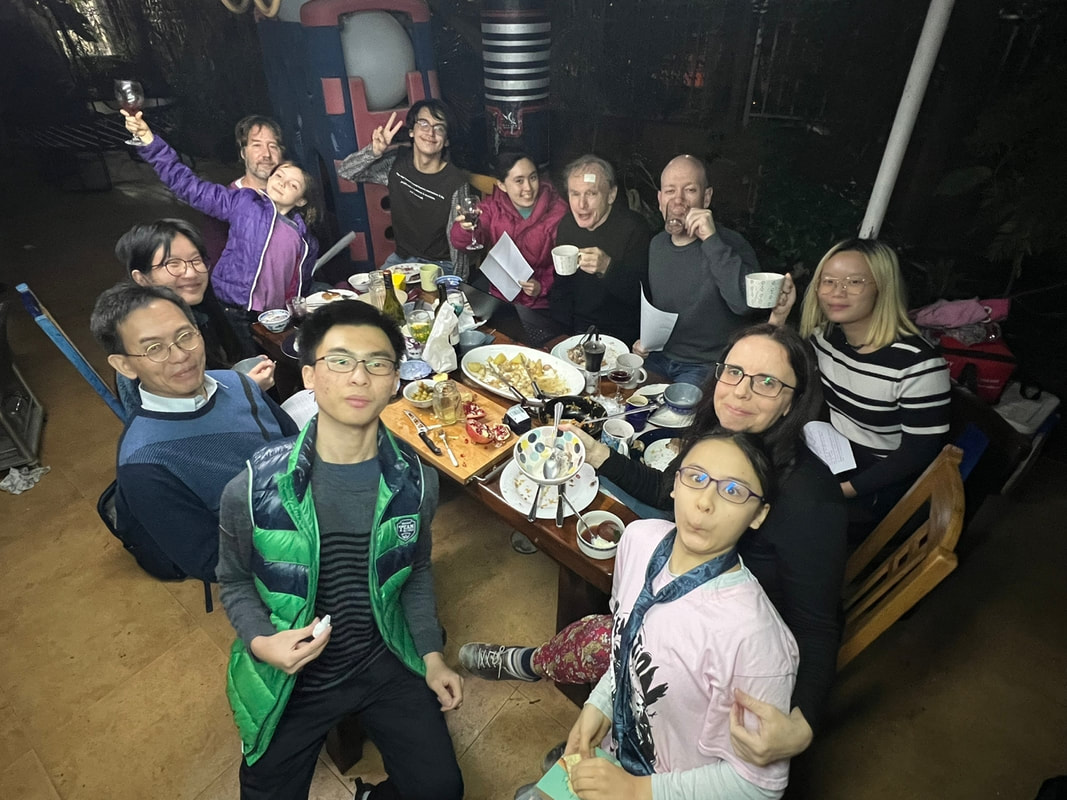
The meeting to mark Chinese New Year as held just before the start of Annus Cunīculāris (The Year of The Rabbit), with Tanya and Keon again generously hosting the event in Campus Pictus (Kam Tin) and Monica, despite not being free that day, sending along cakes brought from Beijing.
We read the usual dialogue on Chinese and Roman spring festivals from the Circulus page (https://linguae.weebly.com/circulus-latinus-honcongensis.html) and this is also pasted below as are the lyrics of three songs sung by the company: Luke Ranieri’s Latin version of `Auld Lang Syne’, the student drinking song `Gaudeamus Igitur’, now often performed at university ceremonies, and some verses from an even older drinking song, `Bacche, Bene Venies’.
Luke’s `Auld Lang Syne’ video is at https://www.youtube.com/watch?v=pg2w6JLrpMM . His own transcription of the lyrics, which John slightly altered for the handout, is as follows:
Oblīvĭscāmur tempora
et amīcŏs antīquōs?
Oblīvĭscāmur tempora
et amīcŏs antīquōs?
Propīnŏ, τᾶν, sodālibus
et īs diēbus!
Sūmēmu’ pōclum amīcīs
et īs diēbus.
The Greek word τᾶν, which means `dear friend’, is normally only used in the phrase ὦ τᾶν (ō tān), with the ὦ functioning, like the `o’ in Latin and old-fashioned English, as an additional indication that the person is being addressed. Luke intended the `o’ at the end of the verb propīno (Greek προπίνω, `I drink a toast to someone’) to stand in for ὦ but John, not realising this, had earlier posted a rather pedantic comment beneath the video on YouTube:
Salve, Luci optime! Hanc pelliculam splendidam, quam nuperrime repperi, nos Honcongenses adhibebimus ut initium Anni Cuniculi septimana proxima celebremus. Incertus, tamen, sum utrum τᾶν vocabulum sine ὦ dicere liceat? Pro τᾶν canendum est `nunc'? Confiteor ita partem significationis originalis amitti. Consilium melius fortasse est `Propin’ ὦ τᾶν’ scribere, etiamsi sic vocalem naturaliter productam correptam reddimus.[Greetings, excellent Luke! We Hongkongers will use this splendid video, which I have very recently discovered, to celebrate the start of the Year of the Rabbit. However, I’m unsure whether it’s permissible to use the word τᾶν without ὦ. Instead of τᾶν, should we sing `nunc’[now]. I admit that would mean losing some of the original meaning. Perhaps a better plan is to write `Propin’ ὦ τᾶν’, even though this would involve lengthening a naturally short vowel.]
Luke’s rejoinder:
Quod item sonat, ὦ τᾶν jam intellegitur.[Because it sounds the same, ὦ τᾶν is already understood.
And John’s reply:
Ita vero! Pervidere debebam te totam iuncturam Graecam iam in animo habuisse. De modo scribendi disputare non continuabo. Annum Cuniculi Faustum Felicemque! [Yes indeed! I ought to have realised you already had in mind the whole Greek phrases, I won’t continue arguing about the spelling. Happy Year of the Rabbit!]
The verb propīno is normally used in Latin with a short final vowel but in at least one place the poet Martial makes it long (as in the Greek), so pronouncing a long `o’ here, as in John’s preferred spelling, would fit the word in front as well as the one after the syllable.
We read the usual dialogue on Chinese and Roman spring festivals from the Circulus page (https://linguae.weebly.com/circulus-latinus-honcongensis.html) and this is also pasted below as are the lyrics of three songs sung by the company: Luke Ranieri’s Latin version of `Auld Lang Syne’, the student drinking song `Gaudeamus Igitur’, now often performed at university ceremonies, and some verses from an even older drinking song, `Bacche, Bene Venies’.
Luke’s `Auld Lang Syne’ video is at https://www.youtube.com/watch?v=pg2w6JLrpMM . His own transcription of the lyrics, which John slightly altered for the handout, is as follows:
Oblīvĭscāmur tempora
et amīcŏs antīquōs?
Oblīvĭscāmur tempora
et amīcŏs antīquōs?
Propīnŏ, τᾶν, sodālibus
et īs diēbus!
Sūmēmu’ pōclum amīcīs
et īs diēbus.
The Greek word τᾶν, which means `dear friend’, is normally only used in the phrase ὦ τᾶν (ō tān), with the ὦ functioning, like the `o’ in Latin and old-fashioned English, as an additional indication that the person is being addressed. Luke intended the `o’ at the end of the verb propīno (Greek προπίνω, `I drink a toast to someone’) to stand in for ὦ but John, not realising this, had earlier posted a rather pedantic comment beneath the video on YouTube:
Salve, Luci optime! Hanc pelliculam splendidam, quam nuperrime repperi, nos Honcongenses adhibebimus ut initium Anni Cuniculi septimana proxima celebremus. Incertus, tamen, sum utrum τᾶν vocabulum sine ὦ dicere liceat? Pro τᾶν canendum est `nunc'? Confiteor ita partem significationis originalis amitti. Consilium melius fortasse est `Propin’ ὦ τᾶν’ scribere, etiamsi sic vocalem naturaliter productam correptam reddimus.[Greetings, excellent Luke! We Hongkongers will use this splendid video, which I have very recently discovered, to celebrate the start of the Year of the Rabbit. However, I’m unsure whether it’s permissible to use the word τᾶν without ὦ. Instead of τᾶν, should we sing `nunc’[now]. I admit that would mean losing some of the original meaning. Perhaps a better plan is to write `Propin’ ὦ τᾶν’, even though this would involve lengthening a naturally short vowel.]
Luke’s rejoinder:
Quod item sonat, ὦ τᾶν jam intellegitur.[Because it sounds the same, ὦ τᾶν is already understood.
And John’s reply:
Ita vero! Pervidere debebam te totam iuncturam Graecam iam in animo habuisse. De modo scribendi disputare non continuabo. Annum Cuniculi Faustum Felicemque! [Yes indeed! I ought to have realised you already had in mind the whole Greek phrases, I won’t continue arguing about the spelling. Happy Year of the Rabbit!]
The verb propīno is normally used in Latin with a short final vowel but in at least one place the poet Martial makes it long (as in the Greek), so pronouncing a long `o’ here, as in John’s preferred spelling, would fit the word in front as well as the one after the syllable.
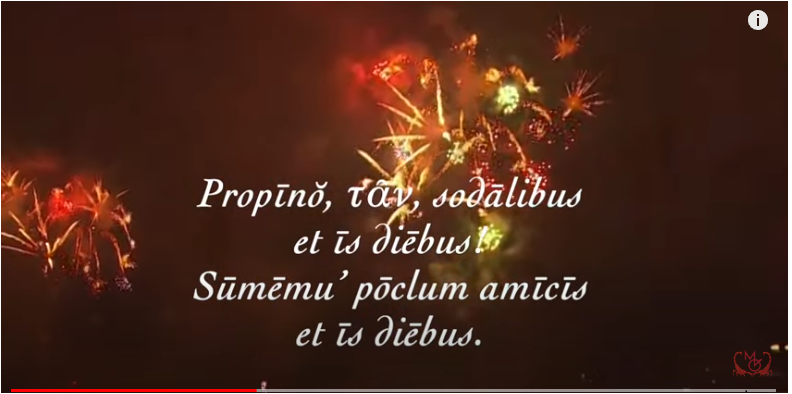
Whilst discussing the song, Chris pointed out that the syncopated form pōclum, with consequent melisma (singing one syllable on two notes) was not necessary, so John emended his own version of the words from pōcl’ (already reflecting the elision before the initial vowel in amīcīs) to pōcul’
Hillary objected to Luke’s use of the spelling jam instead of the classical iam. The use of `j’ for consonantal `i’ became standard in Latin texts printed from the around 16th century onwards but has now been generally abandoned except in Church Latin. It is indeed a little strange to find Luke spelling the word this way as he does normally use the Restored (Classical)Pronunciation, except in special circumstances such as the Latin interviews he conducted at the Vatican (see his video at https://www.youtube.com/watch?v=fDhEzP0b-Wo)
It was only after the meeting that John remembered out use in a precious year of an older, and perhaps better version of Auld Lang Syne, performed by Keith Massey at https://www.youtube.com/watch?v=PYFmz0G82RU
Finally, on the musical front, it was felt that `Bacche, Bene Venies’ had been the most fun to sing and, another year, we should use more of the verses.
Hillary objected to Luke’s use of the spelling jam instead of the classical iam. The use of `j’ for consonantal `i’ became standard in Latin texts printed from the around 16th century onwards but has now been generally abandoned except in Church Latin. It is indeed a little strange to find Luke spelling the word this way as he does normally use the Restored (Classical)Pronunciation, except in special circumstances such as the Latin interviews he conducted at the Vatican (see his video at https://www.youtube.com/watch?v=fDhEzP0b-Wo)
It was only after the meeting that John remembered out use in a precious year of an older, and perhaps better version of Auld Lang Syne, performed by Keith Massey at https://www.youtube.com/watch?v=PYFmz0G82RU
Finally, on the musical front, it was felt that `Bacche, Bene Venies’ had been the most fun to sing and, another year, we should use more of the verses.
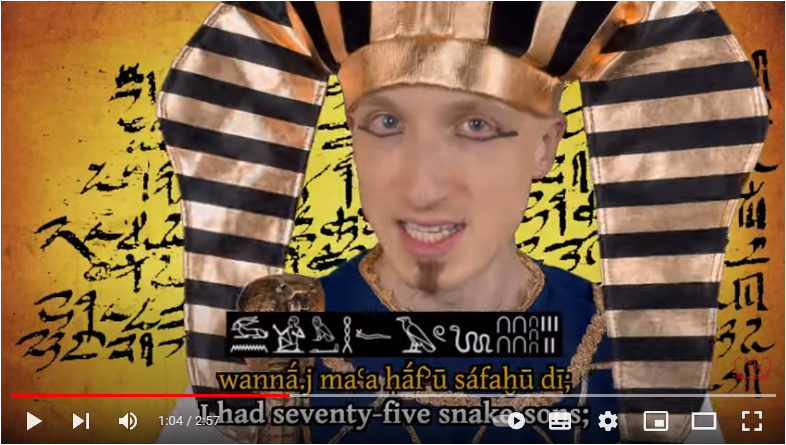
Luke Ranieri trying his hand at an ancient Egyptian version of `The Wellerman’
https://www.youtube.com/watch?v=ww6dN7uoF4g
Teagan, our youngest member, is already competent in a impressive range of languages, including Mandarin, German and Japanese. Her father now wondered whether to have her start on Latin or French first. John mentioned the additional possibility of Spanish which, in addition to being so widely spoken, is often thought of as the best entry point to the Romance languages as a whole. However, as Chris Y was himself fluent in French rather than Spanish, beginning with French and perhaps doing some Latin in parallel seemed the best option..
Hillary’s superb result in the exhausting series of exams she had recently completed included a 96% score in A-Level Classical Civilisation.in AP. She had another excellent performance in the AP, despite having to condense a two year course into four months!
Two of us compared their hospital experiences. One had been taken into Queen Mary’s Hospital in Hong Kong after suffering a stroke. He found it heavily overcrowded and couldn’t initially convince the staff that he had a clot moving through his body as the tests were at first negative. He therefore recommends seeking private treatment despite the expense. Another had spent six days in London’s Chelsea and Westminster Hospital with a cocktail of Covid, urinary retention, pneumonia and sepsis. Space was adequate and staff generally competent and pleasant to deal with but there had been some failures of coordination between all the different people involved in his case. He had been discharged while fitted with a catheter and advised to leave this in place until he consulted a urologist in Hong Kong after one month. In fact, he had actually seen a private urologist immediately after his return and was able to get rid of the inconvenience of the catheter after a further two days and rely simply on medication.
A third member described hallucinating after drinking absinthe outdoors in Norway. When she headed for the single nearby toilet she thought she was looking at a whole row of them. Chris Y referred to the widespread anti-absinthe movement which had led to bans on the drink in many places in the late 19th and early 20th century. The drink, which was immensely popular in France in the mid-19th century, is a spirit, made from the leaves and flowers of wormwood (Artemisia absinthium), a plant whose medical use was known in Egypt at least as early as the 16th century B.C. and is mentioned by the Roman poet Lucretius (c.99 – c.55 B.C.). It is nowadays thought that absinthe is not any more likely to produce hallucinations than strongly alcoholic drinks in general. More details are available at https://en.wikipedia.org/wiki/Absinthe
https://www.youtube.com/watch?v=ww6dN7uoF4g
Teagan, our youngest member, is already competent in a impressive range of languages, including Mandarin, German and Japanese. Her father now wondered whether to have her start on Latin or French first. John mentioned the additional possibility of Spanish which, in addition to being so widely spoken, is often thought of as the best entry point to the Romance languages as a whole. However, as Chris Y was himself fluent in French rather than Spanish, beginning with French and perhaps doing some Latin in parallel seemed the best option..
Hillary’s superb result in the exhausting series of exams she had recently completed included a 96% score in A-Level Classical Civilisation.in AP. She had another excellent performance in the AP, despite having to condense a two year course into four months!
Two of us compared their hospital experiences. One had been taken into Queen Mary’s Hospital in Hong Kong after suffering a stroke. He found it heavily overcrowded and couldn’t initially convince the staff that he had a clot moving through his body as the tests were at first negative. He therefore recommends seeking private treatment despite the expense. Another had spent six days in London’s Chelsea and Westminster Hospital with a cocktail of Covid, urinary retention, pneumonia and sepsis. Space was adequate and staff generally competent and pleasant to deal with but there had been some failures of coordination between all the different people involved in his case. He had been discharged while fitted with a catheter and advised to leave this in place until he consulted a urologist in Hong Kong after one month. In fact, he had actually seen a private urologist immediately after his return and was able to get rid of the inconvenience of the catheter after a further two days and rely simply on medication.
A third member described hallucinating after drinking absinthe outdoors in Norway. When she headed for the single nearby toilet she thought she was looking at a whole row of them. Chris Y referred to the widespread anti-absinthe movement which had led to bans on the drink in many places in the late 19th and early 20th century. The drink, which was immensely popular in France in the mid-19th century, is a spirit, made from the leaves and flowers of wormwood (Artemisia absinthium), a plant whose medical use was known in Egypt at least as early as the 16th century B.C. and is mentioned by the Roman poet Lucretius (c.99 – c.55 B.C.). It is nowadays thought that absinthe is not any more likely to produce hallucinations than strongly alcoholic drinks in general. More details are available at https://en.wikipedia.org/wiki/Absinthe
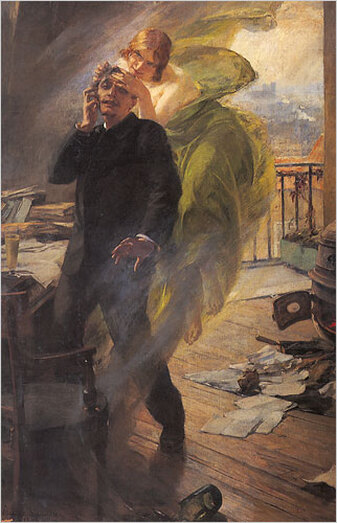
Albert Maignan’s 1895 `La muse verte’ (`Geen Muse), showing a poet under the influence of absinthe, which was often referred to as la fée verte (`the green fairy’)
https://en.wikipedia.org/wiki/Absinthe#/media/File:Albert_Maignan_-_La_muse_verte.jpg
Still on the topic of strong drink, we discussed briefly the term aqua vītae (`water of life’) which in the Middle Ages, if not earlier, came to refer to any alcoholic beverage prepared by distillation. The Gaelic translation, uisce beatha is the origin of English `whisk(e)y.’
Finally, Lily recalled advice to female students from her Spanish teacher to have a knife with them on a first date and propose to their companion that she carve their initials on an appropriate surface. This seemingly romantic gesture had the advantage of letting the man know that they were armed!
DĒ FESTŌ VERNĀLĪ APUD RŌMĀNĪS
Q. Sīnēnsēs novum annum vere instaurant. Quid dē Rōmānīs antīquīs?
Chinese new year in-spring start what about Romans ancient
A. Crēdimus annum Rōmānum in prīncipiō ā mēnse Martiō incēpisse, quam ob
We-believe year Roman in beginning from month March to-have-begun which for
rem nōmina Quīnctīlis, Sextīlis, September, Octōber, November, December
reason names Qjuinctilis Sexti;lis September October November December
mēnsibus data sunt quae, cum initium annī ad Iānuārium mōtum esset, septimus,
to-month s given were which when beginning of-year to January moved had-been seventh
octāvus, nōnus, decimus, ūndecimus et duodecimus factī sunt.
eighth ninth tenth eleventh and twelvth became
Q: Quandō Iānuārius prīmus factus est?
Rēs est incerta. Trāduntur Rōmulus urbem mēnse Martiō condidisse et eundem
Thing is uncertain are-traditionally-said Romulus city in-month March to-have-founded and same
mēnsem initium annī fēcisse, successor eius, Nūma Pompilius mēnsibus
month beginning of-year to-have-made successor his Numa Pompilius to-months
decem predecessōris Iānuārium Februāriumque addidisse et Iānuārium prīmum
ten of-predecessor January and-february to-have-added and January first
fēcisse. Huic fābulae, tamen, historicī diffīdunt, hoc sōlum
to-have-made this story whowever historians distrust this only
prō certō habent, cōnsulēs, ōlim Īdibus Martiīs, ab annō 153 ante Christum nātum
as certain they-consider consuls once on-Ides of-March from year 153 v before Christ born
Kalendīs Iānuāriīs officium suscēpisse. Crēdimus diem mūtātam esse
On-first-of January office to-have-tken-up we-believe day changes to-have-been
quod saepe necesse esset cōnsulibus, rēbus urbānīs compositīs, ad Hispāniam
because often necessary it-was for-consuls with-affairs of-city arranged to Spain
pervenīre antequam tempus pugnandī inciperet.
to-reach before season for-fighting started
Q: Etiamsī aevō classicō mēnsis Martius nōn erat initium annī, fortasse festum
although in-era classical month March not was beginning of-year perhaps festival
vernāle adhūc celebrābātur?
Spring still was-celebrated
A: Rectē dīxistī, nam festum Annae Perennae, quae Īdibus Martiīs incidēbat, quasī
Rightly you-have-said for festival of-Anna Perenna which on-Ides of-March fell as-if
continuātiō erat rītuum quibus ōlim nōn tantum veris sed etiam annī initium
continuation was of-rites with-which once not only of-spring but also of-year start
celebrābant. Quamquam erant inter Rōmānōs ipsōs quī crēdēbant illam deam esse
they-celebrated Although there-were among Romans themselves those-who believed that goddess to-be
Annam Tyriam, sorōrem Dīdōnis, rēvēra nōmen eius `annus’ vocābulō cognātum est.
Anna of-Tyre sister of-Dido realy name of-her `year’ to-word related was
in opere Ovidiī, cui titulus Fastī, poēta modum celebrandī hīs versibus dēscrīpsit:
in work of-Ovid to-which title Fasti poet way of-celebrating in-these verses described
Īdibus est Annae festum geniāle Perennae
on-th-Ides is of-Anna festival merry Perenna
nōn procul ā rīpīs, advena Thӯbri, tuīs
not far from banks stranget Tiber your
plēbs venit ac viridēs passim disiecta per herbās
common-people comes and green everywhere scattered among grass
pōtat, et accumbit cum pare quisque suā.
drinks and sits-together with partner each his-own
sub Iove[1] pars dūrat, paucī tentōria pōnunt,
under Jupiter some endure a-few tents pitch
sunt quibus ē rāmīs frondea facta casa est;
there-are those- for-whom from branches leafy made hut has-been
pars, ubi prō rigidīs calamōs statuēre columnīs,
a-section where instead-of rigid reeds they-have-erected columns
dēsuper extentas imposuēre togās.
above extended have-placed togas
sōle tamen vīnōque calent annōsque precantur
from-sun however and-wine they-are-warm and-years pray-for
quot sūmant cyathōs, ad numerumque bibunt.
as-many-as they-consume glasses up-to-the-number-also they-drink
(ex Librō III, 523-532)
[1] i.e. the open sky
https://en.wikipedia.org/wiki/Absinthe#/media/File:Albert_Maignan_-_La_muse_verte.jpg
Still on the topic of strong drink, we discussed briefly the term aqua vītae (`water of life’) which in the Middle Ages, if not earlier, came to refer to any alcoholic beverage prepared by distillation. The Gaelic translation, uisce beatha is the origin of English `whisk(e)y.’
Finally, Lily recalled advice to female students from her Spanish teacher to have a knife with them on a first date and propose to their companion that she carve their initials on an appropriate surface. This seemingly romantic gesture had the advantage of letting the man know that they were armed!
DĒ FESTŌ VERNĀLĪ APUD RŌMĀNĪS
Q. Sīnēnsēs novum annum vere instaurant. Quid dē Rōmānīs antīquīs?
Chinese new year in-spring start what about Romans ancient
A. Crēdimus annum Rōmānum in prīncipiō ā mēnse Martiō incēpisse, quam ob
We-believe year Roman in beginning from month March to-have-begun which for
rem nōmina Quīnctīlis, Sextīlis, September, Octōber, November, December
reason names Qjuinctilis Sexti;lis September October November December
mēnsibus data sunt quae, cum initium annī ad Iānuārium mōtum esset, septimus,
to-month s given were which when beginning of-year to January moved had-been seventh
octāvus, nōnus, decimus, ūndecimus et duodecimus factī sunt.
eighth ninth tenth eleventh and twelvth became
Q: Quandō Iānuārius prīmus factus est?
Rēs est incerta. Trāduntur Rōmulus urbem mēnse Martiō condidisse et eundem
Thing is uncertain are-traditionally-said Romulus city in-month March to-have-founded and same
mēnsem initium annī fēcisse, successor eius, Nūma Pompilius mēnsibus
month beginning of-year to-have-made successor his Numa Pompilius to-months
decem predecessōris Iānuārium Februāriumque addidisse et Iānuārium prīmum
ten of-predecessor January and-february to-have-added and January first
fēcisse. Huic fābulae, tamen, historicī diffīdunt, hoc sōlum
to-have-made this story whowever historians distrust this only
prō certō habent, cōnsulēs, ōlim Īdibus Martiīs, ab annō 153 ante Christum nātum
as certain they-consider consuls once on-Ides of-March from year 153 v before Christ born
Kalendīs Iānuāriīs officium suscēpisse. Crēdimus diem mūtātam esse
On-first-of January office to-have-tken-up we-believe day changes to-have-been
quod saepe necesse esset cōnsulibus, rēbus urbānīs compositīs, ad Hispāniam
because often necessary it-was for-consuls with-affairs of-city arranged to Spain
pervenīre antequam tempus pugnandī inciperet.
to-reach before season for-fighting started
Q: Etiamsī aevō classicō mēnsis Martius nōn erat initium annī, fortasse festum
although in-era classical month March not was beginning of-year perhaps festival
vernāle adhūc celebrābātur?
Spring still was-celebrated
A: Rectē dīxistī, nam festum Annae Perennae, quae Īdibus Martiīs incidēbat, quasī
Rightly you-have-said for festival of-Anna Perenna which on-Ides of-March fell as-if
continuātiō erat rītuum quibus ōlim nōn tantum veris sed etiam annī initium
continuation was of-rites with-which once not only of-spring but also of-year start
celebrābant. Quamquam erant inter Rōmānōs ipsōs quī crēdēbant illam deam esse
they-celebrated Although there-were among Romans themselves those-who believed that goddess to-be
Annam Tyriam, sorōrem Dīdōnis, rēvēra nōmen eius `annus’ vocābulō cognātum est.
Anna of-Tyre sister of-Dido realy name of-her `year’ to-word related was
in opere Ovidiī, cui titulus Fastī, poēta modum celebrandī hīs versibus dēscrīpsit:
in work of-Ovid to-which title Fasti poet way of-celebrating in-these verses described
Īdibus est Annae festum geniāle Perennae
on-th-Ides is of-Anna festival merry Perenna
nōn procul ā rīpīs, advena Thӯbri, tuīs
not far from banks stranget Tiber your
plēbs venit ac viridēs passim disiecta per herbās
common-people comes and green everywhere scattered among grass
pōtat, et accumbit cum pare quisque suā.
drinks and sits-together with partner each his-own
sub Iove[1] pars dūrat, paucī tentōria pōnunt,
under Jupiter some endure a-few tents pitch
sunt quibus ē rāmīs frondea facta casa est;
there-are those- for-whom from branches leafy made hut has-been
pars, ubi prō rigidīs calamōs statuēre columnīs,
a-section where instead-of rigid reeds they-have-erected columns
dēsuper extentas imposuēre togās.
above extended have-placed togas
sōle tamen vīnōque calent annōsque precantur
from-sun however and-wine they-are-warm and-years pray-for
quot sūmant cyathōs, ad numerumque bibunt.
as-many-as they-consume glasses up-to-the-number-also they-drink
(ex Librō III, 523-532)
[1] i.e. the open sky
Ēheu, exemplum antīquum nōn sequendum est! Ut mittam [1] sodālēs iuvenēs
Oh-dear example old not to-be-followed is let-alone members young
etiam nōs plūs sexagintā annōs nātī ēbriissimī fiāmus, si tot pōcula hauriāmus
even we more-than sixty years born very-drunk would-become if as-many cups we-downed
quot annōs futūrōs dēsīderāmus!
as years future we-want
BACCHE BENE VENIES https://www.youtube.com/watch?v=QBWsnxe1l9w&t=1s
(translation at https://linguae.weebly.com/corvus-corax.html)
Bacche, bene veniēs
grātus et optātus
per quem noster animus
fit laetificātus
Istud vīnum, bonum vīnum
vīnum generōsum
reddit virum curiālem
probum, animōsum
Iste cyphus concāvus
dē bonō merō profluus
sī quis bibit saepius
Satur fit et ēbrius
Istud etc.
Haec sunt vāsa rēgia
quibus spoliātur
Ierusalem et rēgālis
Babilon dītātur.
Istud etc.
Omnēs tibi canimus
maxima praecōnia,
te laudantes merito
tempora per omnia.
Istud etc. x 3
GAUDEĀMUS IGITUR https://www.youtube.com/watch?v=WfGXYkfLJ4s
Gaudeāmus igitur
let-us-be-happy therefore
Iuvenēs dum sumus
young while we-are
Gaudeāmus igitur
Iuvenēs dum sumus
Post iūcundam iuventūtem
after pleasant youth
Post molestam senectūtem
after miserable old age
Nos habēbit humus.
us will- have earth
Nos habēbit humus.
[1] Literally `that I may send aside’
AULD LANG SYNE
https://www.youtube.com/watch?v=pg2w6JLrpMM
Oblīvĭscāmur tempora et amīcŏs antīquōs?
Should-we-forget times and friends old
Oblīvĭscāmur tempora et amīcŏs antīquōs?
Propīn’, ὦ τᾶν, sodālibus et īs diēbus!
Ι-drink-a-toast dear-friends to-companions and to-those days
Sūmēmus pōcul’ amīcīs et īs diēbus.[1]
We’ll-take a-cup for-friends and for-those days
[1] The transcription of the last two lines have been altered slightly from the version given on YouTube, which has `Propīnŏ, τᾶν’ and `Sūmēmus pōcul’ amīcīs’
Oh-dear example old not to-be-followed is let-alone members young
etiam nōs plūs sexagintā annōs nātī ēbriissimī fiāmus, si tot pōcula hauriāmus
even we more-than sixty years born very-drunk would-become if as-many cups we-downed
quot annōs futūrōs dēsīderāmus!
as years future we-want
BACCHE BENE VENIES https://www.youtube.com/watch?v=QBWsnxe1l9w&t=1s
(translation at https://linguae.weebly.com/corvus-corax.html)
Bacche, bene veniēs
grātus et optātus
per quem noster animus
fit laetificātus
Istud vīnum, bonum vīnum
vīnum generōsum
reddit virum curiālem
probum, animōsum
Iste cyphus concāvus
dē bonō merō profluus
sī quis bibit saepius
Satur fit et ēbrius
Istud etc.
Haec sunt vāsa rēgia
quibus spoliātur
Ierusalem et rēgālis
Babilon dītātur.
Istud etc.
Omnēs tibi canimus
maxima praecōnia,
te laudantes merito
tempora per omnia.
Istud etc. x 3
GAUDEĀMUS IGITUR https://www.youtube.com/watch?v=WfGXYkfLJ4s
Gaudeāmus igitur
let-us-be-happy therefore
Iuvenēs dum sumus
young while we-are
Gaudeāmus igitur
Iuvenēs dum sumus
Post iūcundam iuventūtem
after pleasant youth
Post molestam senectūtem
after miserable old age
Nos habēbit humus.
us will- have earth
Nos habēbit humus.
[1] Literally `that I may send aside’
AULD LANG SYNE
https://www.youtube.com/watch?v=pg2w6JLrpMM
Oblīvĭscāmur tempora et amīcŏs antīquōs?
Should-we-forget times and friends old
Oblīvĭscāmur tempora et amīcŏs antīquōs?
Propīn’, ὦ τᾶν, sodālibus et īs diēbus!
Ι-drink-a-toast dear-friends to-companions and to-those days
Sūmēmus pōcul’ amīcīs et īs diēbus.[1]
We’ll-take a-cup for-friends and for-those days
[1] The transcription of the last two lines have been altered slightly from the version given on YouTube, which has `Propīnŏ, τᾶν’ and `Sūmēmus pōcul’ amīcīs’

