| linguae |
|
QUESTIONS ARISING FROM 114th. MEETING – 2/9/20
(the record of earlier meetings can be downloaded from the main Circulus page as can the version of Ciceronis Filius with illustrations added. The illustrated text of Genesis is available on the Genesis page, of Kepler's Somnium on the Somnium page and of Nutting's Ad Alpes on the Ad Alpes page)

Those joining the Zoom session were Valerie (still in the UK)), Stuart, Zhang Wei, Tanya, Sam and John. Keon, who works in Sheung Wan, had brought food from the Basmati for Tanya and Sam. The restaurant has very litle custom at the moment and their usual website (www.basmati.hk) is under repair but they are on Google Maps, with links to delivery services, and the detailed menu is still available at https://linguae.weebly.com/basmati-menu.html
We read from chapter XXVII, line 110 in Ad Alpēs to the end of chapter XXVIII (see the text below). This included a reference to the villa of Livia, wife of Augustus, at Prima Porta, now a Roman suburb 12 miles north of the city centre but in her time deep in the countryside. The villa and estate were famous for a breed of white chickens and therefore known as Ad Gallīnās Albās. `At the [White’] Chickens’ doesn’t sound right as the name of a house in English and Stuart suggested using instead `The Coop’.
The site is famous for the discovery in 1863 of a marble statue of Augustus. Like most Graeco-Roman sculpture this would originally have been brightly coloured and a reconstruction of its original apearance is shown below. For
more details see https://en.wikipedia.org/wiki/Augustus_of_Prima_Porta
The site is famous for the discovery in 1863 of a marble statue of Augustus. Like most Graeco-Roman sculpture this would originally have been brightly coloured and a reconstruction of its original apearance is shown below. For
more details see https://en.wikipedia.org/wiki/Augustus_of_Prima_Porta
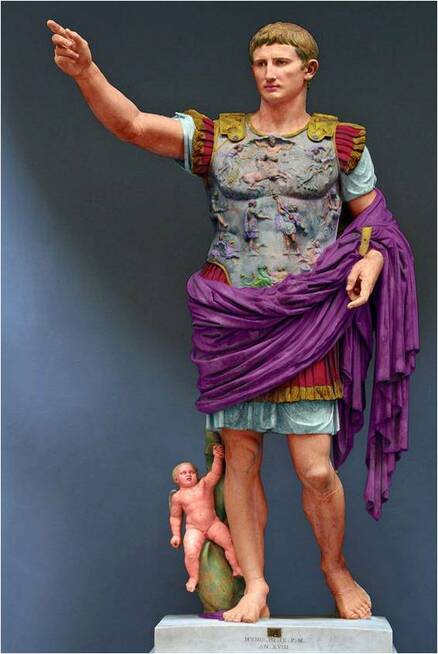
Augustus of Prima Porta with conjectural restoration of original colouring
https://www.reddit.com/r/Colorization/comments/6qsdjq/augustus_caesar/?utm_source=ifttt
Chapter 28 focusses mainly on the kidnapping of and ransoming of Cornelia and we sought an idiomatic English equivalent for `Periī!’ as exclaimed by Drusilla when she realised what had happened to her daughter. Tan suggested switching to Cantonese and using `Sei la!’ (死啦!).
In the story, the kidnappers left their ransom note written on charta, which we normally translate as `paper’ and Zhang Wei asked if the Romans normally made use of this. The Latin word originally applied specifically to papyrus, which was made from thin strips of papyrus reed, in contrast to true paper, which consists of individual plant fibres matted together and was invented in China, not reaching Europe till late in the first millennnium A.D. In classical times the Romans did use papyrus for some important documents but it was quite expensive.
https://www.reddit.com/r/Colorization/comments/6qsdjq/augustus_caesar/?utm_source=ifttt
Chapter 28 focusses mainly on the kidnapping of and ransoming of Cornelia and we sought an idiomatic English equivalent for `Periī!’ as exclaimed by Drusilla when she realised what had happened to her daughter. Tan suggested switching to Cantonese and using `Sei la!’ (死啦!).
In the story, the kidnappers left their ransom note written on charta, which we normally translate as `paper’ and Zhang Wei asked if the Romans normally made use of this. The Latin word originally applied specifically to papyrus, which was made from thin strips of papyrus reed, in contrast to true paper, which consists of individual plant fibres matted together and was invented in China, not reaching Europe till late in the first millennnium A.D. In classical times the Romans did use papyrus for some important documents but it was quite expensive.
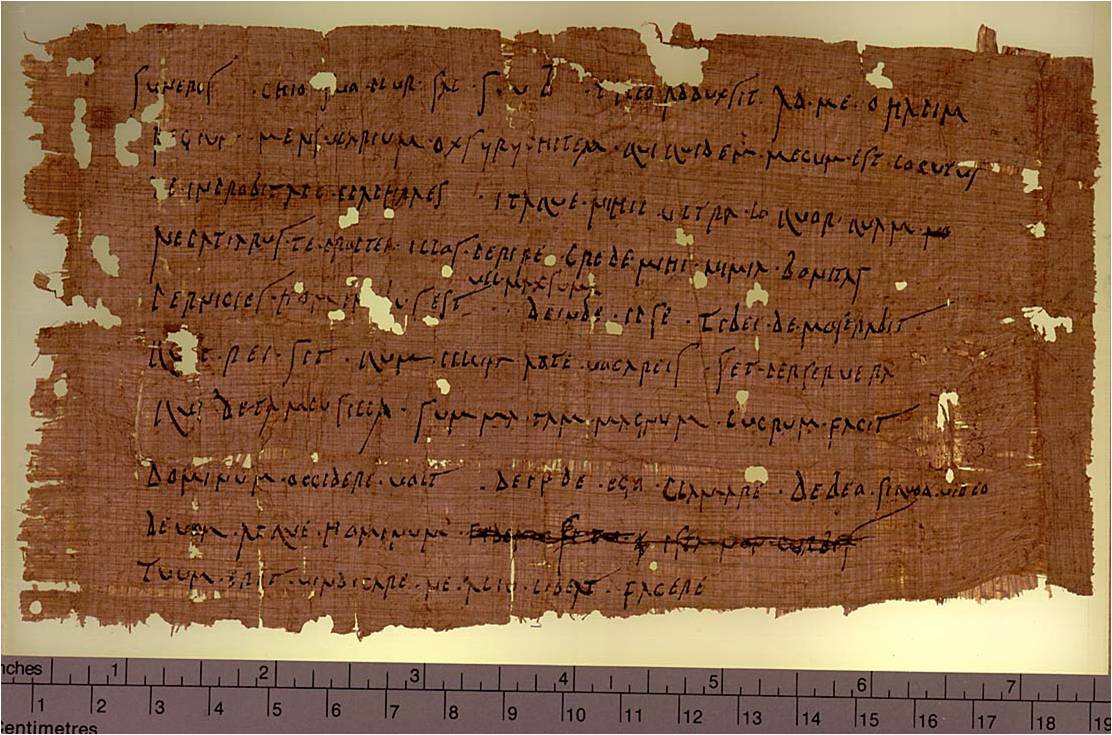
Letter written on papyrus in Egypt, probably between 25 B.C. and 25 A.D.
For everyday writing people frequently employed wooden tablets, which were really more like shallow trays and filled with wax on which letters were inscribed with a metal stylus. The wax, of course, has not survived, but the stylus often made incisions on the wood underneath and these can often still be read, This is the case with many of the earliest examples of Roman writing found in London, the recently discovered Bloomsberg Tablets, the oldest of which probably dates from c. 47 – 53 A.D. See the description and links at https://linguae.weebly.com/londinium.html
For everyday writing people frequently employed wooden tablets, which were really more like shallow trays and filled with wax on which letters were inscribed with a metal stylus. The wax, of course, has not survived, but the stylus often made incisions on the wood underneath and these can often still be read, This is the case with many of the earliest examples of Roman writing found in London, the recently discovered Bloomsberg Tablets, the oldest of which probably dates from c. 47 – 53 A.D. See the description and links at https://linguae.weebly.com/londinium.html
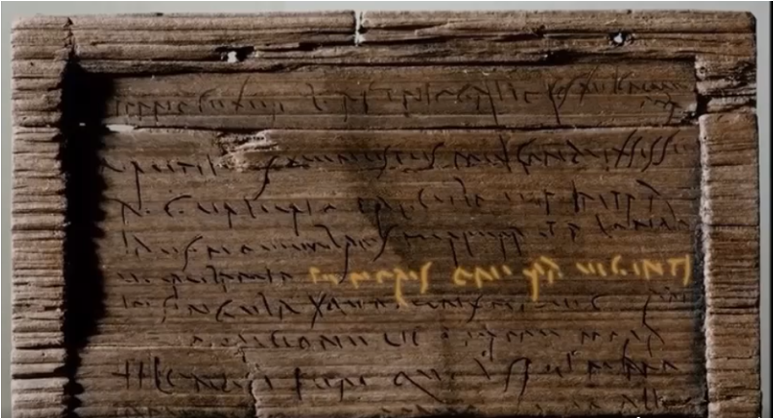
Wooden tablet from the Bloomberg Archive
https://www.facebook.com/Historical.Honeybee.Articles/videos/1213329262054901
An alternative was to write in ink diectly on thin pieces of wood and many documents of this type have been found at Vindolanda, just south of Hadrian’s Wall in Northumberland. They include the famous birthday party invitation sent to the wife of the garrison commander by the wife of another Roman officer.
https://www.facebook.com/Historical.Honeybee.Articles/videos/1213329262054901
An alternative was to write in ink diectly on thin pieces of wood and many documents of this type have been found at Vindolanda, just south of Hadrian’s Wall in Northumberland. They include the famous birthday party invitation sent to the wife of the garrison commander by the wife of another Roman officer.
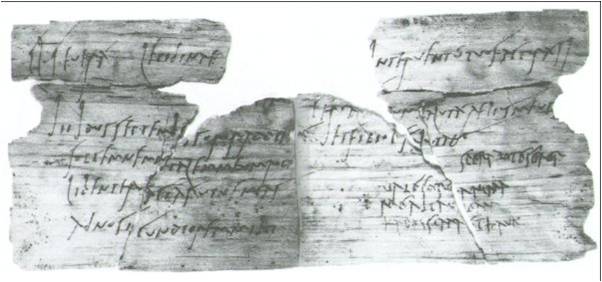
Invitation to Claudia Severa’s birthday bash, c.100 A.D.
During the first millennium the use of parchment, made from animal skin became more important, as did the codex, pages bound together like a modern book, a format much more convenient than the traditional papyrus scroll.
For more examples of the older methods and of Roman handwriting, see roman_writing.ppt, which can be downloaded from https://linguae.weebly.com/courses.html There is also a good survey of the history of paper proper and its advantages over papyrus at https://en.wikipedia.org/wiki/History_of_paper
On the linguistic side, there was some discussion of Nutting’s use of potestās to mean `permission’. Although the latin word more often means `power’ or `authority’, this other meaning is also in fact found in classical Latin.
Valerie and John, who both teach some ancient Greek as well as Latin, talked breifly about the use of the former for conversation. John finds this very difficult, as he’s had almost no practice and his grip on Greek in general is much less than on Latin. His Greek page - https://linguae.weebly.com/res-graecae.html - included links to some collections of phrases, whilst he is has also used in his own teaching some of the oral materials provided in the Ariadne bank of resources for Athenaze at https://www.cornellcollege.edu/classical_studies/ariadne/index.shtml However, time constrainsts make it impossible to do much on this front.
Finally, Stuart kindly offered to host future meetings on Zoom, using a CUHK account. This would remove the need to restart every 40 minutes because on free accounts there is a time limit of 40 minutes on any meeting with more than two participants.
During the first millennium the use of parchment, made from animal skin became more important, as did the codex, pages bound together like a modern book, a format much more convenient than the traditional papyrus scroll.
For more examples of the older methods and of Roman handwriting, see roman_writing.ppt, which can be downloaded from https://linguae.weebly.com/courses.html There is also a good survey of the history of paper proper and its advantages over papyrus at https://en.wikipedia.org/wiki/History_of_paper
On the linguistic side, there was some discussion of Nutting’s use of potestās to mean `permission’. Although the latin word more often means `power’ or `authority’, this other meaning is also in fact found in classical Latin.
Valerie and John, who both teach some ancient Greek as well as Latin, talked breifly about the use of the former for conversation. John finds this very difficult, as he’s had almost no practice and his grip on Greek in general is much less than on Latin. His Greek page - https://linguae.weebly.com/res-graecae.html - included links to some collections of phrases, whilst he is has also used in his own teaching some of the oral materials provided in the Ariadne bank of resources for Athenaze at https://www.cornellcollege.edu/classical_studies/ariadne/index.shtml However, time constrainsts make it impossible to do much on this front.
Finally, Stuart kindly offered to host future meetings on Zoom, using a CUHK account. This would remove the need to restart every 40 minutes because on free accounts there is a time limit of 40 minutes on any meeting with more than two participants.
AD ALPĒS
CAPUT XXVII (contd.)
"Hēia!" inquit Sextus. "Quam vellem ego quoque ānulum similem invenīre possem!"
Wow! Said Sextus how I-would-like I also ring similar to-find could-be-able
"Quid tum facerēs," inquit Cornēlia, "sī habērēs?" 115
What then would-you-do said Cornelia if you-had [one]
At ille: "Modo in dēversōriō servōs audīvī," inquit, "cum inter sē loquerentur dē
And he just-now in inn slaves I-heard said when among selves they-were-talking about
latrōnibus, quī dīcuntur omnibus in partibus Etrūriae vagārī. Ānulum tālem sī habērem, nihil
bandits who are-said all in parts of-Etruria to-roam ring such if I-had nothing
inde timendum esset; nam sīcubi illī scelestī subitō in nōs impetum facerent, mediōs in eōs
then to-be-feared would-be for if-anywhere those villains suddenly against us attack made midst-of into them
cum gladiō inruerem, ubi, nūllō cernente, 120 strāgem ēderem[1] maximam."
with sword I-would-rush where with-nobody seeing slaughter I-would-cary-out very-great
"Prūdentiam tuam laudō," inquit Pūblius rīdēns. "Sed iam Stasimum appropinquantem
good-sense your I-praise said Publius laughing but now Stasimus approaching
videō, et cēnae tempus crēdō adesse. Eāmus."
I-see and for-dinner time I-believe to-be—here let’s-go
Quō audītō, līberī libenter secūtī sunt.
With-which heard children gladly followed
NOTE
[1] The verb ēdō (ēdere, ēdidī, ēditum), a compound of ē and dō, meaning `give out, publish, put on (a play), produce’ should be distinguished carefully from edō (edere/ēsse, ēdī, ēsum), `eat’. Note that the 3rd pers. sing. and first pers. pl. of the present tense of the first verb are identical with the 3rd. pers. sng. and 1st pers. pl. of the perfect tense of the second: ēdit (`he gives out’, `he has eaten’), ēdimus (`we give out’, `we have eaten’)
CAPUT XXVIII
Posterō diē, cum iam omnia ad iter faciendum parāta essent, Drūsilla, forās ēgrediēns,
On-following day when already all-things for journey making prepared had-been Drusila out going
forte līmen pede offendit; quō cāsū paulum āfuit quīn in caput praecipitārētur.
by-chance threshold with-foot hit by-which mishap little it-was-way that-not onto head she-was-thrown-forward
Quae "Ēheu!" inquit. "Ōmen quam īnfaustum ! Profectō dī nōs vetant hodiē 5 iter facere."
She oh-no said omen how inauspicious obviously gods us forbid today journey to-make
"Nolī tam facile perturbārī," inquit Cornēlius. "Haec omnia sunt fortuīta; nec nōs decet
Don’t so easily be-upset said Cornelius these all-things are accidental and-not us is-proper
religiōne vānā terrērī. Audācter in raedam ēscende. Simulatque iter facere incipiēmus,
by-superstition meaningless to-be-scared boldly into wagon climb-up as-soon-as journey to-make we-will-begin
tū nōn diūtius hoc memineris."
You not longer this will-remember
10 Tālī cohortātiōne inducta Drūsillā in raedam ēscendit, etsī mēns eius adhūc ōmine
By-such encouragement influenced Drusilla into wagon got although mind her still by-omen
īnfaustō sollicita erat. Cornēlius autem, quō facilius uxōris animum ā cūrīs tālibus āverteret,
unlucky troubled was Cornelius now so-that more-easily wife’s mind from cares such he-could-divert praetervolantēs aquilās quāsdam dēmōnstrāns: "Aspice," inquit, "ōmen pulcherrimum.
flying-past eagles certain pointing-out look he-said omen very-fine
Rōmānae avēs, quasi ducēs viae, praeeunt; 15 optimīs certē auspiciīs eās sequimur."
Roman birdss as-if leaders of-way go-aheaad with-excellent certainly portents then we-are-following
"Nōnne memoriae trāditum est," inquit Pūblius, "imperātōrem Vitellium ōlim fortiter
Not-? to-memory handed-down has-been said Publius emperor Vitellius once bravely
accēpisse ōmen etiam magis horrendum?"
to-have-received omen even more dreadful
"Rēctē quaeris," inquit pater. "Nam eō ipsō diē, quō ā 20 mīlitibus imperātor salūtātus
Rightly you-ask said father for on-that actual day on-which by soldiers as- emperor hailed
est, triclīnium flagrāvit. Cumque omnēs quasi ōmine adversō anxiī essent, ille sōlus hilaris:
he-was dining-room caught-fire and-when all as-if from-omen unfavouraable anxious were he alone cheerful
'Bonō,' inquit, 'animō ēstote; nōbīs adlūxit!' Quibus verbīs ōmen in bonum vertit.[1]
With-good he-said spirit be to-us it-has-brought-light with-which words omen into good-one he-turned
"Ac dē dictātōre Caesare aliquid eius generis scrīptum esse 25 recordor. Nam ille in
And about dictator Caesar something of-this kind written to-be I-remembder for he into
Āfricam ōlim trānsvectus, cum ex nāvē ēgressus ad lītūs cymbā pervēnisset, pede offēnsō,[2]
Africa once conveyed when from ship having-disembarked to shore in-skiff he-had-reached with-foot caught
prōnus in harēnam prōlāpsus est. Quō casū comitēs perterritī sunt, at ille: 'Aspice ōmen
face-down onto sand fell forward by-which event companions terrified were but he look-at omen
NOTES
[1] The story is told by Suetonius, who explains that the fire had spread from a stove (Vitellius, 8). For details of Vitellius’s brief reign in 69, see chapters XXI and XXIII.
[2] offendō (-ere, offendī, offēnsum) basically means to strike or dash against something.
optimum,' inquit; 'Āfricam oppressī!'"[1]
very-good said Africa I-have-beaten-down
"Apud Suētōnium," inquit Pūblius, "aliud memoriā dignum nūper animadvertī. Cum
In Suetonius said Publius another of-memory wothy recently I-noticed when
enim Līvia Augusta[2] 30 vīllam suam Vēientānam[3] ōlim revīseret, aquila praetervolāns in eius
for Livia Augusta villa her at-Veientian once was-going-out eagle past-flying into her
gremium dīcitur demīsisse gallīnam albam, quae rāmulum laurī rōstrō tenēret.
lap is-said to-have-dropped hen white which twig of-laurel in-beak was-holding
"Cumque nutrīrī gallīnam rāmulumque pangī Līviae placuisset, tanta gallīnarum
And-when to-be-cared-for hen and-twig to-be-planted Livia it-had-pleased so-great of-hens
subolēs prōvēnit, ut posteā ea vīlla 35 'ad Gallīnās'[4] vocārētur, tāle vērō laurētum, ut
brood resulted that afterwards villa `Ad Gallinas’ was-called such indeed laurel-grove that
inde rāmulōs Caesarēs triumphātūrī dēcerperent.
From-there twigs the-Caesars about-to-celebrate-triumphs plucked
"Quotiēnscumque arbor discerpta erat, altera eōdem locō pangēbātur. Et observātum est
Whenever a-tree torn-up had-been another in-same-place used-to-be-planted and observed it-was
sub mortem cuiusque imperātōris arborem ab ipsō īnstitūtam ēlanguisse. Novissimō 40
just-before death of-each emperor tree by himself put-in-place to-have-withered in-last
igitur Nerōnis annō silva tōta radīcitus exāruit, omnēsque gallīnae illae periērunt; nam
therefore of-Nero year grove whole from-roots dried-up and-all chickens those died for
prōgeniēs Caesarum in Nerōne dēfēcit."
the-line of-the-Caesars in Nero ran-out
Dum hīs et tālibus sē oblectant, Drūsilla cūrās suās paulum remīsit;
While with-these and such-things themselves they-were-amusing Drusilla cares her a-little laid-aside
cumque iam ferē quīndecim mīlia passuum fēcissent 45 iter, līberī, quī male ēsuriēbant,
and-when now about fifteen thousands of-paces they-had-made journey children who terribly were-hungry
NOTES
[1] Caesar landed in Africa in December 47 B.C. to pursue his remaining opponents in the civil war of 49-45. Suetonius is again the source of the anecdote and his actual wording is pōlāpsus .. in ēgressū nāvis versō ad melius ōmine: 'teneō tē,' inquit, 'Āfrica.' (Divus Iulius, 59).
[2] Livia Drusilla (?59 B.C. – 29 A.D.), known also as Livia Augusta and Julia Augusta, married Octavian (later Augustus) in 39 B.C after her first husband, Tiberius Claudius Nero had agreed to divorce her. She had no children by Augustus but Tiberius, her son from her first marriage, succeeded Augustus in 14 A.D. and the following three emperors were her descendants through Tiberius’ brother, Drusus the Elder (see the chart on page 3 ). She was the great-grandmother of Caligula, grandmother of Claudius and great-great-grandmother of Nero. Rome’s first five emperors are therefore known as the Julio-Claudian dynasty. See https://en.wikipedia.org/wiki/Livia
[3] i.e. near the city of Veii mentioned in the previous chapter
[4] Literally `At the Hens’
patrem ōrāvērunt, ut equōs cōnsistere iubēret, sub arboribus ut cibum ederent, quem corbulīs
father begged that horses to-stop he-should-order under trees so-that food they-could-eat which in-baskets
sēcum portāvissent.
with-themselves they-had-brought
Potestāte factā, omnēs libenter ex raedīs dēscendērunt ac mox per herbam ōtiōsī
With-permission given all gladly from wagons got-down and soon over grass calm
dispositī sunt. Līberī, cibō consūmptō, 50 longius vagātī erant, quō lātius loca
seated were children with-food eaten further wandered had so-that more-widely places
explōrārent, cum subitō Sextus maximō clāmōre ē silvā parvā ērūpit, ac quantum celeritāte
they-could-explore when suddenly Sextus with-very-loud cry out-of wood small burst and as-much with-speed
potuit ad raedās tendēbat.
[as]-he-could to wagons began-heading
"Periī!" inquit Drūsilla, perterrita exsiliēns. "Ubi est 55 Cornēlia? Mē miseram! Nesciō
I’m-dead said Drusila terrified jumping-up where is Cornelia me wretched I-know-not
quid malī puellae accidit! Haud falsō admonuī hunc diem nōbīs īnfaustum fore! Ō mē
what of-evil to-girl has-happened not falsely I-warned this day for-us unlucky to-be-going-to-be
miseram! Quō mē vertam?"
miserabe where myself am-I-to-turn
Interim Cornēlius et Pūblius cum servīs obviam[1] Sextō properāverant, ut līberīs
Meanwhile Cornelius and Publius with slaves to-meet Sextus had- hurried so-that to-children
opitulārentur, sī quid opus esset. 60 At Sextus, cum patris complexū receptus esset, prīmō
they-could-give-help if any need there-was but Sextus when father’s with-embrace received he-had-been first
prae metū nihil omnīnō ēnūntiāre potuit. Tum, singultū vōcem interpellante, dīxit duōs
from fear nothing at-all say-out could then with-sob voice interrupting he-said two
hominēs, quī subitō ex arborum umbrā exsiluissent,[2] Cornēliam arreptam in silvam
men who suddenly from of-trees shadow had-jumped Cornelia snatched into forest
dēnsiōrem sēcum abstulisse.
denser with-them to-have-taken-away
65 Quō audītō, omnēs sine morā in silvam sē praecipitāvērunt; ubi autem, etsī longē et
With-which heard all without delay into forest selves hurled where however although far and
NOTES
[1] obviam is an adverb (literally `in the way’) used with the dative and a verb of motion with the meaning `to meet’.
[2] The subjnctive is needed here to show that the relative clause is part of what Sextus himself said rather than information added by the writer.
lātē quaerēbant, puellae vestīgium reperīre potuērunt nūllum. Quārē ad raedās reversī inter
wide they-kept-searching of-girl trace find they-could none so to wagons returning among
sē breviter cōnsuluērunt, quid iam optimum factū[1] esset.
selves briefly they-discussed what now best to-do was
Interim Drūsilla dolōre paene āmēns, veste discissā ultrō 70 citrōque cursitābat, sē
Meanwhile Druilla with-grief almost out-of-mind with-clothing torn to and-fro kept-running herself
suōsque omnēs vehementer incūsāns quod ōmine tam manifēstō nōn admonitī essent et
and-her-family all forcefully blaming because by-omen so clear not warned they-had-been and
deīs invītīs iter facere eō diē persevērāssent.
with-gods unwilling journey to-make on-that day they-had-insisted
Cui tandem Cornēlius: "Nōlī dēspērāre, uxor," inquit. "Sine dubiō hī hominēs latrōnēs
To-whom at-last Cornelius do-not despair wife said without doubt these people bandits
sunt; sed pecūniā75 tantum opus est, quā fīlīa redimātur. Puellam ipsam laedere nōn volent."
are but of-money only need is by-which could-be-ransomed girl herself to-harm not they-will-want
At iam subitō Pūblius: "Quid est hoc," inquit, "quod videō? Nōnne procul est mulier,
But now suddenly Publius what is this he-said that I-see not-? in-distance there-is woman
quae aliquid nobīs manū significāre cōnātur?" Quae cum dīceret, digitō mōnstrābat saxum, in
who something to-us with-hand to-convey is-trying this when he-was-saying with-finger he-was-showing rock on
quō stābat mulier, quae modo dīversā ex parte silvae ēgressa erat.
which was-standing woman who just-now different from part of-forest come-out had
80 "Ita est, ut tū dīcis," inquit Cornēlius. "Mulier manū aliquid tenēre vidētur, quod nunc
Thus it-is as you say said Cornelius woman in-hand something to-be-holding seems which now
in saxō pōnit. Iam autem in silvam sē recēpit. Tū, Pūblī, cum Onēsimō et Stasimō
on rock she-is-placing now however into forest herself she-has-taken-back you Publius with Onesimus and Stasimus
ad saxum properā, ut statim sciātur quid sit id, quod ibi ab eā relictum est." Quō audītō,
to rock hurry so-that at-once may-be-known what is it which there by her left has-been with-which heard
illī celeriter abiērunt.
they quickly went-away
85 In saxō inventa est charta, litterīs cruentīs[2] īnscrīpta, quam Stasimus effūsō cursū
On rock found was paper in-letters of-blood written which Stasimus with-full-speed running
ad dominum rettulit. Chartā raptim perlēcta, Cornēlius ēnūntiāvit fīliam ā latrōnibus captam
to master brought-back with-paper rapidly read-through Cornelius announced daughter by bandits captured
NOTES
[1] The ablative of the supine is frequently used with adjectives in this way
[2] cruentus, -a, um can sometimes just mean `blood red’ but normally refrs to actual blood or violences.
esse, quī spondērent sē puellam incolumem pārentibus trāditūrōs, sī intrā diēs trēs pater
to-have-been who pledged selves girl safe to-parents going-to-hand-over if within days three father
inermis sine comite ad saxum illud trīgintā 90 sēstertia[1] adferret, quibus fīlia
unarmed without companion to rock that thirty thousand- sesterces brought with-which daughter
redimerētur; aliter puellam gladiō occīsum īrī.[2]
could-be-ransomed otherwise girl with-sword killed going-to-be
Quae ubi cognita sunt, Drūsilla ululātū ācrī in terram cecidit, ibique exanimāta iacēbat.
These-things when learned were Drusila with-wail piercing to ground fell and-there unconscious lay
Quam cum Anna cūrāret, Stasimō Cornēlius imperāvit ut summā celeritāte contenderet ad 95
Her while Anna was-caring-for to-Stasimus Cornelius gave-order that with-greatest speed he-should-hurry to
oppīdum Narniam (quod iam haud procul aberat), ut inde equōs citōs addūceret.[3]
town Narnia which now not far was-away so-that from-there horses swift he-could-bring
Tum, Drūsillā in raedam sublātā, omnēs maestī ad oppidum profectī sunt. Sed dīmidium
Then with-Drusilla onto wagon lifted all sad to town set off but half
viae vix cōnfectum erat, cum occurrit Stasimus equīs cum recentibus.
of-way hardly completed had-been when met [them) Stasimus horses with fresh
100 Hōs ipsī et Onēsimō trādidit Cornēlius, cum mandātō ut Rōmam quam
These to-[Stasimus]-himself and to-Onesimus handed-over Cornelius with instruction that to-Rome as-possible
NOTES
[1] As explained at https://www.globalsecurity.org/military/world/spqr/money-1.htm, it is virtually impossible to state the equivalent of Roman monetary units in modern curencies because of changes in economic structure. However, on the basis of the price of gold (approx. US$1650 per ounce in March 2020), 30,000 sesterces would be around 150, 000 dollars. Under the early empire, a labourer’s daily wage was probably around 4 sesterces. Note the easily confusable terms sestertius, -ī m (sesterce) and sestertium, - ī n (thousand sesterces).
[2] For the ubiquity of banditry in the Roman world, see Thomas Grünewald’s study, available at https://historicalunderbelly.files.wordpress.com/2012/12/thoma-grunewald-bandits-in-the-roman-empire-myth-and-reality-2004.pdf
[3] Narnia, originally known as Nequinum, was a settlement of the Umbrians, whose language is part of the Osco-Umbrian group, regarded by some scholars as Italic like Latin but by others as a separate branch of Indo-European. Following the Roman conquest of the town in 299 B.C. it was made into a Latin colony and renamed after the nearby river Nar (Nār, Nāris; modern Nera). C.S. Lewis adopted the name for his imaginary kingdom after discovering it in Murray’s Small Classical Atlas (https://archive.org/details/murrayssmallclas00grun/page/n57/mode/2up For more details see https://en.wikipedia.org/wiki/Narni and, for other parallels between the real and the fictional Narnia, https://www.catholicnewsagency.com/news/narni-italys-inspiration-for-the-magical-realm-of-c-s-lewis-54887 These resemblances may, however, be coincidental and there is no evidence that Lewis himself ever visted the town. The Nera, a tributary of the Tiber, is one of the few rivers in Italy, apart from the Tiber itself and the Po, which flow all year round.
celerrimē properārent, ut inde reportārent pecūniam, quā iam opus esset; nē diem
as-quickly they-should-hurry so-that from-there they-could-bring-back of-which now need there-was not day
noctemve intermitterent, nēve aut sibi aut equīs parcerent.
or-night they-should- stop not either selves or horses should- spare
Servī libenter cursū incitātō abiērunt. Cornēlius autem cum 105 cēterīs in oppidum
Slaves willingly at-speed full went-off Cornelius now with the-others into town
perrēxit, ubi nox sollicita et inquiēta exācta est.
continued where night anxious and disturbed spent was
Sed māne praeter opīnīonem Onēsimus et Stasimus praestō fuērunt, quī nūntiāvērunt sē
But in-the-morning outside expectation Onesimus and Stasimus on-the-scene were who announced selves
in itinere obviōs factōs esse[1] cuidam Tulliō, amīcō Cornēlī, quī pecūniam grandem sēcum
on journey in-way-of become to-have a-certain Tullius friend of-Cornelius who money large-amount with-self
portāret, quīque mūtuum dare vellet quodcumque ad puellam līberandam 110 opus esset.
was-carrying and-who on-loan to-give wanted whatever for girl being-freed needed was
Quō audītō, omnēs gaudiō et spē suspēnsī, adventum Tullī cupidē exspectābant. Quī,
With-which heard all with-joy and hope anxious arrival of-Tullius eagerly were-awaiting he
cum hōrā ferē quārtā[2] pervēnisset, crumēnā solūtā, Cornēliō trīgintā sēstertia[3]
when at-hour about forth he-had-arrived with-money-bag untied to-Cornelius thirty thousand-sesterces
in mēnsā numerāvit.
on table counted
Tum ille cum Stasimō sōlō profectus, ut ad locum pervēnit 115 ubi raedae prīdiē
Then he with Stasimus alone having-set-out when to place he-reached where wagons previous-day
cōnstiterant, ibi servum quoque relīquit et inermis ad saxum cōnstitūtum prōgressus est.
had-halted there slave also he-left an d unarmed to rock appointed he advanced
Iam subitō ē silvā signum est audītum, latrōque ingēns ē latebrīs ad saxum rēctā
Now suddenly from forest signal was heard and-bandit huge from hiding-place to rock directly
prōcessit. Quī cum vīdisset Cornēlium inermem pecūniam attulisse, signum alterum dedit, ac
proceeded He when he-had-seen Cornelius unarmed money to-have-brought signal another gave and
mulier 120 Cornēliam ē silvā prōdūxit.
woman Cornelia from forest led-forward
NOTES
[1] obvius fīo (fierī, factus sum) is another way of expressing `encounter’, `meet up with’
[2] i.e. around 9 a.m. or between then and 10 a.m.
[3] Assuming he was carrying the money in gold pieces (aureī), each of which were worth 100 sesterces, he would have needed to count out 300 coins
Dum illa, gaudiō ēlāta, in complexum patris sē praecipitat, latrō, pecūniā arreptā, in
While she with-joy elated into embrace of-father herself hurled robber with-money seized into
silvam cum muliere celeriter rediit; utque prīmum Cornēlius et fīlia sē circumspexērunt,
forest with woman quickly returned and-when first Cornelius and daughter themselves looked-around
nēmō iam in cōnspectū erat. 125
nobody now in sight was
Quō animadversō, Cornēlius: "Age, fīlia mea," inquit; "adde gradum. Stasimus cum
With-which noticed Cornelius come -on daughter my said increase pace Stasimus with
equīs haud procul exspectat ; ac brevī in gremiō eris mātris, quae nunc in dēversōriō metū
horses not far-off is-waiting and soon in embrace you-will-be of-mother who now in inn from-fear
exanimāta iacet."
fainting lies
Quae cum dīceret, Cornēliam ad equōs dūcēbat; quibus 130 celeriter in oppidum
Which-things while he-was-saying Cornelia to horses he-was-leading on-which quickly into town
provectī, ab omnibus summō gaudiō acceptī sunt; ac māter et fīlia in lacrimās effūsae,
having-riddne by all with-greatest joy received they-were and mother and daughter into tears bursting
mūtuō complexū tenēbantur.
in-mutual embrace were-held
