| linguae |
|
QUESTIONS ARISING FROM 115th. MEETING – 23/9/20
(the record of earlier meetings can be downloaded from the main Circulus page as can the version of Ciceronis Filius with illustrations added. The illustrated text of Genesis is available on the Genesis page, of Kepler's Somnium on the Somnium page and of Nutting's Ad Alpes on the Ad Alpes page)
For the first half hour of the Zoom session only Zhang Wei and John were on-line but they were joined at 8 by Valerie and then also by Tan and Sam.
Zhang Wei and John discussed the on-line edition of Eutropius’ Breviarium Ab Urbe Condita which John is currently preparing and which can be accessed at https://linguae.weebly.com/eutropius.html This summary of Roman history, written in 369-370 A.D., covers the period from the foundation of the city, traditionally placed in 753 B.C., till 364, when Eutropius’ patron, the emperor Valens, came to the throne. He relied principally on Livy and then probably on a lost work seems to lie behind similarities between Eutropius's own account and those of some of his contemporaries.
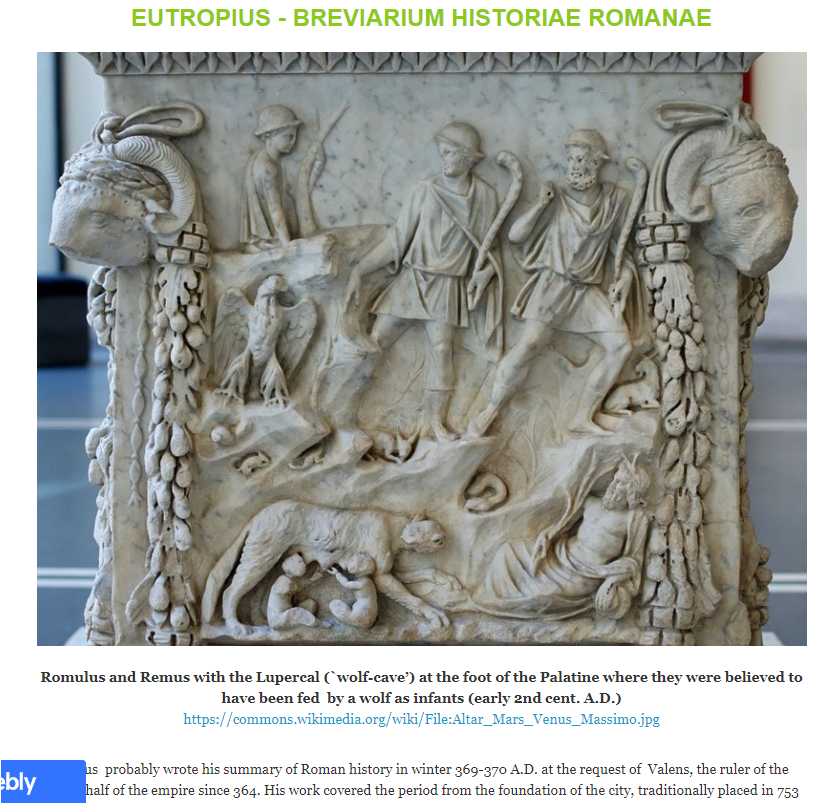
The `Linguae’ page for Eutropius’ Breviarium Historiae Romanae
Eutropius, who was himself a senator, had definite shortcomings as a historian, particularly a bias towards the senatorial aristocracy in all periods and a tendency to ignore the shortcomings and misfortunes of emperors whom he approved of. However, his straightforward Latin makes him very suitable for anyone seeking an authentic ancient text which does not present too many difficulties.
Eutropius, who was himself a senator, had definite shortcomings as a historian, particularly a bias towards the senatorial aristocracy in all periods and a tendency to ignore the shortcomings and misfortunes of emperors whom he approved of. However, his straightforward Latin makes him very suitable for anyone seeking an authentic ancient text which does not present too many difficulties.
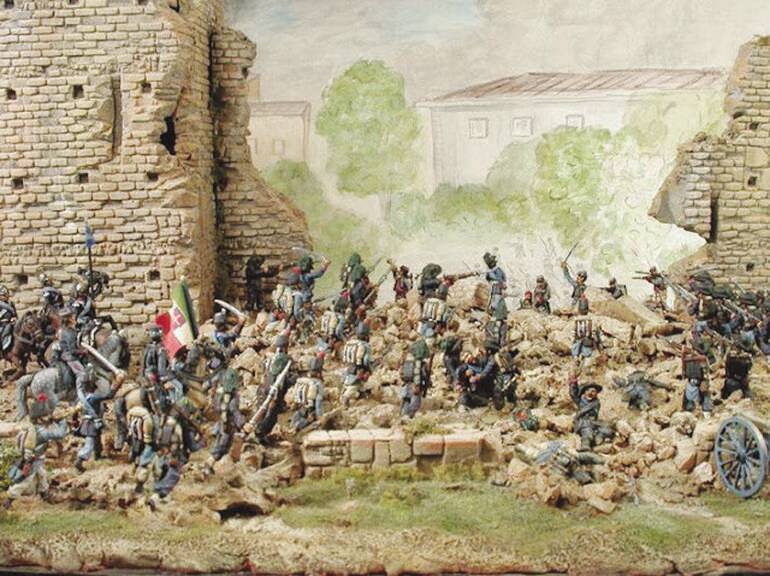
20 September 1870: Italian forces breach the Porta Pia to capture Rome and complete Italian unification
https://abitarearoma.it/20-settembre-1870-la-breccia-di-porta-pia-con-la-presa-di-roma-concludeva-il-sogno-dellunita-ditalia/
In response to John’s posting on Facebook about the 150th anniversary of the Italian state’s 1870 capture of Rome and annexation of the hitherto independent Papal States, Lennon Wong, who teaches ancient Greek in Hong Kong, mentioned David Gilmour’s the The Pursuit of Italy, which suggests that unification may not actually have been in the best interests of the people of the country’s very diverse regions. This prompted consideration of the same question as applied to many other countries. Would China have been better off had the separate regional states continued their independent existence rather than being forced together by Cheun Chi Wong (aka Qin Shi Huang)? Would South Asia be faring better as the twenty or so separate states that would have probably emerged without the British conquest? Zhang Wei said that Sun Yat Sen had been in secret communication before 1911 with European powers suggesting they could take over non-Han regions like Tibet and Xinjiang. This might have been simply a tactical move on his part to obtain Western support fro his campaign against the Qing government but he perhaps at that time regarded such places as not fully part of the `real’, Han China. In any case, before actually coming to power bhe certainly proclaimed his belief in the right of non-Han people within the Chinese Empre to self-determination. Once, in power, of course, his enthusiasm for such a principle drastically diminished.
Zhang Wei had recently been reading Edward Gibbon’s Decline and Fall of the Roman Empire. This 18th century historian popularized the identification of the Huns, invaders from the steppes who terrorised Europe under their leader Attila in the 5th century A.D, with the Xiong-Nu (匈奴) of Chinese history, a theory first put forward by by French scholar Joseph de Guignes in 1757 and discussed in the Circulus meeting for November 2018 , The supposition is that the Xiong-Nu, who moved westward unde Chinese pressure and disappeared from the main Chinese record ater their defeat by another tribe in 153 A.D. in what is now Tashkent, later resumed their wanderings and finally reached Europe. The theory, based primarily on the similarity of names and nomadic life-style, was generally accepted until the mid-20th-century but then became much less popular, partly because of the 200 years that elapsed between 153 and their appearance in Europe. In recent years, however, the ide has again begun attracting support, one of the arguments being the identification of the `Xiong-nu’ with the Huna of Sanskrit sources by a Buddhist writer in Afghanistan in the 3rd cemtury A.D. (see details at https://en.wikipedia.org/wiki/Origin_of_the_Huns).
Zhang Wei also suggested that groups like the Mongols, the Uighurs and the Tatars might be a continuation of the Xiong-Nu. This is a difficult question as nobody is sure what the Huns’ or the Xiong-Nu’s original language(s) was/were, One relatively recent suggestion is that the both groups originally spoke a language belonging to the Yeniseian family of Siberia but that the Huns later switched to a Turkic dialect (see https://en.wikipedia.org/wiki/Hunnic_language and https://en.wikipedia.org/wiki/Xiongnu#Ethnolinguistic_origins). Turkic is the language family to which both the Uighur and Tatar languages and it does seem likely that these earlier groups, who did not survive as distinct peoples, did contribute some of the DNA of modern steppe peoples.
https://abitarearoma.it/20-settembre-1870-la-breccia-di-porta-pia-con-la-presa-di-roma-concludeva-il-sogno-dellunita-ditalia/
In response to John’s posting on Facebook about the 150th anniversary of the Italian state’s 1870 capture of Rome and annexation of the hitherto independent Papal States, Lennon Wong, who teaches ancient Greek in Hong Kong, mentioned David Gilmour’s the The Pursuit of Italy, which suggests that unification may not actually have been in the best interests of the people of the country’s very diverse regions. This prompted consideration of the same question as applied to many other countries. Would China have been better off had the separate regional states continued their independent existence rather than being forced together by Cheun Chi Wong (aka Qin Shi Huang)? Would South Asia be faring better as the twenty or so separate states that would have probably emerged without the British conquest? Zhang Wei said that Sun Yat Sen had been in secret communication before 1911 with European powers suggesting they could take over non-Han regions like Tibet and Xinjiang. This might have been simply a tactical move on his part to obtain Western support fro his campaign against the Qing government but he perhaps at that time regarded such places as not fully part of the `real’, Han China. In any case, before actually coming to power bhe certainly proclaimed his belief in the right of non-Han people within the Chinese Empre to self-determination. Once, in power, of course, his enthusiasm for such a principle drastically diminished.
Zhang Wei had recently been reading Edward Gibbon’s Decline and Fall of the Roman Empire. This 18th century historian popularized the identification of the Huns, invaders from the steppes who terrorised Europe under their leader Attila in the 5th century A.D, with the Xiong-Nu (匈奴) of Chinese history, a theory first put forward by by French scholar Joseph de Guignes in 1757 and discussed in the Circulus meeting for November 2018 , The supposition is that the Xiong-Nu, who moved westward unde Chinese pressure and disappeared from the main Chinese record ater their defeat by another tribe in 153 A.D. in what is now Tashkent, later resumed their wanderings and finally reached Europe. The theory, based primarily on the similarity of names and nomadic life-style, was generally accepted until the mid-20th-century but then became much less popular, partly because of the 200 years that elapsed between 153 and their appearance in Europe. In recent years, however, the ide has again begun attracting support, one of the arguments being the identification of the `Xiong-nu’ with the Huna of Sanskrit sources by a Buddhist writer in Afghanistan in the 3rd cemtury A.D. (see details at https://en.wikipedia.org/wiki/Origin_of_the_Huns).
Zhang Wei also suggested that groups like the Mongols, the Uighurs and the Tatars might be a continuation of the Xiong-Nu. This is a difficult question as nobody is sure what the Huns’ or the Xiong-Nu’s original language(s) was/were, One relatively recent suggestion is that the both groups originally spoke a language belonging to the Yeniseian family of Siberia but that the Huns later switched to a Turkic dialect (see https://en.wikipedia.org/wiki/Hunnic_language and https://en.wikipedia.org/wiki/Xiongnu#Ethnolinguistic_origins). Turkic is the language family to which both the Uighur and Tatar languages and it does seem likely that these earlier groups, who did not survive as distinct peoples, did contribute some of the DNA of modern steppe peoples.
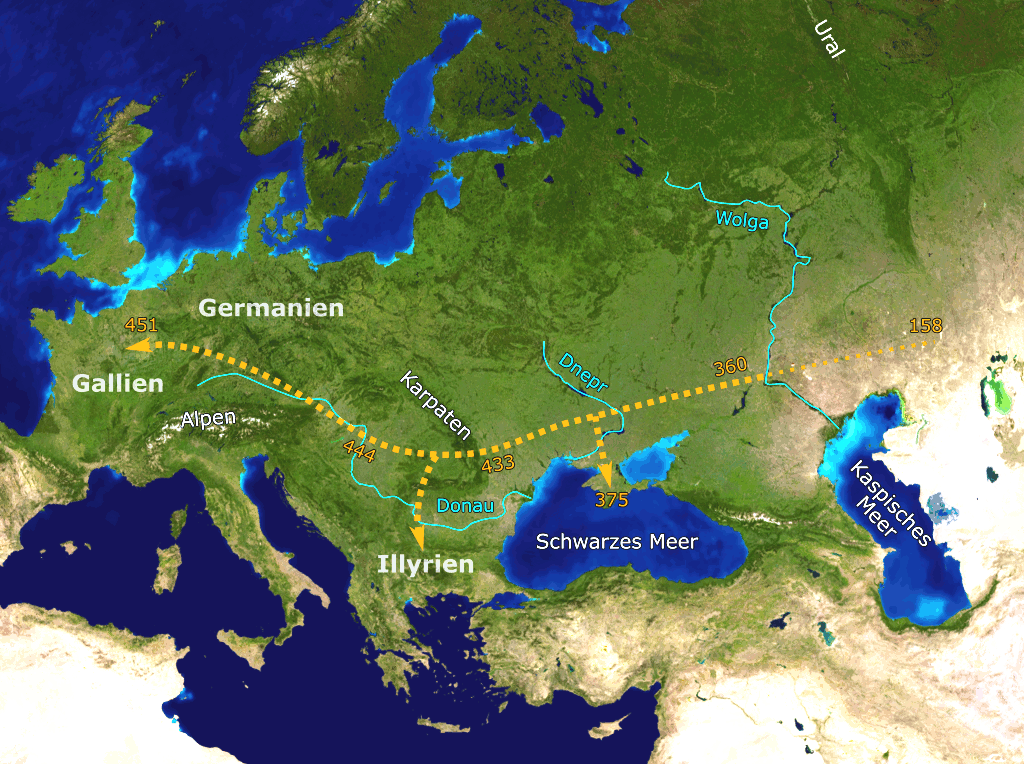
One suggested route for the Huns into Western Europe
https://en.wikipedia.org/wiki/Origin_of_the_Huns#/media/File:Hunnenwanderung.png
Valerie and John spoke briefly again about the teaching of ancient Greek, for which Valerie currently has two beginning students, both now at school in the UK. John has one student here in Hong Kong, who wll be doing the National Greek Exam next year. He is still using Athenaze supplemented by material he is now producing himself and which are available at https://linguae.weebly.com/res-graecae.html
We read chapter 29 of Ad Alpes, which in concerned chiefly with Stasimus’s misadventures with a farmer’s fierce dog so introduces fewer historical or cultural points than usual. We noted the use of sicūbi, which John initially thought could mean `if at any time’ as well as `if anywhere’ but Lewis & Short, like Nutting’s own vocabulary, gives only the spatial meaning. It alo labels the word as `rare but classical’. Another relatively rare word in the chapter is erus, -ī m, a synonym of dominus.
https://en.wikipedia.org/wiki/Origin_of_the_Huns#/media/File:Hunnenwanderung.png
Valerie and John spoke briefly again about the teaching of ancient Greek, for which Valerie currently has two beginning students, both now at school in the UK. John has one student here in Hong Kong, who wll be doing the National Greek Exam next year. He is still using Athenaze supplemented by material he is now producing himself and which are available at https://linguae.weebly.com/res-graecae.html
We read chapter 29 of Ad Alpes, which in concerned chiefly with Stasimus’s misadventures with a farmer’s fierce dog so introduces fewer historical or cultural points than usual. We noted the use of sicūbi, which John initially thought could mean `if at any time’ as well as `if anywhere’ but Lewis & Short, like Nutting’s own vocabulary, gives only the spatial meaning. It alo labels the word as `rare but classical’. Another relatively rare word in the chapter is erus, -ī m, a synonym of dominus.
CAPUT XXIX
Manē viātōrēs, cum grātiās maximās Tulliō ēgissent, Nūceriam[1] versūs profectī sunt;
In-morning the-travellers when thanks gratest to-Tullius they-had-paid Nuceria towards set off
quō pervēnērunt, cum iam nūbēs nigrae in caelō cōgerentur. Paulō post imber est cōnsecūtus.
at-which they-reached when already clouds black in sky were-gathering a-little later shower folllowed
5 Haec nox haud sine trepidātiōne perācta est. Nam cum omnēs, dē itinere fessī mātūrē
This night not without fear passed was for when all from journey tired early
cubitum discessissent, subitō mediā nocte vōx audīta est Cornēliae, quae perterrita opem
to-go-to-bed had-left suddenly in-middle-of night voice heard was of-Cornelia who terrified help implōrābat.
was-pleading-for
Quō clāmōre audītō, Drūsilla, ē somnō excussa, 10 lūmine accēnsō ad fīliae lectum
With-which cry heard Drusilla from sleep shaken-out with-light lit to daughter’s bed
quam celerrimē perrēxit. Ibi in lacrimās effūsa et terrōre paene exanimāta sedēbat Cornēlia;
as-possible as-quickly proceeded there into tears having-burst and from-terro r almost fainting sat Cornelia
cui māter: "Quid factum est, fīliola mea?" inquit, cum puellam trepidantem complexū suō
to-who mother what happened little-daughter my asked when girl trembling in-embrace her
reciperet.
was-holding
"Ō māter, māter!" inquit Cornēlia. "Mihi vīsa sum[2] iterum 15 in silvā errāre. Et ē
O mother mother said Cornelia to-myself I-seemed again in forest to-wander and from
spēluncā subitō ērūpit gigās immānis, quī vōce horrendā clāmāvit: 'Ubi est puella mea?' Tum
from-cave suddenly burst-out giant enormous who in-voice terrible shouted where is girl my then
ego trepidāns: 'Quae est puella tua?' inquam. At ille, mē digitō ingentī dēmōnstrāns: 'Tū, tū,'
I trembling which is girl your said and he me with-finger huge pointing-to you you
inquit. Quō audītō, clāmōrem sustulī maximum, ac tū statim cum lūmine ad mē venistī."
said with-which heard shout I-raised very-loud and you at-once with light to me came
NOTES
[1] The Umbrian Nuceria (modern Nocera), whose name meant `New [town’] in the Osco-Umbrian language, came under Roman control around 300 B.C. The original settlement was in the valley but after this was destroyed, perhaps by Germanic invaders, in the early 5th century, the survivors shifted to the present hill-top site (see https://en.wikipedia.org/wiki/Nocera_Umbra). This town should not be confused with the Nuceria in Campania, many of whose citizens perished in a riot during a gladiator show at Pompeii in 59 A.D. (see Stage 8 of Cambridge Latin course).
[2] videor (passive of videō) means both `I am seen’ and `I seem’
20 Vix ea dicta erant, cum repente forīs audīta est vōx dīcentis: 'Tū, tū,' ac Cornēliā
Scarcely these-things said had-been when suddenly outside heard was voice of-one- saying `Tu tu’ and Cornelia
cōnsternāta mātrem artē amplexa est.
alarmed mother tightly embraced
Illa autem rīdēns: "Quid, fīlia mea? Nōnne tū umquam noctuam audīvistī? Accēde hūc
She however smiling what daughter my not-? you ever owl have-heard come-up here
ad fenestram. Nūbēs iam discessērunt, et nox clāra et serēna est."
to window clouds now have-gone and night clear and calm is
25 Cum Cornēlia ē fenestrā stēllās aspiceret, iterum ex arbore propinquā audīta est vōx
When Cornelia from window stars were-looking-at again from tree neighbouring head was voice
noctuae: 'Tū, tū.' Tum puella quoque adrīsit. Quīn etiam vānī terrōris eam iam pudēbat; quārē
of-owl Tu Tu then girl also smiled indeed even of-pointless fright on her shame-came so
rūrsus quiētī sē dedit, nec quidquam ultrā trepidātiōnis hāc nocte fuit.
again to-quiet herself she-gave and-not anything further of-alarm this night there-was
30 At posterō diē aliquid morae erat, quod, cum hōrā profectiōnis adesset, Stasimus
But on-next day something of-delay there-was because when hour of-departure was-present Stasimus
nusquam reperīrī potuit. Dum autem Cornēlius vehementer commōtus neque vōcī neque īrae
nowhere be-found could while however Cornelius stongly agitated neither voice nor anger
parcit, accessit caupōnis servus, quī dīxit Stasimum multō māne ad quendam fundum
spares approached innkeeper’s slave who said Stasimum very early-in-morning to a-certain farm
vīcīnum abiisse, sī forte[1] ibi ōva recentia 35 reperīret.
neighbouring to-have-gone-off in-case there eggs fresh he-could-find
"Celeritāte, nōn ōvīs, nunc opus est," inquit Cornēlius adhūc īrā incēnsus; "et iūre istī
For-speed not eggs now need is said Cornelius still with-anger burning and justly to-that
scelestō accidat, sī sine eō hinc proficīscāmur. Ī, Onēsime, trēs equōs quaere, ut
villain it-would-happen if without him from-here we-were-to-sert-off go Onesimus three horses look-for so-that
temporis minimum āmittātur."
of-time minimum may-be-lost
40 Equīs adductīs, Pūblius et Onēsimus celeriter ēscendērunt atque ad fundum profectī sunt,
With-horses brought Publius and Onesimus quickly mounted and towards farm set out
cum equum tertium habēnīs dūceret Onēsimus, ut Stasimus quoque vehī posset, cum ad
out while horse third by-reins was-leading Onesimus so-that Stasimus also ride could when to
dēversōrium redīrent.
inn they-were-returning
NOTE
[1] sī forte: literally ` if by chance’
Ubi ad fundum appropinquāvērunt, in mūrō magnīs litterīs 45 īnscrīptus hic titulus
When to farm they-got-clse on wall in-large letters inscribed this phrase
appārēbat : cavē canem ; ac ultrā mūrum audiēbātur canis lātrātus et vōcēs hominum
appeared beware-of dog and beyond wall was-heard dog’s barking and voices of-people
altercantium.
arguing
"Crēdō Stasimum, ut solet, in aliquod perīculum incidisse[1]," inquit Pūblius. Quae
I-believe Stasimus as he-usually-does into some danger to-have-fallen said Publius Which-things
cum dīxisset, equō dīmissō, in saxum ēscendit, unde aspicere poterat quae ultrā mūrum
when he-had-said with-horse sent-off onto rock he-climbed from-where to-watch he-was-able what beyond wall
fierent.
was-happening
50Tum vidēbat Stasimum, quī temerē mūrum trānsiluerat, ā cane in arborem refugere
Then he-could-see Stasimus who rashly wall had-leapt-over from dog in tree to-take-refuge
cōactum esse. Ibi in rāmō sedēns, ille servus vafer lūdificābat agricolam īrātum, quī furcā
forced to-have-been there on branch sitting that slave rascally was-making-fun-of farmer angry who with-fork
armātūs īnfrā stābat. Interim canis frūstrā in arborem saltū cōnābātur ēscendere, cum loca
armed beneath was-standing meanwhile dog in-vain into tree by-leaping was-trying to-go-up while surroundings
longē et lātē lātrātū resonārent.
far and wide with-barking were-echoing
55 "Dēscende īlicō," inquit agricola, "aut tē, ut fūrem manifēstum, furcā trānsfīgam."
Come-down at-once said farmer or you as thief obvious with-fork I’ll-run-through
"Surdus sum," inquit Stasimus, ad aurem manū admōtā. "Maius clāmā, sī vīs."
Deaf I-am said Stasimus to ear with-hand moved louder shout please
Tum maximā vōce agricola: "Dēscende, mastīgia, priusquam 60 tē hāc furcā
Then in-very-loud voice farmer come-down villain before you with-this fork
trānsfīgam."
I-run-through
NOTE
[1] From incidō (incidere, incidī). Distinguish from incīdō (incidere, incīdī, incīsum, `cut into’)
"Tantum strepitum facit canis," inquit Stasimus, "ut nihil plānē audīre possim. Dīxistīne
So-much noise makes dog said Stasimus that nothing clearly hear I-can Did-you-say
tē mihi aliquid datūrum?"
yourself to-me something going-to-give
"Ita vērō," inquit agricola,īrā ēlātus. "Malum maximum tibi dabō, furcifer, sī umquam
Yes indeed said farmer with-anger carried-away evil very-great to-you I-will-give rogue if ever
manūs tibi iniciam.[1]"
hands on-you I-will-get
65 At Stasimus, quasi audīre attentē cōnārētur: "Mālae[2] meae rēctē sē habent," inquit,
But Stasimus as-if to-hear attentively he-was-trying cheeks my alright themselves have said
"sed aurēs mūnere suō fungī nōlunt."
but ears job their carry-out are-unwilling
"Haec furca mūnere suō fungētur," inquit agricola, "nisi tū īlicō in terram tē dēmittēs.
This fork job its will-carry-out said farmer unless you at-once to ground yourself get-down
Dēscendis an nōn dēscendis?"
Are-you-coming-down or not coming-down
"Nunc quidem," inquit Stasimus, "nōn dēscendō; nam in 70 rāmō sedeō."
Now indeed said Stasimus not I-am-coming-down for on branch I-am-sitting
Quō audītō, agricola furibundus in arborem furcam prōicere parābat, cum Pūblius ē saxō
With-which heard farmer furious into tree fork to-throw was-preparing when Publius from rock
vōcem ēmittēns: "Heus tū," inquit. "Quid, obsecrō, factum est? Servum nostrum Stasimum
voice projecting Hey you said What please happened has slave our Stasimus
ego quaerō. Sī eum in hīs locīs vagantem vīdistī, ostende, sīs."
I am-looking-for if him in these places wandering you-have-seen point-out please
75 Cui agricola: "Quisquis es, adulēscēns, hominī negōtiōsō molestiam exhibēs. Nam
To-whom farmer whoever you-sre young-man for-man busy trouble you-are-making for
fūrem manifēstum canis in hanc arborem refugere coēgit , cui nūllō modō persuādēre potuī
thief obvious dog in this tree to-take-refuge has-forced whom by-no-means to- persuade I’ve-been-able
ut inde dēscenderet."
that from-there he-should-descend
NOTES
[1] Literally `I will throw on’
[2] Stasimus is punning with the words mālum, -ī n (evil thing) and māla, -ae f (cheek). Both have to be distinguished from mālum, -ī n (apple or similar-shaped fruit) and mālus, -ī m (apple tree, ship’s mast).
"Id minimē mīrandum est," inquit Pūblius rīdēns, "cum 80 canis saevus arborem
That not-at-all to-be-wondered-at is said Publius laughing since dog ferocious tree
cūstōdiat et tū hominem dēscendentem furcā accipere parātus sīs. Sed suspicor hunc esse
is-guarding and you man coming-down with-fork to-receive ready are but I-suspect this to-be
servum, quem quaerō. Manē ille ē dēversōriō ōva ēmptum profectus est; at nunc, ut vidētur,
slave whom I’m-looking-for in-morning he from hotel eggs to-buy set out but now as it-seems
mōre suō turbās hīc impudenter concitat."
in-way his trouble here impudently is-stirring-up
85 "Quis sit, plānē nesciō," inquit agricola dentibus frendēns. "Sed prō impudentiā suā
Who he-is clearly I-don’t-know said farmer teeth gnashing but for impudence own
certō sciō eum hodiē mihi poenās maximās datūrum."
certainly I-know him today to-me penalties greatest going-to-give
"Ohē, senex," inquit Pūblius; "nōlī saevīre. Sine hominem impūne dēscendere, ac tibi
Hey there old-man said Publius don’t get-mad allow man without-punishment to-descend and for-yourself
hoc accipe." Quō dictō, aureum prōiēcit, quī in terram ante pedēs agricolae cecidit; cuius īra,
this accept with-which said gold-coin he-threw-forward which on ground before feet of-farmer fell whose anger
90 aureō vīsō, paulātim resīdere coepit.
with-gold seen gradually to-subside began
"Celeritāte nunc opus est," inquit Pūblius. "Iam diū in oppidō exspectāmur. Canem
For-speed now need there-is said Publius now long-time in town we-have-been-expected dog
revocā, senex."
call-off old-man
Tum ille, aureō sublātō, canem vinculō redūcere coepit; Stasimus autem[1] celeriter ex
Then he with-gold picked-up dog by-chain bring-back began Stasimus for-his-part quickly from
arbore dēsiluit, et cursū effūsō[2] 95 mūrum petīvit.
tree leapt-down and at-top-speed wall made-for
Canis, cum hostem fugientem vīdisset, summā vī adnīsus vinculum rūpit, et Stasimum,
Dog when enemy fleeing had-seen with-greatest force having-striven chain broke and Stasimus
quantum celeritāte poterat, secūtus est. Ille vix in mūrum ēscendēbat, cum canis saltū sē
with-as-much speed [as]it-could followed He scarcely onto wall was-clambering when dog with-leap self
prōiciēns vestem eius dentibus apprehendit pannumque 100 inde dēripuit longum.
hurling-forward clothing his with-teeth caught and-strip from-there ripped long
NOTES
[1] autem has little real meaning here and could actually be left out in the translation.
[2] Literally `with running poured-out’
Pūblius et agricola, cum Stasimum vīdissent in mūrō stantem, dum vestem discissam
Publius and farmer when Stasimus they-had-seen on wall standing whilst clothing torn
trīstis aspicit, in cachinnōs maximōs effūsī sunt.[1] Ille autem ex mūrō dēsiluit, arreptōque
sadly looks-at into laughter very-loud burst he however from wall leapt-down and-with-grabbed
lapide iterum celeriter ascendit. 105
stone again quickly climbed-up
Quō animadversō, canis dēnuō in mūrum impetum fēcit; sed inde ācriter ululāns refūgit,
With-which noticed dog again on wall attack made but then piercingly howling it-fled
cum Stasimus lapidem summā vī in eius caput impēgisset.
when Stasimus stone with-greatest force onto his head had-hurled
Quā iniūriā incēnsus, agricola cum furcā subsidiō canī prōcurrit. Cēterī autem celeriter
By-which injury incensed farmer with fork as-help for-dog ran-forward the-others however quickly
in equōs ēscendērunt, atque incītātō 110 cursū ad oppidum revectī sunt.
onto horses climbed and at a gallop to town returned
Quōs cum vīdisset, Cornēlius: "Quid tibi vīs, Stasime?" inquit. "Propter tē duārum
Whom when he-had-seen Cornelius what for-yousef do-you-want Stasimus said because-of you of-two
hōrārum iactūram iam fēcimus. Sīcubi nōs posthāc ita dēserēs, tē nōn exspectābimus.
hours loss already we-have-made if-anywhere us after-this thus you-will-desert you not we-will-wait-for
Etiam 115 nunc vix contineor quōminus tē, ut merēris, ulcīscar."
Even now scarcely I-control-myself that-not you as you-deserve I-punish
"Veniam dā, ere, obsecrō," inquit Stasimus. "Putāvī ōva recentia ē fundō līberīs grāta
Forgiveness give master I-beg said Stasimus I-thought eggs fresh from farm to-children pleasing
fore, nec dubitāvī quīn multō ante tempus profectiōnis ego redīre possem."
to-be-going-to-be and-not doubted that much before time of-departure I return could
"Cūr igitur nōn temperī redīstī[2]?" inquit Cornēlius. 120
Why therefore not on-time you-returned asked Cornelius
At ille: "Dum ōva quaerō, dē viā errāvī. Tum mihi obviam vēnit sīmius mōrōsus,[3]
But he while eggs I-was-looking-for off path I-strayed then to-me up came monkey ill-tempered
quī in rāmō arboris mē sedēre coēgit, cum interim canis saevus circumsilīret."
Who on branch of-trees me to-sit forced whilst meanwhile dog savage was-leaping-around
Quō audītō, Cornēlius quamvīs invītus rīsit omnēsque in raedās iussit sine morā
With-which heard Cornelius although unwillingly smiled and-all into wagons ordered without delay
ēscendere. Cuius dictō viātōrēs libenter 125 pāruērunt ac brevī ex oppidō equīs volentibus
to-get whose at-word travellers happily obeyed and soon from town with-horses willing
vectī sunt
they-rode
NOTES
[1] `into very-loud laughter were poured out’
[2] Contraction of rediistī (perfect of redeō, redīre, rediī, reditum)
[3] mōrōsus, -a, -um (peevish, capricious) should be distinguished from late Latin morōsus, -a, -um, `slow in coming.’
Manē viātōrēs, cum grātiās maximās Tulliō ēgissent, Nūceriam[1] versūs profectī sunt;
In-morning the-travellers when thanks gratest to-Tullius they-had-paid Nuceria towards set off
quō pervēnērunt, cum iam nūbēs nigrae in caelō cōgerentur. Paulō post imber est cōnsecūtus.
at-which they-reached when already clouds black in sky were-gathering a-little later shower folllowed
5 Haec nox haud sine trepidātiōne perācta est. Nam cum omnēs, dē itinere fessī mātūrē
This night not without fear passed was for when all from journey tired early
cubitum discessissent, subitō mediā nocte vōx audīta est Cornēliae, quae perterrita opem
to-go-to-bed had-left suddenly in-middle-of night voice heard was of-Cornelia who terrified help implōrābat.
was-pleading-for
Quō clāmōre audītō, Drūsilla, ē somnō excussa, 10 lūmine accēnsō ad fīliae lectum
With-which cry heard Drusilla from sleep shaken-out with-light lit to daughter’s bed
quam celerrimē perrēxit. Ibi in lacrimās effūsa et terrōre paene exanimāta sedēbat Cornēlia;
as-possible as-quickly proceeded there into tears having-burst and from-terro r almost fainting sat Cornelia
cui māter: "Quid factum est, fīliola mea?" inquit, cum puellam trepidantem complexū suō
to-who mother what happened little-daughter my asked when girl trembling in-embrace her
reciperet.
was-holding
"Ō māter, māter!" inquit Cornēlia. "Mihi vīsa sum[2] iterum 15 in silvā errāre. Et ē
O mother mother said Cornelia to-myself I-seemed again in forest to-wander and from
spēluncā subitō ērūpit gigās immānis, quī vōce horrendā clāmāvit: 'Ubi est puella mea?' Tum
from-cave suddenly burst-out giant enormous who in-voice terrible shouted where is girl my then
ego trepidāns: 'Quae est puella tua?' inquam. At ille, mē digitō ingentī dēmōnstrāns: 'Tū, tū,'
I trembling which is girl your said and he me with-finger huge pointing-to you you
inquit. Quō audītō, clāmōrem sustulī maximum, ac tū statim cum lūmine ad mē venistī."
said with-which heard shout I-raised very-loud and you at-once with light to me came
NOTES
[1] The Umbrian Nuceria (modern Nocera), whose name meant `New [town’] in the Osco-Umbrian language, came under Roman control around 300 B.C. The original settlement was in the valley but after this was destroyed, perhaps by Germanic invaders, in the early 5th century, the survivors shifted to the present hill-top site (see https://en.wikipedia.org/wiki/Nocera_Umbra). This town should not be confused with the Nuceria in Campania, many of whose citizens perished in a riot during a gladiator show at Pompeii in 59 A.D. (see Stage 8 of Cambridge Latin course).
[2] videor (passive of videō) means both `I am seen’ and `I seem’
20 Vix ea dicta erant, cum repente forīs audīta est vōx dīcentis: 'Tū, tū,' ac Cornēliā
Scarcely these-things said had-been when suddenly outside heard was voice of-one- saying `Tu tu’ and Cornelia
cōnsternāta mātrem artē amplexa est.
alarmed mother tightly embraced
Illa autem rīdēns: "Quid, fīlia mea? Nōnne tū umquam noctuam audīvistī? Accēde hūc
She however smiling what daughter my not-? you ever owl have-heard come-up here
ad fenestram. Nūbēs iam discessērunt, et nox clāra et serēna est."
to window clouds now have-gone and night clear and calm is
25 Cum Cornēlia ē fenestrā stēllās aspiceret, iterum ex arbore propinquā audīta est vōx
When Cornelia from window stars were-looking-at again from tree neighbouring head was voice
noctuae: 'Tū, tū.' Tum puella quoque adrīsit. Quīn etiam vānī terrōris eam iam pudēbat; quārē
of-owl Tu Tu then girl also smiled indeed even of-pointless fright on her shame-came so
rūrsus quiētī sē dedit, nec quidquam ultrā trepidātiōnis hāc nocte fuit.
again to-quiet herself she-gave and-not anything further of-alarm this night there-was
30 At posterō diē aliquid morae erat, quod, cum hōrā profectiōnis adesset, Stasimus
But on-next day something of-delay there-was because when hour of-departure was-present Stasimus
nusquam reperīrī potuit. Dum autem Cornēlius vehementer commōtus neque vōcī neque īrae
nowhere be-found could while however Cornelius stongly agitated neither voice nor anger
parcit, accessit caupōnis servus, quī dīxit Stasimum multō māne ad quendam fundum
spares approached innkeeper’s slave who said Stasimum very early-in-morning to a-certain farm
vīcīnum abiisse, sī forte[1] ibi ōva recentia 35 reperīret.
neighbouring to-have-gone-off in-case there eggs fresh he-could-find
"Celeritāte, nōn ōvīs, nunc opus est," inquit Cornēlius adhūc īrā incēnsus; "et iūre istī
For-speed not eggs now need is said Cornelius still with-anger burning and justly to-that
scelestō accidat, sī sine eō hinc proficīscāmur. Ī, Onēsime, trēs equōs quaere, ut
villain it-would-happen if without him from-here we-were-to-sert-off go Onesimus three horses look-for so-that
temporis minimum āmittātur."
of-time minimum may-be-lost
40 Equīs adductīs, Pūblius et Onēsimus celeriter ēscendērunt atque ad fundum profectī sunt,
With-horses brought Publius and Onesimus quickly mounted and towards farm set out
cum equum tertium habēnīs dūceret Onēsimus, ut Stasimus quoque vehī posset, cum ad
out while horse third by-reins was-leading Onesimus so-that Stasimus also ride could when to
dēversōrium redīrent.
inn they-were-returning
NOTE
[1] sī forte: literally ` if by chance’
Ubi ad fundum appropinquāvērunt, in mūrō magnīs litterīs 45 īnscrīptus hic titulus
When to farm they-got-clse on wall in-large letters inscribed this phrase
appārēbat : cavē canem ; ac ultrā mūrum audiēbātur canis lātrātus et vōcēs hominum
appeared beware-of dog and beyond wall was-heard dog’s barking and voices of-people
altercantium.
arguing
"Crēdō Stasimum, ut solet, in aliquod perīculum incidisse[1]," inquit Pūblius. Quae
I-believe Stasimus as he-usually-does into some danger to-have-fallen said Publius Which-things
cum dīxisset, equō dīmissō, in saxum ēscendit, unde aspicere poterat quae ultrā mūrum
when he-had-said with-horse sent-off onto rock he-climbed from-where to-watch he-was-able what beyond wall
fierent.
was-happening
50Tum vidēbat Stasimum, quī temerē mūrum trānsiluerat, ā cane in arborem refugere
Then he-could-see Stasimus who rashly wall had-leapt-over from dog in tree to-take-refuge
cōactum esse. Ibi in rāmō sedēns, ille servus vafer lūdificābat agricolam īrātum, quī furcā
forced to-have-been there on branch sitting that slave rascally was-making-fun-of farmer angry who with-fork
armātūs īnfrā stābat. Interim canis frūstrā in arborem saltū cōnābātur ēscendere, cum loca
armed beneath was-standing meanwhile dog in-vain into tree by-leaping was-trying to-go-up while surroundings
longē et lātē lātrātū resonārent.
far and wide with-barking were-echoing
55 "Dēscende īlicō," inquit agricola, "aut tē, ut fūrem manifēstum, furcā trānsfīgam."
Come-down at-once said farmer or you as thief obvious with-fork I’ll-run-through
"Surdus sum," inquit Stasimus, ad aurem manū admōtā. "Maius clāmā, sī vīs."
Deaf I-am said Stasimus to ear with-hand moved louder shout please
Tum maximā vōce agricola: "Dēscende, mastīgia, priusquam 60 tē hāc furcā
Then in-very-loud voice farmer come-down villain before you with-this fork
trānsfīgam."
I-run-through
NOTE
[1] From incidō (incidere, incidī). Distinguish from incīdō (incidere, incīdī, incīsum, `cut into’)
"Tantum strepitum facit canis," inquit Stasimus, "ut nihil plānē audīre possim. Dīxistīne
So-much noise makes dog said Stasimus that nothing clearly hear I-can Did-you-say
tē mihi aliquid datūrum?"
yourself to-me something going-to-give
"Ita vērō," inquit agricola,īrā ēlātus. "Malum maximum tibi dabō, furcifer, sī umquam
Yes indeed said farmer with-anger carried-away evil very-great to-you I-will-give rogue if ever
manūs tibi iniciam.[1]"
hands on-you I-will-get
65 At Stasimus, quasi audīre attentē cōnārētur: "Mālae[2] meae rēctē sē habent," inquit,
But Stasimus as-if to-hear attentively he-was-trying cheeks my alright themselves have said
"sed aurēs mūnere suō fungī nōlunt."
but ears job their carry-out are-unwilling
"Haec furca mūnere suō fungētur," inquit agricola, "nisi tū īlicō in terram tē dēmittēs.
This fork job its will-carry-out said farmer unless you at-once to ground yourself get-down
Dēscendis an nōn dēscendis?"
Are-you-coming-down or not coming-down
"Nunc quidem," inquit Stasimus, "nōn dēscendō; nam in 70 rāmō sedeō."
Now indeed said Stasimus not I-am-coming-down for on branch I-am-sitting
Quō audītō, agricola furibundus in arborem furcam prōicere parābat, cum Pūblius ē saxō
With-which heard farmer furious into tree fork to-throw was-preparing when Publius from rock
vōcem ēmittēns: "Heus tū," inquit. "Quid, obsecrō, factum est? Servum nostrum Stasimum
voice projecting Hey you said What please happened has slave our Stasimus
ego quaerō. Sī eum in hīs locīs vagantem vīdistī, ostende, sīs."
I am-looking-for if him in these places wandering you-have-seen point-out please
75 Cui agricola: "Quisquis es, adulēscēns, hominī negōtiōsō molestiam exhibēs. Nam
To-whom farmer whoever you-sre young-man for-man busy trouble you-are-making for
fūrem manifēstum canis in hanc arborem refugere coēgit , cui nūllō modō persuādēre potuī
thief obvious dog in this tree to-take-refuge has-forced whom by-no-means to- persuade I’ve-been-able
ut inde dēscenderet."
that from-there he-should-descend
NOTES
[1] Literally `I will throw on’
[2] Stasimus is punning with the words mālum, -ī n (evil thing) and māla, -ae f (cheek). Both have to be distinguished from mālum, -ī n (apple or similar-shaped fruit) and mālus, -ī m (apple tree, ship’s mast).
"Id minimē mīrandum est," inquit Pūblius rīdēns, "cum 80 canis saevus arborem
That not-at-all to-be-wondered-at is said Publius laughing since dog ferocious tree
cūstōdiat et tū hominem dēscendentem furcā accipere parātus sīs. Sed suspicor hunc esse
is-guarding and you man coming-down with-fork to-receive ready are but I-suspect this to-be
servum, quem quaerō. Manē ille ē dēversōriō ōva ēmptum profectus est; at nunc, ut vidētur,
slave whom I’m-looking-for in-morning he from hotel eggs to-buy set out but now as it-seems
mōre suō turbās hīc impudenter concitat."
in-way his trouble here impudently is-stirring-up
85 "Quis sit, plānē nesciō," inquit agricola dentibus frendēns. "Sed prō impudentiā suā
Who he-is clearly I-don’t-know said farmer teeth gnashing but for impudence own
certō sciō eum hodiē mihi poenās maximās datūrum."
certainly I-know him today to-me penalties greatest going-to-give
"Ohē, senex," inquit Pūblius; "nōlī saevīre. Sine hominem impūne dēscendere, ac tibi
Hey there old-man said Publius don’t get-mad allow man without-punishment to-descend and for-yourself
hoc accipe." Quō dictō, aureum prōiēcit, quī in terram ante pedēs agricolae cecidit; cuius īra,
this accept with-which said gold-coin he-threw-forward which on ground before feet of-farmer fell whose anger
90 aureō vīsō, paulātim resīdere coepit.
with-gold seen gradually to-subside began
"Celeritāte nunc opus est," inquit Pūblius. "Iam diū in oppidō exspectāmur. Canem
For-speed now need there-is said Publius now long-time in town we-have-been-expected dog
revocā, senex."
call-off old-man
Tum ille, aureō sublātō, canem vinculō redūcere coepit; Stasimus autem[1] celeriter ex
Then he with-gold picked-up dog by-chain bring-back began Stasimus for-his-part quickly from
arbore dēsiluit, et cursū effūsō[2] 95 mūrum petīvit.
tree leapt-down and at-top-speed wall made-for
Canis, cum hostem fugientem vīdisset, summā vī adnīsus vinculum rūpit, et Stasimum,
Dog when enemy fleeing had-seen with-greatest force having-striven chain broke and Stasimus
quantum celeritāte poterat, secūtus est. Ille vix in mūrum ēscendēbat, cum canis saltū sē
with-as-much speed [as]it-could followed He scarcely onto wall was-clambering when dog with-leap self
prōiciēns vestem eius dentibus apprehendit pannumque 100 inde dēripuit longum.
hurling-forward clothing his with-teeth caught and-strip from-there ripped long
NOTES
[1] autem has little real meaning here and could actually be left out in the translation.
[2] Literally `with running poured-out’
Pūblius et agricola, cum Stasimum vīdissent in mūrō stantem, dum vestem discissam
Publius and farmer when Stasimus they-had-seen on wall standing whilst clothing torn
trīstis aspicit, in cachinnōs maximōs effūsī sunt.[1] Ille autem ex mūrō dēsiluit, arreptōque
sadly looks-at into laughter very-loud burst he however from wall leapt-down and-with-grabbed
lapide iterum celeriter ascendit. 105
stone again quickly climbed-up
Quō animadversō, canis dēnuō in mūrum impetum fēcit; sed inde ācriter ululāns refūgit,
With-which noticed dog again on wall attack made but then piercingly howling it-fled
cum Stasimus lapidem summā vī in eius caput impēgisset.
when Stasimus stone with-greatest force onto his head had-hurled
Quā iniūriā incēnsus, agricola cum furcā subsidiō canī prōcurrit. Cēterī autem celeriter
By-which injury incensed farmer with fork as-help for-dog ran-forward the-others however quickly
in equōs ēscendērunt, atque incītātō 110 cursū ad oppidum revectī sunt.
onto horses climbed and at a gallop to town returned
Quōs cum vīdisset, Cornēlius: "Quid tibi vīs, Stasime?" inquit. "Propter tē duārum
Whom when he-had-seen Cornelius what for-yousef do-you-want Stasimus said because-of you of-two
hōrārum iactūram iam fēcimus. Sīcubi nōs posthāc ita dēserēs, tē nōn exspectābimus.
hours loss already we-have-made if-anywhere us after-this thus you-will-desert you not we-will-wait-for
Etiam 115 nunc vix contineor quōminus tē, ut merēris, ulcīscar."
Even now scarcely I-control-myself that-not you as you-deserve I-punish
"Veniam dā, ere, obsecrō," inquit Stasimus. "Putāvī ōva recentia ē fundō līberīs grāta
Forgiveness give master I-beg said Stasimus I-thought eggs fresh from farm to-children pleasing
fore, nec dubitāvī quīn multō ante tempus profectiōnis ego redīre possem."
to-be-going-to-be and-not doubted that much before time of-departure I return could
"Cūr igitur nōn temperī redīstī[2]?" inquit Cornēlius. 120
Why therefore not on-time you-returned asked Cornelius
At ille: "Dum ōva quaerō, dē viā errāvī. Tum mihi obviam vēnit sīmius mōrōsus,[3]
But he while eggs I-was-looking-for off path I-strayed then to-me up came monkey ill-tempered
quī in rāmō arboris mē sedēre coēgit, cum interim canis saevus circumsilīret."
Who on branch of-trees me to-sit forced whilst meanwhile dog savage was-leaping-around
Quō audītō, Cornēlius quamvīs invītus rīsit omnēsque in raedās iussit sine morā
With-which heard Cornelius although unwillingly smiled and-all into wagons ordered without delay
ēscendere. Cuius dictō viātōrēs libenter 125 pāruērunt ac brevī ex oppidō equīs volentibus
to-get whose at-word travellers happily obeyed and soon from town with-horses willing
vectī sunt
they-rode
NOTES
[1] `into very-loud laughter were poured out’
[2] Contraction of rediistī (perfect of redeō, redīre, rediī, reditum)
[3] mōrōsus, -a, -um (peevish, capricious) should be distinguished from late Latin morōsus, -a, -um, `slow in coming.’

