| linguae |
|
LIMPIYADHURA AND LIPU LEKH
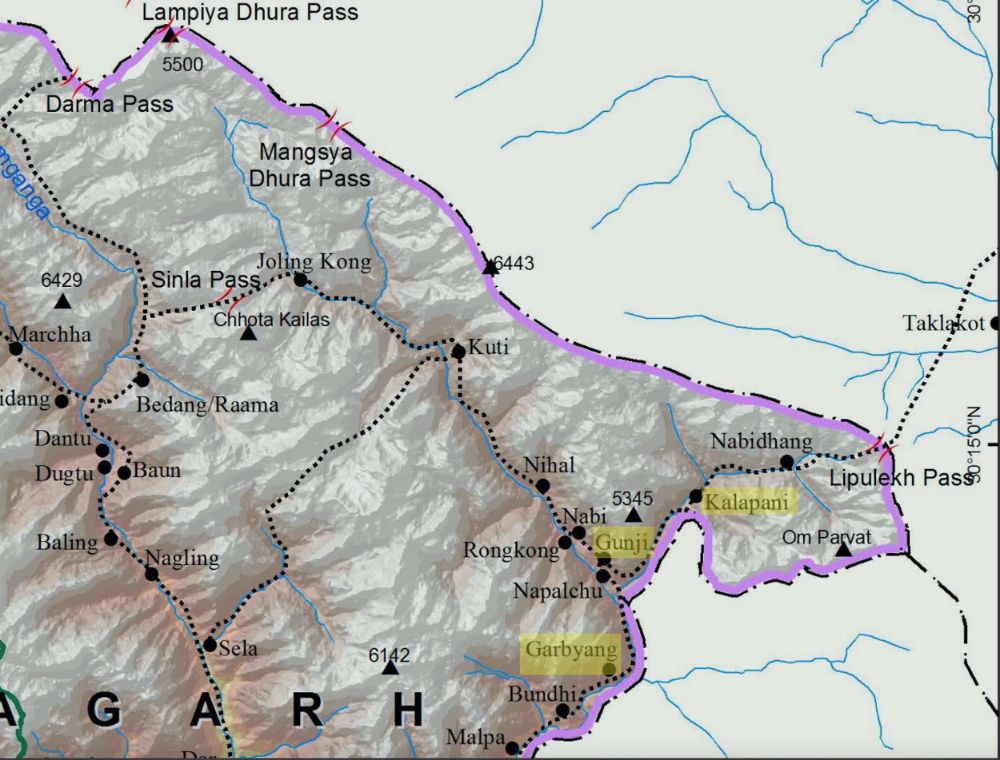
Relief map of the Lipulekh-Limpiyadhura area ( from: http://pahar.in/high-quality-uttarakhand-map/)
`The Gorkha war and its aftermath', in which Sam Cowan argues that Nepal's territorial claim against India was justified in respect of the area south of the river between Lipu Lekh and Kalapani village but not for the land north-east of the river flowing down from Limpiyadhura, was published in The Record in November 2020 and the link was subsequently posted on my Facebook page. The case for the full Nepali claim had been argued by Ava Regmi, daughter of Nepali historian and politician Dilli Raman Regmi, in a Nagarik oped published on 14 July and in an article by Dwarika Nath Dhungel, Jagat Bhusal and Narendra Khanal in Tribhuvan University's Journal of International Affairs two months previously:
`The Gorkha war and its aftermath', in which Sam Cowan argues that Nepal's territorial claim against India was justified in respect of the area south of the river between Lipu Lekh and Kalapani village but not for the land north-east of the river flowing down from Limpiyadhura, was published in The Record in November 2020 and the link was subsequently posted on my Facebook page. The case for the full Nepali claim had been argued by Ava Regmi, daughter of Nepali historian and politician Dilli Raman Regmi, in a Nagarik oped published on 14 July and in an article by Dwarika Nath Dhungel, Jagat Bhusal and Narendra Khanal in Tribhuvan University's Journal of International Affairs two months previously:

| article_1__1-41__joia_vol.3_no.1_may_2020_dird_tu__1_a.pdf |
Dwarika Nath Dhungel and Santa Bahadur Pun had published a shorter discussion of the issue six years previously in the 2014(3) issue of an Indian periodical, Foreign Policy Research Centre Journal:

| nepal_india_relations_origin_of_mahakai.docx |
Debate had apparently been launched in Nepal in 2013 with the publication of Buddhi Narayan Shrestha's Sima Sangram [Border Dispute] but the claim was not advanced by the government of Nepal until 2020.
Response to Ava Regmi's comment on Facebook (November 2020) that `The Gorkha War and its Aftermath' `is not worth a penny.'
Ava, I just cannot understand how you could dismiss Sam Cowan’s article like that. However much you may disagree with his conclusions, they are based on a thorough examination of the available evidence and deserve careful consideration by anyone seriously interested in border issues. I will spell out again, in roughly ascending order of importance, the main points which I myself took away from what I hope was a thorough reading of the paper:
Ava Regmi's response
I dismiss [Sam] 100% John as I dismiss most of the modern history written by Bishweshwar, Ganeshman, Rose et al. Also how come you John write on Nepal and then spew so much vitriol against the country without knowing iota of truth. Please read my article that came in Nagarik which shows clearly what Lord Moira said to the Secret Committee and to Gardner. He said that Gardner should talk with the Nepalese Government to take over that land. Didn't we already give enough? The land that the British called belonged to Kumaon , the Byas, never belonged to Kumaon. It was part of the Jumla Kingdom. Anyway, Kumaon having a separate identity and we Nepali as aliens are also contruct of the British. Me myself all my forefathers are from Kumaon. Its due to the paucity of Nepali researchers foreigners are trying to make hay and also try to stab Nepal at the same time. Such flimsy evidences shown by Sam does not hold a dime in the Court of Truth. Sam can ask Sir Sydney Burrard one of the greatest Surveyor General's of British India to tell him the truth of Kali.
"Thorough evidence" are you joking? what evidence has he given? what he has shown are manipulated maps. The Aitkinson map is a bag of lies.
I don't know what you all have to do with that area. We have lived in that area for millennia and do we need anybody to tell us which is Kali and which is not Kali?
Has Sam seen the unmanipulated maps made by "the greatest cartographer" of his time Trelawney Saunders of the India Office?
I dare Sam to bring out Trelawney Saunders Maps.... haha.... Frankly, speaking John what kind of history book did you write of Nepal? you completely missed the picture. if you do research do good research. The anti Rana movement was started by my father in 1940. Bishweshwar was his party worker. Shouldn't you have delved into finding the real history... Do you even know about Nepal's real history?
Ava, I just cannot understand how you could dismiss Sam Cowan’s article like that. However much you may disagree with his conclusions, they are based on a thorough examination of the available evidence and deserve careful consideration by anyone seriously interested in border issues. I will spell out again, in roughly ascending order of importance, the main points which I myself took away from what I hope was a thorough reading of the paper:
- As has previously been pointed out by Santosh Khaderi, Indian security forces’ presence at Kalapani did not start in the aftermath of the 1962 war with China but at least as early as 1955, as part of India’s response to China’s taking control of Tibet
- As is the case with many other international boundaries, Nepal’s western border cuts across cultural boundaries by separating the Byansi villages to the west from those to the east.
- Comparison of British maps produced in 1850 and in 1879 indicates that the British themselves until 1850 regarded the border as running up to the Lipu Lekh pass but then unilaterally shifted the line to the east. This gives Nepal a strong legal claim to the Kalapani area, although her case is weakened by Nepal’s rulers failure until the 1990s to object to the new British claim.
- It is clear from the official correspondence published in Papers Respecting the Nepaul War that Hastings personally was determined for commercial purposes to secure access to `Tartary’ through Kumaon and therefore would not have accepted an arrangement that left Lipu Lekh under Gorkha control. He would not have agreed to make the Sarda/Kali the border if he had in 1815 understood that river as the one running down from Limpiyadhura. Hastings’ thinking was made even clearer in 1817, when he rejected Bam Shah’s claim to Limpiyadhura, which was based, as was K.P.Oli’s this year, on the argument that the branch of the head waters carrying the greater volume of water should be regarded as the main stream. The continuous administration of this area since 1815 by the British and then by independent India is thus in no way a violation of the Sugauli Treaty
- Regardless of the purely legal merits of the dispute, which appear to be on Nepal’s side for Kalapani and on India’s for Limpiyadhura, it is hard to see, as a matter of practical politics, why the Oli administration expected India to concede on either issue. Raising the dispute enabled Oli to bang the nationalist drum but made little sense in terms of Nepal’s actual national interests.
Ava Regmi's response
I dismiss [Sam] 100% John as I dismiss most of the modern history written by Bishweshwar, Ganeshman, Rose et al. Also how come you John write on Nepal and then spew so much vitriol against the country without knowing iota of truth. Please read my article that came in Nagarik which shows clearly what Lord Moira said to the Secret Committee and to Gardner. He said that Gardner should talk with the Nepalese Government to take over that land. Didn't we already give enough? The land that the British called belonged to Kumaon , the Byas, never belonged to Kumaon. It was part of the Jumla Kingdom. Anyway, Kumaon having a separate identity and we Nepali as aliens are also contruct of the British. Me myself all my forefathers are from Kumaon. Its due to the paucity of Nepali researchers foreigners are trying to make hay and also try to stab Nepal at the same time. Such flimsy evidences shown by Sam does not hold a dime in the Court of Truth. Sam can ask Sir Sydney Burrard one of the greatest Surveyor General's of British India to tell him the truth of Kali.
"Thorough evidence" are you joking? what evidence has he given? what he has shown are manipulated maps. The Aitkinson map is a bag of lies.
I don't know what you all have to do with that area. We have lived in that area for millennia and do we need anybody to tell us which is Kali and which is not Kali?
Has Sam seen the unmanipulated maps made by "the greatest cartographer" of his time Trelawney Saunders of the India Office?
I dare Sam to bring out Trelawney Saunders Maps.... haha.... Frankly, speaking John what kind of history book did you write of Nepal? you completely missed the picture. if you do research do good research. The anti Rana movement was started by my father in 1940. Bishweshwar was his party worker. Shouldn't you have delved into finding the real history... Do you even know about Nepal's real history?
An Indian perspective
This article by Indian scholar M. Vinaya Chandran, `Revisiting The 1816 Sugauli Treaty for Resolution of India – Nepal Boundary Quandary at Kalapani', published in January 2021 in the Calcutta Journal of Global Affairs (5(1): 17-49), suggests referrring the issue to the International Court of Justice if blilateral talks do not produce a solution.
This article by Indian scholar M. Vinaya Chandran, `Revisiting The 1816 Sugauli Treaty for Resolution of India – Nepal Boundary Quandary at Kalapani', published in January 2021 in the Calcutta Journal of Global Affairs (5(1): 17-49), suggests referrring the issue to the International Court of Justice if blilateral talks do not produce a solution.
| vinayachandran3.pdf |
A summary of the apparent problems with Nepal's claim to Limpiyadhura
Slides 3-11 of the PowerPoint below, which accompanied my presentation at the symposium honouring Michael Hutt in Kathmandu on 25 July 2023. deal with the controversy and its political background. My arguments are tentative, but, after a quick look at the discussion of the NW border question in Pitamber Sharma's edited volume (Nepal-India Border Disputes, Mahakali and Susta. Kathmandu: Mandala Book Point, 2022) and a lengthy conversation with Dwarika Nath Dhungel and Jagat Kumar Bhusal, I still believe that the Nepalese claim to the Limpiyadhura `finger' is very weak . The British officials in Kumaon had seven months between their being authorised in May 1815 to fix, if necessary, a border further East than the Sarda/Kali and the signing of the Sugauli Treaty in December 1815. Even though a full survey of Kumaon was not complete by then, they surely had enough time to get a rough idea of the routes and streams involved. They nevertheless did not suggest amending the draft peace treaty to include wording on the lines of `the Kali and Lipu Khola' instead of just `the Kali.' This was surely because they were told by local people that the Kali started with the Lipu Lekh stream, a local belief that continued to be referred to in British sources throughout the 19th century, even when the British themselves had accepted that, on purely hydrological grounds, the Kuti Yangti flowing from Limpiyadhura should be regarded as the principal branch. If in 1815 the Limpiyadhura stream was generally accepted as the start of the Kali, as the Nepalese border activists now argue, we would also have to explain why Bam Shah asked in February 1817 for the transfer to Nepal just of the Byas villages settlements east of the Lipu Lekh stream and only in September requested the ones to the west of it. Presumably, like the British, he was aware that the Lipu Khola was conventionally thought of as the source of the Kali but then realised that, by applying a general Western principle in river classification, he could argue against the local belief.
Slides 3-11 of the PowerPoint below, which accompanied my presentation at the symposium honouring Michael Hutt in Kathmandu on 25 July 2023. deal with the controversy and its political background. My arguments are tentative, but, after a quick look at the discussion of the NW border question in Pitamber Sharma's edited volume (Nepal-India Border Disputes, Mahakali and Susta. Kathmandu: Mandala Book Point, 2022) and a lengthy conversation with Dwarika Nath Dhungel and Jagat Kumar Bhusal, I still believe that the Nepalese claim to the Limpiyadhura `finger' is very weak . The British officials in Kumaon had seven months between their being authorised in May 1815 to fix, if necessary, a border further East than the Sarda/Kali and the signing of the Sugauli Treaty in December 1815. Even though a full survey of Kumaon was not complete by then, they surely had enough time to get a rough idea of the routes and streams involved. They nevertheless did not suggest amending the draft peace treaty to include wording on the lines of `the Kali and Lipu Khola' instead of just `the Kali.' This was surely because they were told by local people that the Kali started with the Lipu Lekh stream, a local belief that continued to be referred to in British sources throughout the 19th century, even when the British themselves had accepted that, on purely hydrological grounds, the Kuti Yangti flowing from Limpiyadhura should be regarded as the principal branch. If in 1815 the Limpiyadhura stream was generally accepted as the start of the Kali, as the Nepalese border activists now argue, we would also have to explain why Bam Shah asked in February 1817 for the transfer to Nepal just of the Byas villages settlements east of the Lipu Lekh stream and only in September requested the ones to the west of it. Presumably, like the British, he was aware that the Lipu Khola was conventionally thought of as the source of the Kali but then realised that, by applying a general Western principle in river classification, he could argue against the local belief.

| being_nepali.ppt |
Captain Webb's visit to Tibet
Further corroboration that the British always regarded the stream flowing directly from Lipu Lekh as the border is provided by Sam Cowan's May 2022 article, `Meetings on Lipu Lekh' also published in The Record, on the negotiations between Capt. William Web and a Tibetan official north of the border in 1816.
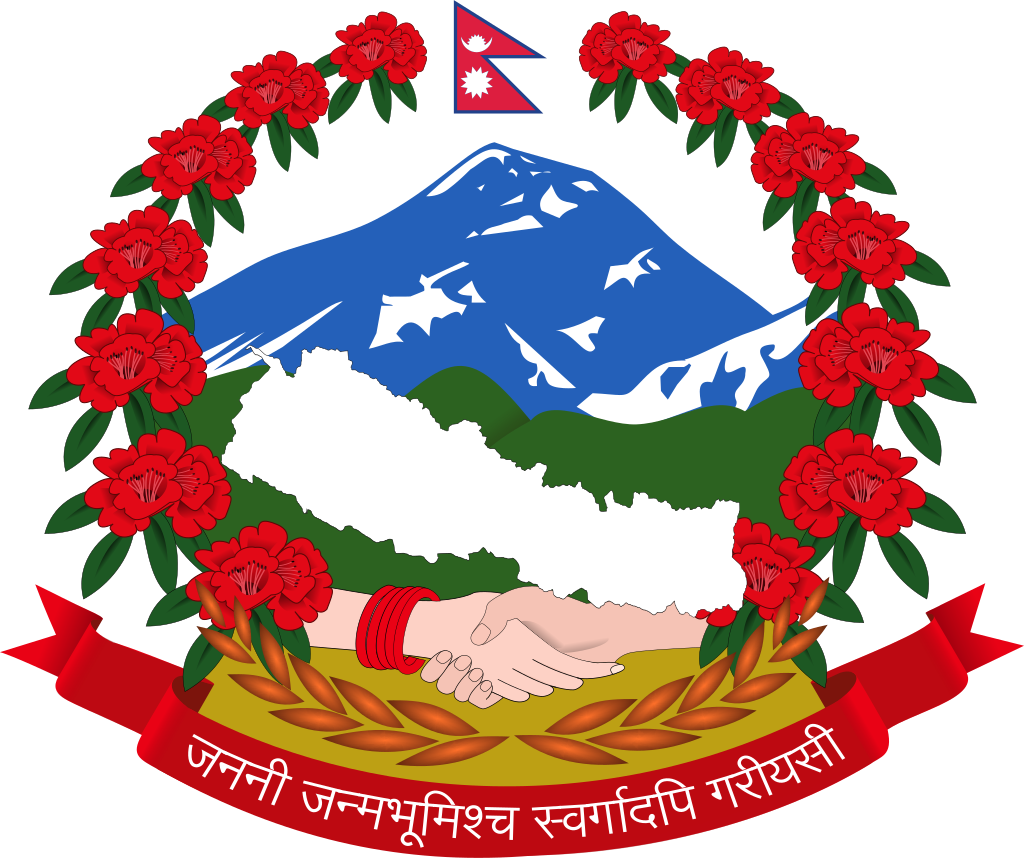
Nepal's national emblem as revised by constitutional amendment in June 2020, with the area now claimed from India the `finger' projecting from the NW corner of the map,
Extract from the letter of John Adam, Secretary to the Governer-General, to Edward Gardner, Commissioner for Kumaon, 3 May 1815
'As soon as the Goorka troops shall have withdrawn from Kamaon and the passage of the Sarda be secured, your attention will be directed to the introduction and establishment of the authority of the Government throughout the province. On this subject, no instructions are deemed to be necessary, beyond which you have already been furnished; except in as much as refers to the boundary which should be assigned to the province. All the Maps in possession of this government are so incorrect, that no satisfactory judgement can be framed from them with regard to what the interests of the Company may require in that respect. To the eastward, the Sarda appears to present a natural limit. Still the important object of securing the trade with Tartary through the Himmaleh mountains against the interference of the Goorkhas might not be attained by fixing that river as the boundary; you are therefore requested to satisfy yourself on this point”. [Papers Respecting the Nepaul War, p. 571] '
Letter from John Adam, Secretary to the Governor-General, to G.W. Trail, Commissioner for Kumaon, 5 September 1817
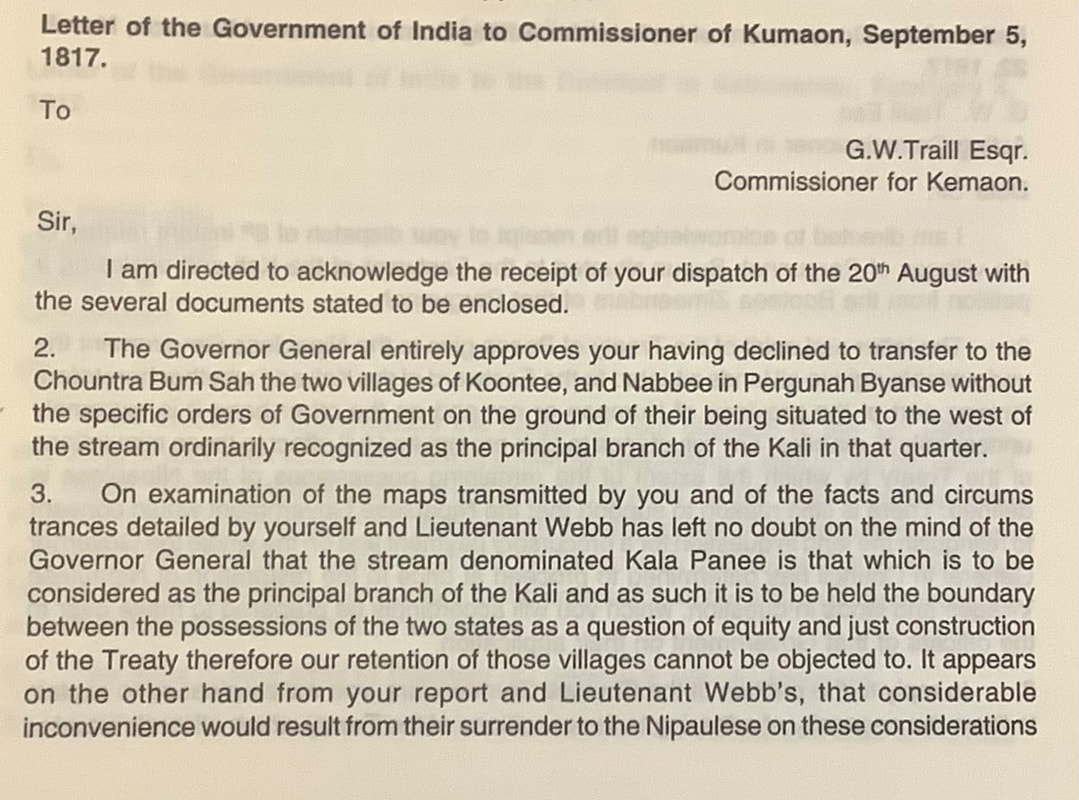
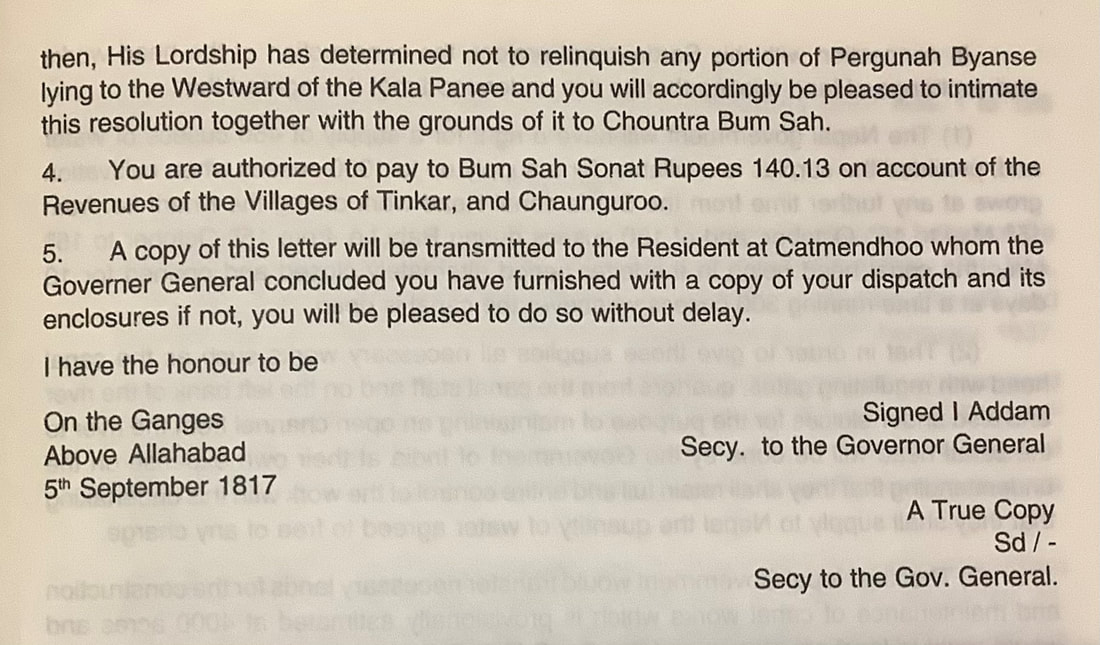
Miscellaneous Letters Received , Vol. 11, Uttar Pradesh State Archives, Lucknow (in A.S. Bhasin (ed.), Nepal-India, Nepal-China Relations, Documents 1947-June 2005, vol. IV, App.-IV, pp.3034-35)
Letter from Prime Minister Girija Koirala to a Committee of the National Assembly, 18 June 1998.
Letter from Prime Minister Girija Koirala to a Committee of the National Assembly, 18 June 1998.
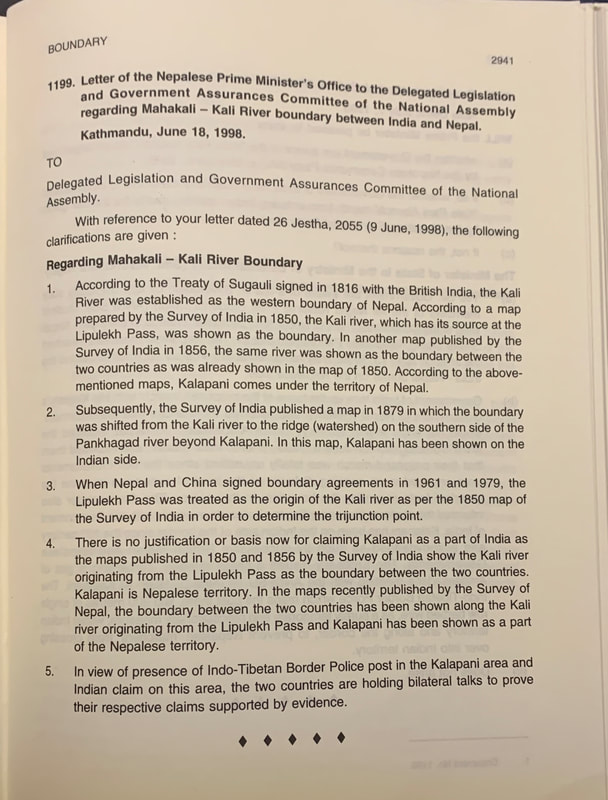
(A.S. Bhasin (ed), Nepal-India, Nepal-China Relations, Documents 1947-June 2005, vol. IV)
