| linguae |
|
Linguae - a site for language and culture
I am a Hong Kong-based teacher and researcher and started this site to bring together links to other sites I find particularly interesting and to make available materials I have produced myself for use at Baptist Lui Ming Choi Secondary School and elsewhere. There are also details of the activities of the Hong Kong Anthropological Society and the Circulus Latinus Honcongensis as well as a list of my own publications and current projects. Fuller information on the contents is provided on the site map. The main emphasis is on Latin and Nepali but there is also material on English and other modern European languages. Material on Chinese has been placed on a companion site (chineselanguages.weebly.com) which is in a preliminary stage at the moment. I would be happy to receive suggestions and comments for both sites on the form at the bottom of the page.
The picture at the head of each page is a relief produced around 1770 by French sculptor Clodion (1738-1814) and now in the Louvre in Paris, showing the woodland god Pan in pursuit of the nymph Syrinx. She appealed to her river god father who turned her into a clump of reeds, which Pan then cut and made into the pan pipes, or syrinx. The Greek myth is retold in Latin verse in Ovid's Metamorphoses and a simplified version for beginners can be read in Latin via Ovid. The whole story is illustrated in a Powerpoint downloadable from the Latin & Greek page on this site.
The picture at the head of each page is a relief produced around 1770 by French sculptor Clodion (1738-1814) and now in the Louvre in Paris, showing the woodland god Pan in pursuit of the nymph Syrinx. She appealed to her river god father who turned her into a clump of reeds, which Pan then cut and made into the pan pipes, or syrinx. The Greek myth is retold in Latin verse in Ovid's Metamorphoses and a simplified version for beginners can be read in Latin via Ovid. The whole story is illustrated in a Powerpoint downloadable from the Latin & Greek page on this site.
Useful language sites
The Ethnologue site includes basic data for all of the world's documented languages and is the online version of M. Paul Lewis (ed.), 2009. Ethnologue: Languages of the World, Sixteenth edition. Dallas, Tex.: SIL International. UNESCO's Atlas of the World's Languages in Danger includes details on around 2,500 languages which are threatened with possible extinction. The Wikipedia article on world languages gives statistics for native speakers and second language speakers plus maps illustrating the geographical distribution of the world's major languages. The numeral systems used by many different languages are being collected on Evan Chan's Numerals site. Words for numbers can become endangered even more readily than the languages themselves - for example, Thai and Japanese long ago switched mostly to using the Chinese system instead of their indigenous ones.
For rapid translation between language, the best choice is probably Google but any translation programme produces some mistakes, especially with long stretches of text, and you cannot rely totally upon the result unless you know enough of both languages to edit it. You can, however, now also hear the words read out with native pronunciationA good alternative when reading material in a major world language you have some knowledge of used to be the Web Reader on Wordchamp, which provided pop-up glosses on individual words in a passage typed or pasted into the site, but this has now unfortunately closed down. The database is still, however, with the site's creator and hopefully it will eventually be made available again.
The Acapela site allows you to type or paste in up to about fifty words in any major language and hear it read aloud by a native speaker. Unlike the similar facility now provided on Google Translate, there is a choice of different voices available for every different language. The result is not, of course, reliable for sentence-level intonation but it is accurate for individual words or phrases and can even use make use of the punctuation to produce the basic rising intonation for a question in English. The Google translation site now also provides audio for short stretches of language but of variable quality. The Forvo site lets you hear individual words in many different languages and also record your own pronunciations to enlarge the data base.
Excellent online bilingual dictionaries for English with other major languages are available on the Word Reference site. These include links to discussions on difficult points of usage and also to verb conjugation charts.
The LibriVox site aims to make available on the Internet recordings of books in the public domain. MP3 files of books already recorded can be downloaded free of charge and volunteers are needed to produce further recordings. A contributor to the LibriVox forum has produced a list of self-access language primers down-loadable from the Internet. The list is also reproduced here.
The US Department of State's Foreign Service Institute has classified major world languages in terms of the level of difficulty they present for a native speaker of English. The number of classroom hours they believe necessary to achieve Level 3 proficiency in speaking and reading (i.e. sufficient to operate efficiently in most professional contexts) ranges from around 600 classroom hours for French and other languages quite similar to English to 2200 for Chinese and Arabic. These estimates assume that the student is supplementing the classroom instruction with extensive practice and self-study.
If you need to type phonetic symbols into documents, the simplest way is probably to copy and paste from lists such as the one compiled at Stockholm University. This uses the Summer Institute of Linguistics Doulos93 font which is employed in documents stored on this site. A shorter list, including only those symbols needed for English, is included in my `Introduction to the Sounds of English', downloadable from the English page.
For two-fingered typists wanting to improve, free on-line tutotials are available at http://www.powertyping.com/qwerty/lessonsq.html
There are a large number of videos on Youtube about language learning and an overview of some of these, together with other advice on language learning, is available in a video from `torbryne.' A TED talk on the same subject, recorded by Chris Lonsdale at Lingnan University in Hong Kong, advances the theis that by applying a simple set of principles and key actions, any normal adult can learn any language within six months.
For language teachers, it is possible to design on-line tests for students both using the Wordchamp platform, and on the Classmarker site.
For rapid translation between language, the best choice is probably Google but any translation programme produces some mistakes, especially with long stretches of text, and you cannot rely totally upon the result unless you know enough of both languages to edit it. You can, however, now also hear the words read out with native pronunciationA good alternative when reading material in a major world language you have some knowledge of used to be the Web Reader on Wordchamp, which provided pop-up glosses on individual words in a passage typed or pasted into the site, but this has now unfortunately closed down. The database is still, however, with the site's creator and hopefully it will eventually be made available again.
The Acapela site allows you to type or paste in up to about fifty words in any major language and hear it read aloud by a native speaker. Unlike the similar facility now provided on Google Translate, there is a choice of different voices available for every different language. The result is not, of course, reliable for sentence-level intonation but it is accurate for individual words or phrases and can even use make use of the punctuation to produce the basic rising intonation for a question in English. The Google translation site now also provides audio for short stretches of language but of variable quality. The Forvo site lets you hear individual words in many different languages and also record your own pronunciations to enlarge the data base.
Excellent online bilingual dictionaries for English with other major languages are available on the Word Reference site. These include links to discussions on difficult points of usage and also to verb conjugation charts.
The LibriVox site aims to make available on the Internet recordings of books in the public domain. MP3 files of books already recorded can be downloaded free of charge and volunteers are needed to produce further recordings. A contributor to the LibriVox forum has produced a list of self-access language primers down-loadable from the Internet. The list is also reproduced here.
The US Department of State's Foreign Service Institute has classified major world languages in terms of the level of difficulty they present for a native speaker of English. The number of classroom hours they believe necessary to achieve Level 3 proficiency in speaking and reading (i.e. sufficient to operate efficiently in most professional contexts) ranges from around 600 classroom hours for French and other languages quite similar to English to 2200 for Chinese and Arabic. These estimates assume that the student is supplementing the classroom instruction with extensive practice and self-study.
If you need to type phonetic symbols into documents, the simplest way is probably to copy and paste from lists such as the one compiled at Stockholm University. This uses the Summer Institute of Linguistics Doulos93 font which is employed in documents stored on this site. A shorter list, including only those symbols needed for English, is included in my `Introduction to the Sounds of English', downloadable from the English page.
For two-fingered typists wanting to improve, free on-line tutotials are available at http://www.powertyping.com/qwerty/lessonsq.html
There are a large number of videos on Youtube about language learning and an overview of some of these, together with other advice on language learning, is available in a video from `torbryne.' A TED talk on the same subject, recorded by Chris Lonsdale at Lingnan University in Hong Kong, advances the theis that by applying a simple set of principles and key actions, any normal adult can learn any language within six months.
For language teachers, it is possible to design on-line tests for students both using the Wordchamp platform, and on the Classmarker site.
Indo-European
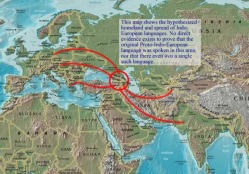
The first Powerpoint gives the same sentence in a number of different European and South Asian languages and invites the viewer to group similar ones together. The answers are provided in the second presentation, a brief introduction to the development of the Indo-European language family, which includes Latin, Greek and Sanskrit as well as most of the modern languages of Europe and of northern India . The Word document provides a longer account with comprehension questions suitable for upper intermediate or advanced learners of English as a second language. (The map shown here is from www.danshort.com (C) Dan Short, and shows a dispersal from the Caucasus rather than the regions north or south of the Black Sea favoured by most scholars.)

| ie_powerpoint.ppt |
| indo-european.ppt |

| ie.doc |
| ie_diagram.doc |
| ie_ans.doc |
Further information on individual IE languages and their development from a common origin is provided on the website of the Linguistics Research Centre of the University of Texas, including basic lessons in many of them. KryssTal.com gives brief information on each member of the family as well as sample passages in non-Roman scripts for languages such as Hindi. A list of the principal words in Indo-European languages that we believe go back to a common parent form is available on Wikipedia. The symbols H1 and H2 in the reconstructed Proto- Indo-European words stand for special sounds made in the throat which have been lost in the later languages but probably existed in the original one. The latest version of 19th-century linguist August Schleicher's fable of `The Sheep and the Horse' in reconstructed IE can be found on the Huffington Post site which also allows you to hear it read aloud by Andrew Byrd of the University of Kentucky.
The homeland of the speakers of proto-IE and the date at which the language began to split up is highly controversial. One early theory (illustrated by the picture above) was that the original homeland was in the Caucasus region but most historical linguists now believe that the Indo-Europeans originated in the steppes north of the Black Sea and that dispersal began 5 to 6,000 years ago. However, a rival theory, of which Colin Renfrew is the best-known advocate, places the homeland in modern Turkey and argues that the language was carried into Europe and India by early farmers two or three millennia earlier, following the domestication of wheat which is generally agreed to have occurred first in Anatolia. A recent article by Remco Bouckaert et al. in Science 2012;337:957-960 uses Bayesian mathematical modelling to argue for the latter theory but their methodology has been questioned by some other historical linguists. Roger Blench's no-holds-barred attack on the approach is presented in this Powerpoint:
The homeland of the speakers of proto-IE and the date at which the language began to split up is highly controversial. One early theory (illustrated by the picture above) was that the original homeland was in the Caucasus region but most historical linguists now believe that the Indo-Europeans originated in the steppes north of the Black Sea and that dispersal began 5 to 6,000 years ago. However, a rival theory, of which Colin Renfrew is the best-known advocate, places the homeland in modern Turkey and argues that the language was carried into Europe and India by early farmers two or three millennia earlier, following the domestication of wheat which is generally agreed to have occurred first in Anatolia. A recent article by Remco Bouckaert et al. in Science 2012;337:957-960 uses Bayesian mathematical modelling to argue for the latter theory but their methodology has been questioned by some other historical linguists. Roger Blench's no-holds-barred attack on the approach is presented in this Powerpoint:

| new_mathematical_methods_blench.pdf |
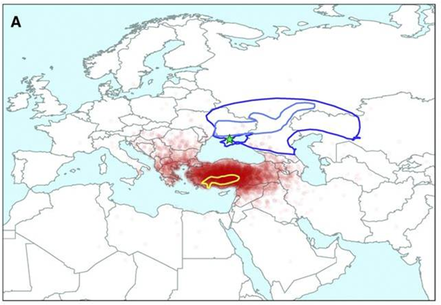
Map illustrating the main theories of the location of the Indo-European homeland (from Remco Bouckaert et al.)
There is also an organisation, Dnghu Soqitis (`Language Association') with the highly eccentric objective of reconstructing and further developing proto-Indo-European as a lingua franca for modern Europe!
Other language families
Because so many of the Indo-European languages have been written languages for so long and because of the elaborate system of grammatical endings they have (or once had), it has been easier to work out their interconnections than it is for languages elsewhere in the world. A number of other language families have, however, been identified, including Sino-Tibetan (Chinese, Tibetan, Burmese etc.), Austronesian (Taiwanese indigenous languages, Malay, Maori and other languages across the Pacific), Austroasiatic (Vietnamese, Khmer, Mon and the Munda branch in NE India and Bangladesh), Afro-Asiatic (ancient Egyptian, Hebrew, Arabic etc.) and Uralic ( Finnish, Hungarian, Estonian etc.). Some linguists also accept the existence of Altaic (Turkish, Mongolian, Manchu and possibly also Japanese and Korean) but others believe similarities between these languages are due to borrowing, not common origin. A brief account of the connections of Chinese is downloadable from the Chinese Languages site.
A very detailed, though controversial, discussion of many of the families and their inter-relation is contained in George van Driem's Languages of the Himalayas, which is previewed on the Nepali page.
The Semitic branch of Afro-Asiatic includes Hebrew, Arabic, Aramaic (the language which Jesus Christ spoke) and Punic (spoken in Carthage) as well as Akkadian, the language of the cuneiform inscriptions of ancient Mesopotamia. A comprehensive dictionary of Akkadian (under the rather old-fashioned title of `The Chicago Assyrian Dictionary' can be downloaded free of charge from the Oriental Institute of the University of Chicago site.
Cuneiform was also used by the Hurrians, a people once spread over much of Mesopotamia and Anatolia. They later came under the political hegemony of the IE-speaking Hittites and Mitanni but no clear relationship has been established between the Hurro-Urartian language family to which Hurrian belongs and any other grouping. Among the Hurrian documents discovered in the ancient city of Ugarit (Ras Shamra) in Syria is a hymn to the goddess Nikkal dating from around 14oo B.C. and claimed to be the world's `oldest preserved song with notation'. Assyriologist Anne Kilmer and her colleagues are among those who believe they have deciphered the notation and the melody can be heard in a YouTube video. Other versions of the tune can be heard here and here. and there is a more detailed discussion of the text on Wikipedia.
The idea of a Eurasian `superfamily' of languages, linking IE with a number of others', has been proposed in various forms, most recently by Mark Pagel and his colleagues. A brief summary of their views was published in the Guardian in May 2013 and a more detailed one in the Daily Mail. Their own full presentation is in the Proceedings of the National Academy of Sciences (Warning: when I tried to download the PDF of the full article from there, my computer crashed!) An early BBC documentary on attempts to trace human languages back to a common origin is no longer on YouTube but the soundtrack is available on the Internet Archive: `Before Babel: in search of the first language' Note that most historical linguists remain unconvinced by attempts to trace links between languages so far back into the past.
A very detailed, though controversial, discussion of many of the families and their inter-relation is contained in George van Driem's Languages of the Himalayas, which is previewed on the Nepali page.
The Semitic branch of Afro-Asiatic includes Hebrew, Arabic, Aramaic (the language which Jesus Christ spoke) and Punic (spoken in Carthage) as well as Akkadian, the language of the cuneiform inscriptions of ancient Mesopotamia. A comprehensive dictionary of Akkadian (under the rather old-fashioned title of `The Chicago Assyrian Dictionary' can be downloaded free of charge from the Oriental Institute of the University of Chicago site.
Cuneiform was also used by the Hurrians, a people once spread over much of Mesopotamia and Anatolia. They later came under the political hegemony of the IE-speaking Hittites and Mitanni but no clear relationship has been established between the Hurro-Urartian language family to which Hurrian belongs and any other grouping. Among the Hurrian documents discovered in the ancient city of Ugarit (Ras Shamra) in Syria is a hymn to the goddess Nikkal dating from around 14oo B.C. and claimed to be the world's `oldest preserved song with notation'. Assyriologist Anne Kilmer and her colleagues are among those who believe they have deciphered the notation and the melody can be heard in a YouTube video. Other versions of the tune can be heard here and here. and there is a more detailed discussion of the text on Wikipedia.
The idea of a Eurasian `superfamily' of languages, linking IE with a number of others', has been proposed in various forms, most recently by Mark Pagel and his colleagues. A brief summary of their views was published in the Guardian in May 2013 and a more detailed one in the Daily Mail. Their own full presentation is in the Proceedings of the National Academy of Sciences (Warning: when I tried to download the PDF of the full article from there, my computer crashed!) An early BBC documentary on attempts to trace human languages back to a common origin is no longer on YouTube but the soundtrack is available on the Internet Archive: `Before Babel: in search of the first language' Note that most historical linguists remain unconvinced by attempts to trace links between languages so far back into the past.
Interlingua
Interlingua, devised between 1937 and 1951 by an international committee of linguists, is one of a number of artificial languages created over the last 150 years as aids to international communication. Unlike the better known Esperanto, which uses a set of systematic rules to generate its vocabulary and structures, Interlingua normally adopts words and grammatical rules to represent most closely the common features of its `control' languages - i.e the Romance languages plus English, with a secondary reference role for German and Russian. As a result, straightforward texts in Interlingua can often be understood immediately by any speaker of a Romance language or any educated speaker of English and there is some evidence that a preliminary course in Interlingua speeds up progress when later learning one of the control languages. A good overview of the language is provided on Wikipedia (though some Interlinguists would say its figures are too conservative) and a grammar and Interlingua-English dictionary are also available online. Individual words can be heard pronounced on the Forvo site and there are some videos on Youtube teaching numbers and colours etc.
Here is a short sample text with English translation:
Le valor pedagogic de interlingua ja esseva demonstrate in Danmark in le initio del 1960s, quando Østersøgades Skole instrueva interlingua al alumnos. Numerose diplomates, ministros, directores etc. ha assi apprendite interlingua quando scholares. Desde 1967, interlingua ha essite usate in gymnasios svedese in le disciplina “general cognoscentia lingual” substituente latino classic.
The pedagogic value of Interlingua was already demonstrated in Denmark at the beginning of the 1960s, when Østersøgades Skole taught Interlingua to its pupils. Numerous diplomats, ministers, directors etc. have thus learned Interlingua when students. Since 1967, Interlingua has been used in Swedish grammar schools in the subject `general linguistic knowledge' replacing classical Latin.
A good source of reading practice in Interlingua and its source languages is Interlingua multilingue, a blog which every day presents a news report in Interlingua, with parallel versions in English and usually one other language.
Here is a short sample text with English translation:
Le valor pedagogic de interlingua ja esseva demonstrate in Danmark in le initio del 1960s, quando Østersøgades Skole instrueva interlingua al alumnos. Numerose diplomates, ministros, directores etc. ha assi apprendite interlingua quando scholares. Desde 1967, interlingua ha essite usate in gymnasios svedese in le disciplina “general cognoscentia lingual” substituente latino classic.
The pedagogic value of Interlingua was already demonstrated in Denmark at the beginning of the 1960s, when Østersøgades Skole taught Interlingua to its pupils. Numerous diplomats, ministers, directors etc. have thus learned Interlingua when students. Since 1967, Interlingua has been used in Swedish grammar schools in the subject `general linguistic knowledge' replacing classical Latin.
A good source of reading practice in Interlingua and its source languages is Interlingua multilingue, a blog which every day presents a news report in Interlingua, with parallel versions in English and usually one other language.
Language learning experiences
Whilst doing my M.A. in applied linguistics twelve years ago I wrote a summary of my experiences learning various languages and circulated it to friends and colleagues to invite contributions on their own experiences. I have updated the piece from time to time and this is the May 2011 version. A more detailed account of my attempt to learn Cantonese can be downloaded from the Chinese Languages site.
| langhist.doc |
