| linguae |
|
Latin Courses and Examinations in Hong Kong
If you live in Hong Kong and are looking for an introductory Latin class, these are provided by the Dante Alighieri Centre in Wanchai and the HKU SPACE campus in Causeway Bay. Adult courses at both institutions use the textbook Latin via Ovid, which features stories adapted from Ovid's anthology of Graeco-Roman myths, the Metamorphoses. An extensive preview of the textbook is available on Google Books. and Powerpoint presentations illustrating the stories can be downloaded from the `Teaching Aids for Latin via Ovid' section lower down this page.
The teenager courses use the Cambridge Latin Course, which can be previewed on-line at https://www.clc.cambridgescp.com/books/book-i
Detailed lists of contents for the various group courses can be found by placing the cursor on LATIN & GREEK in the menu line above, and then on IN CONCLAVI SCHOLARI in the drop-down menu that will appear. Dates shown for each session are for current or past courses and will be corrected when a particular level is offered again:
The teenager courses use the Cambridge Latin Course, which can be previewed on-line at https://www.clc.cambridgescp.com/books/book-i
Detailed lists of contents for the various group courses can be found by placing the cursor on LATIN & GREEK in the menu line above, and then on IN CONCLAVI SCHOLARI in the drop-down menu that will appear. Dates shown for each session are for current or past courses and will be corrected when a particular level is offered again:
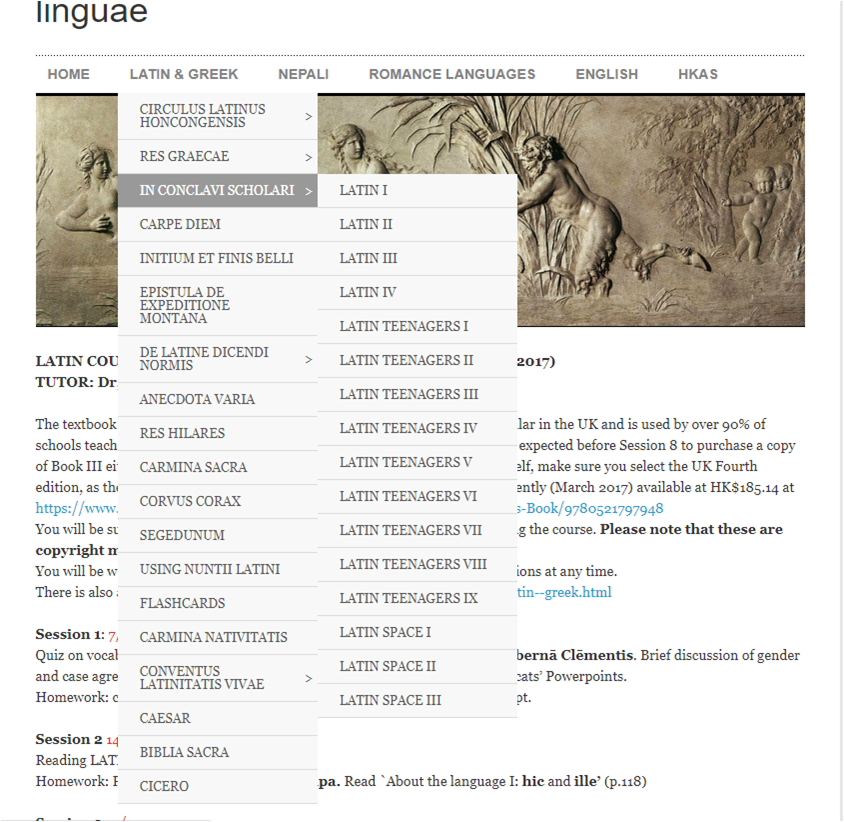
New courses scheduled to begin in 2023, subject to sufficient enrolment. Note that the linked pages showing course contents may still display dates from an earlier course but that the syllabus will remain the same.
Latin III (Dante Alighieri Society)
To be held on Mondays from 7.00 to 9.00 p.m. at the Society’s premises at Room 702, 7/F, Hong Kong Arts Centre, 2 Harbour Road in Wanchai for fifteen sessions starting from 8 January and covering chapters 21-30 in `Latin via Ovid'. The detailed syllabus contents are available at https://linguae.weebly.com/latin-iii.html. If you are interested, please email John Whelpton here or contact Dante at http://ladante.cc/about-us/contact-us/
Latin III (Dante Alighieri Society)
To be held on Saturdays from 2.00 to 4.00 p.m. at the Society’s premises at Room 702, 7/F, Hong Kong Arts Centre, 2 Harbour Road in Wanchai for fifteen sessions starting on 24 February and covering chapters 21-30 in `Latin via Ovid'. The detailed syllabus contents are available at https://linguae.weebly.com/latin-iii.html. If you are interested, please email John Whelpton here or contact Dante at http://ladante.cc/about-us/contact-us/
Dante also hope to start a Latin II course on Tuesday evenings but do not yet have enough students. The detailed syllabus contents are at linguae.weebly.com/latin-ii-mon.html If you are interested, please email John Whelpton here or contact Dante at http://ladante.cc/about-us/contact-us/ and state the earliest date you could start from.
If you have further questions after looking at the links provided, or would like information on individual tuition, please email me here. My profile as a tutor for teenagers is available on the ITS Asia site.
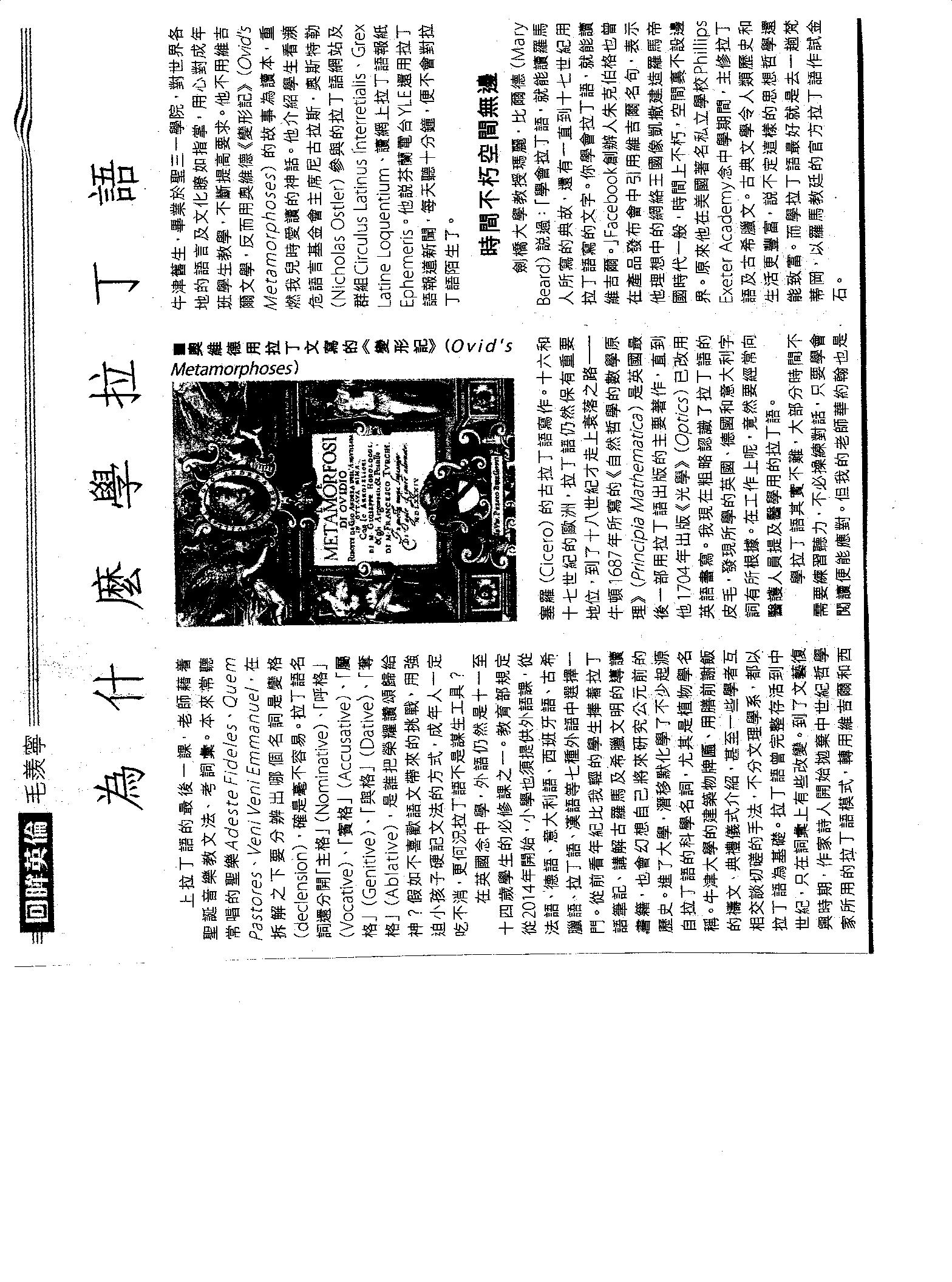
The files below are a short article in Chinese on the SPACE Latin I course held in autumn 2013, published in 信報 in January 2014 and written by one of the participants, and a summary of Latin examinations which can be taken in Hong Kong:
Latin III (Dante Alighieri Society)
To be held on Mondays from 7.00 to 9.00 p.m. at the Society’s premises at Room 702, 7/F, Hong Kong Arts Centre, 2 Harbour Road in Wanchai for fifteen sessions starting from 8 January and covering chapters 21-30 in `Latin via Ovid'. The detailed syllabus contents are available at https://linguae.weebly.com/latin-iii.html. If you are interested, please email John Whelpton here or contact Dante at http://ladante.cc/about-us/contact-us/
Latin III (Dante Alighieri Society)
To be held on Saturdays from 2.00 to 4.00 p.m. at the Society’s premises at Room 702, 7/F, Hong Kong Arts Centre, 2 Harbour Road in Wanchai for fifteen sessions starting on 24 February and covering chapters 21-30 in `Latin via Ovid'. The detailed syllabus contents are available at https://linguae.weebly.com/latin-iii.html. If you are interested, please email John Whelpton here or contact Dante at http://ladante.cc/about-us/contact-us/
Dante also hope to start a Latin II course on Tuesday evenings but do not yet have enough students. The detailed syllabus contents are at linguae.weebly.com/latin-ii-mon.html If you are interested, please email John Whelpton here or contact Dante at http://ladante.cc/about-us/contact-us/ and state the earliest date you could start from.
If you have further questions after looking at the links provided, or would like information on individual tuition, please email me here. My profile as a tutor for teenagers is available on the ITS Asia site.
The files below are a short article in Chinese on the SPACE Latin I course held in autumn 2013, published in 信報 in January 2014 and written by one of the participants, and a summary of Latin examinations which can be taken in Hong Kong:
|

| ||||
 |
 |
Circulus Latinus Honcongensis
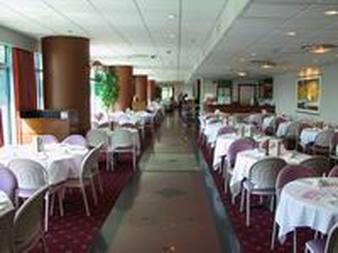
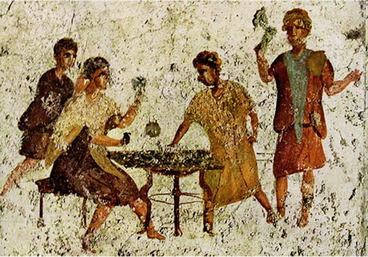
Conventus proximus Circuli Latini Honcongensis septima hora et dimidia post meridiem 22 die mensis Novembris (die Martis) anno MMXXIII in caupona Basmati in Circulo Superiore. De rebus in Circulis Latinis agendis et regulis nostris in pagina Circuli et Latine et Anglice legere poteris. Si plura scire vis, ad Iohannem Velptonium epistula mittenda est.
The next meeting of the Circulus Latinus Honcongensis will be held at 7 .30 p.m. on 22 August (Tuesday) 2023 at the Basmati Restaurant in Sheung Wan. You can read more about what goes on in Circuli Latini and about our rules in both Latin and English on the Circulus page. For further information, you should write to John Whelpton
| hong_kong_latin_circle.doc |
Gaudium Mundo - Latin songs for Christmas
Laura Gibb's page of Latin carols gives the lyrics of two or three carols for each day of December, including both carols like `Adeste Fideles' which were originally written in Latin and translations of carols in other languages. There are also links in many cases to performances available on Youtube.
The CARMINA NATIVITATIS page on my own site includes a link to Andrea Bocelli's performance of `Adeste Fideles' on Youtube and the two verses he actually sings can be read there, with literal translation. The page also contains words, translation and video/audio links for other Christmas songs, including a female choir singing `Veni, Veni Emmanuel'. Gaudium Mundo has a link to a different performance. There also words for the Advent hymn Gaudete which can be heard on Youtube performed by Libera with a boys' choir and also (via the Wikipedia page for the song) by the dwsChorale.
The CARMINA NATIVITATIS page on my own site includes a link to Andrea Bocelli's performance of `Adeste Fideles' on Youtube and the two verses he actually sings can be read there, with literal translation. The page also contains words, translation and video/audio links for other Christmas songs, including a female choir singing `Veni, Veni Emmanuel'. Gaudium Mundo has a link to a different performance. There also words for the Advent hymn Gaudete which can be heard on Youtube performed by Libera with a boys' choir and also (via the Wikipedia page for the song) by the dwsChorale.
On other Classics Sites
(for formal on-line Latin courses see `Latin in Hong Kong' at the bottom of this page)
I keep a list of interesting web pages at http://delicious.com/Velptonius and also post new links in messages sent out to members of the Circulus Latinus Honcongensis. Since the old Wordchamp site closed last year I can no longer gloss the vocabulary used in Finnish Radio's weekly Latin news bulletins but I hope it will be possible to make this database, covering bulletins from 2007 to early 2013, available again at some point in future. The bulletins themselves can be listened to on-line and the transcript read on the main `Nuntii Latini' page, whilst those wishing to download the sound files to store on their own computer can do so from the areena section of the Finnish site.
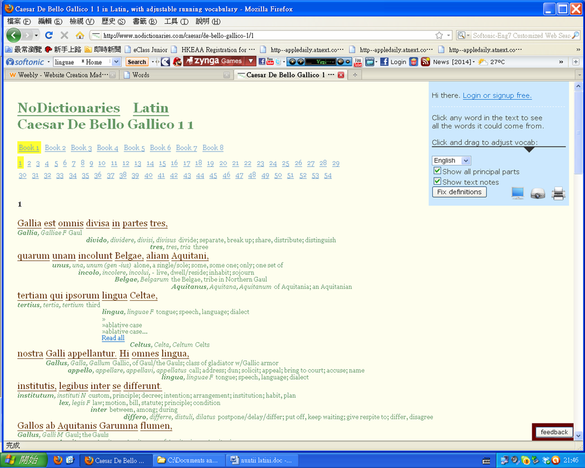
Vocabulary help for reading Latin on-line is available on Lee Butterman's http://nodictionaries.com/ and access is completely free of charge. After the reader has selected from works already listed on the site (e.g. Caeasar's De Bello Gallico or Vergil's Aeneid), or pasted in Latin of his/her own, the text will appear with dictionary entries for words displayed below each line. Sliding the triangle along the line on the right of the screen selects whether the glosses are are shown for all words, for less common words only or hidden completely. The less common meanings of words glossed are not displayed initially but can be called up by clicking on any word in the line. Registered users may also add notes of their own. Fuller details of how to use NoDictionaries are provided in Laura Gibbs' blog. Laura herself regularly uploads interesting material, in particular simple Latin fables - she outlines her plans for 2012 here. Her collection of 1001 Latin distichs (2-line poems) is downloadable as a PDF file from http://distichalatina.blogspot.co.uk/ The poems are divided into three categories: those using only the core vocabulary (1,000 words) on the DCC.Dickinson.edu site, those including one word not on the list and those containing two such words. The meanings of these less common words are provided on the facing page to the poems themselves.
In contrast to my own former method on Wordchamp, NoDictionaries gives only dictionary headwords, and does not parse or translate the inflected forms themselves. Parsing of individual words (i.e. provision of a complete grammatical analysis), but not an exact translation of the word as used in the particular sentence, is available on the Perseus site (by clicking on individual words in the texts in their collection) and on Whittaker's Words (by typing the word into a dialogue box). Perhaps the most user-friendly tool for full parsing plus dictionary entry is the Electronic Pocket Oxford Latin Dictionary but this has to be bought from the publisher or via the Cambridge Latin Course site. The current cost is equivalent to around HK$200 or US$25 and enables the purchaser to use the software indefinitely on two computers.
Vocabulary help for reading Latin on-line is available on Lee Butterman's http://nodictionaries.com/ and access is completely free of charge. After the reader has selected from works already listed on the site (e.g. Caeasar's De Bello Gallico or Vergil's Aeneid), or pasted in Latin of his/her own, the text will appear with dictionary entries for words displayed below each line. Sliding the triangle along the line on the right of the screen selects whether the glosses are are shown for all words, for less common words only or hidden completely. The less common meanings of words glossed are not displayed initially but can be called up by clicking on any word in the line. Registered users may also add notes of their own. Fuller details of how to use NoDictionaries are provided in Laura Gibbs' blog. Laura herself regularly uploads interesting material, in particular simple Latin fables - she outlines her plans for 2012 here. Her collection of 1001 Latin distichs (2-line poems) is downloadable as a PDF file from http://distichalatina.blogspot.co.uk/ The poems are divided into three categories: those using only the core vocabulary (1,000 words) on the DCC.Dickinson.edu site, those including one word not on the list and those containing two such words. The meanings of these less common words are provided on the facing page to the poems themselves.
In contrast to my own former method on Wordchamp, NoDictionaries gives only dictionary headwords, and does not parse or translate the inflected forms themselves. Parsing of individual words (i.e. provision of a complete grammatical analysis), but not an exact translation of the word as used in the particular sentence, is available on the Perseus site (by clicking on individual words in the texts in their collection) and on Whittaker's Words (by typing the word into a dialogue box). Perhaps the most user-friendly tool for full parsing plus dictionary entry is the Electronic Pocket Oxford Latin Dictionary but this has to be bought from the publisher or via the Cambridge Latin Course site. The current cost is equivalent to around HK$200 or US$25 and enables the purchaser to use the software indefinitely on two computers.
For vocabulary flashcards, search on the CRAM site for my username Iohannes or use the direct links provided on the Flashcards page of this site. The cards, which can be accessed by anyone without charge, present words from:
- The BLMCSS Latin course (based on Book 1 of the Cambridge Latin Course with some supplementary material) and from
Books 2-5 of the Cambridge series.
- Latin via Ovid (Wayne State University Press)
- My lessons as part of the Summer Intensive Latin course given at Chinese University of Hong Kong in July 2009.
- Wheelock's Latin
- The prescribed vocabularies for the Canbridge IGCSE , OCR GCSE and Common entrance examinations
Cards for Zinn's So you Really want to Learn Latin Prep , Oulton's So You Really want to Learn Latin and the Oxford Latin Course are currently being added.
A July 2013 Economist article on the current revival of Latin can be read here.
My PowerPoint presentations on Roman Britain and on the career of its best-known governor, Gnaeus Julius Agricola, with a third on the continuing use of Latin after its `death' can be downloaded here:
- The BLMCSS Latin course (based on Book 1 of the Cambridge Latin Course with some supplementary material) and from
Books 2-5 of the Cambridge series.
- Latin via Ovid (Wayne State University Press)
- My lessons as part of the Summer Intensive Latin course given at Chinese University of Hong Kong in July 2009.
- Wheelock's Latin
- The prescribed vocabularies for the Canbridge IGCSE , OCR GCSE and Common entrance examinations
Cards for Zinn's So you Really want to Learn Latin Prep , Oulton's So You Really want to Learn Latin and the Oxford Latin Course are currently being added.
A July 2013 Economist article on the current revival of Latin can be read here.
My PowerPoint presentations on Roman Britain and on the career of its best-known governor, Gnaeus Julius Agricola, with a third on the continuing use of Latin after its `death' can be downloaded here:

|
| ||||
| life_after_death.ppt |
Introduction to Latin
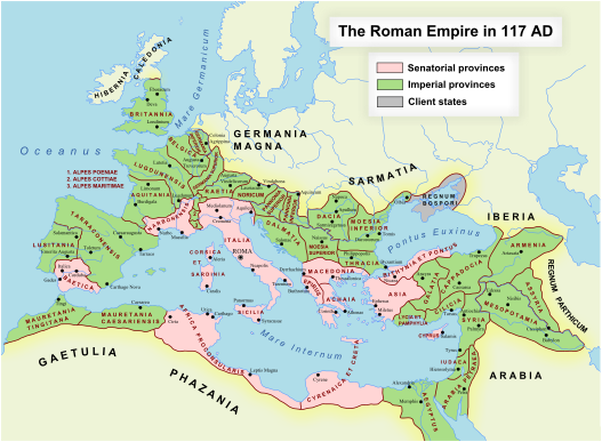
Latin was at first the language of Latium, the ancient name of the area around the mouth of the River Tiber on the western coast of Italy. Between the 4th and the 1st. centuries before the birth of Christ the people of Rome conquered Latium, then all Italy and finally of much of Europe, North Africa and the Middle East. Roman soldiers, traders and settlers spread Latin throughout their empire.
The Roman Empire in the West collapsed in the 5th century after Christ but Latin continued to be spoken in many parts of southern Europe. There were already differences in the way the language was spoken in different areas and these different dialects (方言) gradually changed into Spanish, Portuguese, French, Italian and Romanian. Because they developed from Latin spoken by the Romans, these modern languages are known as `Romance languages’ and we also sometimes use the word `Latin’ as an adjective for the peoples and cultures associated with them. Thus Central and South America, where Spanish or Portuguese are spoken, are known as `Latin America.’
The similarities between Latin and the modern Romance languages can easily be seen by comparing the present tense of the verb `love’ in each of them (see the table below). Written French has changed more than written Spanish, Portuguese or Italian and spoken French (shown in phonetic symbols) has changed even more. A Spaniard can understand most simple sentences in Italian (and vice versa) but, unless they have studied French, neither of them will understand a French person speaking. However, all Romance languages are still so close to the original Latin and to each other that learning a little of any one of them makes it easier when you start learning another.
Table 1: The Verb `love’ in the Romance Languages
Latin was at first the language of Latium, the ancient name of the area around the mouth of the River Tiber on the western coast of Italy. Between the 4th and the 1st. centuries before the birth of Christ the people of Rome conquered Latium, then all Italy and finally of much of Europe, North Africa and the Middle East. Roman soldiers, traders and settlers spread Latin throughout their empire.
The Roman Empire in the West collapsed in the 5th century after Christ but Latin continued to be spoken in many parts of southern Europe. There were already differences in the way the language was spoken in different areas and these different dialects (方言) gradually changed into Spanish, Portuguese, French, Italian and Romanian. Because they developed from Latin spoken by the Romans, these modern languages are known as `Romance languages’ and we also sometimes use the word `Latin’ as an adjective for the peoples and cultures associated with them. Thus Central and South America, where Spanish or Portuguese are spoken, are known as `Latin America.’
The similarities between Latin and the modern Romance languages can easily be seen by comparing the present tense of the verb `love’ in each of them (see the table below). Written French has changed more than written Spanish, Portuguese or Italian and spoken French (shown in phonetic symbols) has changed even more. A Spaniard can understand most simple sentences in Italian (and vice versa) but, unless they have studied French, neither of them will understand a French person speaking. However, all Romance languages are still so close to the original Latin and to each other that learning a little of any one of them makes it easier when you start learning another.
Table 1: The Verb `love’ in the Romance Languages
|
LATIN
AMO AMAS AMAT AMAMUS AMATIS AMANT |
SPANISH
AMO AMAS AMA AMAMOS AMÁIS AMAN |
PORTUG'SE
AMO AMI AMA AMAMOS AMAIS AMAM |
ITALIAN
AMO AMI AMA AMIAMO AMATE AMANO |
FRENCH
AIME/eim/ AIMES/eim/ AIME/eim/ AIMONS/eimõ/ AIMEZ/eimei/ AIMENT /eim/ |
ENGLISH
(I) love (thou) lovest (he/she) loves (we) love (you) love (they) love |
NOTES:
English `(thou) lovest’, which was a singular form contrasting with the originally plural `you love', is now obsolete.
The sign ~ over a vowel means that it is pronounced nasally, with air escaping through the nose as well as through the mouth.
The PowerPoint below provides an overview of the changes from Latin to modern Romance, focussing particularly on the development of Italian:
English `(thou) lovest’, which was a singular form contrasting with the originally plural `you love', is now obsolete.
The sign ~ over a vowel means that it is pronounced nasally, with air escaping through the nose as well as through the mouth.
The PowerPoint below provides an overview of the changes from Latin to modern Romance, focussing particularly on the development of Italian:
| from_latin_to_italian.ppt |
English is not a Romance language but it has borrowed many words directly from Latin with slight changes (e.g. velocity (< velocitas), altitude (<altitudo)) and others indirectly though French (e.g. measure (<Old Fr. mesure < Lat. mensura), beef (< Fr. boeuf < Lat. bovem, cow)). This means that if you know the background to a Latin passage you may be able to guess what it is about even before you have started Latin lessons.
There are also many Latin phrases that are still used in formal English without any alteration at all , including status quo (the way things are at present), ad hoc (for this special purpose) and agenda (things to be done or discussed). This feature of English is discussed in Cantonese by former Hong Kong civil servant Regina Yip (葉劉淑儀) .
Although by about 600 A.D, Latin was very different from what people actually spoke, it remained the official language of the Christian church in Europe. After the Reformation (宗教改革), the Protestant churches began to use local, spoken languages but the Catholic Church (天主教教會) used Latin for its most important ceremony, the Mass, until the 1960s and even today the Pope’s most important statements are still translated into it. During the Middle Ages (中世紀) and the early modern period, government records were kept in Latin and scholars and political leaders used it as an international language, in the same way that French was used from the 18th to the early 20th century and that English is used now. The last major international treaty in Latin was signed in 1756 between Denmark and Turkey, whilst in Britain official records of births and deaths were often maintained in Latin until 1733 and in Hungary and Croatia Latin remained the official language of parliamentary proceedings until the middle of the 19th century.
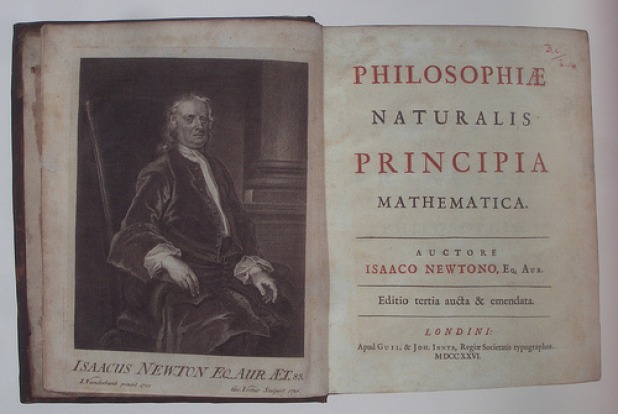
Until the 17th century, scientists usually published their results in Latin. They then largely switched to using the language of their own country, and Isaac Newton’s Principia Mathematica (1687), which explained his theory of gravitation, was one of the last important scientific books to be written in the old language. However, Latin is still used today by biologists for giving scientific names to different species (e.g. Musca domestica = the house fly) and until 2011 descriptions of new plant specieso still had to be published in Latin.
Figure 2: Newton’s Laws of Motion from Principia Mathematica[1]
Lex I Corpus omne perseverare in statu suo quiescendi vel movendi uniformiter in directum, nisi quatenus illud a viribus impressis cogitur statum suum mutare.
[That every object remains in its state of rest or of movement at a constant speed in a straight line except in so far as it is made to change its state by forces applied to it]
Lex II Mutationem motus proportionalem esse vi motrici impressæ, & fieri secundum lineam rectam qua vis illa imprimitur.
[That acceleration is proportional to the applied motive force and takes place in a straight line in the same direction as the application of that force]
Lex III Actioni contrariam semper & æqualem esse reactionem: sive corporum duorum actiones in se mutuo semper esse æquales & in partes contrarias dirigi.
[That there is always an opposite and equal reaction to every action: that is, the actions of two objects upon one another are always equal and in opposite directions]
[1] From Philosophiae Naturalis Principia Mathematica [Mathematical Principles of Natural Philosophy], 3rd. edition, 1726, p.13 and following. This and other extracts are available on-line at http://www.thelatinlibrary.com/newton.html and all of Newton's papers preserved in the Cambridge University Library are currently being digitalised an put on line. A sample of Newton's handwritten Latin notes can be seen here.
English is not a Romance language but it has borrowed many words directly from Latin with slight changes (e.g. velocity (< velocitas), altitude (<altitudo)) and others indirectly though French (e.g. measure (<Old Fr. mesure < Lat. mensura), beef (< Fr. boeuf < Lat. bovem, cow)). This means that if you know the background to a Latin passage you may be able to guess what it is about even before you have started Latin lessons.
There are also many Latin phrases that are still used in formal English without any alteration at all , including status quo (the way things are at present), ad hoc (for this special purpose) and agenda (things to be done or discussed). This feature of English is discussed in Cantonese by former Hong Kong civil servant Regina Yip (葉劉淑儀) .
Although by about 600 A.D, Latin was very different from what people actually spoke, it remained the official language of the Christian church in Europe. After the Reformation (宗教改革), the Protestant churches began to use local, spoken languages but the Catholic Church (天主教教會) used Latin for its most important ceremony, the Mass, until the 1960s and even today the Pope’s most important statements are still translated into it. During the Middle Ages (中世紀) and the early modern period, government records were kept in Latin and scholars and political leaders used it as an international language, in the same way that French was used from the 18th to the early 20th century and that English is used now. The last major international treaty in Latin was signed in 1756 between Denmark and Turkey, whilst in Britain official records of births and deaths were often maintained in Latin until 1733 and in Hungary and Croatia Latin remained the official language of parliamentary proceedings until the middle of the 19th century.
Until the 17th century, scientists usually published their results in Latin. They then largely switched to using the language of their own country, and Isaac Newton’s Principia Mathematica (1687), which explained his theory of gravitation, was one of the last important scientific books to be written in the old language. However, Latin is still used today by biologists for giving scientific names to different species (e.g. Musca domestica = the house fly) and until 2011 descriptions of new plant specieso still had to be published in Latin.
Figure 2: Newton’s Laws of Motion from Principia Mathematica[1]
Lex I Corpus omne perseverare in statu suo quiescendi vel movendi uniformiter in directum, nisi quatenus illud a viribus impressis cogitur statum suum mutare.
[That every object remains in its state of rest or of movement at a constant speed in a straight line except in so far as it is made to change its state by forces applied to it]
Lex II Mutationem motus proportionalem esse vi motrici impressæ, & fieri secundum lineam rectam qua vis illa imprimitur.
[That acceleration is proportional to the applied motive force and takes place in a straight line in the same direction as the application of that force]
Lex III Actioni contrariam semper & æqualem esse reactionem: sive corporum duorum actiones in se mutuo semper esse æquales & in partes contrarias dirigi.
[That there is always an opposite and equal reaction to every action: that is, the actions of two objects upon one another are always equal and in opposite directions]
[1] From Philosophiae Naturalis Principia Mathematica [Mathematical Principles of Natural Philosophy], 3rd. edition, 1726, p.13 and following. This and other extracts are available on-line at http://www.thelatinlibrary.com/newton.html and all of Newton's papers preserved in the Cambridge University Library are currently being digitalised an put on line. A sample of Newton's handwritten Latin notes can be seen here.
Even after modern European languages had taken over its old functions, Latin remained an important part of the school syllabus in Europe until modern times. At the grammar school where I was myself a student in the 1960s, most of us studied Lain until F5 and a few people (including me) studied it also in F6 and 7 and at university. Latin is not now so widely taught in British schools[1] but it is still quite important in Italy, Germany and some other European countries.
Those who still study Latin normally learn it only as a written language and use it just to read ancient Roman literature. However, nowadays some scholars use Latin to send e-mails to each other and also even talk to each other in it. Examples of Latin e-mails can be read on the website of Finnish radio, which hosts a Latin Internet discussion group. The same site lets you hear and read a Latin news bulletin every week (http://www.yle.fi/radio1/tiede/nuntii_latini/ .). There are readings of passages from ancient Latin and Greek literature at http://www.pyrrha.demon.co.uk/psound3.html. and videos of people speaking Latin at the University of Kentucky at http://www.uky.edu/AS/Classics/videocasts/ (if the videos do not play properly, try on Youtube). Latin has also been used (with German subtitles) in a full-length documentary made for German television. Finally, the Romans in Mel Gibson’s film, The Passion of the Christ, all speak in Latin (see extracts below). The filmmakers tried to make this like the simpler Latin we believe ordinary people spoke at this time. The written Latin which was used by educated people and which we study today was rather more complicated.
[1]Out of about 600, 000 students who took the GCSE (equivalent of the HKCE) in 2004, less than 10,000 took Latin. There are now so few specialist Latin teachers working in British schools that the subject will only survive if web-based courses are developed to allow students to study the language by distance-learning. However, numbers were holding up a little better in some other countries; in 2010, there were estimated to be over 600,000 studying Latin in Germany and around 500,000 in the USA.
Those who still study Latin normally learn it only as a written language and use it just to read ancient Roman literature. However, nowadays some scholars use Latin to send e-mails to each other and also even talk to each other in it. Examples of Latin e-mails can be read on the website of Finnish radio, which hosts a Latin Internet discussion group. The same site lets you hear and read a Latin news bulletin every week (http://www.yle.fi/radio1/tiede/nuntii_latini/ .). There are readings of passages from ancient Latin and Greek literature at http://www.pyrrha.demon.co.uk/psound3.html. and videos of people speaking Latin at the University of Kentucky at http://www.uky.edu/AS/Classics/videocasts/ (if the videos do not play properly, try on Youtube). Latin has also been used (with German subtitles) in a full-length documentary made for German television. Finally, the Romans in Mel Gibson’s film, The Passion of the Christ, all speak in Latin (see extracts below). The filmmakers tried to make this like the simpler Latin we believe ordinary people spoke at this time. The written Latin which was used by educated people and which we study today was rather more complicated.
[1]Out of about 600, 000 students who took the GCSE (equivalent of the HKCE) in 2004, less than 10,000 took Latin. There are now so few specialist Latin teachers working in British schools that the subject will only survive if web-based courses are developed to allow students to study the language by distance-learning. However, numbers were holding up a little better in some other countries; in 2010, there were estimated to be over 600,000 studying Latin in Germany and around 500,000 in the USA.
Further information on the language and its use in Europe is included in the Powerpoint presentation INTRODUCING LATIN downloadable here.
| introducing_latin__adults_.ppt |
The Structure of Latin
The main difference between Latin and English is that Latin makes very many changes to the endings of words to show their grammatical role within the sentence. English sometimes does the same thing (e.g. he changes into him when it is the object of a verb and do changes into did when it becomes past tense). However, English (like Chinese) mainly relies just on word order and on adding additional words.
As an example of the Latin method, look at the following sentence:
Marce, Paulus militis pecuniam Petro in templo dedit
Mark, Paul soldier’s money to-Peter in temple gave
i.e Mark, Paul gave the soldier’s money to Peter in the temple.
In the dictionary, the Latin for the English words would be listed like this:
Mark – Marcus, soldier – miles Peter – Petrus give – do
Paul – Paulus money – pecunia temple – templum
In the sentence, only Paulus (the subject of the sentence) keeps its dictionary form. The other words change in different ways:
- Marcus becomes Marce, to show he is the person being talked to.
- We have militis instead of miles to show the soldier owns the money (English adds `s in the same way – soldier’s)
- An m is added to pecunia as the word is the direct object of the verb.
- The –o ending for Petro marks the word as the indirect object of the verb
- The –o of templo is needed as the word is used with the preposition in to show where the action happened.
- Finally, the verb form dedit shows both the tense (past) and also that the subject is one person or thing not taking part in the conversation. The form do in our list actually means `I give’. Among many other forms of the same verb are dedimus (`We gave’), datur (`is given’) and dabimini (`you (plural) will be given’).
This system seems very complicated at first but you need only learn the different endings a few at a time and it will become easier. Because the endings of words give so much information, one word in Latin often does the job of two or more in English. For example, Crucio (one of the Unforgivable Curses in the Harry Potter books) means `I torture!’ The Latin system also gives a speaker or writer freedom to change the order of words to emphasise a particular part of the sentence or to fit the rhythm of a poem. For example, although Latin normally has the word order subject-object-verb (e.g. Marcus Petrum videt – Mark sees Peter), we could also say Petrum Marcus videt if we are especially interested in the fact that it was Peter, not somebody else, that Mark saw. An example from poetry is the opening lines from a famous poem by the Roman writer Horace. He is pretending to be speaking to a former (real or imaginary) girl-friend.
Quis multa gracilis te puer in rosa
What many slender you youth among rose
Perfusus liquidis urget odoribus
Soaked liquid courts perfumes-in
The endings of the words tell us that puer is the subject of the sentence and goes together with the adjectives quis and gracilis and the participle perfusus. Similarly, we know that te is the object of the verb and that multa descibes rosa. So the English meaning is: `What slender youth, soaked in liquid perfumes, courts you (向您求愛) among many a rose.’
In the modern Romance languages, the different endings on nouns have disappeared. However, especially in Spanish and Italian, the verb endings have often been kept with only small changes, as we saw for the present tense in Table 1.
Until recently, people learning Latin were expected to concentrate first on quickly learning all the many different endings which nouns, adjectives and verbs can have. However, schools still teaching Latin nowadays concentrate first on reading and building up vocabulary, and only introduce grammatical rules when they are needed. The central part of the Cambridge Latin Course, which is the most popular Latin textbook in British schools, is a series of simple stories about people living in ancient Rome. You can see the Cambridge material at http://www.cambridgescp.com/latin/clc/onlineA/clc_onlineA_b1.php and there is a 15-minute video showing how the course is used with gifted students in some London primary schools at http://www.teachers.tv/videos/verbatim-latin-in-primary-schools.
As an example of the Latin method, look at the following sentence:
Marce, Paulus militis pecuniam Petro in templo dedit
Mark, Paul soldier’s money to-Peter in temple gave
i.e Mark, Paul gave the soldier’s money to Peter in the temple.
In the dictionary, the Latin for the English words would be listed like this:
Mark – Marcus, soldier – miles Peter – Petrus give – do
Paul – Paulus money – pecunia temple – templum
In the sentence, only Paulus (the subject of the sentence) keeps its dictionary form. The other words change in different ways:
- Marcus becomes Marce, to show he is the person being talked to.
- We have militis instead of miles to show the soldier owns the money (English adds `s in the same way – soldier’s)
- An m is added to pecunia as the word is the direct object of the verb.
- The –o ending for Petro marks the word as the indirect object of the verb
- The –o of templo is needed as the word is used with the preposition in to show where the action happened.
- Finally, the verb form dedit shows both the tense (past) and also that the subject is one person or thing not taking part in the conversation. The form do in our list actually means `I give’. Among many other forms of the same verb are dedimus (`We gave’), datur (`is given’) and dabimini (`you (plural) will be given’).
This system seems very complicated at first but you need only learn the different endings a few at a time and it will become easier. Because the endings of words give so much information, one word in Latin often does the job of two or more in English. For example, Crucio (one of the Unforgivable Curses in the Harry Potter books) means `I torture!’ The Latin system also gives a speaker or writer freedom to change the order of words to emphasise a particular part of the sentence or to fit the rhythm of a poem. For example, although Latin normally has the word order subject-object-verb (e.g. Marcus Petrum videt – Mark sees Peter), we could also say Petrum Marcus videt if we are especially interested in the fact that it was Peter, not somebody else, that Mark saw. An example from poetry is the opening lines from a famous poem by the Roman writer Horace. He is pretending to be speaking to a former (real or imaginary) girl-friend.
Quis multa gracilis te puer in rosa
What many slender you youth among rose
Perfusus liquidis urget odoribus
Soaked liquid courts perfumes-in
The endings of the words tell us that puer is the subject of the sentence and goes together with the adjectives quis and gracilis and the participle perfusus. Similarly, we know that te is the object of the verb and that multa descibes rosa. So the English meaning is: `What slender youth, soaked in liquid perfumes, courts you (向您求愛) among many a rose.’
In the modern Romance languages, the different endings on nouns have disappeared. However, especially in Spanish and Italian, the verb endings have often been kept with only small changes, as we saw for the present tense in Table 1.
Until recently, people learning Latin were expected to concentrate first on quickly learning all the many different endings which nouns, adjectives and verbs can have. However, schools still teaching Latin nowadays concentrate first on reading and building up vocabulary, and only introduce grammatical rules when they are needed. The central part of the Cambridge Latin Course, which is the most popular Latin textbook in British schools, is a series of simple stories about people living in ancient Rome. You can see the Cambridge material at http://www.cambridgescp.com/latin/clc/onlineA/clc_onlineA_b1.php and there is a 15-minute video showing how the course is used with gifted students in some London primary schools at http://www.teachers.tv/videos/verbatim-latin-in-primary-schools.
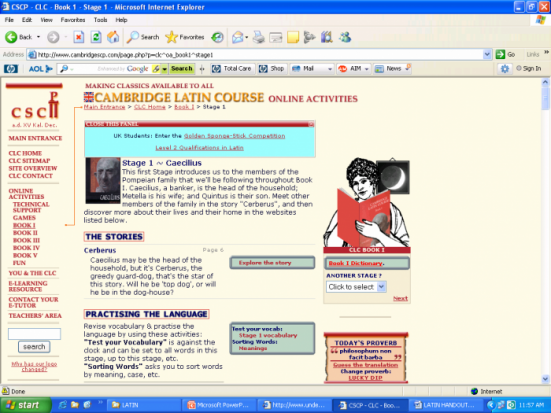
Cambridge Latin Course Website
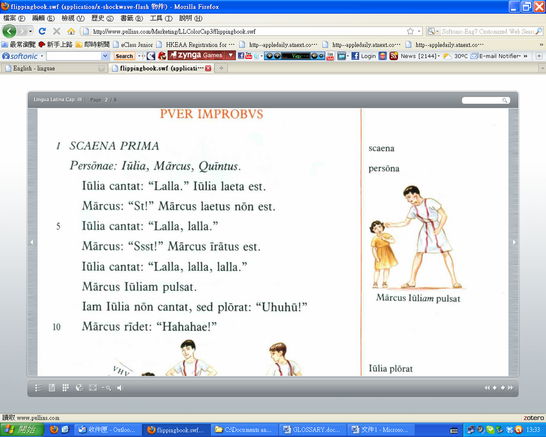
The Cambridge course still involves use of the students' mother tongue to give the meaning of vocabulary and to explain the grammar but Hans Ørberg's Lingua Latin Per Se Illustrata attempts to teach Latin without using any other language. Meanings are demonstrated by illustrations or can be worked out from other words already known. The course is available on CD, with the author himself reading the text aloud. Chapter 3 of Familia Romana, the beginners' book, can be sampled online here.
Pronunciation of Latin
We cannot be completely sure how Latin originally sounded but we know roughly what it was like because we have descriptions of Roman speech by ancient authors and we can also compare how the sounds developed in the modern Romance languages. Today scholars usually read (or speak) Latin using what we think were the original sounds and you can hear extensive examples on Johan Winge's Alatius site. However, the Catholic Church (天主教教會) still uses a pronunciation close to that of modern Italian and you will often hear this in recordings of church music or of medieval Latin; there is an example (the Credo sung clearly and with the Latin text displayed phrase by phrase) here and a translation is available here. You can hear one of the world’s leading teachers of Latin, Fr Reginald Foster, using this pronunciation at http://br.youtube. com/watch? v=_fRW1HUkG3c&feature=related (ignore the commentary in German and the subtitles in Portuguese!). The medieval Latin heard most often today is probably the collection of songs entitled Carmina Burana, some of which have recently been recorded by the German group, Corvus Corax. In the table below, the church pronunciation has been given in square brackets after the original sound.
VOWELS
The main vowels each had a short and a long sound. In Latin as the Romans wrote it, and as it is usually printed today, the vowel is written the same way whether it is pronounced short or long. However, in texts written for beginners long vowels are often marked by a straight line over the top.
Ā (long) as in father A (short) roughly as the `u' in gun or as in in hat
Ē (long) roughly as in day E (short) as in bed
Ī (long) as in see I (short) as in sit
(when followed by another consonant, I normally had the sound /j/ as in yard. In medieval (中世紀的)documents this sound is often written as J, but there was no J in the original Latin alphabet))
Ō (long) as in go O (short) as in got
Ū (long) like `oo' in fool U (short) as in full
DIPHTHONGS
AE like `ie' in die [Church pronunciation is. like the vowel sound in day or the onme in bed. This pronunciation is also used by the readers of Latin news on Finnish Radio (http://www.yleradio1.fi/nuntii. ), even though they follow the original pronunciation for most other Latin sounds)
OE like `oi' in oil
AU like `au' in out
EI like `ay' in day (but often these two letters were pronounced as separate vowels
- /e-i:/ )
VOWELS
The main vowels each had a short and a long sound. In Latin as the Romans wrote it, and as it is usually printed today, the vowel is written the same way whether it is pronounced short or long. However, in texts written for beginners long vowels are often marked by a straight line over the top.
Ā (long) as in father A (short) roughly as the `u' in gun or as in in hat
Ē (long) roughly as in day E (short) as in bed
Ī (long) as in see I (short) as in sit
(when followed by another consonant, I normally had the sound /j/ as in yard. In medieval (中世紀的)documents this sound is often written as J, but there was no J in the original Latin alphabet))
Ō (long) as in go O (short) as in got
Ū (long) like `oo' in fool U (short) as in full
DIPHTHONGS
AE like `ie' in die [Church pronunciation is. like the vowel sound in day or the onme in bed. This pronunciation is also used by the readers of Latin news on Finnish Radio (http://www.yleradio1.fi/nuntii. ), even though they follow the original pronunciation for most other Latin sounds)
OE like `oi' in oil
AU like `au' in out
EI like `ay' in day (but often these two letters were pronounced as separate vowels
- /e-i:/ )
CONSONANTS
These were always pronounced as written, so a double consonant was pronounced as two separate sounds or as a longer sound than that represented by a single consonant. So ille (that) was pronounced il-le
C always like /k/ in cake or king [in church pronunciation, C has the sound of `ch' in church] when it comes before I or E]
G always like /g/ in good or girl [in church pronunciation G has the sound of `g' in gentle when it comes before I or E]
M when reading Latin today, we nearly always pronounce this like English /m/. However, the Romans themselves, at least in poetry, often did not pronounce a final M fully. Instead the vowel before it was nasalised, that is, air passed out through the speaker’s nose as well as his month. There are many vowels of this kind in modern French.
T always like /t/ in tin [in church pronunciation, T has the sound /ts/ (as in hats) when it is followed by I or E]
V like /w/ in we [in church pronunciation,V has the sound /v/ as in very](in the Romans’ own alphabet V was just another shape for U and both letters could represent either the vowel sound /v/ or the consonant /w/. However, when Latin is printed today, only U is normally used for the vowel sound and only V for the consonant. An exception is in the letter combination QU, where we write U but use the pronunciation /kw/ - this, of course, is normally the way QU is pronounced in English – e.g. queen, question etc.).
A fuller account of the individual sounds is available for download here:
These were always pronounced as written, so a double consonant was pronounced as two separate sounds or as a longer sound than that represented by a single consonant. So ille (that) was pronounced il-le
C always like /k/ in cake or king [in church pronunciation, C has the sound of `ch' in church] when it comes before I or E]
G always like /g/ in good or girl [in church pronunciation G has the sound of `g' in gentle when it comes before I or E]
M when reading Latin today, we nearly always pronounce this like English /m/. However, the Romans themselves, at least in poetry, often did not pronounce a final M fully. Instead the vowel before it was nasalised, that is, air passed out through the speaker’s nose as well as his month. There are many vowels of this kind in modern French.
T always like /t/ in tin [in church pronunciation, T has the sound /ts/ (as in hats) when it is followed by I or E]
V like /w/ in we [in church pronunciation,V has the sound /v/ as in very](in the Romans’ own alphabet V was just another shape for U and both letters could represent either the vowel sound /v/ or the consonant /w/. However, when Latin is printed today, only U is normally used for the vowel sound and only V for the consonant. An exception is in the letter combination QU, where we write U but use the pronunciation /kw/ - this, of course, is normally the way QU is pronounced in English – e.g. queen, question etc.).
A fuller account of the individual sounds is available for download here:
| latin_pronunciation.doc |
STRESS:
Latin words were never stressed on their final syllable, so in a word of two syllables the stress was always on the first (this is what usually – but not always- happens with English two-syllable words).
- When a word had three or more syllables, the stress was either on the second-to-last or on the third syllable from the end:
- If the vowel in the second-to-last syllable was long OR if it was followed by two
or more consonants, the second-last-syllable was stressed.
- If the vowel in the second-last syllable was short and was not followed by two
consonants, the stress was placed on the third syllable from the end.
In using these rules, you need to remember that:
An l or r following another consonant was regarded as combining with that consonant to form a single sound. Thus combinations like dr, cl etc.did NOT make a short vowel in front able to take the stress.
The consonant x was really two sounds /ks/, so a short vowel in front COULD take the stress
The letter h was ignored in counting the number of consonants
Some examples of how this system works are given below. The stressed vowel is shown italicised and in red:
amō (I love)
Two-syllable word, stress on first syllable
amās (You (sing.) love)
Two-syllable word, stress on first syllable
amāmus (We love)
Three-syllable word, stress on second syllable from the end as it has a long vowel
contendunt (They struggle)
Three-syllable word, stress on second syllable from the end as the vowel, although short, is followed by two consonants
synaxis (gathering)
Three-syllable word, stress on second syllable from the end as the short vowel is followed by x, which counts as two consonants
corrigunt (They correct)
Three syllable word, stress on third syllable from the end as the second vowel from the end is short and there is only one consonant after it.
exedra
Three syllable word, stress on third syllable from the end as the second vowel from the end is short and is followed by dr, which counts as only one consonant
dominus (lord)
Three syllable word, stress on third syllable from the end as the second vowel from the end is short and there is only one consonant after it.
Pronunciation of Poetry
Before the medieval period (中世紀), Latin poetry did not depend on stress patterns (as English poetry does) but on the arrangement of long and short syllables. A syllable was regarded as long if it was one which could take the stress in the second position from the end, i.e. if it contained:
EITHER a long vowel
OR a short vowel followed by x OR a short vowel followed by two consonants (if h was not one of the consonants and if the second one was not l or r)
In the last-but-one syllable of words with more than two syllables, a long syllable was thus also a stressed one, but in other positions short syllables could be stressed.
When a word ending with a vowel (or with vowel- plus- m) came before a word beginning with a vowel, the final vowel was normally not pronounced. Thus multum ille et was pronounced mult’ ill’ et . The reason for treating vowel-plus- m in the same way as a simple vowel was probably that the m in such a position did not have a separate sound of its own unless it was followed by another consonant (see the CONSONANTS section above).
Now listen to a recording of lines by the Roman poet Virgil (W:SubjectsEnglishEurope ClubAeneid Reading at https://soundcloud.com/rhapsodoi/aeneid-11-49-perf-by-robert-p-sonkowsky
- Real Player is needed). This is the start of the Aeneid, the story of Aeneas, who was believed to have been the ancestor of the first kings of Rome and also of the Roman Emperor Augustus, for whom Virgil wrote. According to the story, Aeneas fled from Troy when it was captured by the Greeks and reached Italy, despite attempts by Juno, the queen of the gods, to stop him. The recording includes 49 lines and these can all be read in the file Aeneid Extract in the Europe Club directory or on the website. In the seven lines given here, the gaps in the Latin are for the translation to be shown for each separate word. After listening once or twice you can try using the pause button to repeat the lines after the speaker.
EITHER a long vowel
OR a short vowel followed by x OR a short vowel followed by two consonants (if h was not one of the consonants and if the second one was not l or r)
In the last-but-one syllable of words with more than two syllables, a long syllable was thus also a stressed one, but in other positions short syllables could be stressed.
When a word ending with a vowel (or with vowel- plus- m) came before a word beginning with a vowel, the final vowel was normally not pronounced. Thus multum ille et was pronounced mult’ ill’ et . The reason for treating vowel-plus- m in the same way as a simple vowel was probably that the m in such a position did not have a separate sound of its own unless it was followed by another consonant (see the CONSONANTS section above).
Now listen to a recording of lines by the Roman poet Virgil (W:SubjectsEnglishEurope ClubAeneid Reading at https://soundcloud.com/rhapsodoi/aeneid-11-49-perf-by-robert-p-sonkowsky
- Real Player is needed). This is the start of the Aeneid, the story of Aeneas, who was believed to have been the ancestor of the first kings of Rome and also of the Roman Emperor Augustus, for whom Virgil wrote. According to the story, Aeneas fled from Troy when it was captured by the Greeks and reached Italy, despite attempts by Juno, the queen of the gods, to stop him. The recording includes 49 lines and these can all be read in the file Aeneid Extract in the Europe Club directory or on the website. In the seven lines given here, the gaps in the Latin are for the translation to be shown for each separate word. After listening once or twice you can try using the pause button to repeat the lines after the speaker.
Arma virumque canō, Trōiae quī prīmus ab ōrīs
Arms man-also sing-I Troy’s who first from shores
Ītaliam, fātō profugus, Lāvīniaque vēnit
Italy by-fate refugee Lavinian-also came-he
lītora, multum ille et terrīs iactātus et altō
coasts much he both on-land troubled and at-sea
vī superum saevae memorem Iūnōnis ob īram;
by-force of-gods of-cruel unforgetting Juno’s because-of anger
multa quoque et bellō passus, dum conderet urbem,
much also and in-war suffered until found-could-he city
īnferretque deōs Latiō, genus unde Latīnum,
carry-could-he-also gods to-Latium race from-whom Latin
Albānīque patrēs, atque altae moenia Rōmae.
Alban-also fathers and high walls Rome’s
Arms man-also sing-I Troy’s who first from shores
Ītaliam, fātō profugus, Lāvīniaque vēnit
Italy by-fate refugee Lavinian-also came-he
lītora, multum ille et terrīs iactātus et altō
coasts much he both on-land troubled and at-sea
vī superum saevae memorem Iūnōnis ob īram;
by-force of-gods of-cruel unforgetting Juno’s because-of anger
multa quoque et bellō passus, dum conderet urbem,
much also and in-war suffered until found-could-he city
īnferretque deōs Latiō, genus unde Latīnum,
carry-could-he-also gods to-Latium race from-whom Latin
Albānīque patrēs, atque altae moenia Rōmae.
Alban-also fathers and high walls Rome’s
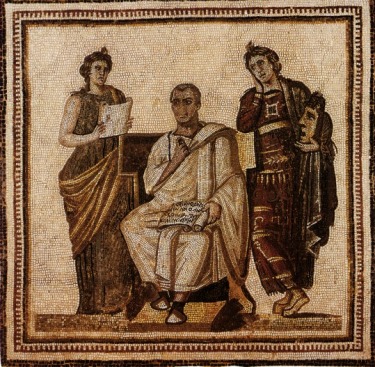
Virgil with the Muses
(In more idiomatic English: I sing of war and of the man who, exiled by fate, first came from Troy’s shores to Italy and the Lavinian coasts. He was troubled much on land and at sea through the violence of the gods because of the memorable anger of cruel Juno. He also suffered much in war until he could found a city and bring his own gods into Latium. From him came the Latin race, the Alban fathers and the walls of towering Rome.)
In the medieval period (中世紀), most Latin poetry did not follow this system but instead used a pattern of stressed and unstressed syllables to give the rhythm, just as in modern English poetry. Medieval Latin poems also often had rhyming words at the end of the lines. Here is the first verse of `Gaudeamus Igitur’, a famous student song, which was probably written after the end of the Middle Ages but which follows the medieval system. It is normally sung to a tune written down in 1781 and later included by Brahms in his `Academic Festival Overture’.
In the medieval period (中世紀), most Latin poetry did not follow this system but instead used a pattern of stressed and unstressed syllables to give the rhythm, just as in modern English poetry. Medieval Latin poems also often had rhyming words at the end of the lines. Here is the first verse of `Gaudeamus Igitur’, a famous student song, which was probably written after the end of the Middle Ages but which follows the medieval system. It is normally sung to a tune written down in 1781 and later included by Brahms in his `Academic Festival Overture’.
GAUDEAMUS IGITUR
Gaudeamus igitur
let-us-be-happy therefore
Iuvenes dum sumus
young while we-are
Gaudeamus igitur
Iuvenes dum sumus
Post iucundam iuventutem
after pleasant youth
Post molestam senectutem
after miserable old age
Nos habebit humus.
us will- have earth
Nos habebit humus.
You can hear this sung online at http://www.youtube.com/watch?v=TJllP6z8jDw&feature=related Listen first and then try to sing along with the choir. You can also hear a solo performance at http://hk.youtube.com/watch?v=WfGXYkfLJ4s&feature=related and the complete words sung by another choir here; this second choral version displays both Latin lyrics and English translation but there are mistakes in both and it is best to read the words in the Wikipedia article on the song. No long and short vowels are marked in the text because the difference between these was often ignored in later Latin pronunciation and, in any case, was not an essential part of the poetry.
Latin poetry is still being written and there is now a free Internet journal VATES, which publishes new poems together with English translations and articles in English on modern Latin poetry.
Gaudeamus igitur
let-us-be-happy therefore
Iuvenes dum sumus
young while we-are
Gaudeamus igitur
Iuvenes dum sumus
Post iucundam iuventutem
after pleasant youth
Post molestam senectutem
after miserable old age
Nos habebit humus.
us will- have earth
Nos habebit humus.
You can hear this sung online at http://www.youtube.com/watch?v=TJllP6z8jDw&feature=related Listen first and then try to sing along with the choir. You can also hear a solo performance at http://hk.youtube.com/watch?v=WfGXYkfLJ4s&feature=related and the complete words sung by another choir here; this second choral version displays both Latin lyrics and English translation but there are mistakes in both and it is best to read the words in the Wikipedia article on the song. No long and short vowels are marked in the text because the difference between these was often ignored in later Latin pronunciation and, in any case, was not an essential part of the poetry.
Latin poetry is still being written and there is now a free Internet journal VATES, which publishes new poems together with English translations and articles in English on modern Latin poetry.

Latinitas Viva (Living Latin)
The movement to revive the use of Latin as a means of real communication, at least amongst scholars, arouses considerable passion among both advocates and opponents: the former argue that no language can be properly appreciated if it is not actually used, whilst the latter think it is a frivolous diversion from the real task of studying ancient and medieval texts. At the very least, however, trying to listen to and speak the language can make the task of learning it more enjoyable for most people. Two of the best-known advocates of the `Living Latin' approach, Terentius Tunberg and Milena Minkova, explain their own reasons for using the method in an English-language documentary film available on YouTube. For those who already know Latin, there is a 2012 essay by Tunberg, `De Latine dicendi normis quas scriptores recentiores (vel neoterici) servasse videntur', discussing the appropriate models to be followed in using the language today. Danish classicist Hans Orberg (1920-2010) was an influential proponent of communicative methodology in the classroom and a video on his life and work, with commentary spoken in Latin, is available here.
For those wanting practical help in beginning to speak, useful books are John Traupman's Conversational Latin for Oral Proficiency, much of which can be freely accessed on the Internet at Google Books, and Angela Wilkes and John Shackell's Latin for Beginners, which is especially suited for young learners as it is lavishly and amusingly illustrated. There are also the bi-monthly magazines Adulescens (for those with about a year's high school Latin) and Iuvenis (for those with about two years) published by ELI magazines, with samples viewable online on the Cultura Classica site. The ELI publications present straightforward material, often related to contemporary life, in comic-book format. Traupman's book marks both long vowels and stressed syllables and the magazines stress only. Wilkes normally shows neither, though the stress is marked in some of the words in her vocabulary lists.
Downloadable internet resources include George Adler's 1858 Practical Grammar of the Latin Language, much of which has been recorded as podcasts available on Evan Millner's Latinum site; and Le latin sans peine, in the Assimil series with translations and explanations in French. Both of these are very thorough, but Adler's extensive treatment of grammatical rules will be heavy going for some whilst the Assimil text does not mark vowel quantity systematically. A much shorter collection of simple passages and conversation prompts is Piazza and Patrick's Collloquia Cottidiana: an Introduction to Everyday Useful Latin, a 23-page draft booklet. This still has many minor errors to be corrected, especially in the marking of long vowels, but is probably the best starting point amongst materials available without charge. There is also a lot of everyday vocabulary and some specimen dialogues in lessons I produced for use at the Chinese University of Hong Kong in 2008. These can be downloaded as a pdf file here but note that some of the Internet links provided in this document still need to be updated. There are also lists of phrases and dialogues on various topics that can be downloaded from the Circulus Latinus Honcongensis page on this site.
In addition to sites mentioned above, there are many other examples of spoken Latin available on the web and links to many of them are available on the Latinitas Viva site.. There are clips of well-known teachers conducting oral lessons on the In conclavi scholare sub-page. At Segedunum (modern Wallsend in NE England) the Metro station has signs in Latin as well as English, the work of artist Michael Pinsky . Pictures of the signs and a link to a bilingual video report on them are on the Segedunum page.
In Conveniamus ad Cauponam (Let's meet at the Cafe), Latin students act out a meeting after many years between Iulia, Quintus and Marcus, the children who play a central role in Familia Romana, the first volume in Hans Orberg's direct method course, Lingua Latina Per Se Illustrata. The video was uploaded by Professor Eduardo Engelsing of Western Washington University, who teaches Latin predominantly by the direct method.
For those wanting practical help in beginning to speak, useful books are John Traupman's Conversational Latin for Oral Proficiency, much of which can be freely accessed on the Internet at Google Books, and Angela Wilkes and John Shackell's Latin for Beginners, which is especially suited for young learners as it is lavishly and amusingly illustrated. There are also the bi-monthly magazines Adulescens (for those with about a year's high school Latin) and Iuvenis (for those with about two years) published by ELI magazines, with samples viewable online on the Cultura Classica site. The ELI publications present straightforward material, often related to contemporary life, in comic-book format. Traupman's book marks both long vowels and stressed syllables and the magazines stress only. Wilkes normally shows neither, though the stress is marked in some of the words in her vocabulary lists.
Downloadable internet resources include George Adler's 1858 Practical Grammar of the Latin Language, much of which has been recorded as podcasts available on Evan Millner's Latinum site; and Le latin sans peine, in the Assimil series with translations and explanations in French. Both of these are very thorough, but Adler's extensive treatment of grammatical rules will be heavy going for some whilst the Assimil text does not mark vowel quantity systematically. A much shorter collection of simple passages and conversation prompts is Piazza and Patrick's Collloquia Cottidiana: an Introduction to Everyday Useful Latin, a 23-page draft booklet. This still has many minor errors to be corrected, especially in the marking of long vowels, but is probably the best starting point amongst materials available without charge. There is also a lot of everyday vocabulary and some specimen dialogues in lessons I produced for use at the Chinese University of Hong Kong in 2008. These can be downloaded as a pdf file here but note that some of the Internet links provided in this document still need to be updated. There are also lists of phrases and dialogues on various topics that can be downloaded from the Circulus Latinus Honcongensis page on this site.
In addition to sites mentioned above, there are many other examples of spoken Latin available on the web and links to many of them are available on the Latinitas Viva site.. There are clips of well-known teachers conducting oral lessons on the In conclavi scholare sub-page. At Segedunum (modern Wallsend in NE England) the Metro station has signs in Latin as well as English, the work of artist Michael Pinsky . Pictures of the signs and a link to a bilingual video report on them are on the Segedunum page.
In Conveniamus ad Cauponam (Let's meet at the Cafe), Latin students act out a meeting after many years between Iulia, Quintus and Marcus, the children who play a central role in Familia Romana, the first volume in Hans Orberg's direct method course, Lingua Latina Per Se Illustrata. The video was uploaded by Professor Eduardo Engelsing of Western Washington University, who teaches Latin predominantly by the direct method.
|
TRANSCRIPT
Marcus: Iūlia, soror mea! Iulia: Marce, mē delectat tē vidēre! Tenē pōcillum theae Marcus: Grātiās tibi agō. Quīnte! Multōs annōs nōn loquimur! Quōmodo tē habēs, frāter mī? Quintus: Bene mē habeō quia hodie bracchiō meō nōn labōrō Iulia Adhūcīne aliquandō dolet? Quintus Dolet. Medicus stultus fuit. Marcus: Nōn tam stultus fuit quam Syra quae putāvit tē mortuum fuisse Iulia: Nōn stulta fuit. Illam amābam!. Illa mē canere docuit Quintus: Adhūcīne in musicam incumbis? Iulia: Volō esse cantātrix. Marcus: Potesne melius nunc canere? An adhūc tam male canis? Iulia: Nunc parva nōn sum! Quintus: Sedēte, puerī! Marcus: Illa hoc incēpit! Quintus: Nōlī esse puer imbecillus. Iulia: Quīnte, quid agis? Quintus: Veterinārius sum. Et tū, Marce? Iulia: Adhūcīne mendāx es? Marcus: Nōn, senātor sum. [Alii rident ] Marcus: Cur ridētis? Quintus: Nihil rēfert Iulia: Quid dē bellō Graecō putās? Marcus: Egēmus plus militēs. Quintus: Militēs enim Graeci fortēs et multī sunt. Quōmodo māter et pater sē habent? Iulia: Sunt tristēs, quia Medus mortuus est. Quintus: Prōh dolor! Quōmodo mortuus est? Marcus: Quia cottīdiē male cantābat? Iulia: Tacē! Marcus: Quid? Servus malus fuit Quintus: Vērum est. Pecūniam patris cēpit. Iulia: Bōs eum interfēcit. [Marcus ridet] Quintus: Eheu! Marcus: Fēlīx sum. Medus servus malus est. Ignosce...fuit Iulia: Māter bene est Marcus: Aliquandōne de mē loquitur? Iulia: Loquitur...cottīdiē... Marcus: Gaudeō [pausa]. Debeō exīre Quintus: Opus est labōrāre. Iulia: Valēte, frātrēs meī. |
Marcus: Julia, my sister! Julia: Marcus, I'm delighted to see you! Have a cup of tea Marcus: Thank you. Quintus! We haven't talked for many years. How are you, my brother? Quintus: I'm fine, because I'm not having trouble with my arm today. Julia Does it still sometimes hurt? Quintus It does. The doctor was a fool. Marcus: Not so foolish as Syra who thought you'd died! Julia: She wasn't foolish. I loved her! She taught me to sing Quintus: Are you still involved in music? Iulia: I want to be a singer. Marcus: Can you sing better now? Or do you still sing as badly Iulia: I'm not small now! Quintus: Sit down, children! Marcus: She started it! Quintus: Don't be a silly boy. Julia: Quintus, what are you doing? Quintus: I'm a vet. And you, Marcus? Julia: Are you still a liar? Marcus: No, I'm a senator. [The others laugh] Marcus: Why are you laughing? Quintus: It doesn't matter. Julia: What do you think about the Greek war? Marcus: We need more troops. Quintus: As the Greek soldiers are brave and there are many of them. How are mother and father Julia: They're sad, because Medus has died. Quintus: Oh what a pity! How did he die? Marcus: Because he was singing badly every day? Julia: Shut up! Marcus: What? He was a bad slave. Quintus: It's true. he took father's money. Iulia: A bull killed him. [Marcus laughs] Quintus: Oh dear! Marcus: I'm happy. Medus is a bad slave. Sorry ... was. Julia: Mother's fine. Marcus: Does she sometimes talk about me? Julia: She does...every day... Marcus: I'm glad. [pause] I have to go. Quintus: Need to work. Iulia: Goodbye, my brothers. |
Another production by Profesor Engelsing and his students, more difficult to follow because there are no sub-titles, is this 15-minute presentation of the story of `Robinus Hood'. A transcript and translation has now been added. Text I am uncertain of is marked in red and I would be glad to hear by email from anyone who thinks they can hear the exact wording. Italics have been used for words which I think may have been used incorrectly.
|
Robīnus: Quās miseriās hīc videō, quot egēnōs hominēs! Dīc mihi, amābō, quid hīc agitis?
Mulier 1: Quid rogās? Ignōrāsne lēgēs quās princeps Iōannēs fēcit? Robīnus: Equidem peregrē versābar. Dīcite mihi omnia, quaesō. Mulier 2: Prīnceps iussit vectigālia augērī, ab oppidānīs omnia quae potuit ēripuit. Mulier3: Reliquī nihilum habent. Mulier 2: Praefectus mē meōsque domō extrūsit Mulier 3: Puerī ēsuriunt nec quicquam ad edendum habēmus. Mulier 1: Rex Ricardus omnēsque aliī nōbilēs, ut tū, aberātis. Nunc, quod advēnistī, nōs adiuvābis, nōnne? Robīnus: Salv'sīs. Licetne hāc trānsīre? Iōhannēs: Quidnī licet? - eā lēge ut mihi pecūniam prīmum dēs. Robīnus: Nōn putō. Quō nōmine vocāris? Iōhannēs: Parvus Iōhannēs Robīnus; Parvus? Nōn ita mihi vidēris. Equidem Robīnus Hood vocor, huius terrae erus sum. Iōhannēs: Huius terrae herus! Nōbilis ergō es. quidem parvus Iōhannēs sum et tibi repetam: sī vīs transīre, pecūnia est solvenda. Robīnus: Tibine pecūniam solvam? Minimē! Tēcum autem, homine honestō, pugnāre nōlō sed pugnābō sī opus erit. Iōhannēs: Tē longē robustior et maior sum. Mihi pār nōn es. Robīnus; Ergō pugnēmus! Iōhannēs: Nequeō nāre! Adiuvā mē! Robīnus: Pugnās bene sed nās malē! Robīnus: Salvēte! Iōhannēs: Est Robīnus Hood.Sylvānī hominēs sunt Vilelmus: Ah sum Vilelmus Ruber. Mihi Ruber est nōmen quia sanguine madidus sum hostium caesor. Iōcor. Ita vocor capillī causā. Sylvānus: Sylvānī hominēs sumus. Nōn ita nunc festīvī. Vilelmus: Prīnceps Iōhannēs domōs nostrās rapuit. Iōhannēs: Etiam incendit domum et omnia quae habebam. Quid cōnsiliī habēs? Robīnus: Cēnseō tempus advēnisse ut prīnceps quaedam audiat. Eum itaque adībō Nārrātor: Haec est Marīa domina. Ea est omnium pulcherrima fēmina in patriā. Omnēs adulescentulī eam dēsīderābant, inter quōs prīnceps Prīnceps: Salvae sītis, Marīa domina et nūtrix. Ut vales? Marīa: Nunc? Valeō male Prīnceps: Licetne tibi aliquid agam quō melius tē habeās? Marīa: Quempiam oculī meī vident? Robīnus: Nōmen mihi est Robinus Hood. Hūc accēdī ut cum prīncipe Iōhanne loquerer Et quem dēlectātiōnem oculī meī admīrantur? Marīa: Nōmen mihi est Marīa domina. Robīnus: Ahh Maria. Marīa est pulcherrimum nōmen. Marīa: Benignē haec dīcis. Prīnceps: Quid enim audiō! Robīnus Hood!? Cur hūc vēnistī? Robīnus: Ab oppidānīs omnia ēripuisti. Populus miseriā excruciātur. Postulō ut ab oppidānīs fūrāta restituās Prīnceps: Quī audēs, furcifer! Mīlitēs, mīlitēs! Marīa: Quis est is Robīnus Hood Prīnceps: Iste? Tacē et tū apage! Praefecte! Praefecte! Āctum est dē mē! Robīnus iterum adest. Eum mortuum volō. Praef: Cūr? Quid ēgit? Prīnceps: Robīnus Hood rēge ūtitur familiāriter. Periī sī quicquam dē nōbīs regī nūntiat Occīde eum! Praef: Factum putā, mī rēgule. Praef: Scīsne quārē tē hūc vocāverim? Robīnum Hood occīdī iubeō. Robīnus: Ī nunc! Robīnus: Iōhannēs prīnceps mōrō cōnātus est mē siccāriō interficere Tempus verbīs et promissīs est āctum. Nunc ā locuplētibus fūrābimur atque pauperibus dabimus. Sylvānī: Bene dīcis. Bonum cōnsilium. Ita agēmus. Praef: Sī Robīnum siccāriō occīdere nōn potuimus, aliter, fortasse, inter- ficiendus. Prīnceps: Perge. Praef: Siccārius dixit Robīnum esse sagittārium. Certāmen igitur sagittāriōrum est instituendum! Prīnceps Teneō. Cum ad certāmen inveniet, Robīnus interficiētur! Marīa: Hem! Robīnus hāc dē rē monendus est. Marīa: Robīne, Robīne, opus est tēcum loquamur! Praefectus sagittāriōrum certāmen īnstituet. Robīnus: Quid malī in hōc est? Marīa: Sī certāmine intereris, prīnceps tē occīdet. Robīnus: Certāmen ergō est vincendum. Marīa: Quid dīcis. Īnsāniistī? Mortuus neminī prōderis. Robīnus: Nōlī timēre, Mariā domina. Nōn moriar. Victor quidem ēvādam. Accēdite! Sagittāriōrum certāmen parābitur! Praecō: Sagittāriōrum certāmen incipiētur! Rēgulās habitōte! Quisque sagittārius trēs sagittās ēmittere poterit. Is quī sagittam albō propius ēmīserit victor ēvādet. Robīnus: Sagittās ego quoque ēmittere volō Praecō: Commēnsāte! Praef: Tua sagittā peior vultū est. Robīnus: Prava fortasse mea, tua vero pravior Praef: Diī immortālēs! Prīnceps: Ubi est Robīnus? Et quis est iste vir? Praef: Iste peregrīnus est sed Robīnum certāmine interesse sciō! Prīnceps: Ita enim spērō. Bene factum. Optimus sagittārius es! Accipe praemium. Praef: Molestus malefactor Robīnus Hood! Robīnus; Equidem iste Robīnus quem populus amat. Marīa: Tē precor clēmentiam ostendere! Prīnceps: Marīa, cūr dīligis istum molestum homunculum? Nimis pulchra est ut eum dīligās! Praefecte, comprehende eum! Marīa: Quid ēgisti? Nōlī eum tangere! ?????????????? Marīa: Robīne, manē! Robīnus: Nōlī sollicitārī, corculum meum! Nūtrix: Eāmus, domina. Robīnus: ??????????! Iōhannēs,?? Non tē loquēbar, Parve, sed principem Iohannēs: Bene! Robīnus: Prīncipātum tuum factum est! Rēx: Siste! Cūr pugnātis? Prīnceps: Culpa praefectī est! Cīvēs dīvellit, nummōs rapuit. Improbās rēs fēcit! Praef: Mentīris! Tua iussa sequēbar! Prīnceps: Mentītus es! Praef: Mentītus es! Rēx: Dēsiste! Iam omnia intellegō! Praefecte, officium tuum neglēxistī, et tū, Iōhanne, mī frāter, iam dē sceleribus tuīs et dē virtūte Robīnī didicī. Iubeō vōs in carcerem dūcī! Nōlīte timēre. Ob crīmina commissa vōs ignōscō. |
What misery I see here, how many people in need! Tell me, please, what are you doing here?
Why do you ask? Do you not know about the laws which Prince John has made? I myself was living abroad. Tell me everything, please. The prince ordered an increase in taxes, he seized everything he could from the townspeople. They have nothing left. The sheriff threw my family and me out of our home. The children are hungry and we have nothing to eat. King Richard and all the other nobles, like you, were away. Now that you've arrived, you will help us won't you? Good day to you. Is it alright to cross by this way? Why not? But on condition that you give me money first. I don't think so. By what name are you called? Little John. Little? You don't seem like that to me. Well, I'm called Robin Hood and I am the lord of this district. Lord of this district! So you're a noble. Well, I'm Little John and I will repeat: if you want to cross, you will have to pay money. I should give you money? No way! I don't want to fight with an honest man like you but I will fight if I have to. I'm much stronger and bigger than you. You are no match for me. Then let's fight! I can't swim! Help me! You fight well, but you swim badly! Hello! This is Robin Hood. These are men of the forest. Ah, I'm Will Scarlet. My name is Scarlet because I'm a blood-drenched killer of my enemies. Just joking. I'm actually called that because of my hair. We are men of the forest. Now we aren't so light-hearted. Prince John seized our homes. He also burned my home and everything that I had. What advice do you have? I think the time has arrived for the prince to hear certain things. So I will approach him. This is Lady Maria. She is the most beautiful woman of all in the country. All the young men wanted her, including the prince. Greetings, Lady Maria and nurse. How are things with you? Now? Things are bad. Can I do something for you to make you feel better? Whom do my eyes behold? My name is Robin Hood. I came here so to speak with Prince John. And what delightful sight are my eyes admiring? My name is Lady Maria. Ahh, Maria. `Maria' is a very beautiful name. It's kind of you to say so. What am I hearing? Robin Hood?! Why have you come here? You have seized everything from the townsfolk. The people are being tortured by misery. I demand that you restore everything stolen from the townsfolk. How dare you, scoundrel! Soldiers, soldiers! Who is this Robin Hood? Him? Shut up you and go! Sheriff! Sheriff! It's all up with me. Robin Hood is here again. I want him dead! Why? What has he done? Robin Hood is on very friendly terms with the king. I'm dead if he tells the king anything about us. Kill him! Consider it done, my prince. Do you know why I've called you here? I order Robin Hood to be killed. Go now! Prince John tried to kill me with a fool of an assassin. The time for words and promises is over. Now we're going to steal from the rich and give to the poor. Well said. Good idea. That's what we'll do. If we couldn't kill Robin Robin with the assassin, perhaps there's another way to finish him off. Go on. The assassin said that Robin is an archer. therefore an archery contest needs to be organised. I get it.! When he comes to the contest, Robin will be killed! Oh no! Robin has got to be told about this! Robin, Robin, we need to talk to you. The sheriff is going to organise an archery contest. What's the harm in that? If you take part in the contest, the prince will kill you! So, I've got to win the contest. What are you saying. Have you gone mad? You'll be no use to anyone dead. Have no fear, Lady Mary. I'm not going to die. In fact I'll come out the winner. Come on! An archery competition going to be held! The archery contest is going to begin! Take note of the rules! Each archer will be able to shoot three arrows. The one who shoots an arrow nearer to the white will be the winner. I also want to shoot arrows. Take aim! Your arrow is worse than your face! ????? yours is uglier than mine???? Oh God! Where is Robin. And who is that man? He's a foreigner but I know Robin is in the contest. I hope so. Well done! You are the best archer! Receive your prize. The troublesome villain Robin Hood. I am indeed that Robin who the people love. I beg you to show mercy! Maria, why do you love that troublesome little man? You are too beautiful to love him! Sheriff, arrest him! What have you done? Don't touch him! ????????? Robin, stay! Don't worry, my darling. Let's go, madam! ????????? ??? I wasn't speaking to you, John, but the prince. Fine! Your rule is over! Stop! Why are you fighting? The sheriff's to blame! He plundered the citizens, seized money. He acted dishonestly! You're lying! I was following your orders! You lied! You lied! Stop! Now I understand everything! Sheriff, you have neglected your duty, and you, John, my brother, now I've learned about your crimes and Robin's virtue. I order you to be taken to prison! Do not worry. I forgive you for the crimes you have committed. |
In the video below, a conjuror makes coins (nummos) pass through a table (mensam transire) via an invisible hole ( foramen invisibile). The Latin words can be read as subtitles but long and short vowels are not marked. The English translation can be added or removed by clicking at the bottom right-hand corner. The captions may be easier to read if watched directly on Youtube:
For other examples of Latin on the web, see the links tagged `video' or `audio' on http://delicious.com/Velptonius. There is also a good selection at http://www.latinitatis.com/latinitas/menu_gb.htm.Those wanting to hear unscripted speech can listen to Latinists in conversation in the Locutorium (`Speaking Room') at www.schola.ning.com. The Scriptorium (`Writing Room') on the same site allows people to type messages to each other in the same way as in other internet chatrooms. Email correspondence in Latin can be conducted using the list of addresses on the Sicilian site or the forum hosted by Finnish Radio, but the best-known group for this activity is the Grex Latine Loquentium (`Latin Speakers' Association') with about 200 members at the beginning of 2010. Two interesting examples of material posted by this group are Finis Belli (`The End of the War') on VJ day in New York and Cave Mulierem Lasagnam Ferentem (`Beware of a Woman Carrying Lasagna') on pasta as a weapon in domestic disputes. It is accepted in the Grex and similar fora that everyone will make errors, but you should not attempt to join in either spoken or written exchanges unless you are able and willing to observe the `Latin only' rule!
Here is a limerick translated into Latin by one of the Grex's leading members, Thomas Ioculator (`Thomas the Joker'). You should be able to recognise the original even if you are a complete beginner in Latin!
Puella Rigēnsis rīdēbat,
quam tigris in tergō vehēbat.
Externa profecta,
interna revecta,
sed rīsus cum tigre manēbat
For other examples of Latin humour, see the RES HILARES page.
Puella Rigēnsis rīdēbat,
quam tigris in tergō vehēbat.
Externa profecta,
interna revecta,
sed rīsus cum tigre manēbat
For other examples of Latin humour, see the RES HILARES page.

O Tempora, O Mores!
A 37-minute documentary in Latin with German subtitles was transmitted by a German TV channel in 2007 and may still be viewed on the station's own website (where, however, it may be slow to donload) and in three sections on Youtube - http://www.youtube.com/watch?v=ZCF3FuQTwz0, http://www.youtube.com/watch?v=1v1J8LKPYtM and
http://www.youtube.com/watch?v=apdcUPBJ2cU Youtube The Latin script can be read via a link on the TV station site.
http://www.youtube.com/watch?v=apdcUPBJ2cU Youtube The Latin script can be read via a link on the TV station site.
King Henry tests Margaret More's Latin
In this scene from the 1966 film of Robert Bolt's A Man for All Seasons, set in 16th century England, King Henry VIII arrives at the home of his Chancellor, Sir Thomas More, and speaks in Latin to More's daghter, Margaret, who, unusually for a woman at this time, has been very well educated. At this time Latin was still taught as a spoken language and was (at least in theory) the medium of instruction in universities as well as a lingua franca in Europe. The king understands her first, simple sentences but then her speech becomes too fluent for him to catch her meaning, and he immediately changes the subject! I fully sympathise with Henry as the Latin at the end was too fast for me as well and I had to google for the script to finish the transcript below!
HENRY Why Margaret, they told me you were a scholar.
THOMAS Answer, Margaret.
MARGARET Among women I pass for one, Your Grace.
HENRY Antīquōne modō Latīnē loqueris, an Oxoniēnsī? [Do you speak Latin the old way or the Oxford one?]
MARGARET Quem me docuit pater, Domine. [The way which my father taught me, Sire.]
HENRY Bene. Optimum est. Graecamne linguam quoque tē docuit? [Good. That's excellent. And has he
taught you Greek too?]
MARGARET Graecam mē docuit nōn pater meus sed meī patris amīcus, Johannes Colētus, Sanctī Paulī Decānus. In litterīs Graecīs tamen, nōn minus quam Latīnīs, ars magistrī minuitur discipulī stultitiā [It wasn’t my father who taught me Greek but my father’s friend, John Colet, deacon of St. Paul’s. However, with Greek no less than with Latin, the teacher’s skill is offset by the student’s stupidity….]
HENRY Can you dance, too?
MARGARET Not well, your Grace.
HENRY Well I dance superlatively. That's a dancer's leg, Margaret.
The `old way' of speaking Latin is probably a reference to Erasmus's recent attempt to re-introduce a pronunciation similar to that of classical times. This had been taken up initially by some at Cambridge but not at Oxford. Margaret does in fact use the classical (`restored') pronunciation and speaks well, though the emphasis in her penultimate sentence should have been on amīcus, not patris. Henry mispronounces the present tense loqueris, which should have all short vowels and stress on the first syylable, and accidentally produces the future tense loquēris by stressing the second syllable and lengthening its vowel. The full script of the film (with one or two errors in the spelling of the Latin, which have been corrected above) is available here.
THOMAS Answer, Margaret.
MARGARET Among women I pass for one, Your Grace.
HENRY Antīquōne modō Latīnē loqueris, an Oxoniēnsī? [Do you speak Latin the old way or the Oxford one?]
MARGARET Quem me docuit pater, Domine. [The way which my father taught me, Sire.]
HENRY Bene. Optimum est. Graecamne linguam quoque tē docuit? [Good. That's excellent. And has he
taught you Greek too?]
MARGARET Graecam mē docuit nōn pater meus sed meī patris amīcus, Johannes Colētus, Sanctī Paulī Decānus. In litterīs Graecīs tamen, nōn minus quam Latīnīs, ars magistrī minuitur discipulī stultitiā [It wasn’t my father who taught me Greek but my father’s friend, John Colet, deacon of St. Paul’s. However, with Greek no less than with Latin, the teacher’s skill is offset by the student’s stupidity….]
HENRY Can you dance, too?
MARGARET Not well, your Grace.
HENRY Well I dance superlatively. That's a dancer's leg, Margaret.
The `old way' of speaking Latin is probably a reference to Erasmus's recent attempt to re-introduce a pronunciation similar to that of classical times. This had been taken up initially by some at Cambridge but not at Oxford. Margaret does in fact use the classical (`restored') pronunciation and speaks well, though the emphasis in her penultimate sentence should have been on amīcus, not patris. Henry mispronounces the present tense loqueris, which should have all short vowels and stress on the first syylable, and accidentally produces the future tense loquēris by stressing the second syllable and lengthening its vowel. The full script of the film (with one or two errors in the spelling of the Latin, which have been corrected above) is available here.
Two scenes from Passion of the Christ
The transcripts below, made from a Youtube clip which has now been taken down, are of two scenes from Mel Gibson’s controversial film, in which the Roman characters speak to each other in Latin. The whole film, in a rather low-quality download, can be seen on Internet Archive, with the first scene starting at 41,20 and the second at 46.40. Although Pilate intially addresses Jesus in Aramaic, the native language of Palestinian Jews at this time, Jesus chooses to switch to Latin. Historians have pointed out that in such an encounter the common language between the two men would more likely have been Greek but both this scene and the later one between Pilate and his wife, Claudia, are well acted. The pronunciation is Italianate/ecclesiastical, with differences in vowel length not marked. The words in italics are in Aramaic and the unglossed phrases are paraphrased by the Latin that follows. As the film company decided not to release the script, the transcription has been made from the soundtrack and may not be fully accurate.
A. (Text adapted by the scriptwriter from John 18: 33-38)
Pilatus: (to soldiers) Vos, ite! (to Jesus) Kant melech i hudaei? [= Are you king of the Jews?]
Iesus:: A temet ipso hoc dicis anne rogas quia alii dixerunt tibi de me?
Pilatus: Quomodo ege ipse talem quaestionem deposuissem? Anai hud? Numquid ego Iudaeus? Pontifices tui mihi te tradiderunt. Me te interficere volunt. Cur? Quid fecisti? Rex es tu?
Iesus: Regnum meum non est de hoc mundo. Si esset, putas ministri mei istos sic tradere me sivissent?
Pilatus: Ant mulchka. Ergo rex es.
Iesus: Ego ad hoc natus sum ut testimonium veritati perhibeam. Omnes qui veritatem audiunt, vocem meam audiunt.
Pilatus: Veritas. Quid est veritas?
B. (Text is the scriptwriter’s own invention)
Pilatus: Qui d est veritas, Claudia. Eamne audis? Eam cognoscis quando dicitur ?
Claudia: Ita. Audio. Num et tu?
Pilatus: Quomodo? Potes mihi dicere ?
Claudia: Si non vis veritatem audire, nemo tibi dicere potest.
Pilatus: Veritas. Vis meam veritatem cognoscere, Claudia? Rebelliones opprimebam in hac statione remota undecim annos. Si hunc non condemnabo, scio Caipham seditionem initiaturum esse. Si autem eum condemnabo,
discipuli eius initiabunt – utra via sanguis effundetur. Caesar me monuit, Caludia, bis monuit, vice proxima
ipse iuravit sanguis erit meus. Ecc' est mea veritas!
Legatus: Domine, Herodus non vult hominem condemnare. Eum huc reddunt. Necesse est supplementum novum habere.
Pilatus: Nolo incitare seditionem.
Legatus: Seditio iam est.
Pilatus: (to soldiers) Vos, ite! (to Jesus) Kant melech i hudaei? [= Are you king of the Jews?]
Iesus:: A temet ipso hoc dicis anne rogas quia alii dixerunt tibi de me?
Pilatus: Quomodo ege ipse talem quaestionem deposuissem? Anai hud? Numquid ego Iudaeus? Pontifices tui mihi te tradiderunt. Me te interficere volunt. Cur? Quid fecisti? Rex es tu?
Iesus: Regnum meum non est de hoc mundo. Si esset, putas ministri mei istos sic tradere me sivissent?
Pilatus: Ant mulchka. Ergo rex es.
Iesus: Ego ad hoc natus sum ut testimonium veritati perhibeam. Omnes qui veritatem audiunt, vocem meam audiunt.
Pilatus: Veritas. Quid est veritas?
B. (Text is the scriptwriter’s own invention)
Pilatus: Qui d est veritas, Claudia. Eamne audis? Eam cognoscis quando dicitur ?
Claudia: Ita. Audio. Num et tu?
Pilatus: Quomodo? Potes mihi dicere ?
Claudia: Si non vis veritatem audire, nemo tibi dicere potest.
Pilatus: Veritas. Vis meam veritatem cognoscere, Claudia? Rebelliones opprimebam in hac statione remota undecim annos. Si hunc non condemnabo, scio Caipham seditionem initiaturum esse. Si autem eum condemnabo,
discipuli eius initiabunt – utra via sanguis effundetur. Caesar me monuit, Caludia, bis monuit, vice proxima
ipse iuravit sanguis erit meus. Ecc' est mea veritas!
Legatus: Domine, Herodus non vult hominem condemnare. Eum huc reddunt. Necesse est supplementum novum habere.
Pilatus: Nolo incitare seditionem.
Legatus: Seditio iam est.
A Latin `duel' in the Old West
Although by the 18th century Latin had ceased in to be widely used for spoken communication, the language's important position in the education system meant that anyone who was well educated could pepper his speech with Latin `tags' - short phrases, sometimes taken directly from ancient Roman authors they had read at school. In the 1993 western `Tombstone', set in Arizona in 1879, Doc Holliday and Johnny Ringo, who meet later in a much more deadly confrontation, show off their Latin in the saloon. Holliday is a friend of Wyatt Earp, the retired law officer running the card game, and Ringo and his friends are members of the Red Sash criminal gang .
Ringo: You must be Doc Holliday.
Holliday: That's the rumor.
Ringo: You retired too?
Holliday: Not me. I'm in my prime.
Ringo: Yeah, you look it.
Holliday: Uh, you must be Ringo. Look, darlin', Johnny Ringo, the deadliest pistoleer since Wild Bill, they say.
What do you think, darlin', should I hate him?
Kate: You don't even know him.
Holliday: No. That's true, but... I don't know, there's just somethin' about him. Somethin' 'round the eyes. I don't know.
Reminds me of... me. No. I'm sure of it, I hate him.
Earp: He's drunk.
Holliday: In vino veritas. [`In wine, truth' i.e. people speak the truth when they're drunk]
Ringo: Age quod agis. [`Do what you do [best]' i.e. (in this context) Keep on getting drunk!]
Holliday: Credat Iudaeus Apella, non ego [`Let Apella the Jew believe that, I won't!']
Ringo: [Putting his hand on his gun] Eventus stultorum magister. [`Experience is the teacher of fools']
Holliday: In pace requiescat. [`May he rest in peace!' i.e `He'll be the one to die!']
Marshal: Come on, boys, we don't want any trouble in here, not in any language.
Holliday: That's Latin, darlin'. Evidently, Mr. Ringo's an educated man. Now I really hate him.
The first, second and fifth tags are very common sayings and even today many educated native-speakers of English would still recognise in vino veritas and in pace requiescat, but the third and fourth, taken from two authors of the `Golden Age ' of Latin literature, which lasted from the middle of the 1st century B.C. to the beginning of the 1st. century A.D. , are less well known.
Credat Apella Iudaeus, non ego is a quotation from a poem by Horace (65 - 8 B.C.) It comes at the end of the fifth poem in Bool 1 of his Satires, where he ridicules the claim of the people of an Italian town he visited that incense melted in their temple without need of any fire. We do not know whether `Apella' is just a foreign sounding name or referred to a particular well-known individual. The use of the vowel `a' in credat shows that the verb is a subjunctive form meaning `let (someone) believe'; the straightforward statement `(someone) believes' would be credit.
Eventus stultorum magister is taken from from book 22, chapter 39 in the history of Rome by Livy (c. 59 B.C. - c. 14 A.D.) In the account of Rome's life and death struggle against Hannibal's invading army in the 3rd. century B.C. , the Roman general Quintus Fabius Maximus argues that his own method of avoiding battle against the enemy is better than confronting him head on: Nec eventus modo hoc docet – stutltorum iste magister est – sed eadem ratio, quae fuit futuraque donec res eaedem manebunt immutabilis est (`Not only experience teaches this - – that is the teacher of fools – but the same rationale which applied before and will not alter in the future, so long as our circumstances remains the same.’ ).
Holliday: That's the rumor.
Ringo: You retired too?
Holliday: Not me. I'm in my prime.
Ringo: Yeah, you look it.
Holliday: Uh, you must be Ringo. Look, darlin', Johnny Ringo, the deadliest pistoleer since Wild Bill, they say.
What do you think, darlin', should I hate him?
Kate: You don't even know him.
Holliday: No. That's true, but... I don't know, there's just somethin' about him. Somethin' 'round the eyes. I don't know.
Reminds me of... me. No. I'm sure of it, I hate him.
Earp: He's drunk.
Holliday: In vino veritas. [`In wine, truth' i.e. people speak the truth when they're drunk]
Ringo: Age quod agis. [`Do what you do [best]' i.e. (in this context) Keep on getting drunk!]
Holliday: Credat Iudaeus Apella, non ego [`Let Apella the Jew believe that, I won't!']
Ringo: [Putting his hand on his gun] Eventus stultorum magister. [`Experience is the teacher of fools']
Holliday: In pace requiescat. [`May he rest in peace!' i.e `He'll be the one to die!']
Marshal: Come on, boys, we don't want any trouble in here, not in any language.
Holliday: That's Latin, darlin'. Evidently, Mr. Ringo's an educated man. Now I really hate him.
The first, second and fifth tags are very common sayings and even today many educated native-speakers of English would still recognise in vino veritas and in pace requiescat, but the third and fourth, taken from two authors of the `Golden Age ' of Latin literature, which lasted from the middle of the 1st century B.C. to the beginning of the 1st. century A.D. , are less well known.
Credat Apella Iudaeus, non ego is a quotation from a poem by Horace (65 - 8 B.C.) It comes at the end of the fifth poem in Bool 1 of his Satires, where he ridicules the claim of the people of an Italian town he visited that incense melted in their temple without need of any fire. We do not know whether `Apella' is just a foreign sounding name or referred to a particular well-known individual. The use of the vowel `a' in credat shows that the verb is a subjunctive form meaning `let (someone) believe'; the straightforward statement `(someone) believes' would be credit.
Eventus stultorum magister is taken from from book 22, chapter 39 in the history of Rome by Livy (c. 59 B.C. - c. 14 A.D.) In the account of Rome's life and death struggle against Hannibal's invading army in the 3rd. century B.C. , the Roman general Quintus Fabius Maximus argues that his own method of avoiding battle against the enemy is better than confronting him head on: Nec eventus modo hoc docet – stutltorum iste magister est – sed eadem ratio, quae fuit futuraque donec res eaedem manebunt immutabilis est (`Not only experience teaches this - – that is the teacher of fools – but the same rationale which applied before and will not alter in the future, so long as our circumstances remains the same.’ ).
The centurion corrects Brian's grammar
In this celebrated scene from The Life of Brian, a comedy set in the 1st. century A.D., the hero is writing an anti-Roman slogan on a wall in Jerusalem when two Roman soldiers discover him. The centurion - an officer in charge of 60 to 100 men - is not bothered by the content of the message but is appalled by his bad Latin and gives him a lesson accompanied by constant threats of violence. Although the whole thing is meant to be ridiculous, it relies for its humour on many in the audience remembering their own experiences learning Latin, which, in the old days, was quite literally beaten into students. The centurion's own explanations are mostly correct but, unfortunately, the lines in red are rather confused. The point should be that because the noun domus is one of the few nouns that has a locative case (domi, `at home'), motion towards (`(to) home') is expressed by the plain accusative (domum), without the preposition ad (`to, towards')
If you have not yet started studying Latin grammar, the dialogue will be difficult to follow. `Conjugate' means list the different forms of a verb, `indicative' means a verb form used for making ordinary statements and `imperative' is a verb from which gives an order. `3rd person plural' means a verb form that can be used with a plural noun or `they' as its subject. It is unclear whether in discussing noun endings they use annus (year) or anus, which should be pronounced in Latin with a long first vowel as in `father' and means either `ring' or, when referring to the body, `anus' ! The Romans distinguished the words by the double pronunciation of `n' as well as by vowel-length but English speakers normally ignore these niceties.
If you have not yet started studying Latin grammar, the dialogue will be difficult to follow. `Conjugate' means list the different forms of a verb, `indicative' means a verb form used for making ordinary statements and `imperative' is a verb from which gives an order. `3rd person plural' means a verb form that can be used with a plural noun or `they' as its subject. It is unclear whether in discussing noun endings they use annus (year) or anus, which should be pronounced in Latin with a long first vowel as in `father' and means either `ring' or, when referring to the body, `anus' ! The Romans distinguished the words by the double pronunciation of `n' as well as by vowel-length but English speakers normally ignore these niceties.
CENTURION What's this then? Romanes eunt domus? "People called Romanes they go the house"?
BRIAN It, it says `Romans go home!'
CENTURION No, it doesn't. What's Latin for `Roman'? Come on, come on!
BRIAN Romanus?
CENTURION Goes like?
BRIAN Annus?
CENTURION Vocative plural of annus is?
BRIAN Anni?
CENTURION Ro-ma-NI. Eunt! What is eunt?
BRIAN Eh...
CENTURION Conjugate the verb `to go'.
BRIAN Ire - eo, is, it, imus, itis, eunt
CENTURION So eunt is?
BRIAN Err, 3rd person plural er present indicative, `they go'.
CENTURION But `Romans go home' is an order, so you must use the...
BRIAN Imperative!
CENTURION Which is?
BRIAN Um err oh i
CENTURION How many Romans
BRIAN Err plural, plural! Ite.
CENTURION I-te. Domus - nominative. `Go home', this is motion towards, isn't it, boy?
BRIAN Err...err..dative! No , not dative, not the dative. Oh! err! The accusative, accusative. Ah domum, sir, ad domum.!
CENTURION Except that domus takes the...?
BRIAN Locative!
CENTURION Which is?
BRIAN Domum!
CENTIRION Domum -um. Understand?
BRIAN Yes, sir.
CENTURION Now write it out a hundred times.
BRIAN Yes sir. Thank you sir. Hail Caesar, sir!
CENTURION If it's not done by sunrise, I'll cut your balls off!
BRIAN Oh, thank you, sir. Thank you, sir, hail Caesar and everything sir! (As dawn breaks) Finished!
SOLDIER Right, now don't do it again!
BRIAN It, it says `Romans go home!'
CENTURION No, it doesn't. What's Latin for `Roman'? Come on, come on!
BRIAN Romanus?
CENTURION Goes like?
BRIAN Annus?
CENTURION Vocative plural of annus is?
BRIAN Anni?
CENTURION Ro-ma-NI. Eunt! What is eunt?
BRIAN Eh...
CENTURION Conjugate the verb `to go'.
BRIAN Ire - eo, is, it, imus, itis, eunt
CENTURION So eunt is?
BRIAN Err, 3rd person plural er present indicative, `they go'.
CENTURION But `Romans go home' is an order, so you must use the...
BRIAN Imperative!
CENTURION Which is?
BRIAN Um err oh i
CENTURION How many Romans
BRIAN Err plural, plural! Ite.
CENTURION I-te. Domus - nominative. `Go home', this is motion towards, isn't it, boy?
BRIAN Err...err..dative! No , not dative, not the dative. Oh! err! The accusative, accusative. Ah domum, sir, ad domum.!
CENTURION Except that domus takes the...?
BRIAN Locative!
CENTURION Which is?
BRIAN Domum!
CENTIRION Domum -um. Understand?
BRIAN Yes, sir.
CENTURION Now write it out a hundred times.
BRIAN Yes sir. Thank you sir. Hail Caesar, sir!
CENTURION If it's not done by sunrise, I'll cut your balls off!
BRIAN Oh, thank you, sir. Thank you, sir, hail Caesar and everything sir! (As dawn breaks) Finished!
SOLDIER Right, now don't do it again!
Blackadder on Hadrian's Wall
Another spoof on ancient Rome with Latin content is in an episode of the BBC's `Blackadder' TV series. The hero, who is supposedly an Elizabethan, uses a time machine to land near Hadrian's Wall in northern England. The Romans themselves mostly talk in English but the visiting general (legatus) after congratulating the consul on practising his English, makes an announcement in Latin.
The commander's arrival is greeted with `Ecce legatus!' (Here's the general!) and he then says:
"Sed, mihi nuntiatum est Romanum undique oppugnari, sed imperator nihil fecisse, praeter matrem venenavisse equumque uxorem duxisse. Itaque, senatus copias e Britannia revocare ad civitatem nostram imperialem defendendam constituit." [But I've been informed that the Roman is under attack everywhere and the emperor has done nothing except poison his mother and marry his horse. So, the senate has decided to withdraw troops from Britain to defend our imperial city.]
The Latin is mostly accurate but `Romanum' should really be either `Romanos' (plural) or Romam (Rome) and imperator should be imperatorem (accusative case, because it is the subject of an infinitive in reorted speech). The sketch is also, of course, historically nonsense: although Nero did indeed murder his mother and Caligula is said to have planned to make his horse consul, Hadrian was a conscientious ruler. His famous wall was originally about 12 feet high, the Roman garrison, if wanting to practise the local language, would have had to speak in British (Brythoneg), an early form of Welsh, and at this time (2nd. century A.D.) the Scots were still in Ireland and the withdrawal of Roman forces from Britain still 200 years away.
"Sed, mihi nuntiatum est Romanum undique oppugnari, sed imperator nihil fecisse, praeter matrem venenavisse equumque uxorem duxisse. Itaque, senatus copias e Britannia revocare ad civitatem nostram imperialem defendendam constituit." [But I've been informed that the Roman is under attack everywhere and the emperor has done nothing except poison his mother and marry his horse. So, the senate has decided to withdraw troops from Britain to defend our imperial city.]
The Latin is mostly accurate but `Romanum' should really be either `Romanos' (plural) or Romam (Rome) and imperator should be imperatorem (accusative case, because it is the subject of an infinitive in reorted speech). The sketch is also, of course, historically nonsense: although Nero did indeed murder his mother and Caligula is said to have planned to make his horse consul, Hadrian was a conscientious ruler. His famous wall was originally about 12 feet high, the Roman garrison, if wanting to practise the local language, would have had to speak in British (Brythoneg), an early form of Welsh, and at this time (2nd. century A.D.) the Scots were still in Ireland and the withdrawal of Roman forces from Britain still 200 years away.
Chelmsford 123
Two extracts from another British TV comedy series set in the 2nd. century A.D. The central characters are Badvoc, a tribal chieftain based in Chelmsford, and a newly appointed Roman governor, Aulus Paulinus. The scenes at the imperial palace and on the emperor's arrival in Britain are spoken in Latin with English subtitles.
At the start of the clip, a party is underway at the emperor's palace and guests are being `entertained' by a recitation from Lucan's `Pharsalia', an epic poem about the civil war between Pompey and Julius Caesar, which culminated with the latter's victory at Pharsalus in 48 B.C. The extract, starting from line 593 in Book 5, is not translated in the subtitles so a version has been added here to the transcript of the first Latin sequence. The Latin in the remainder of the dialogue itself is generally good but at four points ( italicised in red) in the section transcribed below I was not sure of the word used, and at three others (red but non-italicised) I have slightly amended the text as the words as spoken do not make sense or are not grammatical. The transcript for the final two scenes has not yet been prepared :
Poet: ...Non plura locuto, avulsit laceros percussa puppe rudentes He had said no more when a violent squall struck the
turbo rapax fragilemque super volitantia malum stern, tore away the frayed ropes and [carried] the
[ Vela tulit] [sails] flying above the fragile mast
Aulus: Ecce mamma!
Amicus: Certe. Attamen iam trecenti versus soli deinde comissatio!
Aulus: Ita. Quid Marcum Sulpicium tam maestum conspicor?
Amicus: Verisimile'st eum proximum legatum Britanniae.
Aulus: Miser irrumator! Haud libenter inter Britannos habitem.
Amicus: Quare. Terribiles illi?
Aulus: (?) immo. Non adeo stimulant. Insulsi tantum et ignavi.
Amicus: Si tamen munus non est periculosum.
Aulus: Nescio. Potest ut ille tabescat taedio.
(Interlude in Chelmsford)
Aulus: Deis gratias istud destitisse!
Caesar: Omittemus, amici, lupanares mensas. (Gasps from Aulus and his friend) Quin, componamus potius quisque
suum poema dedicatum meis deliciis Portiae! (To the horse) Immo, mea vita, persto!
Amicus: Nonne duxerat capram?
Aulus: Equidem. Nuntius missus est.
Amicus: Miserabile
Aulus: Etiam. Implicata suboles!
Caesar: Tacete! Grasiente, incipe!
Gras.: Oh potentissime Caesar, di ipsi lacrimant (pause) et Oceanum infinitum lacrimis complent invidiae namque ne
illi quidem tam formosi sunt quam tuae deliciae, Portia.
Caesar: Bene serpsisti, Grasiente!
Aulus: Paene toga stercorata!
Amicus: Iste affinis est parasitus odiosus et duplex!
Aulus: Similis est sorori!
(Return to Chelmsford)
Aulus: Britannia! Quare mihi! Constat missum iri Marcum Sulpicium!
Caesar: Ita - dum de meis deliciis Portia tam inurbane locutus es!
Aulus: Quid dixi?!
Caesar: Memora, Grasiente, quid exceperis.
Gras.: Haec quidem Aulus Paulinus : `Nihil est quod ex ore principis venerit quin antea ex culo istius (putris)
caballae.'
Aulus: Testiculos! (to Grasientus) Fricatule!
Caesar: Tace! Tace! Frater uxoris est. Honeste alloquendus. Quid ergo agit tua uxor Marcella?
Aulus: Etiam nunc deformis.
Gras: Quia Aulus, domine, quinque usque annos Roma aberit, forsitan ego tibi aliquid auxilio proferram?
Caesar: Profecto, Grasiente. Aulum ad Britanniam comitando.
Aulus
& Gras.: Minime!
Caesar: Non mihi placet domos discutiendas. Constitui Grasientum comitem tecum mittere cum me uxoremque tuam
venustam certiorem faciat quid tu agas!
Aulus: Quemvis praeter istum!
Gras.: Quovis praeter Britanniam!
Caesar: Dimittimini! Quin etiam, Aule, memento sis discedens meos cyprinos sacros colere.
Aulus: Enim vero, o celsissime princeps!
Caesar: Sollicitatrix mea! (to slave) Ne quid dixeris Portiae! Gaudeo cum ea loquitur lascive!
Gras: Britannia! (to the fish) Salvete sacri cyprini et valete.
Poet: ...Non plura locuto, avulsit laceros percussa puppe rudentes He had said no more when a violent squall struck the
turbo rapax fragilemque super volitantia malum stern, tore away the frayed ropes and [carried] the
[ Vela tulit] [sails] flying above the fragile mast
Aulus: Ecce mamma!
Amicus: Certe. Attamen iam trecenti versus soli deinde comissatio!
Aulus: Ita. Quid Marcum Sulpicium tam maestum conspicor?
Amicus: Verisimile'st eum proximum legatum Britanniae.
Aulus: Miser irrumator! Haud libenter inter Britannos habitem.
Amicus: Quare. Terribiles illi?
Aulus: (?) immo. Non adeo stimulant. Insulsi tantum et ignavi.
Amicus: Si tamen munus non est periculosum.
Aulus: Nescio. Potest ut ille tabescat taedio.
(Interlude in Chelmsford)
Aulus: Deis gratias istud destitisse!
Caesar: Omittemus, amici, lupanares mensas. (Gasps from Aulus and his friend) Quin, componamus potius quisque
suum poema dedicatum meis deliciis Portiae! (To the horse) Immo, mea vita, persto!
Amicus: Nonne duxerat capram?
Aulus: Equidem. Nuntius missus est.
Amicus: Miserabile
Aulus: Etiam. Implicata suboles!
Caesar: Tacete! Grasiente, incipe!
Gras.: Oh potentissime Caesar, di ipsi lacrimant (pause) et Oceanum infinitum lacrimis complent invidiae namque ne
illi quidem tam formosi sunt quam tuae deliciae, Portia.
Caesar: Bene serpsisti, Grasiente!
Aulus: Paene toga stercorata!
Amicus: Iste affinis est parasitus odiosus et duplex!
Aulus: Similis est sorori!
(Return to Chelmsford)
Aulus: Britannia! Quare mihi! Constat missum iri Marcum Sulpicium!
Caesar: Ita - dum de meis deliciis Portia tam inurbane locutus es!
Aulus: Quid dixi?!
Caesar: Memora, Grasiente, quid exceperis.
Gras.: Haec quidem Aulus Paulinus : `Nihil est quod ex ore principis venerit quin antea ex culo istius (putris)
caballae.'
Aulus: Testiculos! (to Grasientus) Fricatule!
Caesar: Tace! Tace! Frater uxoris est. Honeste alloquendus. Quid ergo agit tua uxor Marcella?
Aulus: Etiam nunc deformis.
Gras: Quia Aulus, domine, quinque usque annos Roma aberit, forsitan ego tibi aliquid auxilio proferram?
Caesar: Profecto, Grasiente. Aulum ad Britanniam comitando.
Aulus
& Gras.: Minime!
Caesar: Non mihi placet domos discutiendas. Constitui Grasientum comitem tecum mittere cum me uxoremque tuam
venustam certiorem faciat quid tu agas!
Aulus: Quemvis praeter istum!
Gras.: Quovis praeter Britanniam!
Caesar: Dimittimini! Quin etiam, Aule, memento sis discedens meos cyprinos sacros colere.
Aulus: Enim vero, o celsissime princeps!
Caesar: Sollicitatrix mea! (to slave) Ne quid dixeris Portiae! Gaudeo cum ea loquitur lascive!
Gras: Britannia! (to the fish) Salvete sacri cyprini et valete.
Republic into Empire
r The first part of the 2011 docudrama `The Destiny of Rome' is available for free on the Internet Archive and deals with events from the assassination of Julius Caesar on 15 March 44 B.C. to the defeat of the republican armies at Philippi in 42 B.C. by Marcus Antonius. Caesar's former principal lieutenant, and Caesar's grand-nephew and adopted heir, Octavianus,. The narrator speaks in English, with contributions in French and Italian from experts on the period, and dramatised sections spoken in Latin, with English sub-titles throughout. The Latin pronunciation seems a compromise between the `restored' classical pronunciation and the `Italianate' system but people really need to get used to hearing various styles - as is the case with modern English.
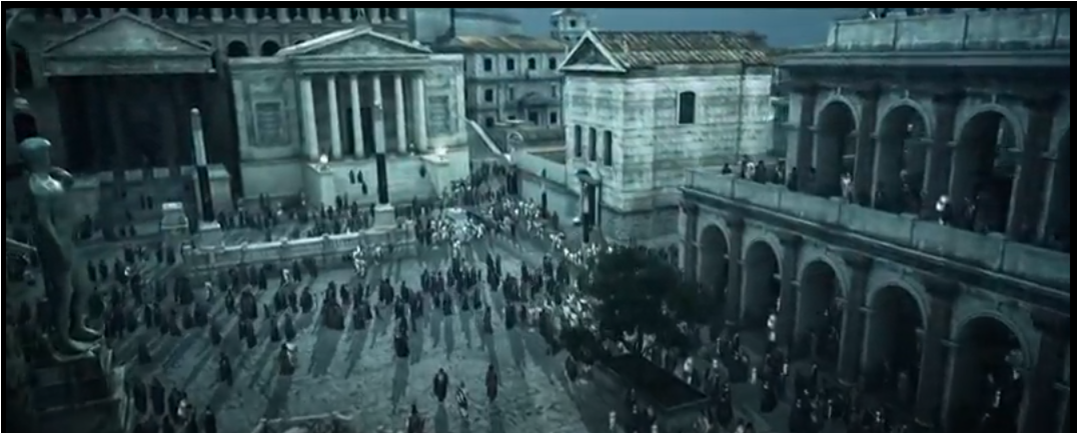
The second part presents the ensuing clash between the victors and the triumph of Octavianus, later to take the name Augustus, over Anthony and Cleopatra at the Battle of Actium in 31 B.C.
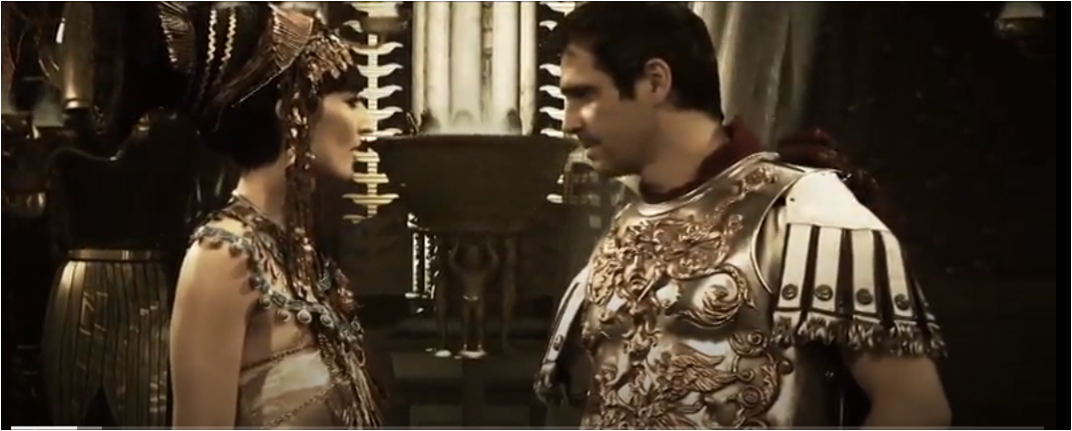
Teaching aids for Latin via Ovid
These Powerpoints have been produced for use with the reading passages in Norma Goldman and Jacob E. Nyenhuis's introductory Latin course, based on simplified versions of some of the Greek myths in the Roman poet Ovid's Metamorphoses. They present a short summary of each passage, consisting mostly of extracted sentences and illustrated with Greek vase paintings and work by major European artists from the Renaissance onwards. Many more illustrations, with the complete text of Metamorphoses can be found on the site of the Goethe-Gymnasium Emmingden by clicking on `Ovidius Naso - Edition' in the left-hand margin of their home page. Ovid's original Latin can also be consulted conveniently on the Latin Library Site and some details of alternative versions of the myths are available at Theoi Greek Mythology, which includes extensive quotes from translations of the original sources. The fullest collection on the Internet of variants and of references to Greek and Roman author is probably the Greek Mythology Link, though this is so comprehensive that the ordinary reader may find it rather daunting! Students should also be aware of After Ovid: New Metamorphoses, a 1996 collection of re-tellings or responses to Ovid's stories by some of the best-known contemporary poets writing in English. Excellent background material and analysis is provided inthe essays on the In Medias Res site marking the bimillennium of the poet's death in 17 or 18 A.D.
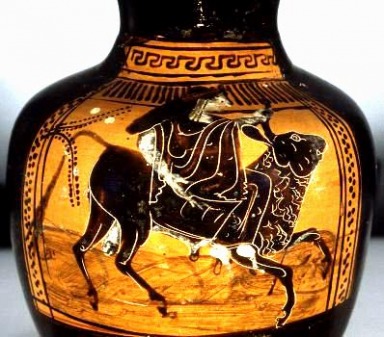
| charta_geographica.ppt |
An introduction to the setting for Ovid's stories - the regions around the shores of the ancient Mediterranean. (Chapter I)
| europa_et_taurus.ppt |
How Jupiter abducted a Phoenician princess and a continent got its name (Chapter II).
| minerva_et_arachne.ppt |
The story of the girl who rashly challenged the goddess Minerva (Athena) to a weaving contest. (Chapters III, IV & V)
| latona_and_niobe.ppt |
The terrible punishment inflicted on Niobe, queen of Thebes, after she boasted of her superiority to Latona, mother of Apollo and Diana. (Chapters VI & VII)
| pan_et_syringa.ppt |
The story of Pan's unsuccessful pursuit of the nymph Syringa (shown at the head of each page on this site) and of how she was changed into reeds and then became a musical instrument. (Chapter VIII)
| callisto.ppt |
The story of how Callisto was seduced by Jupiter and then suffered vengeance at the hands of Juno, queen of the gods before Jupiter turned her into a constellation. (Chapters IX & X). See below for a download of Ovid's full original text.
| philemon_et_baucis.ppt |
The gods Jupiter and Mercury travel through Phrygia in disguise and punish those who refused them hospitality whilst rewarding the old couple who welcomed them into their home. (Chapters XI & XII)
| echo_et_narcissus.ppt |
The tragedy of Echo, another victim of Juno's vengeance, who then fell in love with Narcissus, a young man who loved only himself. (Chapter XIII)
| phoebus_et_daphne.ppt |
The story of the nymph Daphne, who asked her father to transform her into a laurel bush to escape the attentions of the sun god, Phoebus Apollo. (Chapter XIV)
| pyramus_et_thisbe.ppt |
The story of the ill-fated lovers Pyramus and Thisbe, neighbours in ancient Babylon, whose story has strong resemblances to that of Romeo and Juliet. (Chapters XV & XVI)
| atalanta_et_hippomenes.ppt |
Hippomenes wins Atalanta as his wife with the help of Venus's golden apples but forgets to pay proper thanks to the goddess. (Chapters XVII and XVIII)
| midas.ppt |
The misadventures of King Midas of Phrygia, who got more than he bargained for when he asked to be given the `Golden Touch' and was then given a donkey's ears for poor musical judgement. (Chapters XIX and XX)
|
| ||||
The story of Daedalus, the master craftsman who made wings for his son, Icarus, and himself to escape from the island of Crete, only for Icarus to meet with disater because he flew too near the sun (Interim Reading I). The second file gives the text and translation of the story in Ovid's original version (Metamorphoses 8: 183-235), which also has a link to Stephen Daitz's recitation of the Latin.
| orpheus_et_eurydice_a.ppt |
| orpheus_et_eurydice_b.ppt |
Orpheus journeys to the Underworld and persuades Pluto to allow him to take his dead wife, Eurydice, back to the world of the living but then loses her for ever just as they are about to reach the surface. The story is again given in two parts because of size limitations. (Chapter XXI)
| mors_orphei__a_.ppt |
| mors_orphei_b.ppt |
Three years later Orpheus himself meets a violent death at the hands of the Maenades, crazed female followers of Bacchus, but is then reunited with Eurydice in Hades. (Chapter XXII
| phaethon.ppt |
The story of Phaëthon, who, after his divine father rashly promised him anything he wanted, insisted on trying to drive the chariot of the Sun. (Interim Reading II)
|
| ||||||||||||
The start of the story of Jason (chapters XXIII-XXVI plus Interim Reading III), covering his arrival with the Argonauts in Colchis (modern Georgia), King Aeëtes setting of his dangerous conditions under which the visitors will be allowed to take away the Golden Fleece, the final winning of the Fleece with the help of Medea, whose love for him outweighed loyalty to her family, their return home, Medea's magical rejuvenation of Jason's father, revenge on Pelias and his family and finally her murder of Jason's intended new wife and of her own children and flight to Athens.
The fullest treatment of the story of the Argonauts is the Argonautica of Apollonius Rhodius, a Greek poet of the 3rd century B.C. The original Greek text with parallel English translation is available on the Internet Sacred Texts site and there is a comprehensive collection of source material in Jason Colavito's Jason and the Argonauts Through the Ages, a companion site to his book of the same title, which advances the controversial thesis that Jason was originally a Mycenaean god of healing who was each year sacrificed to a mother goddess and then resurrected. Colavito includes a full English translation of Euripides' Medea, of which the Greek original with extensive notes and a running vocabulary is available as a fee download from Geoffrey Steadman. There is a `Silver Age’ Latin one on the same topic by Valerius Flaccus with English translation on the Theoi site and Latin text (not as readable as Ovid) in the Latin Library.
The version of the Argonauts' story in which Orpheus with his lyre, rather than Jason or Medea,subdued the dragon guarding the fleece appears to be from the Argonautica Orphica, a 5th or 6th century A.D.Greek poem in which Orpheus himself is narrator (see https://en.wikipedia.org/wiki/Argonautica_Orphica ). A 1764 edition of this with facing Latin translation is included in the Internet Archive and an English translation on Jason Colavito's site.
The fullest treatment of the story of the Argonauts is the Argonautica of Apollonius Rhodius, a Greek poet of the 3rd century B.C. The original Greek text with parallel English translation is available on the Internet Sacred Texts site and there is a comprehensive collection of source material in Jason Colavito's Jason and the Argonauts Through the Ages, a companion site to his book of the same title, which advances the controversial thesis that Jason was originally a Mycenaean god of healing who was each year sacrificed to a mother goddess and then resurrected. Colavito includes a full English translation of Euripides' Medea, of which the Greek original with extensive notes and a running vocabulary is available as a fee download from Geoffrey Steadman. There is a `Silver Age’ Latin one on the same topic by Valerius Flaccus with English translation on the Theoi site and Latin text (not as readable as Ovid) in the Latin Library.
The version of the Argonauts' story in which Orpheus with his lyre, rather than Jason or Medea,subdued the dragon guarding the fleece appears to be from the Argonautica Orphica, a 5th or 6th century A.D.Greek poem in which Orpheus himself is narrator (see https://en.wikipedia.org/wiki/Argonautica_Orphica ). A 1764 edition of this with facing Latin translation is included in the Internet Archive and an English translation on Jason Colavito's site.
|
| ||||
|
| ||||
The story of Theseus's birth at Troezen (chapter XXVII) and eventful journey to Athens, which has been forced by Minos, king of Crete, to send fourteen youngsters each year to feed the Minotaur (chapter XXVIII), his killing of the monster (chapter XXIX) and his reign as successor to Aegeus (chapter XXX).
The Theseus story is also retold in straightforward Latin by Daniel Petterson, with script displayed on screen in two YouTube videos: Part 1 and Part II. A very simple presentation by Lance Piantaggini in primary-school story-board fashion, suitable for near-beginners is also on YouTube here.
The Theseus story is also retold in straightforward Latin by Daniel Petterson, with script displayed on screen in two YouTube videos: Part 1 and Part II. A very simple presentation by Lance Piantaggini in primary-school story-board fashion, suitable for near-beginners is also on YouTube here.
| pluto_et_proserpina.ppt |
The story of Pluto's abduction of Proserpina, daughter of Ceres, Jupiter's arbitration and the eventual resolution which was the origin of the division of the year into summer and winter (Interim Reading IV)
|
| ||||||||||||||||||||||
Stories connected with the Trojan War and its aftermath, including the sacrifice of Iphigenia (chapter XXXI), the death of Neptune's son, Cygnus (chapter XXXII), the rivalry between Ulysses (Odysseus) and Ajax for Achilles' armour (chapter XXXIII), the fate of the women of Troy including the sacrifice of Polyxena to appease Achilles' ghost (chapter XXXIV), a summary of the Odyssey (chapter XXXV), the wanderings of Aeneas (chapter XXXVI), the story of Achaemenides, left behind by Ulysses and rescued by Aeneas (chapter XXXVII), Ulysses's encounter with the sorceress Circe (chapter XXXVIII), Aeneas's encounter with the Sibyl of Cumae who leads him down to the Underworld and also tells how she herself refused to pay the price Apollo demanded for eternal youth (chapter XXXIX) and Aeneas's final triumph in Italy and deification (chapter XL)
| ceyx_et_alcyone.ppt |
The story of Alcyone, faithful wife of Ceyx, who throws herself into the sea on discovering the drowned body of her husband, only for both lovers to be transformed by the gods into kingfishers.
Errata for Latin via Ovid
The book’s errors over vowel length are often simply mistakes but the authors had a general policy of normally not using a macron before a double consonant, i.e. when the vowel length cannot be deduced from the word’s use in poetry (see the discussion of hidden quantity on p.70). References below are normally to page, then paragraph or section, and finally line or sentence number.
Mistakes with macrons, certainly also to be found on my site, are very easily made and so should be watched out for but viewed charitably, remembering the words of Nicholas Oulton: `It is a brave man who inserts a macron over a vowel in a book which is to be read by people outside his immediate family. Or chooses not to do so, for that matter. Just think of the hoots of derision that will be heard, ringing through the countryside, as the errors are spotted and chortled over.' ( So You Really Want to Learn Latin, Bk 1, p.101).
The book’s errors over vowel length are often simply mistakes but the authors had a general policy of normally not using a macron before a double consonant, i.e. when the vowel length cannot be deduced from the word’s use in poetry (see the discussion of hidden quantity on p.70). References below are normally to page, then paragraph or section, and finally line or sentence number.
Mistakes with macrons, certainly also to be found on my site, are very easily made and so should be watched out for but viewed charitably, remembering the words of Nicholas Oulton: `It is a brave man who inserts a macron over a vowel in a book which is to be read by people outside his immediate family. Or chooses not to do so, for that matter. Just think of the hoots of derision that will be heard, ringing through the countryside, as the errors are spotted and chortled over.' ( So You Really Want to Learn Latin, Bk 1, p.101).
|
Chap 1
1.2.1: Mediterrāneō 3.3.8: Mediterrāneō 7.4.5: Hispānia Chap IV 31.28.3: Lӯdiae 33.IIIA..6: dās 33.IVA.8: Lӯdiae 35.1.16: nōmen 35.1.17: vīlla 36.prefix list: ā, ē, dē, prō, trāns Chap VII 53.4.3: ultimae 53.4.4: clāmat, ultimam 54.ADJECTIVES: ultimus 56.second line: per āera 57.B.5: ultimae Chap X 79.2.3: mānsērunt 79.2.5: animālia 79.2.4: Ā! 79.2.5: Ā! 79.3.2: animālia 80.NOUNS: animal, (pl.-ālia) 80.VERBS: horrēscō 81.61.6: mānsī 82, lines 1-6: mānsī etc.with long vowel throughout 82: Ex I.4: mānsērunt Chap XIII 105.last para, l.1-2: flūminis 108.penultimate line: Lӯdiā 109.3rd line from bottom: `English idiom calls for present or present perfect…’ 110.last line: flūmen, flūminis 111.Ex.I.9: in flūmine Chap XVI 131.3.4: nōbīs 131.4.3: requiēscit 132.OTHER WORDS: nōn iam no longer 134.Ex.I.2: pōma 134.Ex.I.5: ‘Thisbē’ (in this quotation the nominative form should be retained; without quotation marks the accusative is appropriate but should be Thisbēn, not Thisbem.) 135.Ex.IIA.7: requiēscit 135.Ex.2A.9: pōma 136: etymology: Iūnō Chap XIX 159.2.4: tāctum 159.2.5: pōmum 159.2.6: pōmum 159.2.8: tācta 159.3.1: gāvīsus 159.3.3: dūrum 159.3.4: flūxit 159.4.3: dā 159-4-4: inquit should be dīcit (inquit is only used inside the words quoted) 159.4.5: Lӯdiā 159.5.1: flūmen, Lӯdiā 159.5.3: Lӯdiae 160.VERBS: flūxī, flūxum Chap XXII 192.Verba.NOUNS: ardor, -ōris Erīnys, -yos vātēs, -is Interim Reading II: Phaëthōn 206.2.7: altissimi Chap XXV 233.ADJECTIVES: fīxus, -a, -um mīrus, -a, -um 236: I. 5: sedet (present tense is needed to match potes in first part of the sentence) Chap XXIX 277: THESEUS IN CRETA (The locative Crētae is wrong here as this case is only used with small islands) 281.line 5: Neptūnus 284: III.2: sacrificārentur 284: IV.2: quae in Āfricā Chap XXXIV 352 vocab: Sīrēnes Chap XL 412.40d vocab: calestī mūnere dignī |
Chap II
11.2.1: Iuppiter, Iuppiter 12.1.5: Iuppiter Chap V 37.2.1: Lӯdiae 37.fn.2: Iuppiter 38.NOUNS: Iuppiter 42, last line: volēns Chap VIII 61.3.1: Pān 61.4.4: papӯrōs 61.5.2: : papӯrōs, : papӯrōs, : papӯrī 61.5.4: : papӯrōs 62,NOUNS: : papӯrus 65.I.10: : papӯrīs 65.IV.3: : papӯrus Chap XI Dialogue: The first vowel in Marcus was probably long (as indicated by the spelling MAARCUS in one early inscription and stated on pg. 70). However, the classical pronunciation is uncertain) 87.1.1: immēnsa 87.1.5: Iuppiter 88.NOUNS. Philēmōn, -monis, m stāgnum, -ī n 89.line 3: immēnsa 90. table, l.9 and 12: Iuppiter 92.69.1: quārtus 93.ExIII.3 & 16: vōx Chap XIV 115.2.5: Daphnē 115.4.1: crēscunt 115.5.2: Iuppiter 115.6.2: flūminis 116.1.1: rāmōs 116.1.2: ōscula 116. NOUNS: ōsculum 120. Ex.IV.2,4,5: Rōmae 120.Ex.IV.5: cōnsilia ' Chap XVII 139.2.1: ōraculum 139.3.6: crēscunt 139.3.8: ālite 139.3.10: mīrātur 140.1.5: mālit 140.1.6: iūdice 145.Ex.IID.1: ōrnāre… ōrnātur 147.Ex.IV.14: pōma…Hippomenēn or Hippomenam (Greek nouns in –ēs when used in Latin have the Greek accusative ending –ēn or Latin –am, but not –em. All instances of the accusative I have found in literary texts use –ēn. 147.Ex IV.15: pōma Chap XX 167.1.2: dēmōnstrāvit 167.2.1: Lӯdiā 167.3.7: mūrice (mūrex is a sea-snail or the purple dye made from it; mūricus means `mouser'!) 167.4.penultimate line: iussit 167.5.penultimate line: iniūstum 168.2.4: vōce 168.VERBS: Add new item humō (1), bury 171.#115.para 1: cōnor, cōnārī, cōnātus sum para 2: cōnātur, cōnābātur, cōnābitur, cōnātus est, cōnātus erat, cōnātus erit 173.Ex,IIB.1: cōnantur, 6.cōnābāris 174.ExV.4: nōmināre Chap XXIII 212.Verba.VERBS: cōnferō 218.III.2 & 5: heri (yesterday), puerum heri Chap XXVII 258.NOUNS: prōlēs, -is f Scīrōn, -ōnis m Interim Reading IV: Pluto and Proserpina 297.2.3: flammas cineresque 297.2.5: rex (Pluto) timet 298.5.4-5: potes gener Cereris invitae esse. 299.2.2: quaerentem vidērunt 299.2.7: volenti dicere Chap XXXVI 370.188.10: grātiā...grātiā 370.fn 2: grātiā Latin-English Vocabulary 464: `ierī' should be changed to `heri' and moved to the top of the column. 466: līber, -era, -erum, free līberī, -ōrum m, children 468: neglēctus, -a, -um 470: petō...seek, ask for, attack 474: Sīrēnes, -um f, Sirens 475: stāgnum, -ī n |
Chap III
19.1.3, 19.2.4: Lӯdiae 20.1.8: Lӯdiae 24,.IV. 7: Lӯdiae Chap VI 51.3.4: except for respondeō and labōrō Chap IX 69.3.4: neglēctōs 69.4.5: victor 70.NOUNS: victor, victōris 70.ADJECTIVES: fōrmōsus, neglēctus 74.Ex. I.6: neglēctōs 74.Ex. I.10: victor 76.HIDDEN QUANTITY.5: Add footnote: `The stem vowel in the perfect participle is usually long if the final consonant of the present stem is voiced (-g, -ng, -b etc.) Chap XII 97.Dialogue: Quae est quaestiō, quis …Iuppiter? 97.1.1: coniūnx 97.3.3: Philēmonem, coniūnx 97.3.7: Philēmonis 99.30.7: coniūnx 101.Ex.I.5: vāstāre 102.Etymology.14: āēr…āēr, āeris Chap XV 123.1.4: nēmō 123.1.7: ōscula 123.2.1: cōnsilium 123.4.6: ōscula 123.4.8: trāxit, fōns, rādīcem 124. NOUNS: rādīx 124.VERBS: sēnsī 125.VERBS: trāxī 127.1.5: fōns 127.Ex.I.5: cōnsilium 128.Ex.III.9: pōmōrum 128.Ex.IV.4: pōmīs 128.Ex.IV.5: ōscula 129.Etymology: calidārium, tepidārium, frīgidārium Chap XVIII 149.1.1: prōmissum 150.VERBS: scrīpsī 151.Passive Particple column: vīsus 152.2. final example sentence: vīsās 152.final para: prōmissum 153.#104 examples: pōma (twice) 153.#105.2nd & 3rd examples: cōnsilium 154.#107: fēminārum 155.Ex.I.4: pōmīs 155.Ex.I.7: Atalantam an Hippomenēn (`or’ in a question asking for a choice between alternatives is normally an, not aut, and the poets always use the Greek accusative ending –ēn with Hippomenēs) 155.Ex. I.9: mātrimōnium 155.ExIIB.2: Pōmum 155.Ex.III.5 & 9: pōmum 155.Ex.IV.2: pōmum. Chap XXI 183.VERBS: exeō...go out, depart, go out of 186.line 5: dīcentem Chap XXIV 224.para 132.7-8: In the second and fourth conjugations both vowels (-ea- and -ia- respectively) are retained in the stem, and in the third conjugation the characteristic vowel in the present subjunctive is -a-. 225.para 135.1: four independent uses 226. Ex.I.5: patietur Iasoni noceri (the dative rather than accusative is needed here because noceō is not a transitive verb and so the passive infinitive is impersonal) Chap XXVIII 268.10: prehendit 271.para 153: Delete `cum when' from `Indicative' column Chap XXXII 319.para 173. Participles: `Perf. Passive' in first column should be `Perf. Active' 321.Ex1.5: dilata 321.Ex.1.6: sōlāmen Chap XXXVIII 387.38d vocab: Nērēides 388.38e vocab: *rostrum, -ī n, snout, beak |
Who's Who on Olympus - Roman Gods and Goddesses
This Powerpoint presentation, adapted from an original created by William Snyder of Bedford High School, introduces the twelve principal Roman deities. You can read the description of each deity in simple Latin together with their Greek name, then click to see an illustration and their Latin name.
| dei_et_deae.ppt |
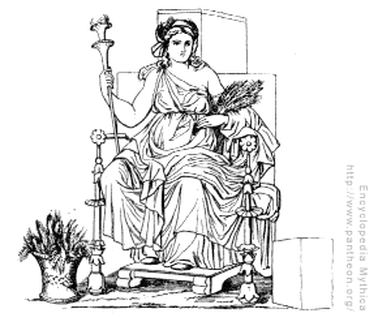
Pluto (the Greek Hades), who ruled over the Underworld, was not normally included among the Twelve chief Olympians but was the brother of Jupiter and Neptune. The Powerpoint below illustrates the various ways in which he was portrayed and tells the story of his abduction of Proserpina (Gr. Persephone), daughter of Ceres (Grk. Demeter), the goddess of vegetation and crops. A fuller version of the Proerpina myth is available for download from the Latin via Ovid section above.
| pluto.ppt |
Two Thousand Years
| two_thousand_years.doc |
 |
 |
A selection of Latin passages starting with Caesar's description of his invasion of Britain in 55 B.C. and including a letter and inscription from the Roman occupation of Britain, an account of the Battle of Hastings, the Declaration of Arbroath (1320), a 17th century description of a journey across the Himalayas, Newton's Laws of Motion, part of Karl Marx's matriculation essay and an eye-witness account of fighting in Italy towards the end of WWII.
Latin in Hong Kong and on the Internet
Latin is not on the curriculum in mainstream Hong Kong schools but is taught at the French and German-Swiss International Schools and also at the Chinese University of Hong Kong (in the Centre for Catholic Studies, Department of Cultures and Religions) and the Hong Kong University of Science and Technology (in the Language Centre). These institutions normally just cater for their own students but, if you are looking for a short introductory course outside ordinary working hours, I myself teach one covering approximately the first half of the textbook Latin via Ovid on Tuesday evenings at the Dante Alighieri Society, and, if enough students enroll, I will be providing a slower course (probably covering about a third of the book) at SPACE (the extramural branch of the University of Hong Kong) on Saturday afternoons from October 2013 onwards. Courses are also provided from time to time by the Catholic Church's Sacred Music Comission, the Hong Kong Federation of Trade Unions, whose website gives details in Chinese only, and the Duns Scotus Bible Centre .
I also provide individual Latin tuition with flexible hours and you can contact me by email for details.
For those who already have some knowledge of Latin, there is now the Circulus Latinus Honcongensis (Hong Kong Latin Circle), which aims to hold meetings every month to practise Latin conversation.
I also provide individual Latin tuition with flexible hours and you can contact me by email for details.
For those who already have some knowledge of Latin, there is now the Circulus Latinus Honcongensis (Hong Kong Latin Circle), which aims to hold meetings every month to practise Latin conversation.
| introducing_latin_blmcss.ppt |
| hong_kong_latin_circle.doc |
It is also possible also to learn using online material. For beginners who are not pursuing a formal qualification, there are two courses developed by London-based Evan Millner:
Latinum Podcast, which includes a wide range of materials but focusses on conversational Latin and uses as core text
George Adler's 1856 textbook which is still available as a free pdf download. Though the podcasts hemselves can be
downloaded freely, a voluntary donation is requested.
Cursus Linguae Latinae, a purely oral course currently beng developed on YouTube
Also available on YouTube is TuTubusLatinus, which includes two, less extensive sets of elementary lessons:
Latin Lessons to support the leaner's use of Book 1 of the Cambridge Latin Course.
Learning Latin with Virgil with lessons centred round the story of the Aeneid.
One of the most efficient paths towards active fluency is to enroll in one of the virtual courses provided by the Schola Latina Universalis. Although free of charge, these give students on-line access to the teacher for help with problems going through the course book, Clément Desessard's Lingua Latina sine molestia (`Le latin sans peine'/ `Il latino senza sforzo', i.e. Latin with ease), from the Assimil series, which has essential accompanying mp3s, CDs or cassette tapes. Unfortunately the material is no longer available from the publisher but it is possible to find copies by searching on the Internet. Students of Schola Latina Universalis who cannot cope with grammatical explanations in French or Italian can obtain an English translation from the course organisers. The school normally provides two courses annually, covering the first and second half of the book and equipping the learner both to read ordinary Latin texts and to converse in Latin. An intensive option to cover the whole book in one year also exists. Instruction is intially in English and Spanish in parallel (lessons 1-50), and switches to Latin as the course progresses (lessons 51-101). Many members of the international Latin community have been educated there and are now active in Latin Circles around the world.
For anyone wanting the equivalent of a high school or college course with some kind of certification provided, options include:
Distance learning with the Cambridge Schools Classics Project It is possible to follow basic courses linked to the
published Cambridge Latin Course, and then revision courses preparing candidates to take the Certificates offered by
the WJEC examination board which are recognised as GCE equivalents. Many of the Cambridge resources are in any case
available free-of-charge on the project website, including texts of the reading passages with hyper-linked glosses.
Latin I with the Iowa State University. This covers the first half of Wheelock's Latin in one semester and may be
followed by Latin II in the following semester which completes the book and provides coverage of all the Latin grammar
needed for ordinary reading. Wheelock focusses on the direct and systematic presentation of grammar in the traditional
manner followed by translation of practice sentences but with a short, continuous passage at the end of each unit For
further details, email Professor Madeleine Henry.
A Wheelock-based course is also provided by the On-line High School run by Stanford University's Education
Programme for Gifted Youth. The foundation course, which involves 3-4 hours a week online and an average of 4-6
hours of independent study, covers about 30 chapters of Wheelock in one academic year, together with other material on
Roman culture. The reminder of the book is completed in the first semester of the second year.
`Scholars On Line' provide the option of covering Wheelock over two years (i.e. a pace similar to that of the average
American high school course) or an accelerated course completing the book in two semesters as would be done at college
level.
The Institute of Biblical Greek also teaches Wheelock over two years.
KET Distance Learning, a company whose courses evolved from Kentucky public television broadcasts into a
web-based system, provides Latin 1, latin 2, Latin 3 and AP Virgil courses . The first two courses cover the basics of
Latin grammar and the beginners' textbook used is Ecce Romani. Courses generally reqire a facilitator to assist and
monitor students in person.
Latinum Podcast, which includes a wide range of materials but focusses on conversational Latin and uses as core text
George Adler's 1856 textbook which is still available as a free pdf download. Though the podcasts hemselves can be
downloaded freely, a voluntary donation is requested.
Cursus Linguae Latinae, a purely oral course currently beng developed on YouTube
Also available on YouTube is TuTubusLatinus, which includes two, less extensive sets of elementary lessons:
Latin Lessons to support the leaner's use of Book 1 of the Cambridge Latin Course.
Learning Latin with Virgil with lessons centred round the story of the Aeneid.
One of the most efficient paths towards active fluency is to enroll in one of the virtual courses provided by the Schola Latina Universalis. Although free of charge, these give students on-line access to the teacher for help with problems going through the course book, Clément Desessard's Lingua Latina sine molestia (`Le latin sans peine'/ `Il latino senza sforzo', i.e. Latin with ease), from the Assimil series, which has essential accompanying mp3s, CDs or cassette tapes. Unfortunately the material is no longer available from the publisher but it is possible to find copies by searching on the Internet. Students of Schola Latina Universalis who cannot cope with grammatical explanations in French or Italian can obtain an English translation from the course organisers. The school normally provides two courses annually, covering the first and second half of the book and equipping the learner both to read ordinary Latin texts and to converse in Latin. An intensive option to cover the whole book in one year also exists. Instruction is intially in English and Spanish in parallel (lessons 1-50), and switches to Latin as the course progresses (lessons 51-101). Many members of the international Latin community have been educated there and are now active in Latin Circles around the world.
For anyone wanting the equivalent of a high school or college course with some kind of certification provided, options include:
Distance learning with the Cambridge Schools Classics Project It is possible to follow basic courses linked to the
published Cambridge Latin Course, and then revision courses preparing candidates to take the Certificates offered by
the WJEC examination board which are recognised as GCE equivalents. Many of the Cambridge resources are in any case
available free-of-charge on the project website, including texts of the reading passages with hyper-linked glosses.
Latin I with the Iowa State University. This covers the first half of Wheelock's Latin in one semester and may be
followed by Latin II in the following semester which completes the book and provides coverage of all the Latin grammar
needed for ordinary reading. Wheelock focusses on the direct and systematic presentation of grammar in the traditional
manner followed by translation of practice sentences but with a short, continuous passage at the end of each unit For
further details, email Professor Madeleine Henry.
A Wheelock-based course is also provided by the On-line High School run by Stanford University's Education
Programme for Gifted Youth. The foundation course, which involves 3-4 hours a week online and an average of 4-6
hours of independent study, covers about 30 chapters of Wheelock in one academic year, together with other material on
Roman culture. The reminder of the book is completed in the first semester of the second year.
`Scholars On Line' provide the option of covering Wheelock over two years (i.e. a pace similar to that of the average
American high school course) or an accelerated course completing the book in two semesters as would be done at college
level.
The Institute of Biblical Greek also teaches Wheelock over two years.
KET Distance Learning, a company whose courses evolved from Kentucky public television broadcasts into a
web-based system, provides Latin 1, latin 2, Latin 3 and AP Virgil courses . The first two courses cover the basics of
Latin grammar and the beginners' textbook used is Ecce Romani. Courses generally reqire a facilitator to assist and
monitor students in person.
Posters for the Latin classroom
An American teacher, Ginny Lindzey, has made available on the PromoteLatin site a series of posters, including both phrases for classroom use and a collection of attractive pitures with latin captions. Please credit her if you use them in any materials of your own and do not include them in anything meant for sale.
Other downloads
Some of these files are among materials stored on the Baptist Lui Ming Choi Secondary School Intranet at S:/Subjects/English/EUROPE CLUB/LATIN. BLMCSS staff and students can access the whole list themselves but others wanting full details should contact me through the comments form on the home page.
| perseus.doc |
This is an extract from Ritchie’s Fabulae Faciles a collection of simple Latin prose versions of Greek myths. It has been provided with an interlinear translation.plus illustrations of the stories from Greek vase paintings and later art. The Latin text itself was downloaded from http://www.mythfolklore.net/fabulaefaciles/index.htm, a site maintained by Laura Gibb, who has also uploaded Ritchie's retellings of the stories of Hercules and Ulysses. The entire text of Ritchie's book (from John Kirtland's 1903 edition) is available for download in various formats from the Many Books site. Another version of the full text (though without marking of vowel quantity) can be read at http://www.fullbooks.com/Ritchie-s-Fabulae-Faciles1.html The Perseue, Jason, Hercules and Ulysses lstroies, together with a selection of sotries from Roman history, are also available for reading on-line on Dale Grote's Getting to Reading Latin site, which also has notes and vocabulary on some of the stories. The illustration below shows Perseus killing the Gorgon, Medusa
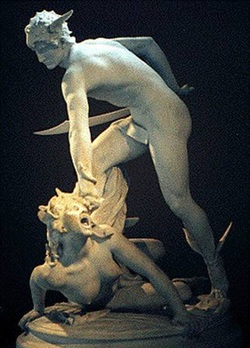
At the moment (September 2015) a trial version of Geoffery Steadman's user-friendly new edition of Ritchie's work, meant as a bridge between a basic Latin course and the reading of authentic classical texts, can be downloaded freely from the Fabulae Faciles page on his site ( downloading from Hong Kong may be slow and it is better to save the file to your hard disk rather than opening immediately). The text itself and vocabulary with Steadman's own commentary are presented on facing pages. The words included in the vocabulary for each page are those which occur less than 15 times in the book. Commoner words are grouped together in an alphabetically arranged list which the learner is encouraged to master before tackling the stories. This is an excellent resource both for learners and for those reactivating rusty Latin reading skills.
____________________________
| hercules1.doc |
| hercules2.doc |
| hercules3.doc |
These files contain chapters 12 to 56 from Fabulae Faciles, telling the story of Hercules and his Twelve Labours and illustrated in the same way as was done for the Perseus stories (capters 1-12). A word-for-word interlinear translation has been provided. The Latin text (which is out of copyright) has been dowloaded from Steadman's beta edition with one or two corrections made. Intermediate students are recommended to read Steadman first, and then check with my version to ensure they have understood. if you have only just started Latin, you may find it useful to look at the interlinear version from the start as one means of acquiring vocabulary rapidly. Another text-cum-translation available on the internet (though not strictly word-for-word) is currently (October 2011) being uploaded in instalments by Angela Thomas at http://ritchieslatin.blogspot.com/, also with grammatical notes.
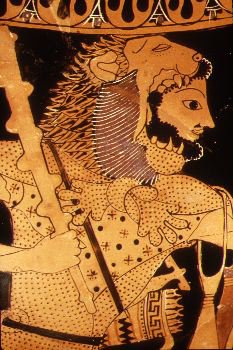
_________________________________
|

|
| ||||||
| chapters_77-80.wav |
The next section of Fabulae Faciles, chapters 57 to 80 covering the story of Jason and the Argonauts, is contained in the Word file above, with interlinear translation added.The text is taken from Steadman's 2015 edition with a few corrections of vowel quantity mistakes and the version of the myth is slightly different from that presented in Latin via Ovid, for which materials are available above. The audio files contain recordings of the Latin text, which are not free from mistakes but generally get the stress right.
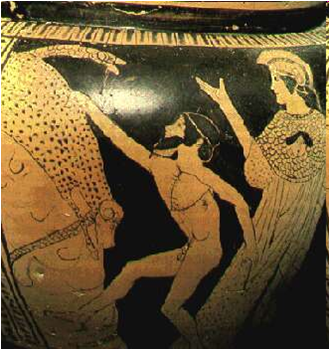
_________________________
|
|
| ||||||||||||||||
The final section of Fabulae Faciles (chapters 81 to 100) is based on Homer's Odyssey and tells the story of Ulysses' return home after the Trojan War. As before, the Word file a combines text and interlinear translation and the audio files a less than perfect but roughly accurate recording of the text. Illustrations of the story can be found in odyssey.ppt, which is included in the `Teaching Aids for Latin via Ovid' section above. One of the pictures, a Greek vase scene depicting the blinding of the giant Polyphemus, is shown below.
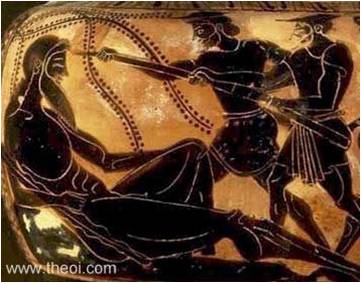
_______________________________

| csar_for_beginners.pdf |
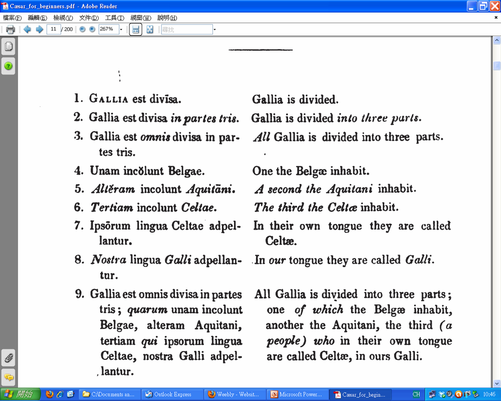
This 3.8 Mb PDF file is an anonymous 1841 edition of Caesar's account of the Helvetic War (from book 1 of de Bello Gallico) which takes each period and presents it first as simplified separate sentences or phrases before presenting the original wording. Particular vocabulary or grammatical forms are highlighted in italics (as is the corresponding word(s) in the parallel translation). The text was uploaded by Google Books and can be read there on line. Caesar's own text is read slowly and carefully by Evan Millner in a YouTube video, The sections of De Bello Gallico prescribed for study in American high Schools (including chapters 1-7 of Book 1), with vocabulary listed below the text and commentary on a facing page, can also currently (August 2011) be read or downloaded from Steadman's Caesar site. Readings of these selections, together with a link to the recordings and other resources on the Dickinson College site are available on the LINGUAE Caesar page.
__________________________________
__________________________________
| iuppiter_et_callisto.doc |
This is a the illustrated text of lines 401 to 530 Book II of Ovid's Metamorphoses, telling the story of the nymph Callisto who was seduced by Jupiter and then suffered Juno's vengeance before finally becoming a constellation in the night sky. The entire text of Metamorphoses, with over 2000 illustrations from different periods of European art, can be found on the site of the Goethe-Gymnasium Emmendingen by clicking on `Ovidius Naso - Edition' in the left-hand margin. Simplified versions of Callisto's and other stories form the reading passages in the introductory textbook Latin via Ovid.
| metamorphoses.doc |
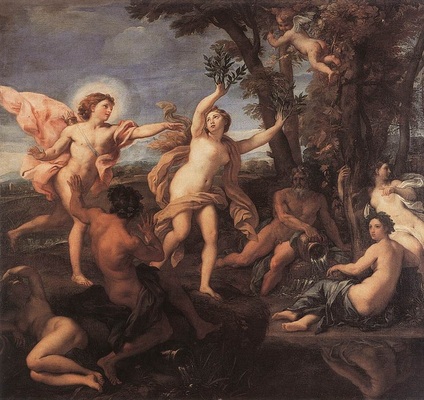
.This file is intended to treat other stories from the Metamorphoses in the same way and will be progressively expanded, using as a guide the extracts presented in C. P. Watson and A.C. Reynell's Ovid's Metamorphoses - Selections (London: Faber, 1968) but expanding these to present more of the original narrative. At present, the file contains a short section from the description of the Golden Age (I. 89-112) and the account of Apollo' unsuccessful pursuit of the nymph Daphne (I, 452-567, illustrated above). As was done with the Callisto story, macrons and pictures have been added. Anyone wanting to start with a simplified version of the story should look first at the Powerpoint phoebus_et_daphne available above in the `Teaching Aids for Latin via Ovid' section above.
Johan Winge's recitation of the whole of Book I of Metamorphoses can be heard on the Internet; the Daphne and Apollo story is the seventh section.
Johan Winge's recitation of the whole of Book I of Metamorphoses can be heard on the Internet; the Daphne and Apollo story is the seventh section.
|
| ||||
A 21-page Word document summarising the basics of Latin grammar but omitting the gerund and gerundive (e.g. agenda, memorandum etc.). A section on this will be added shortly.
| aspice_caudam.ppt |
`Aspice caudam' (`Look at the tail') is an overview of the principal endings of Latin nouns, adjectives and words and of their grammatical functions, plus guidance on looking up words in the dictionary. Most of the slides drill the endings of the 1st and 2nd declensions and of the present, future and imperfect tenses of the 1st and 2nd conjugations (i.e. all the paradigms included in the first five chapters of Wheelock). Where any of these endings are also used with other classes of word, these uses are noted in blue-green type but not included in the drills themselves. Other drills for the same grammatical material can be found on the university of St. Louis site here.
Presents the endings of masculine and feminine nouns in the first three declensions (ancilla, servus, leo), with more transparent names for the cases (subject, object, possessive etc.) in addition to the traditional nominative, accusative etc. The second file adds an example of a 2nd. declension neuter noun.
|
| ||||
Presents the endings of masculine and feminine nouns in the first three declensions (ancilla, servus, leo), with more transparent names for the cases (subject, object, possessive etc.) in addition to the traditional nominative, accusative etc. The second file adds an example of a 2nd. declension neuter noun.
|
| ||||||||
These files include guidance on the format of dictionary entries plus paradigms for the five declension and for the indicative tenses (active voice only) of all four conjugations, plus capio and sum. The possum_volo_nolo file includes forms of these irregular verbs and also of malo, fero, eo and fio. Successive forms are introduced slide by slide allowing the learner to recall them one by one and check immediately. The second version of the noun file uses the order of cases followed in America (as well as Germany and many other countries): nominative, genitive, dative, accusative, ablative. The British order (nominative, accusative, genitive, dative, ablative) followed in the first, and standard in all UK schools and universities, was introduced in the 19th century as it allowed most identical forms (e.g. the dative and ablative plural) to appear next to each other in the paradigms.
|
| ||||
|
| ||||
The first of these files explains the principal functions of the different cases and also lists the main terminations which they take in the different declensions, while the second deals with the `double dative' (also known as `predicative dative') constructions. The third (British order) and fourth (American order) present the main categories of adjective and provide practice through gap-filling from lists of inflected forms provided. The British set also includes material on adverbs.
|
|
| ||||||
These files give practice in recognising the case terminations of different declensions but use descriptions of grammatical function rather than the traditional labels (e.g. nautae: of sailor/to or for sailor/sailors (subj.)
|
| ||||||||
`latin_pronouns' presents the forms of the main 3rd. person pronoun/adjectives (is, hic, ille, iste, qui, quis, se) and of ego and tu, highlighting their distinctive features. It comes in two versions, the second following the American/German order of cases. The third Powerpoint lists the main endings found on nouns and adjectives and in the active indicative forms of verbs and trains the students to remember the possible functions of each of them. The fourth sets out the forms of the promoun hic in combination with a masculine, feminine and neuter noun.
An amusing Powerpoint presentation of basic greetings and commands for classroom use, modified from the original work of American Latin teacher `jeri'
|
Presents the paradigms of the passive voice (indicative mood) for the different conjugations and also introduces deponent verbs (passive endings but active meaning).
| ||||
Describes briefly the main uses of the subjunctive and gives full sets of forms of all tenses in both active and passive voices.
|
A conspectus of the forms and uses of the six tenses. those required for the NLE Latin 1 examination are printed in red and the translation equivalents most commonly encountered are given in bold.
| ||||
|
| ||||
Tabulates the forms of the various infinitives and participles as well as gerund, gerundive and supine as well as explaining their principal uses. the second file gives the forms of the present participle in the American order of cases.
| vowel_length_marking_in_latin.ppt |
Illustrates the different methods (double letters, apex and elongation) used by the Romans themselves to distinguish long vowels and explains modern use of macrons
| conditionals_gerundive_gerund_and_indirect_statement.doc |
Describes the use of conditionals and counter-factual wishes with the subjunctive, the gerundive and gerund and also the main rules for indirect stement (accusative and infinitive for main clause and subjunctive in subordinate ones). Translated examples are provided, plus practice sentences for the student to translate on his/her own.
| gerundive_and_gerund.ppt |
Brief description of the method of of formation of gerund and gerundive with illustrated examples of their use,
| deponent_verbs.doc |
A list of the principal deponent verbs, grouped by conjugation.
|
| ||||
Analyses verb endings in terms of markers for person and number (both active and passive) and `theme vowels' and gives practice in the recognition of different forms. The second file omits subjunctive forms.
| catullus.ppt |
An introduction to the poet Gaius Valerius CATULLUS (?84-?54 B.C.), a contemporary of Julius Caesar and best-known for his poems on his love affair with `Lesbia' and its bitter end. The presentation includes extensive information on the period in which he lived, Latin text and Highet's translation of four of his poems and later verse by Tennyson and Yeats which commemorates him.
| the_villas_of_stabiae.ppt |
A Powerpoint introducing an exhibition of art from the ruins of Stabiae, an area of luxury villas for Rome's rich and famous, which was burieded when Vesuvius erupted in 79 A.D. destroying also the better-known sites of Pompeii and Herculaneum.
| commonest_300_words.doc |
Dietrich's list of the commonest 300 words from a corpus of around 200,000 words of classical and medieval Latin literature, with macrons and translations added. The nominative singular of a noun and the first person singular of the present tense of a verb represent all the forms of the word, so, for example, the total for facio includes instances of fac, faciebam, facis etc. These words are also available as a flashcard set on the CRAM site..
|
| ||||||
These Powerpoints, designed to assist revision for the National Latin Exam's introductory level, explain and illustrate basic terms such as toga, stola, atrium, impluvium etc. as well as sites such as the Forum Romanum and Colosseum.
| corpus_humanum.doc |
A list of names for part of the body together with a labelled drawing for use in TPR-style classroom exercises.
| subsidia_interretialia.doc |
This is a lit of sites useful for Latinists, including several online dictionaries. Many of them have been mentioned elsewhere on this page but it may be useful to have them presented together. The ones in red are those I make the most use of myself.
| animal_noises.doc |
This document includes a passage from a 17th century Latin encyclopaedia
giving the verbs for the cries of different aninals, plus references to
other sources on the Internet.
| roman_cooking.doc |
Basic vocabulary on food and cooking, plus links to various web sites giving information on Roman cuisine,
Latin down the Ages
| troy.ppt |
Although the study of Latin in schools and universities has normally concentrated on works produced in the `Golden Age' of Latin literature - the 1st century B.C. and the 1st and early 2nd. century A.D., the language has continued in use to a greater or lesser extent down to the present day. Including the comedies of Plautus and Terence, created between about 205 and 160 B.C., Latin literature spans more the 22 centuries. An anthology of short passages from different eras is being assembled on the Latinitium site, and another selection, including eye witness accounts of Julius Caesar's landing in Britain (55 B.C.), the Battle of Hastings (1066) and the German resistance to the Allied advance in Italy in 1944, can be downloaded here:
An illustrated English-language account of the Trojan War meant as basic background for students beginning Latin.
| two_thousand_years.doc |
The `Hamiltonian Method'
Although the use of bilingual texts to teach Latin was already standard practice in Roman times, the Irish language teacher James Hamilton (1769-1829) was probably the first ot use modern-style interlinear translations. His method was adopted by William Stevens who described in an 1828 article how he successfully used it to enable his pupils to learn to read Latin extensively and with full comprehension. In the PDF below, David Carter, a present-day British Latin teacher, reproduces the original article, adding his own comparison of the amount Stevens' students read in comparison to their modern counterparts:
| hamiltonian_experiment_dr_william_stevens_full.pdf |
