| linguae |
|
Linguae - a site for language and culture
I am a Hong Kong-based teacher and reasearcher and have started this site to bring together links to other sites I find particularly interesting and to make available materials I have produced myself for use at Baptist Lui Ming Choi Secondary School, Chinese University of Hong Kong,Dante Alighieri di Hong Kong and elsewhere. Fuller details of the contents are provided on the site map. The contents include Latin and modern European languages (including English), Nepal and its history and culture and also different aspects of Hong Kong, particularly its scenery and politics.. There is a companion site on Chinese at https://chineselanguages.weebly.com I would be happy to receive suggestions and comments on the form at the bottom of the page.
The picture at the head of each page is a relief produced around 1770 by French sculptor Clodion (1738-1814) and now in the Louvre in Paris, showing the woodland god Pan in pursuit of the nymph Syrinx. She appealed to her river god father who turned her into a clump of reeds, which Pan then cut and made into the pan pipes, or syrinx. The Greek myth is retold in Latin verse in Ovid's Metamorphoses and a simplified version for beginners can be read in Latin via Ovid. The whole story is illustrated in a Powerpoint downloadable from the Latin & Greek page on this site.
The picture at the head of each page is a relief produced around 1770 by French sculptor Clodion (1738-1814) and now in the Louvre in Paris, showing the woodland god Pan in pursuit of the nymph Syrinx. She appealed to her river god father who turned her into a clump of reeds, which Pan then cut and made into the pan pipes, or syrinx. The Greek myth is retold in Latin verse in Ovid's Metamorphoses and a simplified version for beginners can be read in Latin via Ovid. The whole story is illustrated in a Powerpoint downloadable from the Latin & Greek page on this site.
Useful language sites
The Ethnologue site includes basic data for all of the world's documented languages and is the online version of M. Paul Lewis (ed.), 2009. Ethnologue: Languages of the World, Sixteenth edition. Dallas, Tex.: SIL International. UNESCO's Atlas of the World's Languages in Danger includes details on around 2,500 languages which are threatened with possible extinction.
For rapid translation between language, the best choice is probably Google but any translation programme produces some mistakes, especially with long stretches of text, and you cannot rely totally upon the result unless you know enough of both languages to edit the final result. A good alternative when reading material in a major world language you have some knowledge of used to be the Webreader on the Wordchamp site. After registration (free of charge)) in the nomal way, you could either access the website you want to read via Wordchamp or copy a block of text from that site and paste it into Wordchamp. When you placed the cursor over individual words, you saw `pop-up' glosses in English or whichever language you prefer. Although most of the vocabulary database was user-created and so is inadequate for less commonly used languages. Unfortunately, the webmaster decided in 2013 that other commitments made it impossible to maintain the site and it was shuttered. the database, however, is still in existence and, hopefuly, will one day be re-activated. For more details see the Wordchamp page on this site.
The Acapela site allows you to type or paste in up to about fifty words in any major language and hear it read aloud by a native speaker. The result is not, of course, reliable for sentence-level intonation but it is accurate for individual words or phrases and can even use make use of the punctuation to produce the basic rising intonation for a question in English.
The US Department of State's Foreign Service Institute has classified major world languages in terms of the level of difficulty they present for a native speaker of English. The number of classroom hours they believe necessary to achieve Level 3 proficiency in speaking and reading (i.e. sufficient to operate efficiently in most professional contexts) ranges from around 600 for French and other languages quite similar to English to 2200 hours for Chinese and Arabic.
For rapid translation between language, the best choice is probably Google but any translation programme produces some mistakes, especially with long stretches of text, and you cannot rely totally upon the result unless you know enough of both languages to edit the final result. A good alternative when reading material in a major world language you have some knowledge of used to be the Webreader on the Wordchamp site. After registration (free of charge)) in the nomal way, you could either access the website you want to read via Wordchamp or copy a block of text from that site and paste it into Wordchamp. When you placed the cursor over individual words, you saw `pop-up' glosses in English or whichever language you prefer. Although most of the vocabulary database was user-created and so is inadequate for less commonly used languages. Unfortunately, the webmaster decided in 2013 that other commitments made it impossible to maintain the site and it was shuttered. the database, however, is still in existence and, hopefuly, will one day be re-activated. For more details see the Wordchamp page on this site.
The Acapela site allows you to type or paste in up to about fifty words in any major language and hear it read aloud by a native speaker. The result is not, of course, reliable for sentence-level intonation but it is accurate for individual words or phrases and can even use make use of the punctuation to produce the basic rising intonation for a question in English.
The US Department of State's Foreign Service Institute has classified major world languages in terms of the level of difficulty they present for a native speaker of English. The number of classroom hours they believe necessary to achieve Level 3 proficiency in speaking and reading (i.e. sufficient to operate efficiently in most professional contexts) ranges from around 600 for French and other languages quite similar to English to 2200 hours for Chinese and Arabic.
Indo-European
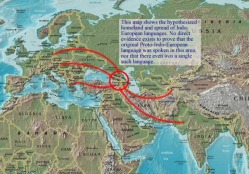
This Powerpoint presentation gives a brief introduction to the devlopment of the Indo-European language family, which includes Latin, Greek and Sanskrit as well as most of the modern languages of Europe and of northern India . The Word document provides a longer account with comprehension questions suitable for upper intermediate or advanced learners of English as a second language. (The map shown here is from www.danshort.com (C) Dan Short)

| ie_powerpoint.ppt |

| ie.doc |
| ie_diagram.doc |
| ie_ans.doc |
Further information on individual IE languages and their development from a common origin is provided on the website of the Linguistics Research Centre of the University of Texas, including basic lessons in many of them. KryssTal.com gives brief information on each member of the family as we,ll as sample passages in non-Roman scripts for languuages such as Hindi. A highly detailed family tre is available from on Wikimedia.
Language learning experiences
Whilst doing my M.A. in applied linguistics twenty-five years ago I wrote a summary of my experiences learning various languages and circulated it to friends and colleagues to invite contributions on their own experiences. I have updated the piece from time to time and this is the April 2009 version with minor corrections
| langhist.doc |
