| linguae |
|
QUESTIONS ARISING FROM 96th MEETING – 6/12/18
(The record of earlier meetings can be downloaded from the main Circulus page as can the version of Ciceronis Filius with illustrations added. Accounts of meetings from September 2016 onwards are also stored as individual web pages (see the list on the Site Map),The illustrated text of Genesis is available on the Genesis page and of Kepler's Somnium on the Somnium page.)
Food ordered include carō concīsa cum pīsīs (keema matar, mincemeat with peas), gallīnācea cum spīnāchiā (sagwala chicken), spīnāchia cum caseō (sag paneer, spinach with cheese), cicera arōmatica (chana masala, chickpeas with spices), melongēna contūsa (baigan bharta, mashed aubergine/eggplant), iūs lentium butyrātum (dal makhani, lentil soup with butter), tubulī vernālēs (春卷, spring rolls), pānis tenuis (papadom), pānis Persicus (nan), orӯza (rice) and, of course, vīnum rubrum/sanguineum
John got temporarily confused over the difference between korma and keema. The former is a dish cooked by braising (i.e. frying and then stewing) meat or vegetables glazed with yoghurt, cream or stockand the name derives from the Urdu word qormā (قورمہ ), `braise’ (see https://en.wikipedia.org/wiki/Korma ). Because the dish as served in an Indian restaurant tends to be prepared with yogurt, we have in the past use the adjective oxygalactīna (from an Ancient Greek word meaning `made with yogurt’). Keema, on the other hand, simply means `mincemeat’ for which we have regularly used the phrase carō concīsa However, this really just means `chopped-up meat’ and the classical Latin seems to have been carō minūt(āt)im concīsa, with the adverb deriving from minūtus (very small), the ultimate origin also of English `mince.’ In addition, Juvenal has the phrase minūtal hesternum, with the second word meaning `yesterday’s’ but this probably refers to a mish-mash of the previous day’s dinner, including vegetables as well as meat, Apicius appears to have used i(n)sicium or i(n)sicia to mean `mince meat,’ or perhaps a specific dish made from it.
John got temporarily confused over the difference between korma and keema. The former is a dish cooked by braising (i.e. frying and then stewing) meat or vegetables glazed with yoghurt, cream or stockand the name derives from the Urdu word qormā (قورمہ ), `braise’ (see https://en.wikipedia.org/wiki/Korma ). Because the dish as served in an Indian restaurant tends to be prepared with yogurt, we have in the past use the adjective oxygalactīna (from an Ancient Greek word meaning `made with yogurt’). Keema, on the other hand, simply means `mincemeat’ for which we have regularly used the phrase carō concīsa However, this really just means `chopped-up meat’ and the classical Latin seems to have been carō minūt(āt)im concīsa, with the adverb deriving from minūtus (very small), the ultimate origin also of English `mince.’ In addition, Juvenal has the phrase minūtal hesternum, with the second word meaning `yesterday’s’ but this probably refers to a mish-mash of the previous day’s dinner, including vegetables as well as meat, Apicius appears to have used i(n)sicium or i(n)sicia to mean `mince meat,’ or perhaps a specific dish made from it.
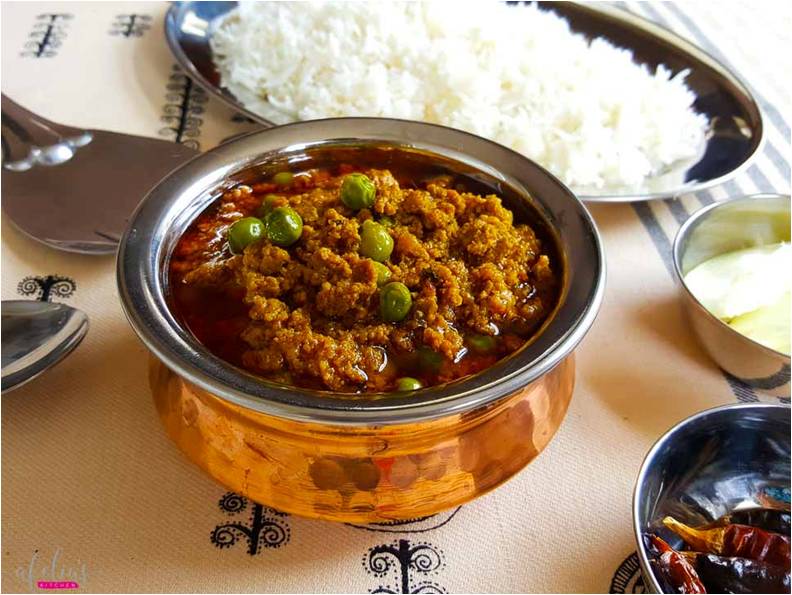
Keema matar https://www.afeliaskitchen.com/classic-keema-matar/
Another food issue that cropped up was the Romans’ use of ice. Without modern, electrical methods of heat extraction they were dependent on `harvesting’ natural ice and preserving it as long as possible. Ice might be obtained from high mountains (Alps or Apennines) and transported in a block large enough for some to survive the journey. Another method involved taking advantage of the extreme temperature drop at night and low humidity in desert locations. Water was apparently placed in the bottom of pits lined with straw as insulation and would then freeze over night ready for collection at 3 or 4 p.m. Ice thus obtained might be used at once or kept in a well-insulted `ice-house.’ See the account at: https://everything2.com/title/Making+Ice+In+Ancient+Rome
We had a brief Latin discussion on our own accommodation and furniture, using the dialogue given below as a guide. Eugene, who has been working hard on vocabularies, had produced a long list of relevnt terms and this, like the other lists, can be downloaded from just above the maps at https://linguae.weebly.com/circulus-latinus-honcongensis.html.
The word both Eugene and John’s document’s recommend for flat is diaeta, a Greek word which originally meant `mode of living’, `diet’, but came to be used for a `dwelling-place’, `dwelling-room’ or `summer-house’ (Lewis & Short). However, other words for a sub-division within a larger building include cēnāculum (originally an upper-storey diing-room, then an attic which might be let out to a poor tenent), conclāve (or plural conclāvia) or even aedēs, which we had thought could only mean `house’! The question in aedibus habitās an in diaetā? (`Do you live in a house or a flat?’) is therefore not well-formed but it is uncertain what the correct formulation would be. We were also unsure of the word for dishwasher but later discovered it Traupman uses māchina ēlūtōria for this, as opposed to māchina lāvātōria
Eugene recommended a Latin-French dictionary. Philippe Guesad and Chrsitelle Laile’s Lexique nouveau de la langue latine, which is topically arranged and includes some modern Latin. Details are at:
https://www.fabula.org/actualites/p-guisard-et-c-laize-lexique-nouveau-de-la-langue-latine_23139.php Eugene also likes David Astori’s phrase-book Nuovo Parlo Latino https://www.amazon.com/Nuovo-parlo-latino/dp/8878872342
To make full use of those resources, familiarity with French and Italian are required. Similar aids in English are Walter Ripman's `Classified Vocabulary' and Carl Meissner's `Latin Phrase Book', both topically organized, are downloadable free of charge as searchable PDF files from http://hiberna-cr.wikidot.com/downloads. Also available from this page is Diederich's list of the commonest 1500 Latin words, which account for over 80% of words occurring in a typical classical or medieval text. This site, managed by Carolus Raeticus's site, contains in addition links to a number of simple Latin readers also available free on the Internet.
Zoe’s remarks on the controversial Chinese scientist producing gene-edited babies without himself even being a doctor (https://www.theguardian.com/science/2018/nov/26/worlds-first-gene-edited-babies-created-in-china-claims-scientist). Zoe, a bio-chemist now working on algae as they are marginally less boring than proteins. explained that the gene-editing technology is relatively simple but nobody had previously dared to use it on a human being.
This led John to mention the Indian scheme to unqualified, quack medical practioners 100 hours training to enable them to act as doctors and also Mao’s earlier bare-foot doctors scheme. Malcolm in-turn brought up the Ping An (Putonghua mis-pronunciation of Ping On /平安-) Insurance Company which has been successfully reducing over-crowding in hospitals by getting people with less serious complaints to use clinics run by paramedical staff. The company’s 100-storey main building in Guangzhou is the largest corporate headquarters in world and they are best known for the efficiency of their motor insurance, with claims sometimes being processed within 4 minutes. Clients send photos of the dmage to them and they are then directed to a suitable garage to have the repairs done. They acquired a base of 30 million clients within 4 months.
We briefly mentioned again Nostratic, the hypothetical linguistic super-family. As explained last month, `Nostraticists’ differ among themselves on which languages should be included but they all accept as members Indo-European, Uralic (the Finno-Ugric languages shown on the map below, plus the Samoyedic languages in Siberia) and `Altaic’,
a grouping of Turkish and Mongolian, which, like Nostratic itself, is not accepted by most comparative linguists.
Another food issue that cropped up was the Romans’ use of ice. Without modern, electrical methods of heat extraction they were dependent on `harvesting’ natural ice and preserving it as long as possible. Ice might be obtained from high mountains (Alps or Apennines) and transported in a block large enough for some to survive the journey. Another method involved taking advantage of the extreme temperature drop at night and low humidity in desert locations. Water was apparently placed in the bottom of pits lined with straw as insulation and would then freeze over night ready for collection at 3 or 4 p.m. Ice thus obtained might be used at once or kept in a well-insulted `ice-house.’ See the account at: https://everything2.com/title/Making+Ice+In+Ancient+Rome
We had a brief Latin discussion on our own accommodation and furniture, using the dialogue given below as a guide. Eugene, who has been working hard on vocabularies, had produced a long list of relevnt terms and this, like the other lists, can be downloaded from just above the maps at https://linguae.weebly.com/circulus-latinus-honcongensis.html.
The word both Eugene and John’s document’s recommend for flat is diaeta, a Greek word which originally meant `mode of living’, `diet’, but came to be used for a `dwelling-place’, `dwelling-room’ or `summer-house’ (Lewis & Short). However, other words for a sub-division within a larger building include cēnāculum (originally an upper-storey diing-room, then an attic which might be let out to a poor tenent), conclāve (or plural conclāvia) or even aedēs, which we had thought could only mean `house’! The question in aedibus habitās an in diaetā? (`Do you live in a house or a flat?’) is therefore not well-formed but it is uncertain what the correct formulation would be. We were also unsure of the word for dishwasher but later discovered it Traupman uses māchina ēlūtōria for this, as opposed to māchina lāvātōria
Eugene recommended a Latin-French dictionary. Philippe Guesad and Chrsitelle Laile’s Lexique nouveau de la langue latine, which is topically arranged and includes some modern Latin. Details are at:
https://www.fabula.org/actualites/p-guisard-et-c-laize-lexique-nouveau-de-la-langue-latine_23139.php Eugene also likes David Astori’s phrase-book Nuovo Parlo Latino https://www.amazon.com/Nuovo-parlo-latino/dp/8878872342
To make full use of those resources, familiarity with French and Italian are required. Similar aids in English are Walter Ripman's `Classified Vocabulary' and Carl Meissner's `Latin Phrase Book', both topically organized, are downloadable free of charge as searchable PDF files from http://hiberna-cr.wikidot.com/downloads. Also available from this page is Diederich's list of the commonest 1500 Latin words, which account for over 80% of words occurring in a typical classical or medieval text. This site, managed by Carolus Raeticus's site, contains in addition links to a number of simple Latin readers also available free on the Internet.
Zoe’s remarks on the controversial Chinese scientist producing gene-edited babies without himself even being a doctor (https://www.theguardian.com/science/2018/nov/26/worlds-first-gene-edited-babies-created-in-china-claims-scientist). Zoe, a bio-chemist now working on algae as they are marginally less boring than proteins. explained that the gene-editing technology is relatively simple but nobody had previously dared to use it on a human being.
This led John to mention the Indian scheme to unqualified, quack medical practioners 100 hours training to enable them to act as doctors and also Mao’s earlier bare-foot doctors scheme. Malcolm in-turn brought up the Ping An (Putonghua mis-pronunciation of Ping On /平安-) Insurance Company which has been successfully reducing over-crowding in hospitals by getting people with less serious complaints to use clinics run by paramedical staff. The company’s 100-storey main building in Guangzhou is the largest corporate headquarters in world and they are best known for the efficiency of their motor insurance, with claims sometimes being processed within 4 minutes. Clients send photos of the dmage to them and they are then directed to a suitable garage to have the repairs done. They acquired a base of 30 million clients within 4 months.
We briefly mentioned again Nostratic, the hypothetical linguistic super-family. As explained last month, `Nostraticists’ differ among themselves on which languages should be included but they all accept as members Indo-European, Uralic (the Finno-Ugric languages shown on the map below, plus the Samoyedic languages in Siberia) and `Altaic’,
a grouping of Turkish and Mongolian, which, like Nostratic itself, is not accepted by most comparative linguists.
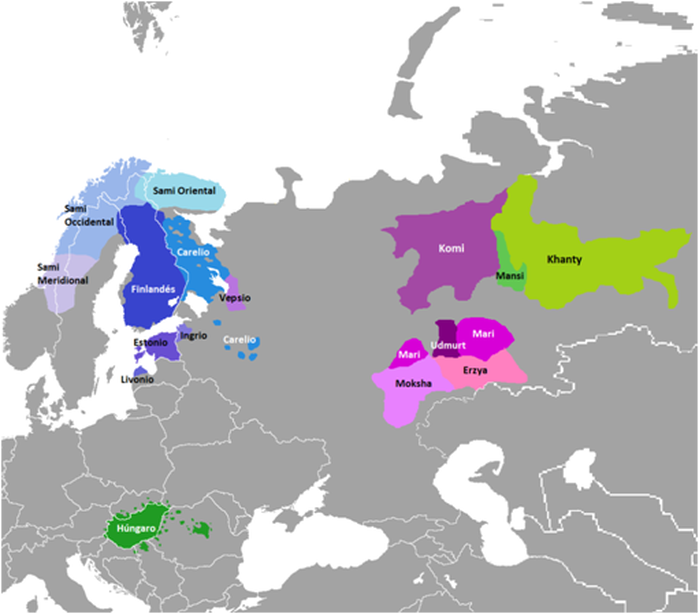
Finno-Ugric btranch of the Urali language family
https://commons.wikimedia.org/wiki/File:Lenguas_finougrias.png
Zhang Wei was curious about the Persians (an Indo-European people) and Zoroaster, the founder of their ancient religion which is still practiced by the Parsis (a word related to `Persian’), most of whom now live in India. The Parsi merchant Sir Hormusjee Naorojee Mody, who emigrated as a young man to Hong Kong, is commemorated by Mody Road in Tsim Sha Tsui and his bust in the main building of Hong Kong University, to whose establishment he had been the principal contributor. More recently, Freddie Mercury, whose Parsi family emigrated to Britain via Zanzibar, won fame as a rock musician. There is still a small Parsi community in Hong Kong and its Zoroastrian priest is a friend of Pat’s and said Grace in Avestan, the Old Iranian language in which Zoroastrian scriptures were written, at his 70th birthday party.
Zhang Wei though that the Persians had been instrumental in bringing Buddhism into China but the major role in this seems to have been played by the Kushans (貴霜), according to Chinese sources originally one of the five tribes in the Yuezhi (大月氏) confederacy, which suposedly migrated west from Gansu in north-west China in the 2nd. century B.C. under pressure from the Xiongnu (匈奴). Scholars disagree on their ethnic origins but they could have been an Indo-European people. They established themselves in what is now northern Afghanistan and Uzbekistan, displacing Graeco-Bactrian rulers and eventually establishing an empire which included much of northern India and the Tarim Basin in western China.
We also disussed the script the Persians used before they adopted the Arabic one. John thought this was cuneiform but in fact this was only in use from around 500 to 300 B.C., after which their language was written in a number of scripts but particularly in the Pahlavi alphabet adapted from that of Aramaic. A Semitic language like Hebrew and Arabic, Aramaic had become a lingua franca across much of the Middle East and was the mother tongue of Jesus Christ. The Zoroastrian scriptures have been preserved in Pahlavi script, which remained in general use until its replacement by the Persi-Arabic script some three hundred years after the 7th centry Arab conquest.
https://commons.wikimedia.org/wiki/File:Lenguas_finougrias.png
Zhang Wei was curious about the Persians (an Indo-European people) and Zoroaster, the founder of their ancient religion which is still practiced by the Parsis (a word related to `Persian’), most of whom now live in India. The Parsi merchant Sir Hormusjee Naorojee Mody, who emigrated as a young man to Hong Kong, is commemorated by Mody Road in Tsim Sha Tsui and his bust in the main building of Hong Kong University, to whose establishment he had been the principal contributor. More recently, Freddie Mercury, whose Parsi family emigrated to Britain via Zanzibar, won fame as a rock musician. There is still a small Parsi community in Hong Kong and its Zoroastrian priest is a friend of Pat’s and said Grace in Avestan, the Old Iranian language in which Zoroastrian scriptures were written, at his 70th birthday party.
Zhang Wei though that the Persians had been instrumental in bringing Buddhism into China but the major role in this seems to have been played by the Kushans (貴霜), according to Chinese sources originally one of the five tribes in the Yuezhi (大月氏) confederacy, which suposedly migrated west from Gansu in north-west China in the 2nd. century B.C. under pressure from the Xiongnu (匈奴). Scholars disagree on their ethnic origins but they could have been an Indo-European people. They established themselves in what is now northern Afghanistan and Uzbekistan, displacing Graeco-Bactrian rulers and eventually establishing an empire which included much of northern India and the Tarim Basin in western China.
We also disussed the script the Persians used before they adopted the Arabic one. John thought this was cuneiform but in fact this was only in use from around 500 to 300 B.C., after which their language was written in a number of scripts but particularly in the Pahlavi alphabet adapted from that of Aramaic. A Semitic language like Hebrew and Arabic, Aramaic had become a lingua franca across much of the Middle East and was the mother tongue of Jesus Christ. The Zoroastrian scriptures have been preserved in Pahlavi script, which remained in general use until its replacement by the Persi-Arabic script some three hundred years after the 7th centry Arab conquest.
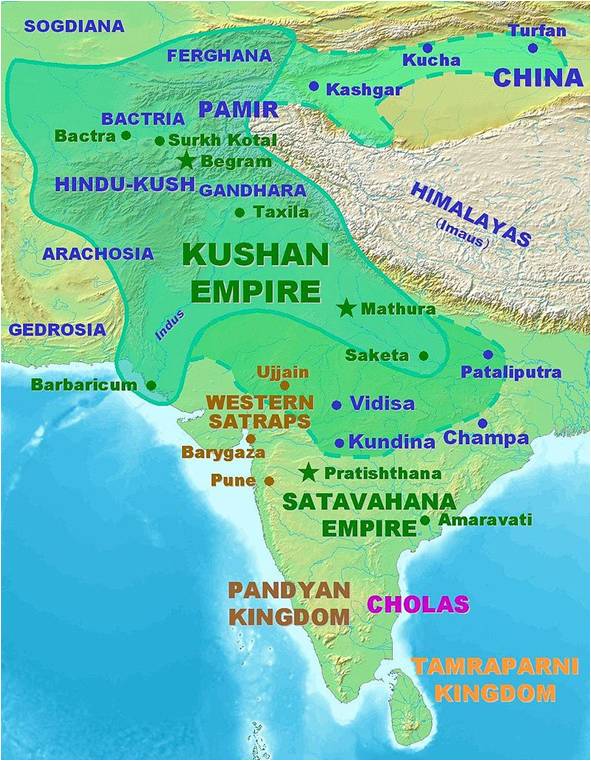
The Kushan Empire, c.130 A.D.
https://commons.wikimedia.org/w/index.php?curid=2110032
Persian cuneiform took the general principle of using patterns of wedge shapes from Mesopotamia but individual signs may have been separately invented rather than evolved from individual Mesoptamian ones. The principal Persian signs make up a syllabary but (as in many modern South Asian writing systems) most of them could also stand for a consonant on its own. There were also a handful of logograms representing complete words:
https://commons.wikimedia.org/w/index.php?curid=2110032
Persian cuneiform took the general principle of using patterns of wedge shapes from Mesopotamia but individual signs may have been separately invented rather than evolved from individual Mesoptamian ones. The principal Persian signs make up a syllabary but (as in many modern South Asian writing systems) most of them could also stand for a consonant on its own. There were also a handful of logograms representing complete words:
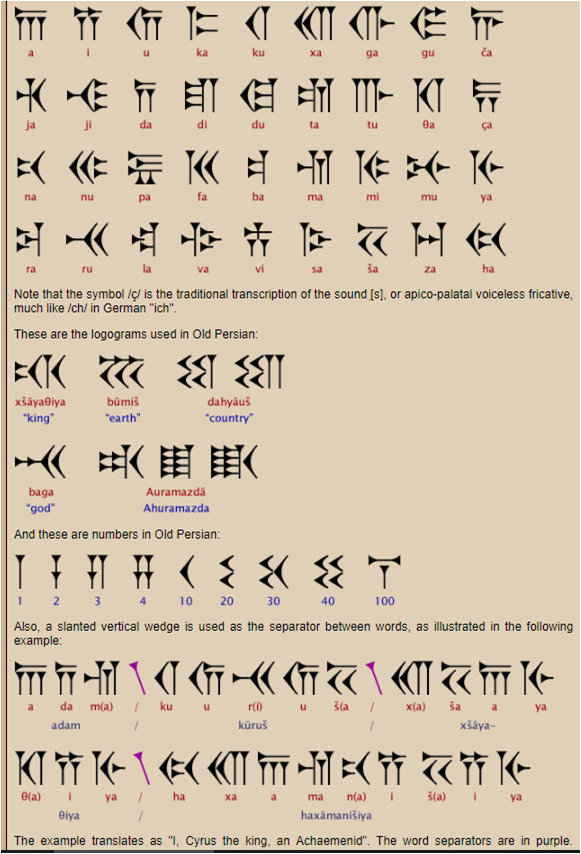
http://www.ancientscripts.com/oldpersian.html
The decipherment of this script in the 19th century was made with the aid of the Behistun Inscription, carved on a mountainside in western Iran and recording the victories of King Darius the Great (reigned c. 550-486 B.C)., remembered in European history mainly for the defeat at Marathon in 490 B.C. of the army he sent against Athens but otherwise a successful ruler. Persian cuneiform may actually have been devised during his reign. There is an English translation of the inscription at https://en.wikipedia.org/wiki/Full_translation_of_the_Behistun_Inscription
The decipherment of this script in the 19th century was made with the aid of the Behistun Inscription, carved on a mountainside in western Iran and recording the victories of King Darius the Great (reigned c. 550-486 B.C)., remembered in European history mainly for the defeat at Marathon in 490 B.C. of the army he sent against Athens but otherwise a successful ruler. Persian cuneiform may actually have been devised during his reign. There is an English translation of the inscription at https://en.wikipedia.org/wiki/Full_translation_of_the_Behistun_Inscription
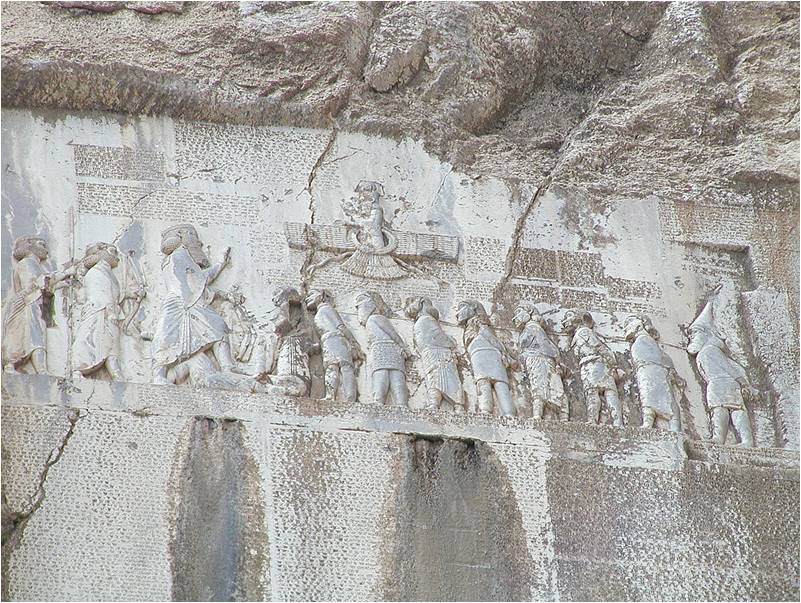
The Behistun Inscription
https://en.wikipedia.org/wiki/Behistun_Inscription#/media/File:Bisotun_Iran_Relief_Achamenid_Period.JPG
Darius’s inscription included not only the Old Persian text but also versions in Akkadian, the Semitic language of Mesopotamia where cuneiform writing was first devised, and Elamite, a language once spoken in south-western Iran which most linguists think is related to no other known language but a few link with the Dravidian language of South India. The Akkadian cuneiform system is considerably more complex than that of Old Persian, so the decipherment of the latter came first and was a major help in deciphering the former.
Old Persian, once spoken in western Iran, is the ancestor of the modern Perisan language and is also quite similar to Sanskrit, the classical Indian language, though it had lost much more of the old Indo-European system of inflections. A very brief introduction to the language, with all the texts in romanisation, is T. Hudson-William A Short Grammar of Old Persian with a Reader . This is not in any Hong Kong library but is available on the internet from several sellers (e.g. https://www.calibanbooks.com/pages/books/s00011372/t-hudson-williams/a-short-grammar-of-old-persian-with-a-reader-accompanied-by-a-word-for-word-translation-notes-and ) and John has a copy which he will be happy to lend to anyone interested. A more thorough course, including exercises in reading the cuneiform script, can be downloaded from https://sites.fas.harvard.edu/~iranian/OldPersian/index.html Avestan, the language of the Zorasterian scriptures was spoken further east, including in Afghanistan and some areas to the north and is closer than Old Persian to Sanskrit. The illiustration below shows Avestan in Pahlavi script with the modern Persi-Arabic one on the facing page.
The Akkadian language had two major dialects, Assyrian and Babylonian, the latter being used in the Behistun inscription. Probably the best place to get an idea of what the language was like is the Complete Babylonian volume in the Teach Yourself series and you can hear roughly what it sounded like in the video embedded at https://www.thevintagenews.com/2018/12/14/babylonian-movie/ In the 19th century the word `Assyrian’ was often used for Akkadian as a whole and this usage is retained in the title of the mammoth Chicago Assyrian Dictionary completed a few years ago.
Before Akkadian became dominant in Mesopotamia, cuneiform script, probably the world’s earliest writing system, had been used to write down Sumerian, an even more ancient language which, as far as we know, has no present-day relatives. Sumerian went out of use as a spoken language around about 2000 B.C. but it was retained as a written code for cultural purposes, with a similar kind of role in the educational system to that traditionally played by Latin in Europe.
There is more detail at https://en.wikipedia.org/wiki/Sumerian_language
https://en.wikipedia.org/wiki/Behistun_Inscription#/media/File:Bisotun_Iran_Relief_Achamenid_Period.JPG
Darius’s inscription included not only the Old Persian text but also versions in Akkadian, the Semitic language of Mesopotamia where cuneiform writing was first devised, and Elamite, a language once spoken in south-western Iran which most linguists think is related to no other known language but a few link with the Dravidian language of South India. The Akkadian cuneiform system is considerably more complex than that of Old Persian, so the decipherment of the latter came first and was a major help in deciphering the former.
Old Persian, once spoken in western Iran, is the ancestor of the modern Perisan language and is also quite similar to Sanskrit, the classical Indian language, though it had lost much more of the old Indo-European system of inflections. A very brief introduction to the language, with all the texts in romanisation, is T. Hudson-William A Short Grammar of Old Persian with a Reader . This is not in any Hong Kong library but is available on the internet from several sellers (e.g. https://www.calibanbooks.com/pages/books/s00011372/t-hudson-williams/a-short-grammar-of-old-persian-with-a-reader-accompanied-by-a-word-for-word-translation-notes-and ) and John has a copy which he will be happy to lend to anyone interested. A more thorough course, including exercises in reading the cuneiform script, can be downloaded from https://sites.fas.harvard.edu/~iranian/OldPersian/index.html Avestan, the language of the Zorasterian scriptures was spoken further east, including in Afghanistan and some areas to the north and is closer than Old Persian to Sanskrit. The illiustration below shows Avestan in Pahlavi script with the modern Persi-Arabic one on the facing page.
The Akkadian language had two major dialects, Assyrian and Babylonian, the latter being used in the Behistun inscription. Probably the best place to get an idea of what the language was like is the Complete Babylonian volume in the Teach Yourself series and you can hear roughly what it sounded like in the video embedded at https://www.thevintagenews.com/2018/12/14/babylonian-movie/ In the 19th century the word `Assyrian’ was often used for Akkadian as a whole and this usage is retained in the title of the mammoth Chicago Assyrian Dictionary completed a few years ago.
Before Akkadian became dominant in Mesopotamia, cuneiform script, probably the world’s earliest writing system, had been used to write down Sumerian, an even more ancient language which, as far as we know, has no present-day relatives. Sumerian went out of use as a spoken language around about 2000 B.C. but it was retained as a written code for cultural purposes, with a similar kind of role in the educational system to that traditionally played by Latin in Europe.
There is more detail at https://en.wikipedia.org/wiki/Sumerian_language
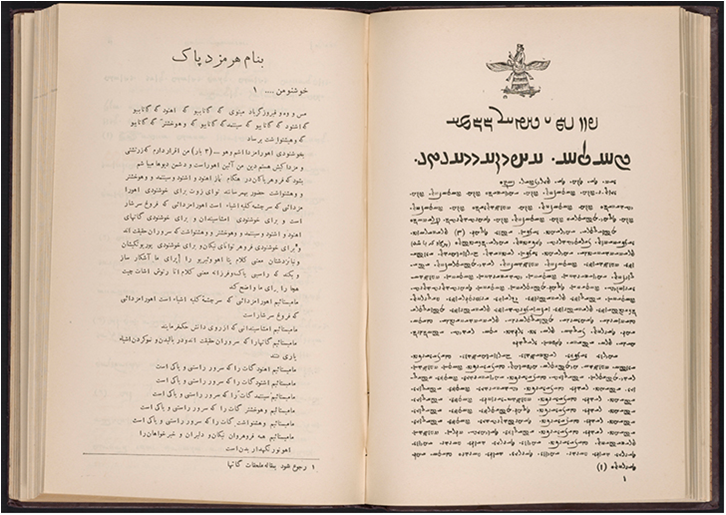
Persi-Arabic and Pahlavi script http://www.ancientscripts.com/pahlavi.html
Whilst reading lines 601-631 of Book II of the Aeneid (see below), we discussed alternative translations of spissīs in the clause [Venus] spissīs noctis sē condidit umbrīs in line 621. The word normally means `thick’, `dense’ or `frequent’ but perhaps `hid hersef in the impenetrable shadows of the night’ might be best in contexrt. We also noted that Robert Sonkowsky’s recording of the opening lines of Book I, available at https://www.rhapsodes.fll.vt.edu/aeneid1.htm, iss till probably the best for getting a feel for Virgil’s language,
We noted that Alan Smith, a judge who Malcolm knows,was interested in Latin and might be a possible recruit, and also that the district name Sai Ying Pun (西營盤) literally means `western (military-) camp’ and commemorates the area's early use by the British army. A possible latinization would therefore be Castra Occidentalia
Whilst reading lines 601-631 of Book II of the Aeneid (see below), we discussed alternative translations of spissīs in the clause [Venus] spissīs noctis sē condidit umbrīs in line 621. The word normally means `thick’, `dense’ or `frequent’ but perhaps `hid hersef in the impenetrable shadows of the night’ might be best in contexrt. We also noted that Robert Sonkowsky’s recording of the opening lines of Book I, available at https://www.rhapsodes.fll.vt.edu/aeneid1.htm, iss till probably the best for getting a feel for Virgil’s language,
We noted that Alan Smith, a judge who Malcolm knows,was interested in Latin and might be a possible recruit, and also that the district name Sai Ying Pun (西營盤) literally means `western (military-) camp’ and commemorates the area's early use by the British army. A possible latinization would therefore be Castra Occidentalia
DOMUS ET SUPPELLEX / HOME AND FURNITURE
|
Ubi habitās? In īnsulā Honcongō / Novendracōnibus /
in Terrīs Novīs / in Īnsulīs Remōtiōribus/ in Lantāviā / in Lāmā In aedibus habitās an in diaetā? Quot cubicula habēs? Ūnum /duo /trēs /quattuor. Est etiam exedrium culīna et balneum,. Habēsne solium an tantum balneum pluvium? Estne maeniānum? Quae suppellex est in exedriō? mēnsa /sellae / sella bracchiāta / bibliothēca/ pluteī / televīsōrium /cēdeātrum / armārium Quid est in cubiculīs? In quōque cubiculō est lectus et vestiārium. In cubiculō prīncipālī est etiam mēnsa scrīptōria/ mēnsa computrālis Habēsne āerem temperātrum? Ita, est temperātrum āeris in omnibus conclāvibus. Minimē, ventigenīs ūtor, Quid est in culīnā? Calamus, fūsōrium, frīgidārium et māchina lavātōria Habēsne ancillam? Quōmodo ad officīnam pervenīs? pedibus / autocinētō / raedā longā /raedā mediā/ trāmine /currū electricō /raedā meritōriā Quantō tempore pervenītur? Ūnā hōrā /quīndecim/trīgintā/quadrāgintā/ quīnquāgintā minūtīs Quid ā fenestrīs tuīs aspicitur? Alia aedificia/mare/montēs/arborēs |
Where do you live?
On Hong Kong island / in Kowloon/ in the New Territories / in the Outlying Islands on Lantau / on Lama Do you live in a house or a flat? How many bedrooms do you have? One/two/three/four. There is also a living-room, a kitchen and a bathroom Do you have a bath-tub or just a shower? Is there a balcony? What furniture is there in the living room? table / chairs / armchair / bookcase/shelves / TV set/CD player / cupboard What’s in the bedrooms? In each bedroom there’s a bed and a wardrobe. In the master bedroom there’s also a desk/computer desk Do you have air-conditionin Yes, there’s an air-conditioner in all the rooms No, I use fans. What’s in the kitchen A stove, a sink, a fridge and a washing machine, Do you have a maid? How do you get to work? on foot/by car /by bus / by minibus /by train/by tram/by taxi How long does it take to get there? An hour /15/30/40/50 minutes What can you see from your windows? Other buildings/the sea/the hills/trees |
N.B: solium, -ī n throne, bath-tub; solum, -ī n ground, soil; sōlus, -a, -um alone (adv. sōlum). Possibly aedificium separātum rather than aedēs should be used for `house’ as opposed to `flat’ (diaeta)
AENEID II, 601-631
nōn tibi Tyndaridis faciēs invīsa Lacaenae mortālīs hebetat vīsūs tibi et ūmida circum 605
culpātusve Paris, dīvum inclēmentia, dīvum cālīgat, nūbem ēripiam; tū nē qua parentis
hās ēvertit opēs sternitque ā culmine Troiam. iussa timē neu praeceptīs pārēre recūsā):
aspice (namque omnem, quae nunc obducta tuentī
TRANSLATION
For you the face of Spartan Tyndaris is not to be hated nor Paris blamed. The gods’, yes the gods’ ruthlessness is overthrowing your prosperity and driving Troy down from its high perch. Look – for I will tear away all the cloud which now, damp and dark around you, is spread over and obstructs mortal vision as you watch; you should not fear any of your mother’s orders nor refuse to obey her instructions.
601-602 : Tyndaris, Tyndaridis f daughter/female descendant of Tyndareus, a legendary king of Sparta (here referring to Helen as Tyndareus was the husband of her mother, Leda, even though her actual father was Jupiter, who had visited Leda in the form of a swan.) faciēs, faciēī f face. Lacaenus, -a, -um Spartan. īnvīsus, -a, -um hateful, despised. culpō, culpāre, culpāvī, culpātum blame. –ve: or (placed after noun as alternative to vel/aut in front. inclementia, -ae f harshness, unforgiving spirit. dīvus, -ī m god.
tibi : `for you’ (used here to emphasise the importance to aeneas of this message.)
īnvīsa ... culpātus: literally `hated’ and `blamed’ but the meaning intended is really `deserving to be hated ... desrving to be blamed’. Venus is arguing that the real cause of Troy’s destruction is not Paris and Helen but the gods whose actions she is about to reveal.
dīvum: contracted form of dīvōrum. The repetition of the word emphasises the gods’ responsibility.
603 : ēvertō, -ere, ēvertī, ēversum overturn. opēs, opum f pl wealth. sternō, -ere, strāvī, strātum strew, lay low. culmen, culminis n summit, peak (the word similarly used by Hector in aeneas’s dream for Troy’s former ppower and prosperity).
604: aspiciō, aspicere, aspexī, aspectum look at, consider. namque for. omnis, omne all. nunc now obdūcō, -ere, obdūxī, obductum cover, lay over, screen. tueor, tuērī, tuitus sum look at, view.
tuentī ... tibi: `for you as you watch’
605:mortālis, -e mortal vīsus, vīsūs vision hebetō, hebetāre, hebetāvī, hebetātum weaken, clog ūmidus, -a, -um moist. circum around.
606: cālīgō, -āre, cālīgāvī, cālīgātum be dark. nūbēs, nūbis f cloud. ēripiō, ēripere, ēripuī, ēreptum tear away.
nē ... timē : this use of nē to make a negative imperative is an unusual alternative to nōlī timēre.
qua: alternative form to the usual quae as neuter accusative plural from the adjective quī, quāē, quod (`which/any’). parēns, parentis m f parent.
607: iussum, -ī n order. neu and not. praeceptum, -ī n order, instruction. pāreō, pārēre, pāruī, obey (with dative). recūsō, -āre, recūsāvī, recūsātum refuse.
hīc, ubi disiectās mōlēs āvulsaque saxīs ēruit. hīc Iūnō Scaeās saevissima portās
saxa vidēs, mixtōque undantem pulvere fūmum, prīma tenet sociumque furēns ā nāvibus agmen
Neptūnus mūrōs magnōque ēmōta tridentī 610 ferrō accincta vocat.
fundāmenta quatit tōtamque ā sēdibus urbem
TRANSLATION
Here, where you see the massive structures torn apart, the stones ripped away from stones, and the billowing smoke with dust mixed in it, Neptune is shaking the walls and the foundations shifted with his great trident and destroying the whole city from its base. Here most savage Juno in the lead holds the Western gate and, in rage and girded with iron summons the allied force from their ships.
608: hīc here. ubi where.disiciō, -ere, disiēcī, disiectum. tear apart. mōlēs, mōlis f massive structure. āvellō, āvellere, āvellī/āvulsī, āvulsum tear away. saxum, -ī n rock. saxīs: ablative used without ā to mean `from rocks’..
609: videō, vidēre, vīdī, vīsum see. misceō, miscēre, miscuī, mixtum/mistum mix. undō, -āre, undāvī, undātum billow, move in waves. pulvus, pulveris n dust. fūmus, ī m smoke. mixtō...fūmum: literally `smoke billowing with mixed dust’ i.e. billowing smoke with dust mixed in it. The intertwining of the accusative and ablative phrases matches the picture of a physical mingling.
610: mūrus, -ī m wall. magnus, -a, -um big. ēmoveō, -ēre, ēmōvī, ēmōtum move out, move away. tridēns, tridentis m trident.
Neptūnus: there is great irony in this god’s role in the destruction of Troy’s walls since he himself had originally helped build them but then been denied his promised payment by King Laomedon. magnō ... tridentī : ablative of instrument ; the foundations were dislodged by the trident. The first four feet of the line, which are all spondees, perhaps suggest the slow levering out of the huge stones.
611: fundamentum, -ī n foundation. quatiō, quatere, quassum shake. tōtus, -a, -um whole. sēdēs, sēdis f seat, base. urbs, urbis f city.
612: ēruō, ēruere, ēruī, ērutum overthrow, destroy. saevus, -a, -um savage. Scaeus, -a, -um western (Greek adjective used as a proper name in Latin) porta., -ae f Scaeās saevissima: note the alliteration.
613: prīmus, -a, -um first, teneō, tenēre, tenuī, tentum hold, possess. socius, -a, -um allied. furō, furere, furuī be in a rage.nāvis, nāvis f ship. agmen, agminis n column (of troops), army. furēns: the colour coding shows this present participle as describing Juno but, as its nominative singular is the same in all genders, it could also apply to the Greek army (agmen) and the poet may well have meant it to be ambiguous.
614: ferrum, -ī n iron accingō, -ere, acīnxī, accīnctum equip, provide, gird. vocō, vocāre, vocāvī, vocātum.call,
This line is one of a number which Virgil left unfinished.
iam summās arcēs Trītōnia, respice, Pallas 615 ēripe, nāte, fugam fīnemque impōne labōrī; 619
īnsēdit nimbō effulgēns et Gorgone saevā. nusquam aberō et tūtum patriō tē līmine sistam.’
ipse pater Danaīs animōs vīrīsque secundās dīxerat et spissīs noctis sē condidit umbrīs
sufficit, ipse deōs in Dardana suscitat arma.
TRANSLATION
Now, look back, Tritonian Pallas has taken her seat on top of the citadel, gleaming out from the cloud and with her savage Gorgon. Father Jupiter himself provides courage and matching strength to the Danaans, himself rouses them against the Dardanian forces. Flee, son, and put an end to your work; I will nowhere be absent and I will set you safely at your father’s doorstep.’ She said these words and then hid herself in the thick shadows of the night.
615: iam now, already. summus, -a, -um highest, top of arx, arcis f citadel. Triītōnius, -a –um Tritonian, of Triton a river and lake in Africa, where Athena/Minerva was said to have been born. respiciō, respicere, respexi, respectum look back, look about. Pallas, Palladis a name for Athena.
616: īnsideō, īnsidēre, īnsēdī, īnsessum sit on. nimbus, -ī m cloud. effulgeō, effulgēre, effulsī shine out. Gorgo, Gorgonis f female monster whose glance could turn men to stone. saevus, -a, -um savage. summās arcēs ... īnsēdit: `has taken her seat on’ / is sitting upon the top of the citadel ‘(i.e. the central fortified area in the city). nimbō, `from a (storm-) cloud Gorgone saevā. `with her savage Gorgon’, referring to the haed of the most famous Gorgon, Medusa, which was fixed to Athena’s shield after she was beheaded by Perseus (see the PERSEUS file) who Athena had been helping.
617: ipse, ipsa, ipsum –self (emphatic). pater, patris m father (referring here to Juppiter as father of the gods). Danaī, Danaōrum Danaäns (i.e. Greeks). animus, -ī m spirit, mind, courage. secundus, -a, -um favourable, following vīrēs, vīrium f pl strength (vīrīs is accus. Pl.)
618: sufficiō, sufficere, suffēcī, suffectum make sufficient deus, -ī m god. Dardanus, -a, -um Dardanian (i.e. Trojan). suscitō, -āre, suscitāvī, sucitātum rouse, raise up arma : literally `arms’ but here meaning `forces’, `army.’
619: ēripiō, ēripere, ēripuī, ereptum snatch away. fuga, -ae f flight. fīnis, fīnis f end. impōnō, -ere, imposuī, impositum impose, place upon. labor, labōris m work.
620: nusquam nowhere. absum, esse, afuī be absent. tūtus, -a, -um safe. patrius, -a, -um paternal, belonging to one’s fathers or ancestors. līmen, līminis n threshold, entrance. sistō, sistere, stetī, statum place, set up. patriō ... līmine: ablative phrase giving location. In prose the preposition in would be required
621: dīcō, dīcere, dīxī, dictum say. spissus, -a, -um thick. nōx, noctis f night. condō, condere, condidī, conditum found, hide. umbra, -ae f shade.
appārent dīrae faciēs inimīcaque Troiae cum ferrō accīsam crēbrīsque bipennibus īnstant
nūmina magna deum. ēruere agricolae certātim, illa usque minātur
Tum vērō omne mihī vīsum cōnsīdere in ignīs et tremefacta comam concussō vertice nūtat
Īlium et ex īmō vertī Neptūnia Troia: 625 vulneribus dōnec paulātim ēvicta suprēmum 630
ac velutī summīs antīquam in montibus ornum congemuit trāxitque iugīs āvulsa ruīnam.
TRANSLATION
There appear the terrible faces and the mighty divine powers of the gods, hostile to Troy. Then all of Ilium seemed to me to subside into the fires and Neptune’s Troy to be overthrown from the bottom up. And it is as when, on the mountain tops, farmers press hard in rivalry to uproot an ancient ash-tree weakened by frequent blows with iron and double axes. It continues to threaten and, with its foliage trembling and its crown violently shaken, it sways until, gradually overcome by the blows, it has given a last groan and, torn away from the ridge, left destruction in its wake.
622: appareō, apparēre, apparuī appear. dīrus, -a, -um terrible.faciēs, faciēī f face. inimīcus, -a, -um hostile.
623: nūmen, nūminis n divinity, divine will. magnus, -a, -um great. deus, deī m god .
Note the strong alliteration with `m’ and `n’ in this line, perhaps the most famous unfinished one in the poem. It is possible that, even if he had lived to finish revising the poem, Virgil might have left this line as it stands, perhaps implying that Aeneas was lost for words at this point. The terrible picture of divine anger is heightened by the contrast with Venus’s motherly care.
deum: not an acccusative but the short form of the genitive plural.
624: tum indeed. vērō indeed, truly. omnis, -e all (of). videō, vidēre, vīdī, vīsum see (in passive `be seen’ or `seem’). cōnsīdō, cōnsīdere, cōnsēdī, cōnsessum sit down, subside. ignis, ignis m fire (ignīs is accusative plural. mihī vīsum:`seemed to me.’ This is the perfect tense with the verb est understood. The participle is neuter nominative singular to agree with Īlium in the next line although the feminine Troia in the next line is also a subject of the verb.
cōnsīdere in ignīs: this phrase is perhaps meant to suggest the sinking down of a corpse as the funeral pyre burns and collapses beneath it.
625: Īlium, -ī n Ilium (another name for Troy). īmum, -ī n bottom. vertō, -ere, vertī, versum turn, overthrow, turn upside down. Neptūnius, -a, -um Neptunian (adjective applied to Troy because of Neptune’s role in building the city. vertī : 3rd conjugation passive infinitive (`to be overthrown’)
626: ac and. velutī just as summus, -a, -um top, top of antīquus, -a, -um old, ancient mōns, montis m mountain. ornus, -ī ash-tree.
627: ferrum, ī n iron accīdō, accīder, accīdī, accīsum cut short, weaken. creber, crebra, crebrum close together, frequent. bipennis, bipennis f two-edged axe. īnstō, īnstāre, īnstāvī, īnstātum threaten, press hard on ferrō... crēbrīsque bipennibus: literally `with iron and with axes close together’ i.e. with frequent blows from iron axes. accīsam: This passive perfect participle can be translated literally into English (`they press hard to uproot a weakend tree’) or, as it is the famers themselves who weakened it) turned into a clause with an active verb (they weaken a treee tree with axe blows, then press hard to uproot it’)
628: ēruō, ēruere, ēruī, ērutum uproot, destroy. agricola, -ae m farmer. certātim in rivalry. usque continuously. minor, minārī, minātus sum threaten (here the meaning is `threatens to fall’)
629: tremefaciō, tremefacere, tremefēcī, tremefactum cause to tremble. com, -ae f foliage. concutiō, concutere, concussī, concussum shake violently. vertex, verticis m crown of head, peak. nūtō, nūtāre, nūtāvī, nūtātum nod, sway.
tremefacta: femine perfect participle describing (as do ēvicta and āvulsa in the folllowing lines) the ash-tree (ornus), which is the subject of nūtat, congemuit and trāxit.
comam: this is not a direct object (since the participle tremefacta is passive) but `accusative of respect’ so the tree is literally `caused to temble with respect to its foliage’ concussō vertice: ablative absolute (`with its top shaken’)
630: vulnus, vulneris n wound. dōnec until. paulātim gradually. ēvincō, ēvincere, ēvīcī, ēvictum defeat utterly.
suprēmus, -a, -um last.
631: congemō, congemere, congemuī utter a cry of grief or pain. trahō, trahere, trāxī, tractum draw, drag. iugum, -ī n
ridge (iugīs `from the ridge’). āvellō, āvellere, āvellī/āvulsī, āvulsum tear off/away. ruīna, -ae f ruin, destruction.
trāxit…ruīnam: referring to either the tree’s own fall (`crashed down’) or the crushing of trees and plants below it.


