| linguae |
|
QUESTIONS ARISING FROM 101st MEETING – 31/5/19
(the record of earlier meetings can be downloaded from the main Circulus page).
Food ordered included carō concīsa cum pīsīs (keema matar, mincemeat with peas), gallīnācea cum spīnāchiā (sagwala chicken), . cicera arōmatica (chana masala, chickpeas with spices), melongēna contūsa (baigan bharta, mashed aubergine/eggplant), iūs lentium butyrātum (dal makhani, lentil soup with butter), carium piscium (fish curry), carnēs assae mixtae (mixed grill), iogurtum arōmaticum (raita), pānis Persicus (nan), orӯza (rice) and the usual vīnum rubrum/sanguineum.
Sausages were not on the menu, but we discussed the various words for them, including hillae, -ārum f, botulus, -ī m (rather rare in the classical language), farcīmen, farcīminis n (the word the Circulus has employed most frequently though it was apparently used before and after rather than during the classical period) and lūcānica (or lūcāna), -ae f (a spicy variety of sausage from the Lucania region of southern Itlay.
Sausages were not on the menu, but we discussed the various words for them, including hillae, -ārum f, botulus, -ī m (rather rare in the classical language), farcīmen, farcīminis n (the word the Circulus has employed most frequently though it was apparently used before and after rather than during the classical period) and lūcānica (or lūcāna), -ae f (a spicy variety of sausage from the Lucania region of southern Itlay.
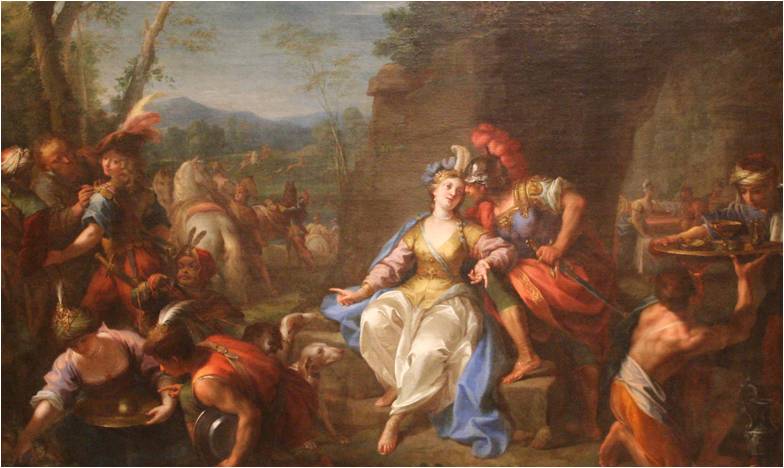
Dido and Aeneas by Jean RAOUX (1677-1734)
https://www.sru.edu/news/042817b
In addition to discussing briefly in Latin our daily routines, using words and phrases from the Circulus webpage (see below) we read lines 129 to 176 from Book IV of the Aeneid, covering the hunt and thunderstorm during which Dido and Aeneas make love in the cave where they took shelter. We discussed the structure of Latin hexameter verse and the controversy over whether it was read with the natural word stresses or with the stress always placed on the initial syllable of each foot (sequences of two long, or one long and two short syllables, six of which make up the line). Most scholars nowadays believe that the normal word stress was followed and that this resulted in a kin of counterpoint between stress and metrical structure, except normally in the last two feet where the two regularly coincided, producing a `DUM did-di/DUM di’ pattern, which, unlike the metre in the first four feet, can be readily appreciated by the modern Anglophone ear; for more details, download the file latin_verse.doc from https://linguae.weebly.com/courses.html. and see the discussion in the dialogue Dē Poēsī Latīnā at https://linguae.weebly.com/circulus-latinus-honcongensis.html Occasionally the accentual symmetry at the end of the line was violated, as with the final words of l.132 (odōra canum vīs, where the word stress falls on the last syllables of the fifth and sixth feet. This discordance often signified disorder in the scene being described, in thi case presumably the dogs barking and milling around the hunstmen.
Tanya raised the question of whether Latin was a syllable-timed or stresse-timed language, i.e. whether each syllable took about the same time to pronounce or stretches of unstressed syllable were passed over more quickly to maintain regular intervals between stressed ones. In Latin verse, the answer seems to be neither of these, as two short syllables were regarded as the equivalent of one long syllable, regardless of stress placement. Mora timing, as this system is called, came naturally with the adoption of quantative verse on the Freek pattern (see http://www.ling.fju.edu.tw/phono/farrah/Moraic%20Phonology.htm ) but things nay have been different in colloquial speech. The very earliest Roman poetry depended, like modern English, on stress, and poetry of this type continued to be produced among the ordinary people as opposed to the literary elite. The best-known example is the cheeky verses sung by Caesar’s legions during his triumph in 45 B.C. and preserved in his biography by Suetonius:
Ecce Caesar nunc triumphat qui subēgit Galliās,
Nīcomēdes non triumphat qui subēgit Caesarem. (Divus Iulius, 49)
[See, Caesar now trumphs, who conquered Gaul, No triumph for Nicomedes, who conquered Caesar]
The reference is to the alleged homosexual relationship between the young Caesar and King Nicomedes when the former was srving in Asia Minor in 80-78 B.C. From Caesar’s point ovf view the damaging part of the allegation, which was used by his enemies and which he always denied, was the suggestions that he had himself been the passive partner. The tradtion of soldiers mocking their commander at a triumphal procession may have been intended to avert the gods’ jealousy from him.
https://www.sru.edu/news/042817b
In addition to discussing briefly in Latin our daily routines, using words and phrases from the Circulus webpage (see below) we read lines 129 to 176 from Book IV of the Aeneid, covering the hunt and thunderstorm during which Dido and Aeneas make love in the cave where they took shelter. We discussed the structure of Latin hexameter verse and the controversy over whether it was read with the natural word stresses or with the stress always placed on the initial syllable of each foot (sequences of two long, or one long and two short syllables, six of which make up the line). Most scholars nowadays believe that the normal word stress was followed and that this resulted in a kin of counterpoint between stress and metrical structure, except normally in the last two feet where the two regularly coincided, producing a `DUM did-di/DUM di’ pattern, which, unlike the metre in the first four feet, can be readily appreciated by the modern Anglophone ear; for more details, download the file latin_verse.doc from https://linguae.weebly.com/courses.html. and see the discussion in the dialogue Dē Poēsī Latīnā at https://linguae.weebly.com/circulus-latinus-honcongensis.html Occasionally the accentual symmetry at the end of the line was violated, as with the final words of l.132 (odōra canum vīs, where the word stress falls on the last syllables of the fifth and sixth feet. This discordance often signified disorder in the scene being described, in thi case presumably the dogs barking and milling around the hunstmen.
Tanya raised the question of whether Latin was a syllable-timed or stresse-timed language, i.e. whether each syllable took about the same time to pronounce or stretches of unstressed syllable were passed over more quickly to maintain regular intervals between stressed ones. In Latin verse, the answer seems to be neither of these, as two short syllables were regarded as the equivalent of one long syllable, regardless of stress placement. Mora timing, as this system is called, came naturally with the adoption of quantative verse on the Freek pattern (see http://www.ling.fju.edu.tw/phono/farrah/Moraic%20Phonology.htm ) but things nay have been different in colloquial speech. The very earliest Roman poetry depended, like modern English, on stress, and poetry of this type continued to be produced among the ordinary people as opposed to the literary elite. The best-known example is the cheeky verses sung by Caesar’s legions during his triumph in 45 B.C. and preserved in his biography by Suetonius:
Ecce Caesar nunc triumphat qui subēgit Galliās,
Nīcomēdes non triumphat qui subēgit Caesarem. (Divus Iulius, 49)
[See, Caesar now trumphs, who conquered Gaul, No triumph for Nicomedes, who conquered Caesar]
The reference is to the alleged homosexual relationship between the young Caesar and King Nicomedes when the former was srving in Asia Minor in 80-78 B.C. From Caesar’s point ovf view the damaging part of the allegation, which was used by his enemies and which he always denied, was the suggestions that he had himself been the passive partner. The tradtion of soldiers mocking their commander at a triumphal procession may have been intended to avert the gods’ jealousy from him.
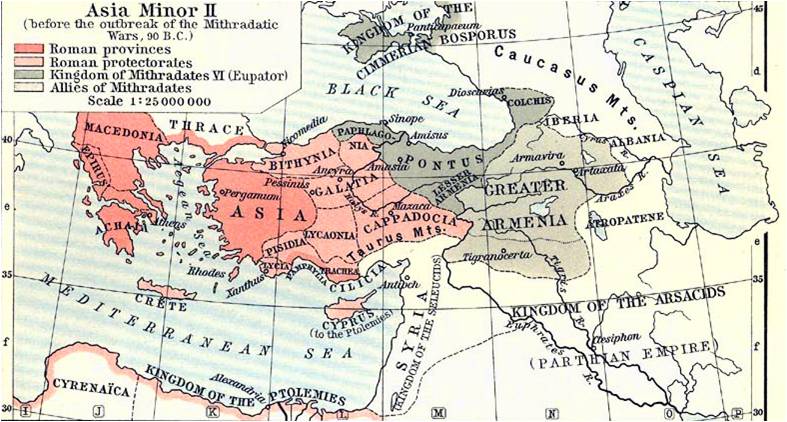
Asia Minor in the early 1st century B.C.
Minor linguistic issues that cropped up whilst reading Virgil included the length of the vowel followed by `i’ and another vowel. Many textbook authors and editors assume that, if the syllable including the first vowel is long then the vowel itself is also lons, and hebce write Trōia and Trōiānus. It is likely, however, that the vowel was actually short and the syllable lengthened because the `I’ was actual;y pronounced as a double consonant – so Troia and Troiānus (troyya, troyyānus). See the discussion at http://www.alatius.com/latin/quantity.html
We also noted the use of the neuter perfect particple in the `impersonal passive’, e.g. perventum est (literally `it was arrived’) for `people arrived’. The particple is distinguished grammatically from the supine, a verbal noun identical in the accusative with the neuter perfect particple but with an ablative in –ū. The accusative can be used when expressing purpose after a verb of motion (e.g. Londinium īvit rēgīnam spectandum instead of ut regīnam spectāret or ad rēgīnam spectandam for `to look at the queen’.
In addition we comented on the impossibility of determining whther vōtīs in line 158 is dative or ablative. If the former, then darī…vōtīs optat apum would means `wishes that a boar would be given in answer to his prayers’, if the latter it would be `wishes with his prayers that a boar be given to him’
There was a brief discussion of the various names of Admiralty, the district and NTR station on HK island. The English one, meaning `naval headquarters’, is a straightforward description of the area’s function in British times, and the Latin Nāvālis (Statiō) a simple translation. People were uncertain about the Chinese name 金鐘 (Gam Jung, `Golden Bell’ ) but John had read somewhere it referred to a bell that used to be rung there at midday. Subsequent investigation showed there was indeed a golden-coloured time-keeping bell (not necessarily just for noon!) at Wellington Barracks, which once stood on the site of Harcourt Garden.
Minor linguistic issues that cropped up whilst reading Virgil included the length of the vowel followed by `i’ and another vowel. Many textbook authors and editors assume that, if the syllable including the first vowel is long then the vowel itself is also lons, and hebce write Trōia and Trōiānus. It is likely, however, that the vowel was actually short and the syllable lengthened because the `I’ was actual;y pronounced as a double consonant – so Troia and Troiānus (troyya, troyyānus). See the discussion at http://www.alatius.com/latin/quantity.html
We also noted the use of the neuter perfect particple in the `impersonal passive’, e.g. perventum est (literally `it was arrived’) for `people arrived’. The particple is distinguished grammatically from the supine, a verbal noun identical in the accusative with the neuter perfect particple but with an ablative in –ū. The accusative can be used when expressing purpose after a verb of motion (e.g. Londinium īvit rēgīnam spectandum instead of ut regīnam spectāret or ad rēgīnam spectandam for `to look at the queen’.
In addition we comented on the impossibility of determining whther vōtīs in line 158 is dative or ablative. If the former, then darī…vōtīs optat apum would means `wishes that a boar would be given in answer to his prayers’, if the latter it would be `wishes with his prayers that a boar be given to him’
There was a brief discussion of the various names of Admiralty, the district and NTR station on HK island. The English one, meaning `naval headquarters’, is a straightforward description of the area’s function in British times, and the Latin Nāvālis (Statiō) a simple translation. People were uncertain about the Chinese name 金鐘 (Gam Jung, `Golden Bell’ ) but John had read somewhere it referred to a bell that used to be rung there at midday. Subsequent investigation showed there was indeed a golden-coloured time-keeping bell (not necessarily just for noon!) at Wellington Barracks, which once stood on the site of Harcourt Garden.
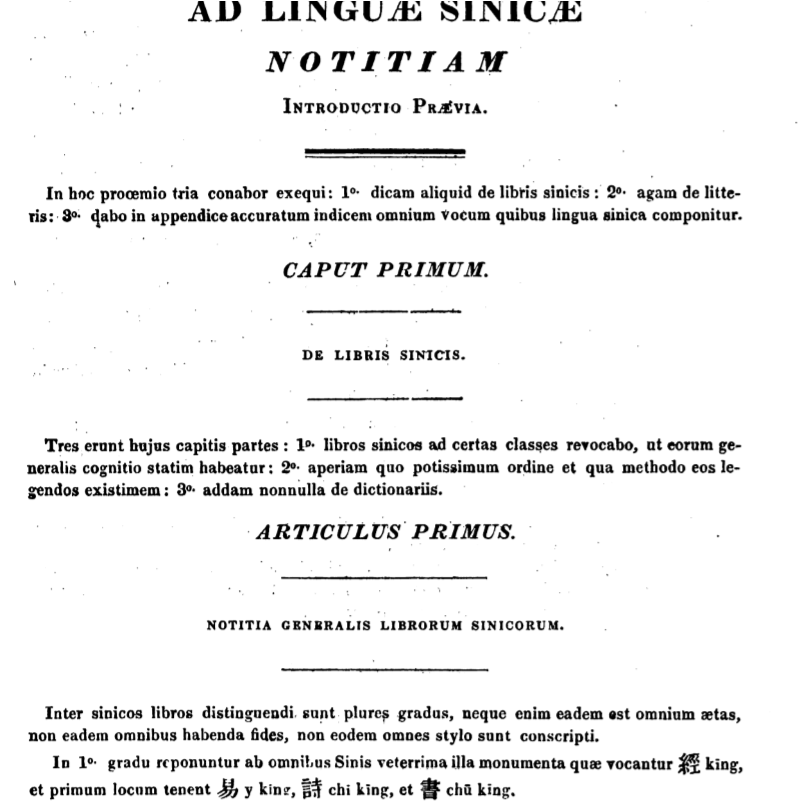
First page of Prémare’s Notitiae Linguae Sinicae
In the meeting and in subsequent correspondence, Eric gave details of Notitia Linguae Sinicae, a description of the Chinese language by the Jesuit Joseph Henri Marie de Prémare who came to China in 1698 and who is described by Joseph Needham (Science and Civilisation in China: Volume 7, The Social Background, Part 1, Language and Logic in Traditional China, p.16) as `undoubtedly the most outstanding grammarian of Chinese in the 18th century’. Prémare worked as a missionoary in Guangxi but the grammar was probably produced during his enforced retirement in Guangzhou and Macao after the papal ruling against Chinese rites resulted in the virtual banning of Christianity. The Latin text was published in Malacca in 1831 (available at https://archive.org/details/bub_gb_iOg5lxl9Y0sC ). The 1847 English translation is at https://archive.org/details/notitialinguaes00bridgoog 1 The work includes a wealth of idioms, one of which Zhang Wei thought was the still very current 喝小酒 (Hē xiǎo jiǔm `Drink a little wine’). Eugene and Eric failed to find this particular phrase in the text but Eugene found gems such as 飲三杯..., siccare tres calices" (p. 47), "你且說怎麼該吃三杯..., dic rogo cur opporteat tres calices potare?" (p. 111) and "三杯和萬事..., omnia negotia componuntur inter scyphos" (p. 143)
In the meeting and in subsequent correspondence, Eric gave details of Notitia Linguae Sinicae, a description of the Chinese language by the Jesuit Joseph Henri Marie de Prémare who came to China in 1698 and who is described by Joseph Needham (Science and Civilisation in China: Volume 7, The Social Background, Part 1, Language and Logic in Traditional China, p.16) as `undoubtedly the most outstanding grammarian of Chinese in the 18th century’. Prémare worked as a missionoary in Guangxi but the grammar was probably produced during his enforced retirement in Guangzhou and Macao after the papal ruling against Chinese rites resulted in the virtual banning of Christianity. The Latin text was published in Malacca in 1831 (available at https://archive.org/details/bub_gb_iOg5lxl9Y0sC ). The 1847 English translation is at https://archive.org/details/notitialinguaes00bridgoog 1 The work includes a wealth of idioms, one of which Zhang Wei thought was the still very current 喝小酒 (Hē xiǎo jiǔm `Drink a little wine’). Eugene and Eric failed to find this particular phrase in the text but Eugene found gems such as 飲三杯..., siccare tres calices" (p. 47), "你且說怎麼該吃三杯..., dic rogo cur opporteat tres calices potare?" (p. 111) and "三杯和萬事..., omnia negotia componuntur inter scyphos" (p. 143)
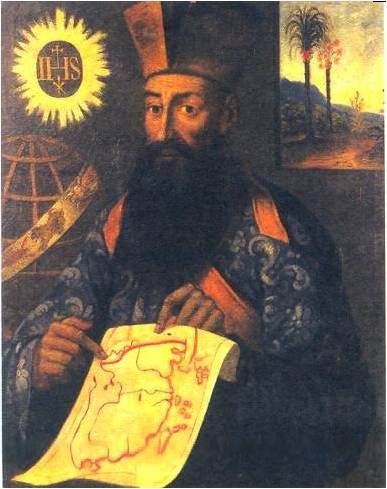
Martino Martini (1614-1661)
https://en.wikipedia.org/wiki/Martino_Martini
Subsequently, Eugene unearthed details of Martino Martini’s short grammar of Mandarin Chnese, which, so far as we know, is the earliest surviving one to gave been wrtiiten and to have been published. At least one Chinese grammar is known to have been produced earlier but this is not extant and was probably based on the Minnanhua spoken by the Chinese community in Malacca. Martini is best known for producing the first atlas of China (Novus Atlas Sinensis 1655) and for a history of the Manchu conquest (De Bello Tartica Historia, 1654). His grammar was initially published in 1696 as part of a work entitled Relations de Divers Voyages Curieux and a facsimile of the copy in the Boston public library can be read at https://archive.org/details/grammaticalingua0015p A detailed account of the various revisions the work went through is provided by Luisa Paternicò at https://www.academia.edu/543055/Paternicò_Luisa_M._2011_Martino_Martini_and_the_First_Grammar_of_Mandarin_Chinese_Hanxue_Yanjiu_vol._29_n._3_pp._229-266 and for a review of the comprehensive edition of all Martini’s work, with both Latin texts and Italian translation, see
https://www.cambridge.org/core/journals/journal-of-asian-studies/article/martino-martini-sj-opera-omnia-edited-by-bertuccioligiuliano-with-preface-by-franco-demarchi-trento-universita-degli-studi-di-trento-1998-volume-1-lettere-e-documenti-547-pp-80000-lire-volume-2-opere-minori-516-pp-80000-lire/67B141CE173689032D1922F9ADB0C446
Eugene also noted Martini’s use of the analyticalframework in Dinysius Thrax’s Greek grammar (see : https://en.wikisource.org/wiki/The_grammar_of_Dionysios_Thrax).
We will be looking at Martini's work in a later meeting, as it is is generally accessible to anyone literate in Latin and standard Chinese, though difficulties occasionally arise because in the 18th centuty Mandarin stil reflected Nanjing rather than Beijung pronunciation. John will also need to incorporate mention both of Martini and Prémare in his SINA LATINA Powerpoint (available at https://linguae.weebly.com/sina-latina.html), which at the moment only mentions Arcade Huang (黃嘉略)and Étienne Fourmont’s grammar, published in Paris in 1742.
Another subject for future discussion is the work of Stuart McManus, a new member who attended the April meeting and who has recently produced an edition of the Latin poem by a Tagalog writer Bartolome Saguinsin on the fighting beteen the British and Spanish at Manila during the Seven Years War. This is the earlest example of Latin literature produced by a native of the Philippines.
We touched on censorship on the Internet and China’s Great Firewall which is apparently blocking anything with the word `God’. In the rest of the world, reliance on automated systems to cut out obscenity can prouce annoying results, On the CRAM platform, used by John for his flashcards since the demise of Wordchamp, Latin dīcunt (`they say’) has to be rendered dī*cunt because of the software’s misinterpretation of the second syllable. This reminded Tan of her mother’s problem as a French teacher with the word facteur (`postman’), whose pronunciation suggested an entirely different meaning to Anglophone adolescents and rendered classes uncontrollable,
On the anthropological front, Zhang Wei confirmed that traditional Chinese society followed conservative Hindus in not allowing widow re-marriage, and Tan contrasted this with Western attitudes as reflected in literature like the Widow od Bath’s tale in Chaucer’s Canterbury Tales.
Finally reverting to Rome, we noted that Robert Grave’s I Claudius and Claudius the God novels, being cast as an autobiography, did not cover the emperor’s death and subsequent deification (or apokolocyntosis (`pumpkinification’) as unkindly suggested in the satire attributed to Seneca) . Claudius does, however, acknowledge various signs that his death is imminent. We also resolved the confusion between Claufius’s wife and niece , Agrippina the Younger, who was eventually murdered on the order of her son Nero, and her mother, Agrippa the Elder, wife of Claudius’s brother, Germanicus,
AENEID IV: 128-176
Ōceanum intereā surgēns Aurōra relīquit.
Ocean meanwhile rising Dawn left
it portīs iubare exortō dēlēcta iuventūs, 130
goes from-gates with-light risen selected youth
rētia rāra, plagae, lātō vēnābula ferrō,
nets meshed snares with-broad hunting-spears iron
Massȳlī[1]que ruunt equitēs et odōra canum vīs.
Massylian also rush horsemen and keen-scented of-dogs strength
rēgīnam thalamō cūnctantem ad līmina prīmī
queen in-chamber delaying at thresholf chiefs
Poenōrum exspectant, ostrōque īnsignis et aurō
of-Carthaginians await and-with-purple conspicuous and with-gold
stat sonipēs ac frēna ferōx spūmantia mandit. 135
stands steed and bit fiercely foaming chomps-upon
tandem prōgreditur magnā stīpante catervā
at-last she-advances with-large accompanying group
Sīdoniam pictō chlamydem circumdata[2] limbō;
Sidonian wirh-embroidered cloak clad-in border
cui pharetra ex aurō, crīnēs nōdantur in aurum,
for-whom quiver from gold hair tied-in-knot into fold
aurea purpuream subnectit fībula vestem.
golden purple fastens-up pin clothing
nec nōn et Phrygiī comitēs et laetus Iūlus 140
additionally both Phrygian companions and happy Iulus
incēdunt. ipse ante aliōs pulcherrimus omnīs
arrive e-himself before others most-handsome all
īnfert sē socium Aenēās atque agmina iungit.
Brings himself as-compnion Aeneas nd forces joins
quālis ubi hībernam Lyciam[3] Xanthīque fluenta
like when winter-home Lycia and-of-Xanthus streams
dēserit ac Dēlum[4] māternam invīsit Apollō
abandons and Delos maternal visits Apollo
NOTES
[1] The Massylians were a Numidian tribe living immediately to the west of Carthage. In the Second Punic War their leader Masinissa went over to the Roman side and was afterwards made king by the Romans of a united Numidian kingdom including the larger Masaesyli tribe who had hitherto been the Massylians’ rivals.
[2] A passive perfect particpale (literally `surrounded’) but usedm in imitation of the Greek middle voice, with an object in the accusative,
[3] Lycia was a region on the south coast of Asia Minor (see map) with its capital Xanthos standing on the river of the same name.
[4] Latona is supposed to have gven birth to Apollo and his twin sister Diana on the island of Delos in the central Aegean.
īnstauratque chorōs, mixtīque altāria circum 145
and-inaugurates dances and-mixed-together altars around
Crētēsquē[1] Dryopēs[2]que fremunt pictīque Agathyrsī;[3]
Both-Cretans and-Dryopes make-noise and-tattooed Agathyrsi
ipse iugīs Cynthī[4] graditur mollīque fluentem
he-himself on-ridges of-Cynthus walks and-soft flowing
fronde premit crīnem fingēns atque implicat aurō,
with-foliage he-presses [his]hair arranging[it] and entwines with-gold
tēla sonant umerīs: haud illō sēgnior ībat
weapons clatter on-his-houlders not than-him slower was-going
Aenēās, tantum ēgregiō decus ēnitet ōre. 150
Aeneas so-much from-outstanding distinction shines-out face
postquam altōs ventum in montīs atque invia lustra,
after high it-was-cone into mountains and trackless lairs
ecce ferae saxī dēiectae vertice caprae
see wild of-rog dislodged from-top she-goats
dēcurrēre iugīs; aliā dē parte patentīs
fan-down from-ridges other from direction wide-open
trānsmittunt cursū campōs atque agmina cervī
pass-over in-running fields and bands deer
pulverulenta fugā glomerant montīsque relinquunt. 155
dusty in-flight masss and-mountains leave
at puer Ascanius mediīs in vallibus ācrī
but boy Ascanius middle-of in valleys in-keen
gaudet equō iamque hōs cursū, iam praeterit illōs,
rejoices hosrse and-now these –in-galloping now overtakes these
spūmantemque darī pecora inter inertia vōtīs
and-frothing to-be-given herds amongst passive with-prayers
optat aprum, aut fulvum dēscendere monte leōnem.
he-wishes boar or tawny to-descend from-mountain lion
Intereā magnō miscērī murmure caelum 160
meanwhile with-great to-be-stirred roar sky
NOTES
[1] Following Homer’s usage with the similar conjunction τε, Virgil sometimes lengthens the vowel in que when is is the first of a pair meaning `both…and’
[2] An ancient tribe originally living in the Epirus region of western Greece.
[3] The Agathyrsi were a people living in what is now Romania, speaking an Indo-European language and probably of mixed Dacian and Scythian origin. The Scythian language is known to have been part of the Iranian branch but the exact position of Dacian within Indo-European is uncertain. It has been variously linked with the extinct Thracian language, with the Baltic languages (Latvian, Lithuanian etc.) or with Albanian.
[4] A mountain on Delos
incipit, īnsequitur commixtā grandine nimbus,
begins folws with-mixec-in hail cloud
et Tyriī comitēs passim et Troiāna iuventūs
both Tyian companions on-all-sides and Trojan youth
Dardaniusque nepōs Veneris dīversa per agrōs
And-Dardanian grandson of-Venus various through fields
tēcta metū petiēre; ruunt dē montibus amnēs.
shelters in-fear sought rush down-from mountains streams
spēluncam Dīdō dux et Troiānus eandem 165
cave Dido leader and Trojan the-same
dēveniunt. prīma et Tellūs et prōnuba[1] Iūnō
arrive-at first both Earth and bride-conductor Juno
dant signum; fulsēre ignēs et cōnscius aether
give signal shone fires and as-accomplice air
cōnūbiīs summōque ululārunt vertice Nymphae.
For-the-marriage amd-from-topmost cried-out summit nymphs
ille diēs prīmus lētī prīmusque malōrum
that day first of-death and-first of-evils
causa fuit; neque enim speciē fāmāve movētur 170
cause was neither for by-appearance or-by-reputation she-ismoved
nec iam fūrtīvum Dīdō meditātur amōrem:
nor now furtive Dido contemplates love
coniugium vocat, hōc praetexit nōmine culpam.
Marriage she-calls[it] by-this conceals name [her guilt
Extemplō Libyae magnās it Fāma per urbēs,
At-once of-Libya great goes Rumour through cities
Fāma, malum quā nōn aliud vēlōcius ūllum:
Rumour evil than-which not other swifter any
mōbilitāte viget vīrīsque adquīrit eundō,[2] 175
in-movement it-is-vigotous and-strength acquires as-it-does
parva metū prīmō, mox sēsē attollit in aurās
small with-fear at-first soon itself it-raiss-up into the winds
NOTES
[1] The prōnuba was a married woman who escorted the bride at a Roman wedding.
[2] Literally `by going’
Quotā hōrā māne surgis? What time do you get up in the morning?
Sextā hōrā et dimidiā 6.30
Septimā hōrā et quadrante 7.15
Balneō māne an vesperī ūteris? Do you have a bath in the morning or the evening?
Plērumque māne. In soliō nōn sedeō, balneō Generally in the morning. I don't sit in
plūviō ūtor. bathtub but have a shower
Quotā hōrā ientāculum sūmis? What time do you have breakfast?
Octāvā hōrā At eight o’clock.
Quid edis? What do you eat?
Pānem tostum /frūctūs/ ova frīcta et Toast/fruit/fried eggs and bacon/cereals
lardum/cereālia
Quid bibis? What do you have to drink?
Theam/caffeam/lactem/aurantiī succum Tea/coffee/milk/orange juice
Quotā hōrā ad officīnam proficisceris? What time do you leave for work?
Octāvā hōrā et dōdrante At 8.45
Domī labōrō. I work at home
Nōn est hōra cōnstitūta There's no fixed time.
Quantō temporis ad officīnam pervenīs? How long does it take you to get to work?
Quinquaginta minūtīs Fifty minutes.
Iter quamdiu terit? How long does the journey take?
Dimidiam hōram Half an hour
Quōmodo iter facis? How do you travel?
Autoraedā/Raedā longā/Tramine/Currū I go by car/bus/train/tram and then walk
ēlectricō vehor deinde ambulō.
Birotā ūtor. I use a bike
Ubi prandium sūmis? Where do you have lunch
In caupōnā prope officīnam/universitātem In a restaurant near my work/university
Quid edis? What do you eat?
Pastillum fartum/collӯram/iūs collӯricum/ A sandwich/noodles/soup noodles/rice/dim sum
orӯzam/cuppēdiolās
Quotā horā ab officīnā proficisceris? What time do you leave work?
Sextā hōrā et dimidiā At 6.30
Vesperī quid facis? What do you do in the evening?
Cēnam coquō (ancillam nōn habeō) deinde I cook dinner (I don’t have a maid) then
tēlevīsiōnem spectō vel librum legō. Watch TV or read a book.
interdum suppelectilem detergeō vel Sometimes I dust the furniture or do other
aliās operās domesticās facio. Lectum housework as there’s no time for
quoque sternere dēbeō quod māne tempus that in the morning
nōn sufficit
Quid edis vesperī? What do you eat in the evening?
Varium est. Saepe būbulam vel porcīnam It varies. I often have roast beef or
assam ūnā cum solānīs frīctīs et holeribus pork with fried potatoes and vegetables.
edō. Plērumque cervisiam vel vīnum bibō. Generally I drink beer or wine
Domī furculā cultellōque an bacillīs ūteris? Do you use a knife and fork or chopsticks?
Sī orӯzam vel collӯram edō, bacillīs, If I’m having rice or noodles I use chopsticks
sī cibum occidentālem, cultellō et furculā. if it’s Western food, a knife and fork.
Quandō cubitum īs? When do you go to bed?
Inter hōrās ūndecimam et duodecimam. Between 11 and 12. I normally listen to Soleō antequam dormiam, radiophōnum the radio before I go to sleep
audīre,
https://en.wikipedia.org/wiki/Martino_Martini
Subsequently, Eugene unearthed details of Martino Martini’s short grammar of Mandarin Chnese, which, so far as we know, is the earliest surviving one to gave been wrtiiten and to have been published. At least one Chinese grammar is known to have been produced earlier but this is not extant and was probably based on the Minnanhua spoken by the Chinese community in Malacca. Martini is best known for producing the first atlas of China (Novus Atlas Sinensis 1655) and for a history of the Manchu conquest (De Bello Tartica Historia, 1654). His grammar was initially published in 1696 as part of a work entitled Relations de Divers Voyages Curieux and a facsimile of the copy in the Boston public library can be read at https://archive.org/details/grammaticalingua0015p A detailed account of the various revisions the work went through is provided by Luisa Paternicò at https://www.academia.edu/543055/Paternicò_Luisa_M._2011_Martino_Martini_and_the_First_Grammar_of_Mandarin_Chinese_Hanxue_Yanjiu_vol._29_n._3_pp._229-266 and for a review of the comprehensive edition of all Martini’s work, with both Latin texts and Italian translation, see
https://www.cambridge.org/core/journals/journal-of-asian-studies/article/martino-martini-sj-opera-omnia-edited-by-bertuccioligiuliano-with-preface-by-franco-demarchi-trento-universita-degli-studi-di-trento-1998-volume-1-lettere-e-documenti-547-pp-80000-lire-volume-2-opere-minori-516-pp-80000-lire/67B141CE173689032D1922F9ADB0C446
Eugene also noted Martini’s use of the analyticalframework in Dinysius Thrax’s Greek grammar (see : https://en.wikisource.org/wiki/The_grammar_of_Dionysios_Thrax).
We will be looking at Martini's work in a later meeting, as it is is generally accessible to anyone literate in Latin and standard Chinese, though difficulties occasionally arise because in the 18th centuty Mandarin stil reflected Nanjing rather than Beijung pronunciation. John will also need to incorporate mention both of Martini and Prémare in his SINA LATINA Powerpoint (available at https://linguae.weebly.com/sina-latina.html), which at the moment only mentions Arcade Huang (黃嘉略)and Étienne Fourmont’s grammar, published in Paris in 1742.
Another subject for future discussion is the work of Stuart McManus, a new member who attended the April meeting and who has recently produced an edition of the Latin poem by a Tagalog writer Bartolome Saguinsin on the fighting beteen the British and Spanish at Manila during the Seven Years War. This is the earlest example of Latin literature produced by a native of the Philippines.
We touched on censorship on the Internet and China’s Great Firewall which is apparently blocking anything with the word `God’. In the rest of the world, reliance on automated systems to cut out obscenity can prouce annoying results, On the CRAM platform, used by John for his flashcards since the demise of Wordchamp, Latin dīcunt (`they say’) has to be rendered dī*cunt because of the software’s misinterpretation of the second syllable. This reminded Tan of her mother’s problem as a French teacher with the word facteur (`postman’), whose pronunciation suggested an entirely different meaning to Anglophone adolescents and rendered classes uncontrollable,
On the anthropological front, Zhang Wei confirmed that traditional Chinese society followed conservative Hindus in not allowing widow re-marriage, and Tan contrasted this with Western attitudes as reflected in literature like the Widow od Bath’s tale in Chaucer’s Canterbury Tales.
Finally reverting to Rome, we noted that Robert Grave’s I Claudius and Claudius the God novels, being cast as an autobiography, did not cover the emperor’s death and subsequent deification (or apokolocyntosis (`pumpkinification’) as unkindly suggested in the satire attributed to Seneca) . Claudius does, however, acknowledge various signs that his death is imminent. We also resolved the confusion between Claufius’s wife and niece , Agrippina the Younger, who was eventually murdered on the order of her son Nero, and her mother, Agrippa the Elder, wife of Claudius’s brother, Germanicus,
AENEID IV: 128-176
Ōceanum intereā surgēns Aurōra relīquit.
Ocean meanwhile rising Dawn left
it portīs iubare exortō dēlēcta iuventūs, 130
goes from-gates with-light risen selected youth
rētia rāra, plagae, lātō vēnābula ferrō,
nets meshed snares with-broad hunting-spears iron
Massȳlī[1]que ruunt equitēs et odōra canum vīs.
Massylian also rush horsemen and keen-scented of-dogs strength
rēgīnam thalamō cūnctantem ad līmina prīmī
queen in-chamber delaying at thresholf chiefs
Poenōrum exspectant, ostrōque īnsignis et aurō
of-Carthaginians await and-with-purple conspicuous and with-gold
stat sonipēs ac frēna ferōx spūmantia mandit. 135
stands steed and bit fiercely foaming chomps-upon
tandem prōgreditur magnā stīpante catervā
at-last she-advances with-large accompanying group
Sīdoniam pictō chlamydem circumdata[2] limbō;
Sidonian wirh-embroidered cloak clad-in border
cui pharetra ex aurō, crīnēs nōdantur in aurum,
for-whom quiver from gold hair tied-in-knot into fold
aurea purpuream subnectit fībula vestem.
golden purple fastens-up pin clothing
nec nōn et Phrygiī comitēs et laetus Iūlus 140
additionally both Phrygian companions and happy Iulus
incēdunt. ipse ante aliōs pulcherrimus omnīs
arrive e-himself before others most-handsome all
īnfert sē socium Aenēās atque agmina iungit.
Brings himself as-compnion Aeneas nd forces joins
quālis ubi hībernam Lyciam[3] Xanthīque fluenta
like when winter-home Lycia and-of-Xanthus streams
dēserit ac Dēlum[4] māternam invīsit Apollō
abandons and Delos maternal visits Apollo
NOTES
[1] The Massylians were a Numidian tribe living immediately to the west of Carthage. In the Second Punic War their leader Masinissa went over to the Roman side and was afterwards made king by the Romans of a united Numidian kingdom including the larger Masaesyli tribe who had hitherto been the Massylians’ rivals.
[2] A passive perfect particpale (literally `surrounded’) but usedm in imitation of the Greek middle voice, with an object in the accusative,
[3] Lycia was a region on the south coast of Asia Minor (see map) with its capital Xanthos standing on the river of the same name.
[4] Latona is supposed to have gven birth to Apollo and his twin sister Diana on the island of Delos in the central Aegean.
īnstauratque chorōs, mixtīque altāria circum 145
and-inaugurates dances and-mixed-together altars around
Crētēsquē[1] Dryopēs[2]que fremunt pictīque Agathyrsī;[3]
Both-Cretans and-Dryopes make-noise and-tattooed Agathyrsi
ipse iugīs Cynthī[4] graditur mollīque fluentem
he-himself on-ridges of-Cynthus walks and-soft flowing
fronde premit crīnem fingēns atque implicat aurō,
with-foliage he-presses [his]hair arranging[it] and entwines with-gold
tēla sonant umerīs: haud illō sēgnior ībat
weapons clatter on-his-houlders not than-him slower was-going
Aenēās, tantum ēgregiō decus ēnitet ōre. 150
Aeneas so-much from-outstanding distinction shines-out face
postquam altōs ventum in montīs atque invia lustra,
after high it-was-cone into mountains and trackless lairs
ecce ferae saxī dēiectae vertice caprae
see wild of-rog dislodged from-top she-goats
dēcurrēre iugīs; aliā dē parte patentīs
fan-down from-ridges other from direction wide-open
trānsmittunt cursū campōs atque agmina cervī
pass-over in-running fields and bands deer
pulverulenta fugā glomerant montīsque relinquunt. 155
dusty in-flight masss and-mountains leave
at puer Ascanius mediīs in vallibus ācrī
but boy Ascanius middle-of in valleys in-keen
gaudet equō iamque hōs cursū, iam praeterit illōs,
rejoices hosrse and-now these –in-galloping now overtakes these
spūmantemque darī pecora inter inertia vōtīs
and-frothing to-be-given herds amongst passive with-prayers
optat aprum, aut fulvum dēscendere monte leōnem.
he-wishes boar or tawny to-descend from-mountain lion
Intereā magnō miscērī murmure caelum 160
meanwhile with-great to-be-stirred roar sky
NOTES
[1] Following Homer’s usage with the similar conjunction τε, Virgil sometimes lengthens the vowel in que when is is the first of a pair meaning `both…and’
[2] An ancient tribe originally living in the Epirus region of western Greece.
[3] The Agathyrsi were a people living in what is now Romania, speaking an Indo-European language and probably of mixed Dacian and Scythian origin. The Scythian language is known to have been part of the Iranian branch but the exact position of Dacian within Indo-European is uncertain. It has been variously linked with the extinct Thracian language, with the Baltic languages (Latvian, Lithuanian etc.) or with Albanian.
[4] A mountain on Delos
incipit, īnsequitur commixtā grandine nimbus,
begins folws with-mixec-in hail cloud
et Tyriī comitēs passim et Troiāna iuventūs
both Tyian companions on-all-sides and Trojan youth
Dardaniusque nepōs Veneris dīversa per agrōs
And-Dardanian grandson of-Venus various through fields
tēcta metū petiēre; ruunt dē montibus amnēs.
shelters in-fear sought rush down-from mountains streams
spēluncam Dīdō dux et Troiānus eandem 165
cave Dido leader and Trojan the-same
dēveniunt. prīma et Tellūs et prōnuba[1] Iūnō
arrive-at first both Earth and bride-conductor Juno
dant signum; fulsēre ignēs et cōnscius aether
give signal shone fires and as-accomplice air
cōnūbiīs summōque ululārunt vertice Nymphae.
For-the-marriage amd-from-topmost cried-out summit nymphs
ille diēs prīmus lētī prīmusque malōrum
that day first of-death and-first of-evils
causa fuit; neque enim speciē fāmāve movētur 170
cause was neither for by-appearance or-by-reputation she-ismoved
nec iam fūrtīvum Dīdō meditātur amōrem:
nor now furtive Dido contemplates love
coniugium vocat, hōc praetexit nōmine culpam.
Marriage she-calls[it] by-this conceals name [her guilt
Extemplō Libyae magnās it Fāma per urbēs,
At-once of-Libya great goes Rumour through cities
Fāma, malum quā nōn aliud vēlōcius ūllum:
Rumour evil than-which not other swifter any
mōbilitāte viget vīrīsque adquīrit eundō,[2] 175
in-movement it-is-vigotous and-strength acquires as-it-does
parva metū prīmō, mox sēsē attollit in aurās
small with-fear at-first soon itself it-raiss-up into the winds
NOTES
[1] The prōnuba was a married woman who escorted the bride at a Roman wedding.
[2] Literally `by going’
Quotā hōrā māne surgis? What time do you get up in the morning?
Sextā hōrā et dimidiā 6.30
Septimā hōrā et quadrante 7.15
Balneō māne an vesperī ūteris? Do you have a bath in the morning or the evening?
Plērumque māne. In soliō nōn sedeō, balneō Generally in the morning. I don't sit in
plūviō ūtor. bathtub but have a shower
Quotā hōrā ientāculum sūmis? What time do you have breakfast?
Octāvā hōrā At eight o’clock.
Quid edis? What do you eat?
Pānem tostum /frūctūs/ ova frīcta et Toast/fruit/fried eggs and bacon/cereals
lardum/cereālia
Quid bibis? What do you have to drink?
Theam/caffeam/lactem/aurantiī succum Tea/coffee/milk/orange juice
Quotā hōrā ad officīnam proficisceris? What time do you leave for work?
Octāvā hōrā et dōdrante At 8.45
Domī labōrō. I work at home
Nōn est hōra cōnstitūta There's no fixed time.
Quantō temporis ad officīnam pervenīs? How long does it take you to get to work?
Quinquaginta minūtīs Fifty minutes.
Iter quamdiu terit? How long does the journey take?
Dimidiam hōram Half an hour
Quōmodo iter facis? How do you travel?
Autoraedā/Raedā longā/Tramine/Currū I go by car/bus/train/tram and then walk
ēlectricō vehor deinde ambulō.
Birotā ūtor. I use a bike
Ubi prandium sūmis? Where do you have lunch
In caupōnā prope officīnam/universitātem In a restaurant near my work/university
Quid edis? What do you eat?
Pastillum fartum/collӯram/iūs collӯricum/ A sandwich/noodles/soup noodles/rice/dim sum
orӯzam/cuppēdiolās
Quotā horā ab officīnā proficisceris? What time do you leave work?
Sextā hōrā et dimidiā At 6.30
Vesperī quid facis? What do you do in the evening?
Cēnam coquō (ancillam nōn habeō) deinde I cook dinner (I don’t have a maid) then
tēlevīsiōnem spectō vel librum legō. Watch TV or read a book.
interdum suppelectilem detergeō vel Sometimes I dust the furniture or do other
aliās operās domesticās facio. Lectum housework as there’s no time for
quoque sternere dēbeō quod māne tempus that in the morning
nōn sufficit
Quid edis vesperī? What do you eat in the evening?
Varium est. Saepe būbulam vel porcīnam It varies. I often have roast beef or
assam ūnā cum solānīs frīctīs et holeribus pork with fried potatoes and vegetables.
edō. Plērumque cervisiam vel vīnum bibō. Generally I drink beer or wine
Domī furculā cultellōque an bacillīs ūteris? Do you use a knife and fork or chopsticks?
Sī orӯzam vel collӯram edō, bacillīs, If I’m having rice or noodles I use chopsticks
sī cibum occidentālem, cultellō et furculā. if it’s Western food, a knife and fork.
Quandō cubitum īs? When do you go to bed?
Inter hōrās ūndecimam et duodecimam. Between 11 and 12. I normally listen to Soleō antequam dormiam, radiophōnum the radio before I go to sleep
audīre,
