| linguae |
|
QUESTIONS ARISING FROM 150th. MEETING – 15/9/23
(the record of earlier meetings can be downloaded from the main Circulus page as can the version of Ciceronis Filius with illustrations added. The illustrated text of Genesis is available on the Genesis page, of Kepler's Somnium on the Somnium page, of Eutropius' Breviarium on the Eutropius page, of Suetonius' Vita Neronis on the Suetonius page and of Nutting's Ad Alpes on the Ad Alpes page)
Food consumed at the Basmati included squillae arōmaticae (prawn masala), fragmenta gallīnācea (chicken tikka), melongēna contūsa (baigan bharta, mashed aubergine), ocrum arōmaticum (bhindi masala, `lady’s fingers’, okra with spices), spināchia cum caseō (palak paneer, spinach with cheese), agnīna assa cylindrāta (lamb shekh kebab), cicera arōmatica (chana masala, spiced chickpeas), gallīnācea arōmatica (chicken masala), gallīnācea cum āliō (chicken with garlic) , iūs lentium butyrātum (daal makhani), pānis tenuis (papadom), pānis Persicus rēgulāris and cum āliō (plain and garlic nan), and, of course, orӯza (plain rice). This was washed down with vīnum rubrum/sanguineum or succus nuci Indicae (coconut water)

Sheekh kebab, a dish particularly popular in Pakistan (see https://en.wikipedia.org/wiki/Seekh_kebab), consists of meat formed into cylinders and roasted on skewers. The Latin translation suggested here for lamb shekh kebab translates literally as `cylindrical roasted lamb’
We established that Hillary will be studying at Durham University in the UK. Her first choice had been Sapienza in Rome but there had been problems securing an Italian visa. Having already had her translation of the `Somnium Scipionis’ published (see the account of the August meeting), she was now searching for a suitable passage to translate for a Chicago journal. She was looking for something in prose, as the journal’s poetry translations always had to be in verse form, and was considering tackling something from Apuleius’s Metamorphoses, also known as The Golden Ass, a 2nd. century AD novel about a man who was changed into a donkey but eventually regained human form with help from the goddess Isis. A well-known section of this gives the story of a man whose face was stolen by witches in Thessaly and an adapted version is included in the Cambridge Latin Anthology (see the on-line text at https://www.cla.cambridgescp.com/cambridge-latin-anthology-prose-selections/sagae-thessalae, which has the usual hyperlinked glossing). John has also prepared an interlinear translation of the Cambridge text, which, for copright reasons, cannot be placed on his site but which can be shared with any Circuuls member requesting it,
We established that Hillary will be studying at Durham University in the UK. Her first choice had been Sapienza in Rome but there had been problems securing an Italian visa. Having already had her translation of the `Somnium Scipionis’ published (see the account of the August meeting), she was now searching for a suitable passage to translate for a Chicago journal. She was looking for something in prose, as the journal’s poetry translations always had to be in verse form, and was considering tackling something from Apuleius’s Metamorphoses, also known as The Golden Ass, a 2nd. century AD novel about a man who was changed into a donkey but eventually regained human form with help from the goddess Isis. A well-known section of this gives the story of a man whose face was stolen by witches in Thessaly and an adapted version is included in the Cambridge Latin Anthology (see the on-line text at https://www.cla.cambridgescp.com/cambridge-latin-anthology-prose-selections/sagae-thessalae, which has the usual hyperlinked glossing). John has also prepared an interlinear translation of the Cambridge text, which, for copright reasons, cannot be placed on his site but which can be shared with any Circuuls member requesting it,
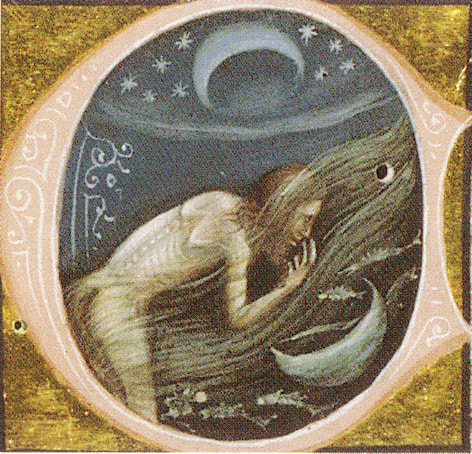
An illustration of Apuleius’ Metamorphoses in a 14th century Vatican manuscript
https://en.wikipedia.org/wiki/The_Golden_Ass#/media/File:Apuleius_Metamorphoses_c._65.jpg
Carie mentioned her recent graduation in psychology and art history and John explained that he was glad to have students of the latter in this classe because they could help identifying the paintings he downloaded from the web to illustrate the myths in Ovid’s Metamorphoses. He admitted that he often included these in his Powerpoints without properly identifying the source. This might sometimes result in technical infringement of copyright, as, unlike material from the Cambridge source, these teaching aids were publicly available on his site at https://linguae.weebly.com/latin--greek.html (see the section `Teaching Aids for Latin via Ovid’). He knew that at least one law firm regularly trawled the net looking for illustrations used without authorisation and then offering the offender the choice of making an immediate payment or facing legal action! However, since John’s site was not a commercial one, he thought it most unlikely he could become one of the firm’s victims.
https://en.wikipedia.org/wiki/The_Golden_Ass#/media/File:Apuleius_Metamorphoses_c._65.jpg
Carie mentioned her recent graduation in psychology and art history and John explained that he was glad to have students of the latter in this classe because they could help identifying the paintings he downloaded from the web to illustrate the myths in Ovid’s Metamorphoses. He admitted that he often included these in his Powerpoints without properly identifying the source. This might sometimes result in technical infringement of copyright, as, unlike material from the Cambridge source, these teaching aids were publicly available on his site at https://linguae.weebly.com/latin--greek.html (see the section `Teaching Aids for Latin via Ovid’). He knew that at least one law firm regularly trawled the net looking for illustrations used without authorisation and then offering the offender the choice of making an immediate payment or facing legal action! However, since John’s site was not a commercial one, he thought it most unlikely he could become one of the firm’s victims.
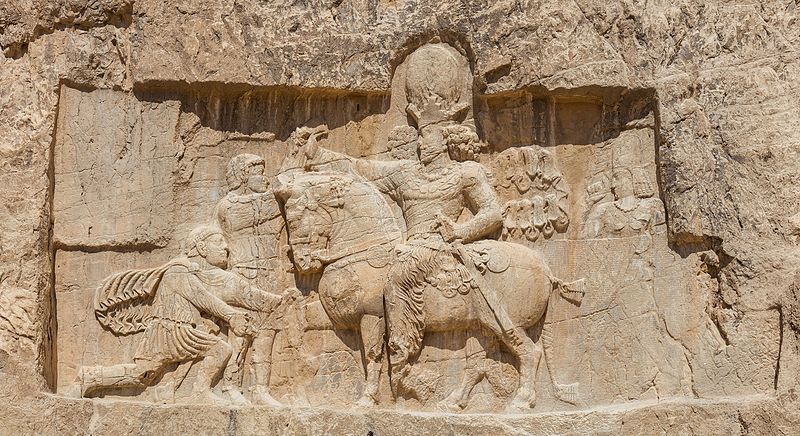
Relief carving at Naqsh-e rostam in Iran, showing Philip the Arab kneeling in submission before
King Shapor I of Persia and Valerian held cative by the arm
https://commons.wikimedia.org/wiki/File:Naghsh-e_rostam,_Ir%C3%A1n,_2016-09-24,_DD_12.jpg
There was also mention of Donna Tartt’s The Secret History, a novel about classics students at an elite Liberal Arts college in the USA, which gives the impression classics departments are full of fascists and gays. This reminded Lily of an HKU Greco-Roman classics course at HKU which emphasised the previously exclusive nature of the subject and made John recall Dan-el Padilla Peralta, a Princeton professor who seems to think that the discipline is irredeemably associated with racist ideology; see the article at https://www.nytimes.com/2021/02/02/magazine/classics-greece-rome-whiteness.htm and also https://archiemckenzie.substack.com/p/is-classics-a-useless-degree?utm_medium=email.internal-newsletter.np&utm_term=9%2F13%2F2023 , a link Malcolm sent me some time back. The discipline in fact includes both dyed-in-the-wool reactionaries and also people like Donna Zuckerberg (Mark’s sister), who used to edit the on-line classics journal Eidolon and who Stuart once described as excessively woke. There are details of her career at https://en.wikipedia.org/wiki/Donna_Zuckerberg.
The ancients themselves would proably have found the whole idea of `whiteness’ very srange, whether treated as something to celebrate or to attack. There was no shortage of prejudice but it revolved round ancestry and culture rather than skin colour and Roman emperors included the part-African (or part-Phoenician?) Septimius Severus as well as the lesser-known Philip the Arab.
It is certainly true that the Roman and Greek literature which survives overwhelmingly reflects the attitudes of elite males but epigraphy, archaeologty etc, provide ways of redressing this. A recent attempt to broaden the picture of Roman society presented by the average Latin textbook is Suburani. Produced by a team including Will Griffiths, formerly of the Cambridge Latin course, this features characters living in Subura, a down-market area east of the Forum. The first two chapters are available as a free sample from https://hands-up-education.org/tryit.html
King Shapor I of Persia and Valerian held cative by the arm
https://commons.wikimedia.org/wiki/File:Naghsh-e_rostam,_Ir%C3%A1n,_2016-09-24,_DD_12.jpg
There was also mention of Donna Tartt’s The Secret History, a novel about classics students at an elite Liberal Arts college in the USA, which gives the impression classics departments are full of fascists and gays. This reminded Lily of an HKU Greco-Roman classics course at HKU which emphasised the previously exclusive nature of the subject and made John recall Dan-el Padilla Peralta, a Princeton professor who seems to think that the discipline is irredeemably associated with racist ideology; see the article at https://www.nytimes.com/2021/02/02/magazine/classics-greece-rome-whiteness.htm and also https://archiemckenzie.substack.com/p/is-classics-a-useless-degree?utm_medium=email.internal-newsletter.np&utm_term=9%2F13%2F2023 , a link Malcolm sent me some time back. The discipline in fact includes both dyed-in-the-wool reactionaries and also people like Donna Zuckerberg (Mark’s sister), who used to edit the on-line classics journal Eidolon and who Stuart once described as excessively woke. There are details of her career at https://en.wikipedia.org/wiki/Donna_Zuckerberg.
The ancients themselves would proably have found the whole idea of `whiteness’ very srange, whether treated as something to celebrate or to attack. There was no shortage of prejudice but it revolved round ancestry and culture rather than skin colour and Roman emperors included the part-African (or part-Phoenician?) Septimius Severus as well as the lesser-known Philip the Arab.
It is certainly true that the Roman and Greek literature which survives overwhelmingly reflects the attitudes of elite males but epigraphy, archaeologty etc, provide ways of redressing this. A recent attempt to broaden the picture of Roman society presented by the average Latin textbook is Suburani. Produced by a team including Will Griffiths, formerly of the Cambridge Latin course, this features characters living in Subura, a down-market area east of the Forum. The first two chapters are available as a free sample from https://hands-up-education.org/tryit.html
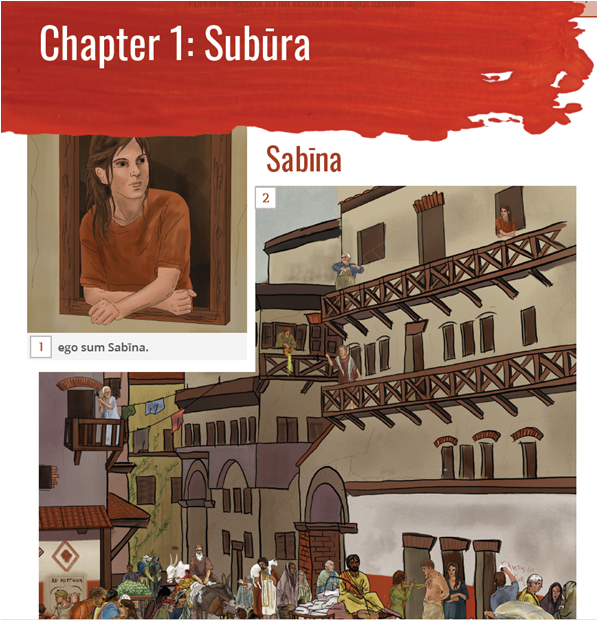
First page of the PDF of Subūra, chapter 1
We briefly disussed the wide use in Classics school courses in the UK of books by David Taylor, who seems to have achiecved a position surpassed only by the Cambridge Latin Course. John is particularly annoyed by hisfailure to use macrons in his Latin books and the omission of accents in the initial chapters of Greek to GCSE, which has supplanted the much more thorough Athenaze course.
We also touched on the nature of memory, including in particular the `memory palace’ approach Tanya has long been interested in, which involves linking words or concepts to particular places in the immediate environment. John always rembers in this context his Oxford Entrance Exam taken in 1967 in a small room in his secondary school. Whilst translating from English into ancient Greek he found he had forgotten the very basic word for `sacrifice - ’θυσία. Luckily had had once had a Christian Doctrine lesson in the same room and had had a copy of the Greek New Testament with him. The surroundings sudently made him recall reading the sentence ἔλεος θέλω καὶ οὐ θυσίαν (`I want mercy and not sacrifice’, Matthew 9:13).
We also touched on kinetic memory, the association of what is to be remembered with specific movements. John remembered in his early days as a teacher in Hong Kong watching students who need to look up words in a Chinese-English dictionary tracing out a character with the finger of one on the plan of another so they could count the number of strokes involved.
Hillary mentioned that a friend of hers was unhappy with the use now by an American teacher at the British-style Kellett School of Orberg;s Lingua Latina Per Se Illustrata. The friend’s attitude might be partially linked to dislike of the teacher himself, but John pointed out that the direct method of teaching Latin, whilst fine in theory, actually required much more extensive exposure to the language than a normal school timetable provided. He himself sommeties used Orberg as a suplemetary resource but the exercises involving word-endings could not really be done without memorising word forms and Orberg’s presentation of these was in user-unfriendly small typeface in the page margins..
There was a short discussion of the problem of physiological alcohol-intolerance, particularly associated with SE Asia but also encountered further north. John later remembered the Japanese blogger who uploaded a Latin poem bemoaning his own inability to enjoy whisky. The poem references a Japanese advert featuring a woman being plied with whisky by her husband.
We briefly disussed the wide use in Classics school courses in the UK of books by David Taylor, who seems to have achiecved a position surpassed only by the Cambridge Latin Course. John is particularly annoyed by hisfailure to use macrons in his Latin books and the omission of accents in the initial chapters of Greek to GCSE, which has supplanted the much more thorough Athenaze course.
We also touched on the nature of memory, including in particular the `memory palace’ approach Tanya has long been interested in, which involves linking words or concepts to particular places in the immediate environment. John always rembers in this context his Oxford Entrance Exam taken in 1967 in a small room in his secondary school. Whilst translating from English into ancient Greek he found he had forgotten the very basic word for `sacrifice - ’θυσία. Luckily had had once had a Christian Doctrine lesson in the same room and had had a copy of the Greek New Testament with him. The surroundings sudently made him recall reading the sentence ἔλεος θέλω καὶ οὐ θυσίαν (`I want mercy and not sacrifice’, Matthew 9:13).
We also touched on kinetic memory, the association of what is to be remembered with specific movements. John remembered in his early days as a teacher in Hong Kong watching students who need to look up words in a Chinese-English dictionary tracing out a character with the finger of one on the plan of another so they could count the number of strokes involved.
Hillary mentioned that a friend of hers was unhappy with the use now by an American teacher at the British-style Kellett School of Orberg;s Lingua Latina Per Se Illustrata. The friend’s attitude might be partially linked to dislike of the teacher himself, but John pointed out that the direct method of teaching Latin, whilst fine in theory, actually required much more extensive exposure to the language than a normal school timetable provided. He himself sommeties used Orberg as a suplemetary resource but the exercises involving word-endings could not really be done without memorising word forms and Orberg’s presentation of these was in user-unfriendly small typeface in the page margins..
There was a short discussion of the problem of physiological alcohol-intolerance, particularly associated with SE Asia but also encountered further north. John later remembered the Japanese blogger who uploaded a Latin poem bemoaning his own inability to enjoy whisky. The poem references a Japanese advert featuring a woman being plied with whisky by her husband.
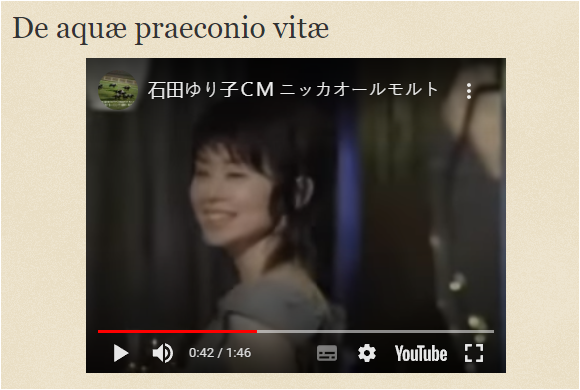
From Irisatus Yokohamensis’ `Ludamus Latine’ blog
http://irisatus.blogspot.com/2014/02/de-aqu-praeconio-vit.html
http://irisatus.blogspot.com/2014/02/de-aqu-praeconio-vit.html
|
"cur tŭam uxōrem cŭpĭs ēbrĭārĕ?
quæ tĭbī mēmet dărĕ dōnă vis? dīc!" pulchră præcōnātŭr ăquam rŭbellăm fēmĭnă vītæ. quam bĭbam gāvīsŭs ĕt immŏdestŭs, sī sĭt enzȳmum jĕcŏrī mĭhi illŭd. non lĭcet sed mi id făcĕre atquĕ tantŭm sentĭo ŏdōrĕm. |
Why do you want to get your wife drunk?
What presents do you want from me? Tell me! A beautiful woman is advertising the amber water of life. How I would drink happily and unrestrainedly if that enzyme were in my liver but I’m not allowed to do this and I just smell the odour |
Keon, who joined us at the end of the evening, agreed that northern Asians in general are used to drinking a lot but recounted his own discomforture when caught in a drinking game in Chengdu.
We also swapped tales of misadventure with airlines. Keon mentioned a flight from Melbourne to Sydney which had to turn back when just about to land because it was past the airport’s night curfew time. They were, however, provided with free alcohol and hotel beds in contrast to John and family whose delayed flight from Rome to London in 2015, followed by other mishaps, meant they only tumbled into self-paid beds in Croydon at 5.00 a.m. Lilly had probably had the most hair-raising experience when her Ryan Air flight had to abort a landing when the pilot spotted an aircraft on the runway he had been assigned!
Sam described the requirements for Chinese essays at his school. You were generally asked to take one side or another with general philosophical questions such as `Which is more important, honesty or kindness?’ You also had to include in each paragraph both a traditional Chinese and a modern example, while the essay as a whole had to display geographical diversity. The spirit of the `eight-legged essay’ of the old Imperial Examinations seems to have survived!
We also swapped tales of misadventure with airlines. Keon mentioned a flight from Melbourne to Sydney which had to turn back when just about to land because it was past the airport’s night curfew time. They were, however, provided with free alcohol and hotel beds in contrast to John and family whose delayed flight from Rome to London in 2015, followed by other mishaps, meant they only tumbled into self-paid beds in Croydon at 5.00 a.m. Lilly had probably had the most hair-raising experience when her Ryan Air flight had to abort a landing when the pilot spotted an aircraft on the runway he had been assigned!
Sam described the requirements for Chinese essays at his school. You were generally asked to take one side or another with general philosophical questions such as `Which is more important, honesty or kindness?’ You also had to include in each paragraph both a traditional Chinese and a modern example, while the essay as a whole had to display geographical diversity. The spirit of the `eight-legged essay’ of the old Imperial Examinations seems to have survived!
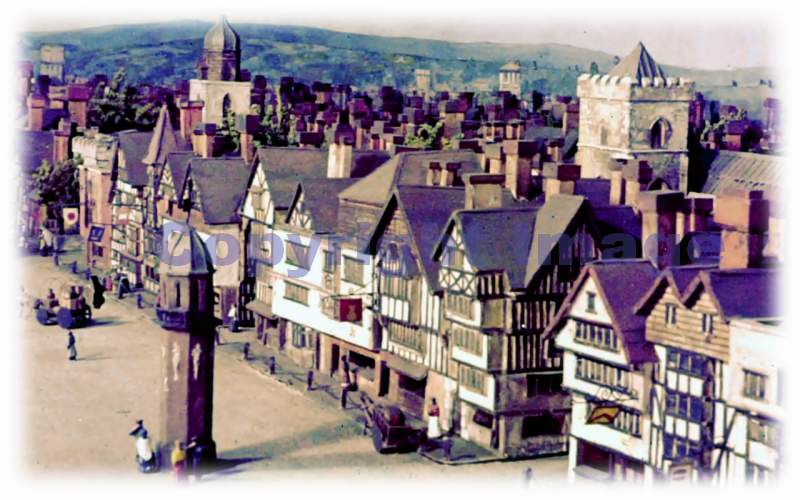
A reconstructed view of medieval Cheapside, scene of John Rykener’s arrest
https://knowyourlondon.wordpress.com/2021/01/11/cheapside-medieval-model-street/
The only Suetonius we read was a short section from c.23 of Life of Nero, assigned to Carie who had to leave at 9.00. The rest of us then read the greater part of a celebrated 14th century document, the record of the interrogation of John/Eleanor Rykener, a cross-dressing prostitute arrested in London in December 1394. The text was taken, with one or two corrections, from Fordham’s Internet Sourcebook for Medieval History (https://sourcebooks.fordham.edu/source/1395rykener.asp).We were unable to finish as we ran up against the retaurant’s 11.00 pm. closing time!
The time at which Rykener’s arrest was said to have taken place was the 8th to 9th hour at night, and Sam thought this was the time when `first sleep’ normally ended, under the pattern of sleeping in two shifts which seems to have been ended by the industrial revolution. This concept is also perhaps attested for Roman times by the expression prīma quiēs in Virgil’s account of the taking of Troy in Book II of the Aeneid.
We discussed the pronunciation of the name `Rykener’. The letter `Y’ in the Greek alphabet represented a rounded high-front vowel (the sound of `u’ in French `lune’ and the vowel in Cantonese 書) and its value in the Roman alphabet was initially the same, only being used in Greek loanwords. However, as with Brits or Americans pronouncing French, the Romans frequently unrounded the vowel to produce the sound /i/ and the name of the letter became `I Graeca’ (Greek `i’). In English, a long /i/ was often further modified to /ai/ (as in `bite’). In 1394 the `y’ in `Rykener’ would still have been/i/ (see the diagram at https://en.wikipedia.org/wiki/Great_Vowel_Shift)
The discussion then moved to the changes in the pronunciation of Greek, whose classical pronunciation is markedly different from the Byzantine of modern one. The most famous example is provided by Aristophanes’ use of βη to represent, quite accurately, the sound of a sheep bleating. The modern pronunciation of the same syllable is `vee’! It is, therefore, advisable to use the reconstructed ancient pronunciation when reading Classical Greek authors but, since by the time of Christ some of the changes were well under way, the later pronunciation is not unreasonable for the New Testament.
Returning to Latin, we noted that the Classical long/short distinction in vowels disappeared by early medieval times, but that the stress, originally partly determined by the length of the vowel in the penultimate syllable, remained in the same place. the use of macrons with medieval texts is thus not entrirely pointless,
SUETONIUS (Vīta Nerōnis)
XXIĪĪ. Nam et quae dīversissimōrum temporum sunt, cōgī in ūnum annum,
For both those-which of-very-different times are to-be-brought-together into one year
quibusdam etiam iterātīs, iussit et Olympiae quoque praeter cōnsuētūdinem mūsicum agōna
with-some-of-them even repeated he-ordered and at Olympia also contrary-to custom, musical contest
commīsit. Ac nē quid circā haec occupātum āvocāret dētinēretve, cum praesentiā eius urbicās
organised and lest anything with these [him]busy should-call-away or-detain when presence his of-city
rēs egēre ā lībertō Helīō admonērētur, rescrīpsit hīs verbīs:"Quamvīs nunc tuum cōnsilium sit
affairs to-require by freedman Helius he-was-being-warned he-wrote-back in-these words although now your advice is
et vōtum celeriter revertī mē, tamen suādēre et optāre potius dēbēs, ut Nerōne dignus
and wish quickly to-return me still to-urge and to desire rather you-ought that of-Nero worthy
revertar."[1]
tI-should-return
JOHN RYKENER
Ūndecimō diē Decembris annō rēgnī rēgis Ricardī secundī decimō octāvō, ductī fuērunt[2] hīc[3]
On 11th day of-December in-year of-reign of-king Richard II 10th 8th brought were here
cōram Jōhanne Fressh maiōre et aldermannīs cīvitātis Londoniensis Jōhannēs Britby dē
before John Fressh mayor and alderman of-city of-London John Britby from
cōmitāte Eborācum et Jōhannēs Rykener, sē Elianoram nōmināns veste muliebrī dētēctus.
county York and John Rykener self Eleanor calling in-clothing woman’s detected
Quī[4] diē dominicā ultimō preterita per quōsdam dictē cīvitātis ministrōs noctanter inter hōrās
they on-day Lord’s last passed by certain of-said city officers at-night between hours
octāvam et nōnam super quoddam stallum in venellā vocātā Sopereslane[5] inventī fuērunt
eighth and ninth on-top-of a-certain stall in lane called Soper’s Lane found were
iacentēs, illud vitium dētestābile, nephandum, et ignōminiōsum committentēs, prō seperātī[6]
lying that vice detestable unmentionable and disgraceful committing for separate
exāminātiōne cōram dictīs maiōre et aldermannīs super premissa fienda et audienda etcētera.
Examination before the-said mayor and-aldermen concerning aforesaid-things being-made and being-heard etc.
Quī quidem Jōhannēs Britby inde allocūtus fatēbātur quod ipse per vīcum rēgium dē Chepe[7]
That indeed John Britby then spoken-to confessed that himself along street royal of Cheap
diē dominicā inter hōrās supradictās trānsiēns, dictum Jōhannem Rykener vestītū muliebrī
on-day Lord’s between hours above-said passing the-said John Rykener in-clothing woman’s
ōrnātum, ipsumque mulierem fore suspicans fuerat assecūtus, petēns ab eō, tanquam ā
adorned and-him woman to-be suspecting he-had spoken-to asking from him as [he-would] from
muliere, sī cum eā libīdinōsē agere possit. Quī ab eō argentum prō labōre suō petēns sibi
woman if with her lustfully to-act he-could he [Rykener] from him money for work his asking for-himself
cōnsentiēbat, invicem trānseuntēs ad illud complendum[8] usque stallum predictum. Ipsī tamen
he[Rykener] consented together going-across to that to-be-filled still stall aforesaid they however
tunc ibīdem per ministrōs predīctōs in eōrum maleficiīs dētestābilibus captī fuērunt, carcere
then in-same-place by officers aforesaid in their evil-doing detestable caught were to-prison
vērō mancipātī hūcusque, etcetera. Et predictus Jōhannēs Rykener in veste muliebrī hīc
indded consigned so-far etc. and aforesaid John Rykener in clothing woman’s here
adductus dē māteriā predictā allocūtus cognōvit sē fēcisse in omnibus prout īdem Jōhannēs
brought about matter aforesaid questioned acknowledged himself to-have-done in all-details as same[as] John
Britby superius fatēbātur etcetērā. Quesitum fuit ulterius ā prefātō Jōhanne Rykener quis eī[9]
Britby above confessed etc. asked it-was further of aforesaid John Rykener who him
docuit dictum vitium exercēre et quantō tempore, in quibus locīs, et cum quibus persōnīs
taught said vice to-practice and for-how-much time in which places and with which persons
NOTES
[1] According to Dio (63, 12 & 19), Helius had been left in charge of the city in Nero’s absence. When his written appeals were unsuccessful, he travelled to Greece to see Nero in person and persuaded him to return by claiming there was a conspiracy against him. Dio adds that many hoped Nero would drown in a storm on the way back but Pike is wrong to claim that this hope was shared by Helius himdelf.
[2] The use of the perfect rather than present tense of esse to form the perfect passive tense is found sometimes in classical Latin and became more common in the medieval period.
[3] Hīc is presumably used here in the meaning of `to this place’ rather than `at this place’ and the correct Classical Latin would therefore have been hūc (`hither’).
[4] As in Classical Latin, a relative pronoun could be used at the start of a new sentence and should therefore normally be translated into English with a demonstrative pronoun.
[5] A street running off Cheapside and corresponding roughly to the present-day Queen’s Street
[6] Presumably an error for feminine ablative singular separatā agreeing with examinātiōne.
[7] i.e. Cheapside, the famous street running through the city of London adjacent to St Paul’s Cathedral. The name derives from Old English ceapan (to buy) and cheapside originally meant simply `market place.’ Latin vīcus could refer to a hamlet, a city block or a street and vīcus regius was a high road.
[8] Presumably this means the stall had yet to be filled with hay.
[9] In classical Latin docēre was used with an accusative for the person taught rather than a dative.
masculīs sīve fēminīs illud āctum libīdinōsum et nephandum commīsit. Quī in animam suam
masculine or feminine that act libidinous and unspeakable he-committed he on soul his
sponte iūrāvit et cognōvit quod quaedam Annā, meretrīx[1] quondam[2] cuiusdam famulī
willingly swore and acknowledged that a-certain Anna mistress once of-a-certain servant of
dominī[3] Thomē Blount, prīmō docuit ipsum vitium dētestābile modō muliebrī exercēre.
Sir Thomas Blount first taught that vice detestable in-manner of-woman to-practice
Item dīxit quod quaedam Elizabeth Brouderer prius vestīvit ipsum veste muliebrī; quae etiam
Likewise he-said that a-certain Elizabeth Brouderer previously dressed him in-clothing of-woman she also
condūxit quandam Alīciam fīliam suam dīversīs hominibus luxuriae causā, ipsam cum eīsdem
brought a-certain Alice daughter her to-various men of-lust for-sake her with same
hominibus in lectīs eōrum noctanter absque lūmine repōnēns et eandem summō māne ab
men in beds there at-nigh and-without light placing also her early in-morning from
eīsdem recēdere fēcit, mōnstrandō eīs dictum Jōhannem Rykener veste muliebrī ōrnātum
them to-withdraw made showing them the-said John Rykener in-clothing woman’s dressed-up
ipsum Alianoram nōminantem,[4] asserēns ipsōs cum ipsā sinistrē ēgisse.[5] Item dīxit quod
himself Eleanor calling asserting them with her badly to-have-behaved likewise he-said that
quīdam Philippus, Rēctor dē Theydon Gernon,[6] concubuit cum eōdem Jōhanne Rykener ut
a-certain Philip rector of Theydon Gernon went-to-bed with the-same John Rykener as
cum muliere in domō cuiusdam Elizabeth Brouderer extrā Bisshoppesgāte,[7] quō tempore
with woman in house of-a-certain Elizabeth Brouderer outside Bishopsgate at-which time
dictus Jōhannēs Rykener asportāvit duās togās ipsīus Philippī. Et quandō īdem Philippus illās
the-said John Rykener took-away two gowns of-himself Philip and when the-same Philip them
petiit ā prefātō Jōhanne Rykener, ipse dīxit quod fuit uxor cuiusdam hominis, et sī ipse illās
asked-for from aforesaid John Rykener he said that he-was wife of-a-certain man and if he them
repetere vellet faceret marītum suum versus ipsum prōsequī.[8] Item dictus Jōhannēs Rykener
to-get-back wanted he-should-get husband his against him to-bring-case likewise the-said John Rykener
NOTES
[1] meretrīx had a more negative connotation than `mistress’ as it could also mean `prostitute’. The Sourcebook translates as `whore’. The word derives from the verb mereor, `to receive one’s share’ and refers to any woman receiving money in return for sex.
[2] To be taken with famulī rather than meretrīx.
[3] The word dominus could be used as the title of a knight (as assumed in the Internet Medieval Sourcebook and followed here) but also meant `lord’ or `master’. In neo-Latin it is used for `Mr,’.
[4] The accusative case shows that the participle goes with Jōhannem Rykener and that ipsum should therefore be translated `himself’. However, as the Sourcebook assume, nōmināntem might be a grammatical mistake for nōmināns
[5] Presumably she presented Rykener to them so that he rather than her own daughter would risk being recognised in the street later.
[6] Theydon Gernon (now usually spelled `Garnon’) is a village north of London in Epping Forest.
[7] Bishopsgate was the gate in the old walls of the city from which Ermine Street, the Roman road to York, started. Named from its supposed rebuilding by a 7th century bishop, it was rebuilt again several times and finally demolished in the 18th century. See https://en.wikipedia.org/wiki/Bishopsgate,
https://gargleyark.wordpress.com/2016/04/18/the-medieval-gates-of-london-a-history-of-bishopsgate/ and https://knowyourlondon.wordpress.com/2019/10/09/bishopsgate-gate/ The name now refers to the city ward within which the gate previously stood.
[8] faceret..prosequī : the context suggests that Rykener was daring the rector to sue Rykener’s supposed husband for return of the gowns, in which case one would have expected simply maritum suum prosequeretur. However the Latin as it stands certainly cannot mean this but either `he {Philip} would leave Rykener’s husband no choice but to sue him [Philip]’ or `he [Rykener] would get his husband to sue him [Philip],’ presumably the charge in either case being adultery. It is best to assume that Rykener was indeed suggesting Philip sue the husband and that the clerk muddled his Latin syntax!
fatēbātur quod per quīnque septimānās ante fēstum sanctī Michaēlis[1] ultimō ēlāpsum
said that for five weeks before feast of-St, Michael last passed
morābātur apud Oxōnium et operātus est ibīdem in veste muliebrī in arte dē brouderer
he-was-staying at Oxford and worked there in clothing women’s in skill of embroideress
nōmināns ipsum Alianoram. Et ibīdem in mariscō trēs scolārēs ignōtōs,[2] quōrum ūnus
calling himself Eleanor and in-same-place in marsh three scholars unsuspecting of-whom one
nōminātur dominus Willielmus Foxlee, alius dominus Jōhannēs, et tertius dominus Walterus,
is-called Sir William Foxley another Sir John and third Sir Walter
ūsī fuērunt sepius cum ipsō abōminābile vitium suprādictum
engaged-in more-often with himself abominable vice aforesaid
NOTES
[1] i.e. Michaelmas (29 September), also known as the Feast of Saints Michael, Gabriel, and Raphael, the Feast of the Archangels, or the Feast of Saint Michael and All Angels. The Archangel Michael was credited with defeating Lucifer’s rebellion against God. Michaelmas (along with Lady Day (2 the Feast of the Annunciation on 25 March), Midsummer’s Day and Christmas Day) was one of the `quarter days’ in the British Isles when accounts were supposed to be settled. Many of the older universities in Britain and Ireland still refer to the first section of the academic year as `Michaelmas Term’. For further details see https://en.wikipedia.org/wiki/Michaelmas
[2] ignōtus normally means `unknown’ but, even in Classical Latin, occasionally meant `unknowing’. The scholars were presumably unaware at the start that Rykener was a man.
https://knowyourlondon.wordpress.com/2021/01/11/cheapside-medieval-model-street/
The only Suetonius we read was a short section from c.23 of Life of Nero, assigned to Carie who had to leave at 9.00. The rest of us then read the greater part of a celebrated 14th century document, the record of the interrogation of John/Eleanor Rykener, a cross-dressing prostitute arrested in London in December 1394. The text was taken, with one or two corrections, from Fordham’s Internet Sourcebook for Medieval History (https://sourcebooks.fordham.edu/source/1395rykener.asp).We were unable to finish as we ran up against the retaurant’s 11.00 pm. closing time!
The time at which Rykener’s arrest was said to have taken place was the 8th to 9th hour at night, and Sam thought this was the time when `first sleep’ normally ended, under the pattern of sleeping in two shifts which seems to have been ended by the industrial revolution. This concept is also perhaps attested for Roman times by the expression prīma quiēs in Virgil’s account of the taking of Troy in Book II of the Aeneid.
We discussed the pronunciation of the name `Rykener’. The letter `Y’ in the Greek alphabet represented a rounded high-front vowel (the sound of `u’ in French `lune’ and the vowel in Cantonese 書) and its value in the Roman alphabet was initially the same, only being used in Greek loanwords. However, as with Brits or Americans pronouncing French, the Romans frequently unrounded the vowel to produce the sound /i/ and the name of the letter became `I Graeca’ (Greek `i’). In English, a long /i/ was often further modified to /ai/ (as in `bite’). In 1394 the `y’ in `Rykener’ would still have been/i/ (see the diagram at https://en.wikipedia.org/wiki/Great_Vowel_Shift)
The discussion then moved to the changes in the pronunciation of Greek, whose classical pronunciation is markedly different from the Byzantine of modern one. The most famous example is provided by Aristophanes’ use of βη to represent, quite accurately, the sound of a sheep bleating. The modern pronunciation of the same syllable is `vee’! It is, therefore, advisable to use the reconstructed ancient pronunciation when reading Classical Greek authors but, since by the time of Christ some of the changes were well under way, the later pronunciation is not unreasonable for the New Testament.
Returning to Latin, we noted that the Classical long/short distinction in vowels disappeared by early medieval times, but that the stress, originally partly determined by the length of the vowel in the penultimate syllable, remained in the same place. the use of macrons with medieval texts is thus not entrirely pointless,
SUETONIUS (Vīta Nerōnis)
XXIĪĪ. Nam et quae dīversissimōrum temporum sunt, cōgī in ūnum annum,
For both those-which of-very-different times are to-be-brought-together into one year
quibusdam etiam iterātīs, iussit et Olympiae quoque praeter cōnsuētūdinem mūsicum agōna
with-some-of-them even repeated he-ordered and at Olympia also contrary-to custom, musical contest
commīsit. Ac nē quid circā haec occupātum āvocāret dētinēretve, cum praesentiā eius urbicās
organised and lest anything with these [him]busy should-call-away or-detain when presence his of-city
rēs egēre ā lībertō Helīō admonērētur, rescrīpsit hīs verbīs:"Quamvīs nunc tuum cōnsilium sit
affairs to-require by freedman Helius he-was-being-warned he-wrote-back in-these words although now your advice is
et vōtum celeriter revertī mē, tamen suādēre et optāre potius dēbēs, ut Nerōne dignus
and wish quickly to-return me still to-urge and to desire rather you-ought that of-Nero worthy
revertar."[1]
tI-should-return
JOHN RYKENER
Ūndecimō diē Decembris annō rēgnī rēgis Ricardī secundī decimō octāvō, ductī fuērunt[2] hīc[3]
On 11th day of-December in-year of-reign of-king Richard II 10th 8th brought were here
cōram Jōhanne Fressh maiōre et aldermannīs cīvitātis Londoniensis Jōhannēs Britby dē
before John Fressh mayor and alderman of-city of-London John Britby from
cōmitāte Eborācum et Jōhannēs Rykener, sē Elianoram nōmināns veste muliebrī dētēctus.
county York and John Rykener self Eleanor calling in-clothing woman’s detected
Quī[4] diē dominicā ultimō preterita per quōsdam dictē cīvitātis ministrōs noctanter inter hōrās
they on-day Lord’s last passed by certain of-said city officers at-night between hours
octāvam et nōnam super quoddam stallum in venellā vocātā Sopereslane[5] inventī fuērunt
eighth and ninth on-top-of a-certain stall in lane called Soper’s Lane found were
iacentēs, illud vitium dētestābile, nephandum, et ignōminiōsum committentēs, prō seperātī[6]
lying that vice detestable unmentionable and disgraceful committing for separate
exāminātiōne cōram dictīs maiōre et aldermannīs super premissa fienda et audienda etcētera.
Examination before the-said mayor and-aldermen concerning aforesaid-things being-made and being-heard etc.
Quī quidem Jōhannēs Britby inde allocūtus fatēbātur quod ipse per vīcum rēgium dē Chepe[7]
That indeed John Britby then spoken-to confessed that himself along street royal of Cheap
diē dominicā inter hōrās supradictās trānsiēns, dictum Jōhannem Rykener vestītū muliebrī
on-day Lord’s between hours above-said passing the-said John Rykener in-clothing woman’s
ōrnātum, ipsumque mulierem fore suspicans fuerat assecūtus, petēns ab eō, tanquam ā
adorned and-him woman to-be suspecting he-had spoken-to asking from him as [he-would] from
muliere, sī cum eā libīdinōsē agere possit. Quī ab eō argentum prō labōre suō petēns sibi
woman if with her lustfully to-act he-could he [Rykener] from him money for work his asking for-himself
cōnsentiēbat, invicem trānseuntēs ad illud complendum[8] usque stallum predictum. Ipsī tamen
he[Rykener] consented together going-across to that to-be-filled still stall aforesaid they however
tunc ibīdem per ministrōs predīctōs in eōrum maleficiīs dētestābilibus captī fuērunt, carcere
then in-same-place by officers aforesaid in their evil-doing detestable caught were to-prison
vērō mancipātī hūcusque, etcetera. Et predictus Jōhannēs Rykener in veste muliebrī hīc
indded consigned so-far etc. and aforesaid John Rykener in clothing woman’s here
adductus dē māteriā predictā allocūtus cognōvit sē fēcisse in omnibus prout īdem Jōhannēs
brought about matter aforesaid questioned acknowledged himself to-have-done in all-details as same[as] John
Britby superius fatēbātur etcetērā. Quesitum fuit ulterius ā prefātō Jōhanne Rykener quis eī[9]
Britby above confessed etc. asked it-was further of aforesaid John Rykener who him
docuit dictum vitium exercēre et quantō tempore, in quibus locīs, et cum quibus persōnīs
taught said vice to-practice and for-how-much time in which places and with which persons
NOTES
[1] According to Dio (63, 12 & 19), Helius had been left in charge of the city in Nero’s absence. When his written appeals were unsuccessful, he travelled to Greece to see Nero in person and persuaded him to return by claiming there was a conspiracy against him. Dio adds that many hoped Nero would drown in a storm on the way back but Pike is wrong to claim that this hope was shared by Helius himdelf.
[2] The use of the perfect rather than present tense of esse to form the perfect passive tense is found sometimes in classical Latin and became more common in the medieval period.
[3] Hīc is presumably used here in the meaning of `to this place’ rather than `at this place’ and the correct Classical Latin would therefore have been hūc (`hither’).
[4] As in Classical Latin, a relative pronoun could be used at the start of a new sentence and should therefore normally be translated into English with a demonstrative pronoun.
[5] A street running off Cheapside and corresponding roughly to the present-day Queen’s Street
[6] Presumably an error for feminine ablative singular separatā agreeing with examinātiōne.
[7] i.e. Cheapside, the famous street running through the city of London adjacent to St Paul’s Cathedral. The name derives from Old English ceapan (to buy) and cheapside originally meant simply `market place.’ Latin vīcus could refer to a hamlet, a city block or a street and vīcus regius was a high road.
[8] Presumably this means the stall had yet to be filled with hay.
[9] In classical Latin docēre was used with an accusative for the person taught rather than a dative.
masculīs sīve fēminīs illud āctum libīdinōsum et nephandum commīsit. Quī in animam suam
masculine or feminine that act libidinous and unspeakable he-committed he on soul his
sponte iūrāvit et cognōvit quod quaedam Annā, meretrīx[1] quondam[2] cuiusdam famulī
willingly swore and acknowledged that a-certain Anna mistress once of-a-certain servant of
dominī[3] Thomē Blount, prīmō docuit ipsum vitium dētestābile modō muliebrī exercēre.
Sir Thomas Blount first taught that vice detestable in-manner of-woman to-practice
Item dīxit quod quaedam Elizabeth Brouderer prius vestīvit ipsum veste muliebrī; quae etiam
Likewise he-said that a-certain Elizabeth Brouderer previously dressed him in-clothing of-woman she also
condūxit quandam Alīciam fīliam suam dīversīs hominibus luxuriae causā, ipsam cum eīsdem
brought a-certain Alice daughter her to-various men of-lust for-sake her with same
hominibus in lectīs eōrum noctanter absque lūmine repōnēns et eandem summō māne ab
men in beds there at-nigh and-without light placing also her early in-morning from
eīsdem recēdere fēcit, mōnstrandō eīs dictum Jōhannem Rykener veste muliebrī ōrnātum
them to-withdraw made showing them the-said John Rykener in-clothing woman’s dressed-up
ipsum Alianoram nōminantem,[4] asserēns ipsōs cum ipsā sinistrē ēgisse.[5] Item dīxit quod
himself Eleanor calling asserting them with her badly to-have-behaved likewise he-said that
quīdam Philippus, Rēctor dē Theydon Gernon,[6] concubuit cum eōdem Jōhanne Rykener ut
a-certain Philip rector of Theydon Gernon went-to-bed with the-same John Rykener as
cum muliere in domō cuiusdam Elizabeth Brouderer extrā Bisshoppesgāte,[7] quō tempore
with woman in house of-a-certain Elizabeth Brouderer outside Bishopsgate at-which time
dictus Jōhannēs Rykener asportāvit duās togās ipsīus Philippī. Et quandō īdem Philippus illās
the-said John Rykener took-away two gowns of-himself Philip and when the-same Philip them
petiit ā prefātō Jōhanne Rykener, ipse dīxit quod fuit uxor cuiusdam hominis, et sī ipse illās
asked-for from aforesaid John Rykener he said that he-was wife of-a-certain man and if he them
repetere vellet faceret marītum suum versus ipsum prōsequī.[8] Item dictus Jōhannēs Rykener
to-get-back wanted he-should-get husband his against him to-bring-case likewise the-said John Rykener
NOTES
[1] meretrīx had a more negative connotation than `mistress’ as it could also mean `prostitute’. The Sourcebook translates as `whore’. The word derives from the verb mereor, `to receive one’s share’ and refers to any woman receiving money in return for sex.
[2] To be taken with famulī rather than meretrīx.
[3] The word dominus could be used as the title of a knight (as assumed in the Internet Medieval Sourcebook and followed here) but also meant `lord’ or `master’. In neo-Latin it is used for `Mr,’.
[4] The accusative case shows that the participle goes with Jōhannem Rykener and that ipsum should therefore be translated `himself’. However, as the Sourcebook assume, nōmināntem might be a grammatical mistake for nōmināns
[5] Presumably she presented Rykener to them so that he rather than her own daughter would risk being recognised in the street later.
[6] Theydon Gernon (now usually spelled `Garnon’) is a village north of London in Epping Forest.
[7] Bishopsgate was the gate in the old walls of the city from which Ermine Street, the Roman road to York, started. Named from its supposed rebuilding by a 7th century bishop, it was rebuilt again several times and finally demolished in the 18th century. See https://en.wikipedia.org/wiki/Bishopsgate,
https://gargleyark.wordpress.com/2016/04/18/the-medieval-gates-of-london-a-history-of-bishopsgate/ and https://knowyourlondon.wordpress.com/2019/10/09/bishopsgate-gate/ The name now refers to the city ward within which the gate previously stood.
[8] faceret..prosequī : the context suggests that Rykener was daring the rector to sue Rykener’s supposed husband for return of the gowns, in which case one would have expected simply maritum suum prosequeretur. However the Latin as it stands certainly cannot mean this but either `he {Philip} would leave Rykener’s husband no choice but to sue him [Philip]’ or `he [Rykener] would get his husband to sue him [Philip],’ presumably the charge in either case being adultery. It is best to assume that Rykener was indeed suggesting Philip sue the husband and that the clerk muddled his Latin syntax!
fatēbātur quod per quīnque septimānās ante fēstum sanctī Michaēlis[1] ultimō ēlāpsum
said that for five weeks before feast of-St, Michael last passed
morābātur apud Oxōnium et operātus est ibīdem in veste muliebrī in arte dē brouderer
he-was-staying at Oxford and worked there in clothing women’s in skill of embroideress
nōmināns ipsum Alianoram. Et ibīdem in mariscō trēs scolārēs ignōtōs,[2] quōrum ūnus
calling himself Eleanor and in-same-place in marsh three scholars unsuspecting of-whom one
nōminātur dominus Willielmus Foxlee, alius dominus Jōhannēs, et tertius dominus Walterus,
is-called Sir William Foxley another Sir John and third Sir Walter
ūsī fuērunt sepius cum ipsō abōminābile vitium suprādictum
engaged-in more-often with himself abominable vice aforesaid
NOTES
[1] i.e. Michaelmas (29 September), also known as the Feast of Saints Michael, Gabriel, and Raphael, the Feast of the Archangels, or the Feast of Saint Michael and All Angels. The Archangel Michael was credited with defeating Lucifer’s rebellion against God. Michaelmas (along with Lady Day (2 the Feast of the Annunciation on 25 March), Midsummer’s Day and Christmas Day) was one of the `quarter days’ in the British Isles when accounts were supposed to be settled. Many of the older universities in Britain and Ireland still refer to the first section of the academic year as `Michaelmas Term’. For further details see https://en.wikipedia.org/wiki/Michaelmas
[2] ignōtus normally means `unknown’ but, even in Classical Latin, occasionally meant `unknowing’. The scholars were presumably unaware at the start that Rykener was a man.


