| linguae |
|
QUESTIONS ARISING FROM 105th. MEETING – 22/11/19
(the record of earlier meetings can be downloaded from the main Circulus page as can the version of Ciceronis Filius with illustrations added. The illustrated text of Genesis is available on the Genesis page, of Kepler's Somnium on the Somnium page and of Nutting's Ad Alpes on the Ad Alpes page).
Whilst ordering food we briefly discussed the history of chilli, which Rene thought might have originated in India rather than his native Mexico. Later fact-checking confirmed that Mexico is indeed the source (see https://en.wikipedia.org/wiki/Chili_pepper) and the only real dispute is whether the plant was first brought to Asia by the Portuguese via Goa or the Spanish via the Philippines, but it seems to be agreed that Portuguese missionaries brought it to Japan in 1542, from where it entered Korea.
Despite its ubiquitous use in Indian cuisine, chilli is thus a relatively recent import, as are potatoes, carrots, peas, cauliflower and tomatoes, as well as naan, which originated in Central Asia and whose name is simply the Persian word for bread. The contrast between modern Indian food and the strictly traditional dishes served in southern India at shraddha meals eaten in honour of a family’s ancestors is explored at http://www.bbc.com/travel/story/20190609-the-surprising-truth-about-indian-food
Despite its ubiquitous use in Indian cuisine, chilli is thus a relatively recent import, as are potatoes, carrots, peas, cauliflower and tomatoes, as well as naan, which originated in Central Asia and whose name is simply the Persian word for bread. The contrast between modern Indian food and the strictly traditional dishes served in southern India at shraddha meals eaten in honour of a family’s ancestors is explored at http://www.bbc.com/travel/story/20190609-the-surprising-truth-about-indian-food
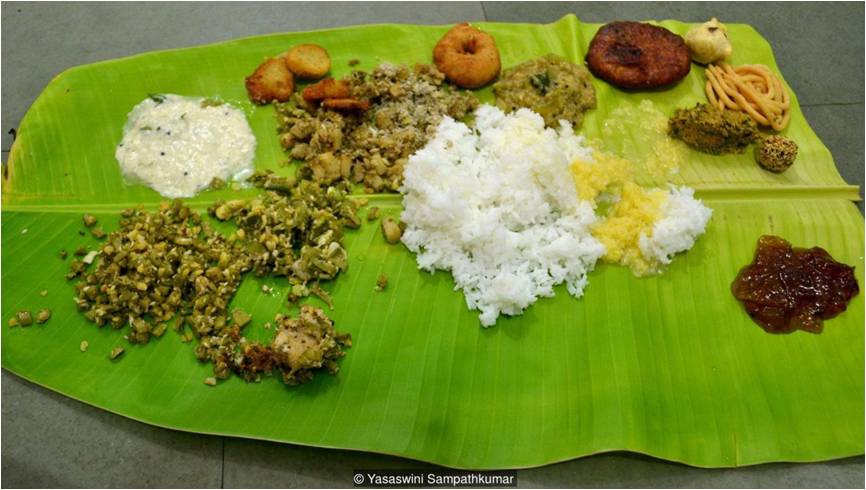
An authentic Indian meal
http://www.bbc.com/travel/story/20190609-the-surprising-truth-about-indian-food
Before the arrival of chilli Asians did, of course have other ways of spicing up their dishes, using peppers native to the region, such as black pepper. This still grows wild in Hong Kong, though, as Pat and Don pointed out when this topic was discussed before, the character 胡 (= imported) in the name for pepper (胡椒 (Cantonese wu jiu, Putonghua hu jiao)) shows it was regarded as non-indigenous over China as a whole. Black pepper appears to have been indigenous to more southerly regions within Asia.
Locating references to chilli in the record of our earlier meetings was made more difficult, because of the different spellings in use. `Chilli’ is the standard spelling in the UK and `chili’ in the USA, although in the latter case `chile’ is an acceptable variant in America. The word itself comes from the Nahuatll language spoken by the Aztecs and the ealiest transcriptions of the word is `chilli’, as in British orthography. The ealiest spelling in English is`chille’ (1662). For a full discussion see the article at https://www.grammarphobia.com/blog/2013/09/chili-chile-or-chilli.html
We discussed a picture from the Quomodoloquitur site (see below) in which a creature with a horse’s head and a man’s body looks through a fence at a normal horse. In a comment posted on the site (http://quomododicitur.com/2019/10/21/qdp-ep-150-de-imagine-satis-ridicula/#comments). `Patavinus’ suggested that the hybrid was in fact the adult Pinocchio, who, when a boy, had been turned into a donkey with a friend after they had run away from school to the Land of Toys. In the original story. Pinocchio had eventually been turned from a donkey into a puppet again and then finally to a real boy, thanks to the intervention of the Blue Fairy. Patavinus thinks that in later life he and his friend ran off to Las Vegas and began patronizing street walkers, whereupon as a punishment the Blue Fairy, now married to Pinocchio, turned them into horses. Pinocchio, whose transformation has just begun, looks in horror at his friend in fully equine state.
An alternative explanation was suggested by Tanya who thought the hybrid was actually a horse having a bad dream in which after eating psychedelic mushrooms he starts turning into a semi-human, yet he is still able to look back through time and sees himself before he made his terrible mistake.
Yet another explanation was offered by sam, who thought the creature might be a centaur with his body parts reversed.
On the language front, we wondered about Patavinus’s use of faga for `fairy’, as we couldn’t find the word in any dictionary. John thought that nympha was the closest Latin equivalent, and this word is suggested, along with nūmen and dīva in the Morgan-Owens lexicon (http://neolatinlexicon.org), whilst Smith-Hall thinks nūmen the best general equivalent. The problem with nūmen, however, is that it can cover any supranatural agency, including the major gods.
The word fairy itself derives ultimately from hypothetical Vulgar Latin fāta, -ae f. `fate’ or `goddess of fate’, which appears to have been a reinterpretation of the neuter plural fāta (from fātum, -ī n, fate). The word arrived in English around 1300 as a borrowing of Old French faerie (`land of fairies, magic, witchcraft’) with the meaning of an individual fairy developing later. Towards the end of the 14th century, Old French fae (Modern French fée) was itself borrowed as the now archaic fay (preserved in `Morgan the Fay’ of Arthurian legend).
We read part of chapter 19 of Ad Alpēs, which mainly covers the eruption of Vesuvius as described by Pliny the Younger in two of his most famous letters but reached only as far as the point where Pliny the Elder and his companions, deciding they were better off outside than waiting indors for the roof to collapse, equipped themselves with pillows to protect their heads from falling pumice stones and torches to find their way in the darkness ( lūminibus viam explōrāre necesse erat, pg. 111, l.60 in the Latinitium edition; pg. 54 in my ad_alpes_ii__interlinear_.doc)
The original letters were read in the March 2014 meeting of the Circulus, when we discussed the treatment of the story in the 2014 film `Pompeii’. Text and translation of the Pliny letters themselves and of two modern letters on the film are available in vesuvius_transl_.doc, which can be downloaded from https://linguae.weebly.com/pliny.html There is an extremely detailed presentation of Pliny’s text, with description of the manuscript tradition, translation, full explanation of the physical background, and stylistic analysis at https://quemdixerechaos.com/2012/11/19/translatingplinypt1/ and linked pages.
http://www.bbc.com/travel/story/20190609-the-surprising-truth-about-indian-food
Before the arrival of chilli Asians did, of course have other ways of spicing up their dishes, using peppers native to the region, such as black pepper. This still grows wild in Hong Kong, though, as Pat and Don pointed out when this topic was discussed before, the character 胡 (= imported) in the name for pepper (胡椒 (Cantonese wu jiu, Putonghua hu jiao)) shows it was regarded as non-indigenous over China as a whole. Black pepper appears to have been indigenous to more southerly regions within Asia.
Locating references to chilli in the record of our earlier meetings was made more difficult, because of the different spellings in use. `Chilli’ is the standard spelling in the UK and `chili’ in the USA, although in the latter case `chile’ is an acceptable variant in America. The word itself comes from the Nahuatll language spoken by the Aztecs and the ealiest transcriptions of the word is `chilli’, as in British orthography. The ealiest spelling in English is`chille’ (1662). For a full discussion see the article at https://www.grammarphobia.com/blog/2013/09/chili-chile-or-chilli.html
We discussed a picture from the Quomodoloquitur site (see below) in which a creature with a horse’s head and a man’s body looks through a fence at a normal horse. In a comment posted on the site (http://quomododicitur.com/2019/10/21/qdp-ep-150-de-imagine-satis-ridicula/#comments). `Patavinus’ suggested that the hybrid was in fact the adult Pinocchio, who, when a boy, had been turned into a donkey with a friend after they had run away from school to the Land of Toys. In the original story. Pinocchio had eventually been turned from a donkey into a puppet again and then finally to a real boy, thanks to the intervention of the Blue Fairy. Patavinus thinks that in later life he and his friend ran off to Las Vegas and began patronizing street walkers, whereupon as a punishment the Blue Fairy, now married to Pinocchio, turned them into horses. Pinocchio, whose transformation has just begun, looks in horror at his friend in fully equine state.
An alternative explanation was suggested by Tanya who thought the hybrid was actually a horse having a bad dream in which after eating psychedelic mushrooms he starts turning into a semi-human, yet he is still able to look back through time and sees himself before he made his terrible mistake.
Yet another explanation was offered by sam, who thought the creature might be a centaur with his body parts reversed.
On the language front, we wondered about Patavinus’s use of faga for `fairy’, as we couldn’t find the word in any dictionary. John thought that nympha was the closest Latin equivalent, and this word is suggested, along with nūmen and dīva in the Morgan-Owens lexicon (http://neolatinlexicon.org), whilst Smith-Hall thinks nūmen the best general equivalent. The problem with nūmen, however, is that it can cover any supranatural agency, including the major gods.
The word fairy itself derives ultimately from hypothetical Vulgar Latin fāta, -ae f. `fate’ or `goddess of fate’, which appears to have been a reinterpretation of the neuter plural fāta (from fātum, -ī n, fate). The word arrived in English around 1300 as a borrowing of Old French faerie (`land of fairies, magic, witchcraft’) with the meaning of an individual fairy developing later. Towards the end of the 14th century, Old French fae (Modern French fée) was itself borrowed as the now archaic fay (preserved in `Morgan the Fay’ of Arthurian legend).
We read part of chapter 19 of Ad Alpēs, which mainly covers the eruption of Vesuvius as described by Pliny the Younger in two of his most famous letters but reached only as far as the point where Pliny the Elder and his companions, deciding they were better off outside than waiting indors for the roof to collapse, equipped themselves with pillows to protect their heads from falling pumice stones and torches to find their way in the darkness ( lūminibus viam explōrāre necesse erat, pg. 111, l.60 in the Latinitium edition; pg. 54 in my ad_alpes_ii__interlinear_.doc)
The original letters were read in the March 2014 meeting of the Circulus, when we discussed the treatment of the story in the 2014 film `Pompeii’. Text and translation of the Pliny letters themselves and of two modern letters on the film are available in vesuvius_transl_.doc, which can be downloaded from https://linguae.weebly.com/pliny.html There is an extremely detailed presentation of Pliny’s text, with description of the manuscript tradition, translation, full explanation of the physical background, and stylistic analysis at https://quemdixerechaos.com/2012/11/19/translatingplinypt1/ and linked pages.
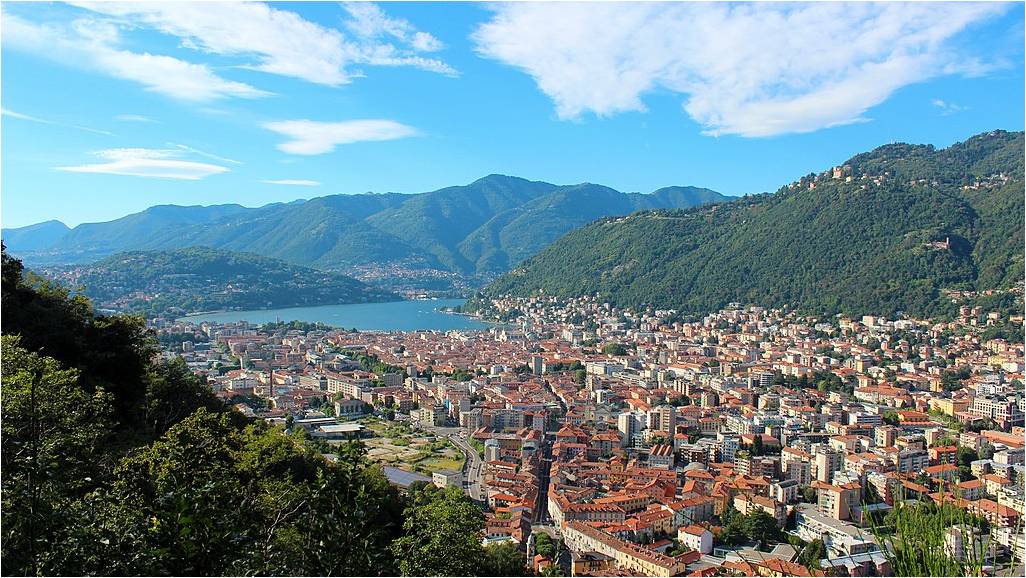
Como (ancient Comum), Pliny's birthplace on Lake Como in northern Italy
https://en.wikipedia.org/wiki/Como#/media/File:Como_and_it's_lake.jpg
We briefly discussed the setting of the Ad Alpēs stories, told by members of the family of Publius Cornelius, who is returning to Italy on the orders of the new emperor, Antonius Pius, in 138, after five years as a provincial administrator in Asia Minor. `Publius’ is his praenōmen (personal name) and `Cornelius’ his nōmen (clan name) and he evidently lacks the cognōmen (family surname) that most upper class Romans would have possessed at this time. He is accompanied by his wife, Drusilla, sons Publius (16-years) and Sextus (12-years), daughter Cornelia (10-years) and infant son Lucius. Also in the party are Onesimus (a middle-aged slave acting as Cornelius’s business manager), Stasimus (a young and mischievous slave) and Anna, the Jewish nanny looking after Lucius.
We briefly discussed the setting of the Ad Alpēs stories, told by members of the family of Publius Cornelius, who is returning to Italy on the orders of the new emperor, Antonius Pius, in 138, after five years as a provincial administrator in Asia Minor. `Publius’ is his praenōmen (personal name) and `Cornelius’ his nōmen (clan name) and he evidently lacks the cognōmen (family surname) that most upper class Romans would have possessed at this time. He is accompanied by his wife, Drusilla, sons Publius (16-years) and Sextus (12-years), daughter Cornelia (10-years) and infant son Lucius. Also in the party are Onesimus (a middle-aged slave acting as Cornelius’s business manager), Stasimus (a young and mischievous slave) and Anna, the Jewish nanny looking after Lucius.
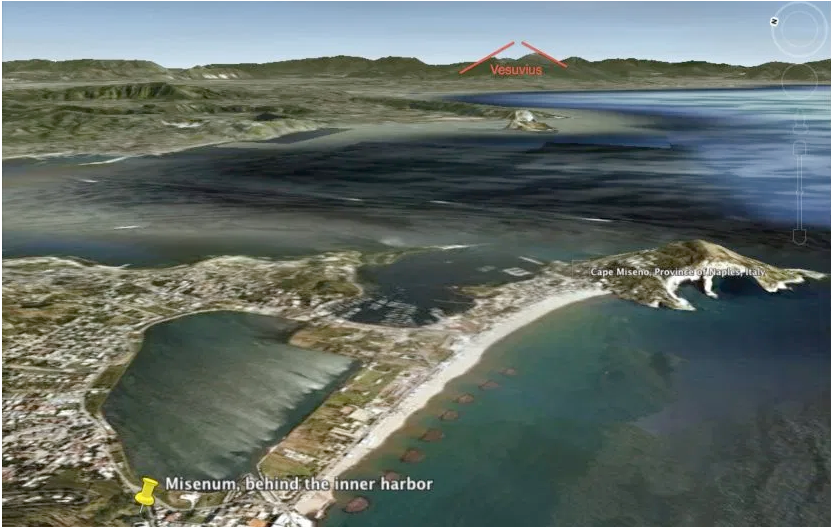
Looking south-east across the Bay of Naples from Misenum towards Vesuvius
https://quemdixerechaos.com/2013/01/01/translatingplinypt6/misenum2vesuviusgooglee3/
Language points that arose whilst reading included the technical terms prōducta (`extended’) and correpta (`compressed’), for long and short vowels respectively. We also noted the two different words for `uncle’ – patruus for father’s brother and avunculus for mother’s brother, the latter being Pliny the Younger’s original relation to the Elder, who subsequently also adopted him. Many cultures, including those of China and South Asia make a similar distinction and there may be a tendency for the maternal uncle (Cantonese kau5fu6,舅父) to be regarded as a `soft touch’ in contrast to the parternal one, who shares to a degree the father’s disciplinary responsibilities. This would mesh with the meaning of `avuncular’ in English and also to an extent with the sometimes pejorative connotations of mama (मामा), the Nepali word for a maternal uncle.
John initially thought there might be a grammatical mistake on page 110 (l.30-31) in the words ōrābat ut sē discrīminī ēriperet as he himself would have preferred ē discrīmine (`get her out of danger’). However subsequent checking in the Lewis & Short dictionary revealed that the plain dative is also allowed, i.e aliquem alicui as well as aliquem ex aliquō ēripere
We noted the wide range of meaning of sinus (-ūs, m), which basically tefers to anything curved in shape, and can mean `bay’, `bosom’ or `lap’. Tan also mentioned her favourite etymological fact, vix.the common derivation of shit and science from proto-Indo-European *skei (cut, split). The underlying semantic link in the first case is through the ide of something becoming separated from the body, and in the second presumably to the metaphorical segmentation of reality in analysing it.
We touched again on the thorny question of coining new Latin words, something vital if we want to discuss modern topics in Latin as well as studying the older texts. There is no ultimate authority for neo-Latin vocabulary but the Lexicon Morgianum (also known as the Morgan-Owens Lexicon), available at http://neolatinlexicon.org/, is the best reference source. This which can be supplemented by books like John Traupman’s Conversational Latin and Robert Maier’s Latein Deutsch Visuelles Wörterbuch. The reliance of the last-mentioned work on illustrations makes it useful even for those who do not read German, though the small print may be a barrier for some of us. An incomplete list of words found useful in past Circulus discussions, CIRCULUS VOCABULARY, plus more specific lists covering Indian food and household objects compiled by Eugene, can be downloaded from the Circulus web page (https://linguae.weebly.com/circulus-latinus-honcongensis.html), just above the location map for the Basmati restaurant. There is a discussion of other reference materials lower down the page
When the standard resources fail us and we need to devise new words or expressions ourselves, it is very much a matter of taste, though we do need to abide by the normal rules of Latin phonology and orthography. Thus in umbrivir (`ghost-man’, i.e. gweilo) the middle vowel has to be `i’ because an original short `a’ is normally replaced by `i’ in word compounds. However, everyone is free to use either this word or Pat’s preferred alternative, vir daemoniacus (`devilish man’).
There are, of course, a number of gweilo who still object to the name itself, and, as John has often pointed out, the cure for this condition is to buy or lend them a copy of Gweilo: a Memoir of a Hong Kong Childhood, Martin Booth’s magical recreation of Hong Kong in the 1950s, seen through the eyes of a 7-year-old British boy.
https://quemdixerechaos.com/2013/01/01/translatingplinypt6/misenum2vesuviusgooglee3/
Language points that arose whilst reading included the technical terms prōducta (`extended’) and correpta (`compressed’), for long and short vowels respectively. We also noted the two different words for `uncle’ – patruus for father’s brother and avunculus for mother’s brother, the latter being Pliny the Younger’s original relation to the Elder, who subsequently also adopted him. Many cultures, including those of China and South Asia make a similar distinction and there may be a tendency for the maternal uncle (Cantonese kau5fu6,舅父) to be regarded as a `soft touch’ in contrast to the parternal one, who shares to a degree the father’s disciplinary responsibilities. This would mesh with the meaning of `avuncular’ in English and also to an extent with the sometimes pejorative connotations of mama (मामा), the Nepali word for a maternal uncle.
John initially thought there might be a grammatical mistake on page 110 (l.30-31) in the words ōrābat ut sē discrīminī ēriperet as he himself would have preferred ē discrīmine (`get her out of danger’). However subsequent checking in the Lewis & Short dictionary revealed that the plain dative is also allowed, i.e aliquem alicui as well as aliquem ex aliquō ēripere
We noted the wide range of meaning of sinus (-ūs, m), which basically tefers to anything curved in shape, and can mean `bay’, `bosom’ or `lap’. Tan also mentioned her favourite etymological fact, vix.the common derivation of shit and science from proto-Indo-European *skei (cut, split). The underlying semantic link in the first case is through the ide of something becoming separated from the body, and in the second presumably to the metaphorical segmentation of reality in analysing it.
We touched again on the thorny question of coining new Latin words, something vital if we want to discuss modern topics in Latin as well as studying the older texts. There is no ultimate authority for neo-Latin vocabulary but the Lexicon Morgianum (also known as the Morgan-Owens Lexicon), available at http://neolatinlexicon.org/, is the best reference source. This which can be supplemented by books like John Traupman’s Conversational Latin and Robert Maier’s Latein Deutsch Visuelles Wörterbuch. The reliance of the last-mentioned work on illustrations makes it useful even for those who do not read German, though the small print may be a barrier for some of us. An incomplete list of words found useful in past Circulus discussions, CIRCULUS VOCABULARY, plus more specific lists covering Indian food and household objects compiled by Eugene, can be downloaded from the Circulus web page (https://linguae.weebly.com/circulus-latinus-honcongensis.html), just above the location map for the Basmati restaurant. There is a discussion of other reference materials lower down the page
When the standard resources fail us and we need to devise new words or expressions ourselves, it is very much a matter of taste, though we do need to abide by the normal rules of Latin phonology and orthography. Thus in umbrivir (`ghost-man’, i.e. gweilo) the middle vowel has to be `i’ because an original short `a’ is normally replaced by `i’ in word compounds. However, everyone is free to use either this word or Pat’s preferred alternative, vir daemoniacus (`devilish man’).
There are, of course, a number of gweilo who still object to the name itself, and, as John has often pointed out, the cure for this condition is to buy or lend them a copy of Gweilo: a Memoir of a Hong Kong Childhood, Martin Booth’s magical recreation of Hong Kong in the 1950s, seen through the eyes of a 7-year-old British boy.

We learned that our new member. Rene, speaks French, Italian and German as well as his native Spanish. He also picked up a little Hindi when working in Gujarat in western India and is now learning Japanese in Causeway Bay, just down the road from Dante, where John, the sole northern barbarian on the staff, teaches Latin. John struggles to get his tongue round any non-English sounds, and it is convenient that the native speakers of Latin are all dead, thus sparing him great embarrassment. The general standard of spoken Latin nowadays is so low, even among professional Latinists, that even minimal fluency makes you look good: inter caecōs luscus rēx (`in the kingdom of the blind, the one-eyed man is king’)
DĒ PICTŪRĀ MĪRĀBIlĪ
DĒ PICTŪRĀ MĪRĀBIlĪ

Quid in pictūrā censēs fierī? What do you rthink is going on in the picture?
Quid cēnsēs anteā factum? What do you think happened before?
capite equī With the head of a horse
corpore equī With the body of a man
in________ mūtātus est has been changed into _______
AD ALPĒS CAPUT XIX
Cum hōram ūnam Caudiī morātī essent, raedīs iterum profectī sunt. Dumque per rūra
When hour one at Caudium stayed they-had in-wagons again they set out and-while through countryside
amoena celeriter vehuntur, Cornēlia: “Vidētisnē,” inquit, “cacūmen montis illīus, quī nūbibus
charming quickly they-are-conveyed Cornelia do-you-see said summit of-mountain that which with-clouds
miscērī vidētur?” Quibus verbīs mōnstrāvit montem ingentem, quī ad occidentem plānē
to-be-mixed seems with-which words he-showed mountain huge which to west clearly
aspicī poterat.
be-seen could
Et pater: “Hic,” inquit, “est mōns ille Vesuvius, quī semel atque iterum agrōs et urbēs
And father this he-said is mountain that-famous Vesuvius which once and again fields and cities
fīnitimās magnā clāde obruit.”[1]
neighbouring in-great disaster overwhelmed
“Dē istīs rēbus,” inquit Sextus, “ego numquam audīvī. Dē hīs amplius, sī vīs.”
About those things said Sextus I never have-heard about them more if you-will
“Ē nātūrā locī,” inquit pater, “facile appāret etiam antīquitus clādēs maximās ibi
From-nature of-place said father easily it-appears even in-olden-time disasters very-great there
exstitisse; sed patrum memoriā facta est nōtissima illa calamitās, dē quā Plīnius loquitur in
to-have-occurred but of-fathers in-mmory happened most-famous that disaster about which Pliny speaks in
litterīs,[2] quās ad Tacitum, familiārem suum, scrīpsit. Fortasse Pūblius, sī hās lēgit, vōbīs
letters which to Tacitus close-friend his wrote perhaps Pulblius if these he-has-read to-you
nārrābit quid ibi invēnerit.”
will-tell what there he-found
Quā cohortātiōne inductus Pūblius: “Plīniō erat avunculus eiusdem nōminis, quī tum
By-which encouragement swayed Pulius to-Pliny was uncle of-same name who then
erat praefectus classī, quae Misēnī agēbat. Ille Plīnius maior opus magnum cōnficiēbat, cui
was commander for-fleet which at-Misenun operated That Pliny the-elder work great was-completing for-which
est nōmen “Nātūrālis Historia'; ac summō studiō exquīrēbat omnia, quae mīranda et
is name Natural History and with-greatest enthusiasm was-investigating all-things which wonderous and
vīsū aut audītū digna vidēbantur.
seeing or hearing worth seemed
“Itaque ōlim, cum subitō eī nūntiātum esset in caelō appārēre nūbem īnsolitā
And-so once when suddenly to-him announced had-been in sky to-appear cloud with-unusual
magnitūdine et speciē, ex aedibus ēgressus ēscendit locum, unde commodissimē mirāculum
size and appearance out-of house having-gone climbed-to place from-which most-conveniently wonder
illud cōnspicī poterat.
That be-observed could
NOTES
[1] The geographer Strabo (63 B.C. – 24 A.D.).noted that the ash-like soil at the summit of the mountain and rocks that appeared burned by fire showed it had once been an active volcano (Geographica, 5.4.8, http://www.pompeiana.org/Resources/Ancient/Strabo%20Geography%205.4.8.htm). However, in 79 A.D. it had been dormant for 700 years and there was no memory of previous disasters.
[2] Pliny the Younger (61-c.113 A.D.) wrote two letters to the historian Tacitus on this topic: VI.16 on the experiences of his uncle, Pliny the Elder (23-79) and VI.20 on those of his mother and himself at Misenum. The younger Pliny was both nephew and adopted son of the older. The complete text of the two letters, with interlinear translation, is at https://linguae.weebly.com/ad-alpes.html For text with translation and full commentary see https://quemdixerechaos.com/2012/11/19/translatingplinypt1/
“Ibi cognōvit fūmum, immēnsae nūbī similem, orīrī ex monte , quī procul in adversō
There he-found smoke to-immense cloud similar to-be-arising from mountain which far-off on opposite
lītore stābat. Quārē statim Liburnicam[1] parārī iussit, ut sinum trānsīre et rem tam mīrābilem
shore stood therefore at-once light-galley to-be-prepared he-ordered so-that bay to-cross and thing so amazing
propius nōscere posset.
from-closer investigate he-could
“Sed iam advēnit tabellārius, litterās adferēns cuiusdam mulieris, quae in vīllā Vesuviō
But now arrived courier letter bringing of-certain woman who in villa Vesuvius
subiacente morābātur. Immīnente perīculō perterrita, illa Plīnium ōrābat ut sê discrīminī
lying-under was-staying by-imminent danger terrified she Pliny was-begging that her from crisis
ēriperet; nam nisi nāvibus nūllam fugae esse spem. Ille igitur cōnsilium mūtāvit et
might-rescue for except by-ship no of-flight to-be hope he therefore plan changed and
quadrirēmēs[2] aliquot dēdūxit, ut auxilium ferret omnibus , quī ex illō locō effugere vellent.
quadriremes several launched so-that help he-could-bring to-all who from that place to-escape wanted
“Tum rēctum cursum in perīculum tenuit, cum interim summā dīligentiā observâbat
Then direct course into danger he-maintained when . meanwhile with-greatest diligence he-was-observing
omnia, quae memorātū digna erant. Mox cinis in nāvēs incidere[3] coepit; cum autem
all-things which remembering worth were soon ash onto ships to-fall began when however
monēret gubernātor ut Mīsēnum redīret, ille vērō: “Fortēs,' inquit, “Fortūna adiuvat,' ac
was-advising helmsman that to-Misenum he-should-return he indeed the-brave said fortune helps and
rēctā in perīculum contendit.”
straight into danger hurried
“Ille certê intrepidus erat,” inquit Sextus. “Quem exitum rēs habuit?”
He certainly fearless was said Sextus what ending thing had
At, Pūblius: “Brevī audiēs,” inquit: “Ubi ad lītus nāvēs appulsae sunt, Plīnius in terram
But Publius soon you-wil-hear haid when to shore ships brought had-been Pliny onto land
ēgressus hominēsque trepidantīs cōnsōlātus, sē in balneum dēferrī iussit, ut suā
having-disembarked and-people in-fear having-consoled himself into bath to-be-carried ordered so-that by-own
sēcūritāte timōrem cēterōrum lēnīret; ac paulō post, cum noctū flammae ex monte relūcērent,
tranqulity fear of-others he-might-alleviate and a-little later when at-night flames from mountain were-glowing
dictitābat ab agricolīs ignēs relictōs esse vīllāsque dēsertās ardēre.
he-kept-saying by farmers fires left to-have-been and-villas deserted to-be--burning
NOTES
[1] A Liburnica (or Liburna) derived its name from the Liburnians, an Illyrian people on the coast of what is now Croatia, renowned as seafarers and at one time as pirates. After the Romans adopted the design they modified it, with two banks of oars instead of the original one, but it remained lighter and swifter than a conventional bireme. See https://en.wikipedia.org/wiki/Liburna
[2] Although biremes and triremes had two and three banks of oars, it is now thought that the terms quadrireme, quinquereme etc. referred to the number of rowers, with a quadrireme having two banks of oars but with two men on each oar (see https://en.wikipedia.org/wiki/Hellenistic-era_warships)
[3] incidō, -cidere, -cidī, -cāsum (fall into/onto, occur) should be carefully distinguished from incīdō, -cīdere, -cīdī, -cīsum (cut into/through).
“Interim flūctūs magnōs in lītus ventus tam adversus volvēbat, ut inde nūllō modō nāvēs
Meanwhile waves great onto shore wind so unfavourable was-rolling that then in-no way ships
solvī[1] possent. Quārē Plīnius quiētī sē dēdit; cumque aliī ānxiā mente vigilārent, ille
set-sail could therefore Pliny to-rest himself gave and-while others with-anxious mind kept-awake he
somnō artissimō quiēscēbat. Postrēmō autem ārea, pūmicibus opplēta, tam altē surrēxerat, ut,
in-sleep deepest was-resting finally however yard in-pumice-stones covered so high had-risen that
sī diūtius intus morārētur, ē cubiculō exīre eī omnīnō nōn licēret.
if longer inside he-stayed from room to-come-out for-him completely not would-be-possible
“Quārē ab amīcīs ex somnō excitātus sē cēterīs reddidit. Tum in commūne cōnsultant
Therefore by friends from sleep awakened himself to-the-rest restored then in common they-consider
utrum in tēctīs maneant, an in apertō vagentur; nam tēcta crēbrīs ac vāstīs tremōribus
whether in buildings they-should-remain or in open roam for buildings from-frequent and great tremors
nūtābant, in apertō autem lapidum cāsus metuēbātur.
were-swaying in open however of-stones fall was-feared
“Tandem exīre cōnstituērunt, et cervīcālia capitibus imposita sunt, quae contrā
At-last to-go-out they-decided and pillows on-heads placed were which against
incidentēs lapidēs mūnīmentō essent. Iam alibī erat diēs, sed illīc nox omnibus noctibus
falling stones protection could-be now elsewhere was day but there night than-all nights
nigrior et dēnsior; quārē lūminibus viam explōrāre necesse erat.
blacker and more-inpenetrable so with-lights way to-scout-out necessary was
NOTE
[1] Literally, `to be untied’
