| linguae |
|
QUESTIONS ARISING FROM 94th MEETING – 19/10/18
(the record of earlier meetings can be downloaded from the main Circulus page as can the version of Ciceronis Filius with illustrations added. The illustrated text of Genesis is available on the Genesis page and of Kepler's Somnium on the Somnium page.)
Food ordered included cicera aromatica (chana massala, spiced chick peas), batātae cum brassicā Pompēiānā (alu gobi, potatoes and cauliflower), squillae cum cariō (prawn curry), holera mixta frīcta (fried mixed vegetables),
agnīna cum cariō Casmiricō (Kashmere lamb curry), fragmenta gallīnācea (chicken tikka), spināchia cum caseō (sag paneer, spinach with cheese), and iūs lentium butyrātum (daal makhani). Before the meal we had the normal pānis tenuis (papadom) and tubulī vernī (spring rolls). The main dishes were accompanied by orӯza (rice) and pānis Persicus, (naan) as well as trēs lagoenae vīnī rubrī (three bottles of red wine). Names of one or two other items on the table were pointed out, including baculī (chopsticks) and corbula (basket).
Relying on the authority of Traupman’s Conversational Latin, the Circulus has always used the phrase brassica Pompeiāna for `cauliflower.’ The noun brassica, though usually translated `cabbage’, seems to have referred to any of the different vegetable nowadays grouped together as a single species, Brassica oleacea, and including cabbages, brussel sprouts, cauliflowers, broccoli and kales.There seems, however, to be no hard evidence for the use of Pompēiāna in the classical period to refer to a cauliflower-like plant, even though it has been explicitly claimed that the name was used in this sense by Pliny the Elder (1st cent. B.C.) and Cato (1st century B.C.) – see, for example, pg. 456 of `On the Gastronomy of the Romans’ The American Quarterly Review (vol. II, part 4, 1827),’ which draws on G. Peignot’s Des comestibles et des vins de la Grèce et de l'Italie, en usage chez les romains (1822) and is on-line at https://books.google.com.hk/books?id=T_8RAAAAYAAJ
In fact Pliny does use the term Pompēiānum for a variety of caulis (a term originally meaning `stalk’ and later also a synonym for brassica) but the words procerius, caule ab radice tenuī, intrā folia crassēscit (`taller, with a stalk which is thin at the root, and increasing in thickness as it rises among the leaves’) this seems more likely to be a kind of kale (see Naturalis Historia 19.41 and the discussion by Maggioni et al. in the January 2018 issue of Genetic Resources and Crop Evolution, available at https://link.springer.com/article/10.1007/s10722-017-0516-2, which assembles all the evidence from ancient authors; Pliny’s text, with facing English translation is available on-line in volumes of the Loeb series and conveniently accessible via the index at http://www.attalus.org/info/pliny_hn.html). The Wikipedia article on cauliflowers https://en.wikipedia.org/wiki/Cauliflower) suggests that Pliny’s cyma, described in N.H. 20.25 as ex omnibus brassicae generibus suāvissima (`best-tasting of all varieties of brassica’), might be similar to the modern vegetable but this is highly speculative and the Loeb edition identifies it with brussel-sprouts whilst the Morgan-Owens neoLatin lexicon suggests broccoli! Elsewhere in Pliny, cyma is not a specific variety but a shoot from the main stem of the plant, possibly but not necessarily ending in an inflorescence (flower-assemblage) similar to a cauliflower head,
agnīna cum cariō Casmiricō (Kashmere lamb curry), fragmenta gallīnācea (chicken tikka), spināchia cum caseō (sag paneer, spinach with cheese), and iūs lentium butyrātum (daal makhani). Before the meal we had the normal pānis tenuis (papadom) and tubulī vernī (spring rolls). The main dishes were accompanied by orӯza (rice) and pānis Persicus, (naan) as well as trēs lagoenae vīnī rubrī (three bottles of red wine). Names of one or two other items on the table were pointed out, including baculī (chopsticks) and corbula (basket).
Relying on the authority of Traupman’s Conversational Latin, the Circulus has always used the phrase brassica Pompeiāna for `cauliflower.’ The noun brassica, though usually translated `cabbage’, seems to have referred to any of the different vegetable nowadays grouped together as a single species, Brassica oleacea, and including cabbages, brussel sprouts, cauliflowers, broccoli and kales.There seems, however, to be no hard evidence for the use of Pompēiāna in the classical period to refer to a cauliflower-like plant, even though it has been explicitly claimed that the name was used in this sense by Pliny the Elder (1st cent. B.C.) and Cato (1st century B.C.) – see, for example, pg. 456 of `On the Gastronomy of the Romans’ The American Quarterly Review (vol. II, part 4, 1827),’ which draws on G. Peignot’s Des comestibles et des vins de la Grèce et de l'Italie, en usage chez les romains (1822) and is on-line at https://books.google.com.hk/books?id=T_8RAAAAYAAJ
In fact Pliny does use the term Pompēiānum for a variety of caulis (a term originally meaning `stalk’ and later also a synonym for brassica) but the words procerius, caule ab radice tenuī, intrā folia crassēscit (`taller, with a stalk which is thin at the root, and increasing in thickness as it rises among the leaves’) this seems more likely to be a kind of kale (see Naturalis Historia 19.41 and the discussion by Maggioni et al. in the January 2018 issue of Genetic Resources and Crop Evolution, available at https://link.springer.com/article/10.1007/s10722-017-0516-2, which assembles all the evidence from ancient authors; Pliny’s text, with facing English translation is available on-line in volumes of the Loeb series and conveniently accessible via the index at http://www.attalus.org/info/pliny_hn.html). The Wikipedia article on cauliflowers https://en.wikipedia.org/wiki/Cauliflower) suggests that Pliny’s cyma, described in N.H. 20.25 as ex omnibus brassicae generibus suāvissima (`best-tasting of all varieties of brassica’), might be similar to the modern vegetable but this is highly speculative and the Loeb edition identifies it with brussel-sprouts whilst the Morgan-Owens neoLatin lexicon suggests broccoli! Elsewhere in Pliny, cyma is not a specific variety but a shoot from the main stem of the plant, possibly but not necessarily ending in an inflorescence (flower-assemblage) similar to a cauliflower head,
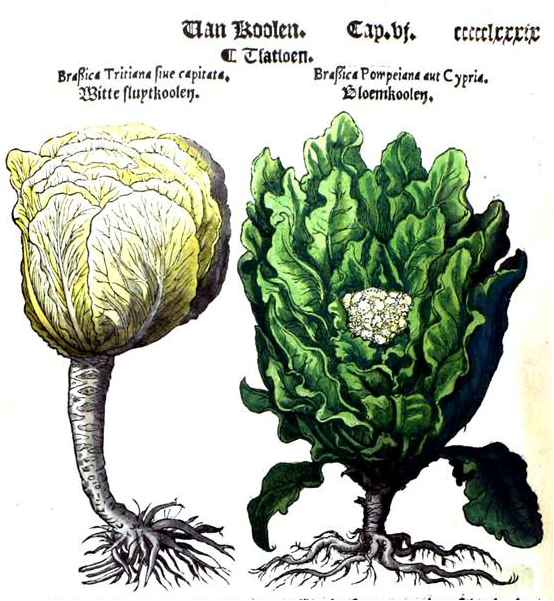
Brassica Pompeiana aut Cypria and Brassica Tritiana as drawn by Dutch botanist Rembert Dodoens
https://leesmaar.nl/cruijdeboeck/deel5/capitel006.htm
https://leesmaar.nl/cruijdeboeck/deel5/capitel006.htm
The name brassica Pompēiāna was, however, definitely in use for the cauliflower in the 16th century, as shown by the drawing and description in Dutch botanist Rembert Dodoens’1554 Cruydtboeck (`Book of Herbs’), which was a standard reference for two centuries and, in the author’s lifetime, the most translated book in Europe after the Bible. In the illustration above, the cauliflower is paired with `brassica Tritiana’, a name presumably adapted from Pliny’s Tritiānum, a brassica/caulis variety which is listed along with the Pompēiānum in the same chapter of Naturalis Historia. Dodoens was thus probably consciously following Pliny but mis-identifying the plant referred to. The modern cauliflower in fact probably developed only after the classical period with the Aegean/Eastern Mediterranean as one possible area of origin, as is suggested by the use of Cypria (`from Cyprus’). The earliest certain reference to the vegetable is by a 12th century Arab writer who uses the modern Arabic name for it. For more informationsee the Generic Resources article referred to above and Maggioni’s thesis (https://pub.epsilon.slu.se/12424/1/maggioni_l_150720.pdf especially page 50-51)
The English word `cauliflower’ derives from the Italian cavoli fiori (`flowered cabbages’), which itself comes from Latin caulis (stalk, cabbage) and flōs. Back-formation has produced the alternative Latin terms cauliflōra (included in Morgan-Owens) and caulis flōridus (listed in the Vatican’s neo-Latin dictionary). The Vatican also recomends brassica botryōdēs (`cabbage shaped like a grape-cluster’), which echoes the modern botanical name Brassica oleacea botrytis. Because caulis in classcal times was also an informal term for penis (see the warning at http://latindiscussion.com/forum/latin/in-cauliflower-we-trust.605/), we are safer chosing between Pompeiāna and botryōdēs, with the former supported by several centuries of neo-Lain usage, even if it originally rested on a mis-interpretation of Pliny. Let us continue, therefore, to place our trust in brassica Pompēiānā.
We discussed our summer activities, using as a basis the bilingual dialogue given below. Eugene was on an extensive block of accumulated leave during which he and Jesse spent two weeks in Italy, visting among other places Rōma and Flōrentia. His Latin account included the word commeātus, which John had not realised could mean `leave’ as well as `going to and fro’ or `passage’. In fact, Liddell & Scott give more examples for that meaning than any of the others.
Tanya mentioned her children going skiing in Australia, which, of course, has its winter in the northern summer.The Finnish editors of Nunti Latini use scrīda, scrīdēre, scrīdātiō, scriātor/-trix for `ski (noun), to ski, skiing and skier respectively, deriving the words from the first element of the medieval Latin ethnonym Scrīdifinnī , which perhaps referred to the Lapps in the far north and meant `skiing Finns’ (cf. the Old Norse word skríða (to slither, to ski) as explained at https://www.reddit.com/r/AskHistorians/comments/9qiy8i/who_were_the_screnfenni_people/ Many neo-Latinists use narta, nartāre, nartātiō and nartātor but the original Sami word narta actually means `sled’ (see the Latin essay at https://septentrio.uit.no/index.php/nordlit/article/download/3174/3043
The English word `cauliflower’ derives from the Italian cavoli fiori (`flowered cabbages’), which itself comes from Latin caulis (stalk, cabbage) and flōs. Back-formation has produced the alternative Latin terms cauliflōra (included in Morgan-Owens) and caulis flōridus (listed in the Vatican’s neo-Latin dictionary). The Vatican also recomends brassica botryōdēs (`cabbage shaped like a grape-cluster’), which echoes the modern botanical name Brassica oleacea botrytis. Because caulis in classcal times was also an informal term for penis (see the warning at http://latindiscussion.com/forum/latin/in-cauliflower-we-trust.605/), we are safer chosing between Pompeiāna and botryōdēs, with the former supported by several centuries of neo-Lain usage, even if it originally rested on a mis-interpretation of Pliny. Let us continue, therefore, to place our trust in brassica Pompēiānā.
We discussed our summer activities, using as a basis the bilingual dialogue given below. Eugene was on an extensive block of accumulated leave during which he and Jesse spent two weeks in Italy, visting among other places Rōma and Flōrentia. His Latin account included the word commeātus, which John had not realised could mean `leave’ as well as `going to and fro’ or `passage’. In fact, Liddell & Scott give more examples for that meaning than any of the others.
Tanya mentioned her children going skiing in Australia, which, of course, has its winter in the northern summer.The Finnish editors of Nunti Latini use scrīda, scrīdēre, scrīdātiō, scriātor/-trix for `ski (noun), to ski, skiing and skier respectively, deriving the words from the first element of the medieval Latin ethnonym Scrīdifinnī , which perhaps referred to the Lapps in the far north and meant `skiing Finns’ (cf. the Old Norse word skríða (to slither, to ski) as explained at https://www.reddit.com/r/AskHistorians/comments/9qiy8i/who_were_the_screnfenni_people/ Many neo-Latinists use narta, nartāre, nartātiō and nartātor but the original Sami word narta actually means `sled’ (see the Latin essay at https://septentrio.uit.no/index.php/nordlit/article/download/3174/3043
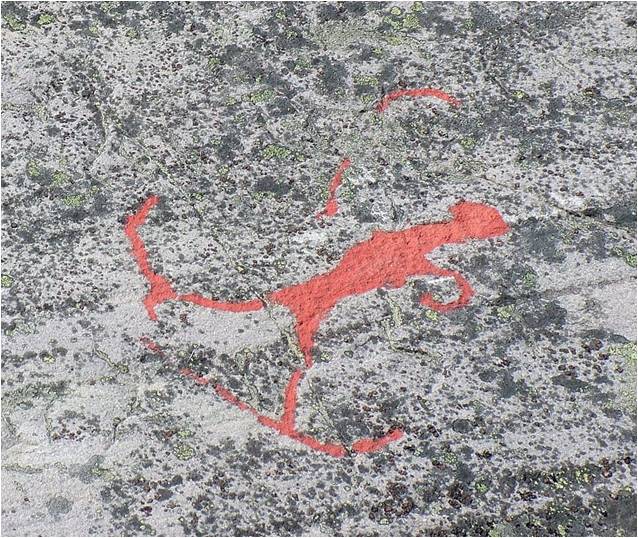
Rock-carving from Norway (1000 B.C.) showing skier hunting with bow and arrow
https://en.wikipedia.org/wiki/History_of_skiing#/media/File:Alta_Felszeichnung_Elch_und_Ski_(cropped).jpg
https://en.wikipedia.org/wiki/History_of_skiing#/media/File:Alta_Felszeichnung_Elch_und_Ski_(cropped).jpg
Tanya herself had been working through the summer on her Master’s degree in psychology. One of her projects is an investigaon into verbs which can take both contents and container as their object, as, for example, `load the truck with boxes’ alongside `load boxes into the truck.’ These are sometimes known as Pinker verbs because the Chomskian linguist Stephen Pinker is particularly prominent in studying them. Pinker is better known to the general public for works like The Language Instinct, The Better Angels of our Natures, and, most recently, Enlightenment Now. The latter two books aegue that, despite current gloom and doom, life has been getting steadily better over recent centuries.
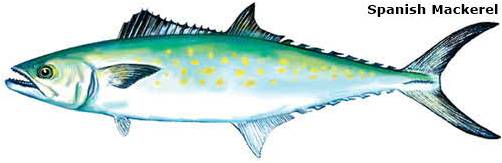
Malcolm had been in the UK, where he fished for Spanish mackerel (scomberomorīnī from the zoological name for this segment of the Scombridae family, which includes tunas as well as mackerels; scomber, scombrī m is classical Latin for mackerel in general)). The Latin for `to fish’ is piscor, -ārī, -ātus sum, which seems to be intransitive, whilst `fish for’ is expiscor, though examples from classical literatiure use this figuratively (`fish out information’ etc.) rather than literally. As in Hong Kong, Malcolm also took part in Quiz Nights (certāmina inquaesitoria?) as wel as indulging in our usual habit of procrastination (prōcrāstināre).
Malcolm had been in the UK, where he fished for Spanish mackerel (scomberomorīnī from the zoological name for this segment of the Scombridae family, which includes tunas as well as mackerels; scomber, scombrī m is classical Latin for mackerel in general)). The Latin for `to fish’ is piscor, -ārī, -ātus sum, which seems to be intransitive, whilst `fish for’ is expiscor, though examples from classical literatiure use this figuratively (`fish out information’ etc.) rather than literally. As in Hong Kong, Malcolm also took part in Quiz Nights (certāmina inquaesitoria?) as wel as indulging in our usual habit of procrastination (prōcrāstināre).
http://www.foodreference.com/html/art-spanish-mackerel-7806.html
Whilst reading lines from Book II of the Aeneid, we discussed the weak nature of the consonant `h’, which was ignored completely in versification. John pointed out tht the sound had by Virgil’s time become virtually silent in daily conversation among the uneducated and that this was the reason it does not occur in modern Romance languages (although it may still be indicated in the spelling) and why speakers of these languages have problems with the `h’ in English. Tanya commented on how her French classmates on a German course had not simply omitted `h’ in their pronunciation but sometimes actually inserted it unnecessarily. For example, her classmates regularly pronounced ein Hund (a dog) as `hein Und’ This might be explained by their not being able to hear the sound but knowing how to make it and then misremembering which words to apply it to.
As in many English-speaking societies (think of Henry Pickering and Eliza Dolittle in `My Fair Lady’), the proper use of `h’ was considered a mark of educated status, with the added Roman complication that the correct deployment of the strongly apirated `k’ sound, representd in Geek by the letter χ and in Latin by `ch’ was another sign of linguistic sophistication. A well-known poem of Catullus (c.84 – 54B.C.) mocks a poseur who overdoes things in his anxiety not to drop his `h’s
CATULLUS 84
As in many English-speaking societies (think of Henry Pickering and Eliza Dolittle in `My Fair Lady’), the proper use of `h’ was considered a mark of educated status, with the added Roman complication that the correct deployment of the strongly apirated `k’ sound, representd in Geek by the letter χ and in Latin by `ch’ was another sign of linguistic sophistication. A well-known poem of Catullus (c.84 – 54B.C.) mocks a poseur who overdoes things in his anxiety not to drop his `h’s
CATULLUS 84
Chommoda dīcēbat, si quandō commoda vellet "Hadvantages" Arrius was saying whenever he wished to say advantages
dīcere, et Ī-īnsidiās Arrius hīnsidiās. And ambush he was saying "hambush,"
et tum mīirificē spērabāt sē esse locūtum, And then he was hoping that he had spoken wonderfully
cum quantum poterat dīxerat hīnsidiās. When he said "hambush" as much as he was able,
Crēdō, sīc māter, sīc līber avunculus eius, I believe, thus his mother, thus his free uncle,
sīc māternus avus dīxerat atque avia. Thus his maternal grandfather and grandmother had spoken.
Hōc missō in Syriam requiērant omnibus aurēs:With this man having been sent into Syria, the ears of all had rested:
audībant eadem haec lēniter et leviter, They were hearing the same thing more softly and more lightly,
nec sibi postillā metuēbant tālia verba, Nor afterwards were they themselves fearing such words,
cum subitō affertur nūntius horribilis, When suddenly the horrible message is brought that:
Īoniōs fluctūs, postquam illūc Arrius īsset, The Ionian waves, after Arrius had gone there,
iam nōn Īoniōs esse sed Hīoniōs. Were now no longer Ionian but "Hionian."
The phrase līber avunculus (`free (maternal) uncle’) implies that his mother’s other brothers were still slaves. The Ionian Sea stretches south from the `heel’ of the Italy peninsula, bounded on the west by Italy and Sicily on the east by Greece. Hīonius is presumably a pun on the Greek adjective χιονέους (chioneus), `snowy’, suggesting both the supposedly chilling effect of Arrius’s pronunciation and the coming of winter, when sailing in the Mediterranean was dangerous.
Mention was made of the Bloomberg tablets, a collection of Latin correspondence on wooden tablets which was discovered during the excavation for the foundations ofthe finance company’s new European headquarters in London. The tablets include the earliest (57 B.C.) dated Latin writing to have been found in Britain and are planned to be put in display in a museum within the building. For further details, see https://linguae.weebly.com/londinium.html, which incudes a link to a lecture on the discovery by the man who did the decipherment, Roger Tomlin.
dīcere, et Ī-īnsidiās Arrius hīnsidiās. And ambush he was saying "hambush,"
et tum mīirificē spērabāt sē esse locūtum, And then he was hoping that he had spoken wonderfully
cum quantum poterat dīxerat hīnsidiās. When he said "hambush" as much as he was able,
Crēdō, sīc māter, sīc līber avunculus eius, I believe, thus his mother, thus his free uncle,
sīc māternus avus dīxerat atque avia. Thus his maternal grandfather and grandmother had spoken.
Hōc missō in Syriam requiērant omnibus aurēs:With this man having been sent into Syria, the ears of all had rested:
audībant eadem haec lēniter et leviter, They were hearing the same thing more softly and more lightly,
nec sibi postillā metuēbant tālia verba, Nor afterwards were they themselves fearing such words,
cum subitō affertur nūntius horribilis, When suddenly the horrible message is brought that:
Īoniōs fluctūs, postquam illūc Arrius īsset, The Ionian waves, after Arrius had gone there,
iam nōn Īoniōs esse sed Hīoniōs. Were now no longer Ionian but "Hionian."
The phrase līber avunculus (`free (maternal) uncle’) implies that his mother’s other brothers were still slaves. The Ionian Sea stretches south from the `heel’ of the Italy peninsula, bounded on the west by Italy and Sicily on the east by Greece. Hīonius is presumably a pun on the Greek adjective χιονέους (chioneus), `snowy’, suggesting both the supposedly chilling effect of Arrius’s pronunciation and the coming of winter, when sailing in the Mediterranean was dangerous.
Mention was made of the Bloomberg tablets, a collection of Latin correspondence on wooden tablets which was discovered during the excavation for the foundations ofthe finance company’s new European headquarters in London. The tablets include the earliest (57 B.C.) dated Latin writing to have been found in Britain and are planned to be put in display in a museum within the building. For further details, see https://linguae.weebly.com/londinium.html, which incudes a link to a lecture on the discovery by the man who did the decipherment, Roger Tomlin.
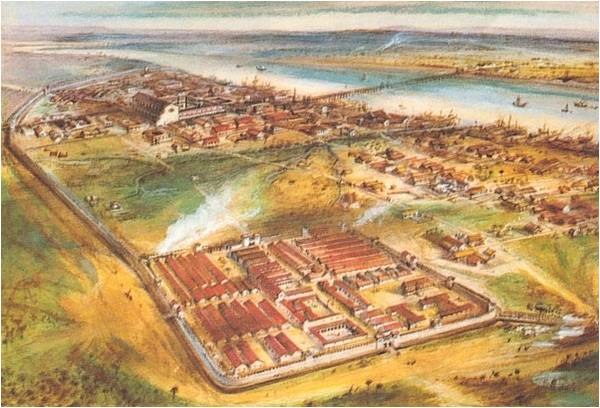
Londinium
There was also a discussion on the easiest Roman author to tackle after completion of a basic course. If you want to focus on just one author then Julius Caesar probably remains the logical choice, though the contents will not attract those who do not enjoy military history. An alterative is to read a selection of pieces from different writers, such as the Wheelock or Oxford antholgies. For more details see the handout `After the Basics’, now available on the Linguae site at https://linguae.weebly.com/after-the-basics.html
We aso briefly touched on the history of Latvia, the Baltic country Tanya’s mother comes from, and whose border with the Soviet Union was demarcated after independence in 1918 by her grandfather. The name Latvia derived from that of the Latgalians, who together with three oither Baltic Indo-European tribes, the Couronians, Selonians and Semigallians, plus the Finnic-speaking Livonians, united to form the Latvian people (https://en.wikipedia.org/wiki/Latvia) We discussed the geographical and linguistic complexities at length in March and October 2013 and again in April 2014 (see QUESTIONS ARISING for those months at https://linguae.weebly.com/circulus-latinus-honcongensis.html).
Minor points of Latin usage were also discussed . An Australian Latinist John sometimes meets up with in the Skype Locūtōrium (chatroom) uses experimentum for `essay’ but the meaning of this in classical Latin is `experiment’ or `experience’ and so tractātus (-, ūs, m) is definitely better. The Latin for New Zealand should probably be Nova Zēlandia, though the Latin name bestowed on it by Dutch cartographers in 1645 was Nova Zeelandia, from the Zeeland province of the Netherlands. The English `New Zealand’ is actually James Cook’s translation of the original Latin (see https://en.wikipedia.org/wiki/New_Zealand#Etymology) Prompted by a call from the partner of one of us, we tried to come up ith the Latin for `Don’t scratch your backside with the hand you touch the dice with’. John suggested aleam tangente manū nōlī culum rādere. After the session was over he decided nōlī eādem manū aleam tangere atque culum rādere would be better..
Finally, Eugene had thoughtfully compiled and brought to the meeting a list of Latin names for the various Indian dishes. This will eventually be amalgamated with the `CIRCULUS VOCABULARY’ document at present in preparation
Dē feriīs aestīvīs
Quid fēcistī in feriīs aestīvīs? Dē Hongcongō excessistī? What did you do in the summer holidays? Did you
leave Hong Kong ?
Ita vērō. Ad continentem/Britanniam/Austrāliam/ Yes, I did. I went to the mainland/Britain/Australia
Americam/Īnsulās Philippīnās…… the Philippines…..
īvī ut familiārēs visitārem. Diēs iucundōs agēbam to visit my relatives. I had a good time
sed semper laetus sum cum Honcongum revertar but I’m always glad when I get back to Hong Kong
AdEurōpam/Iapōniam/continentem/Americam ut I went to Europe/Japan/the mainland/America as a
itinerātor adiī. tourist
Minimē. Honcongī mānsī No. I stayed in Hong Kong,
In Nepālō et Indiā in rēbus academicīs versātus sum I was involved in academic activities in Nepal and India
Quid ibi/hīc fēcistī? What did you do there/here?
In montibus ambulāvī I walked in the hills.
In ōra māris apricātus sum et natāvī I sunbathed on the beach and swam.
Mūsaea et aulās antīquās īnspexī I looked at museums and old palaces
Parietinās Rōmānās effōdī I excavated Roman remains
Urbēs historicās vīsitāvī I visited historic cities
Interdiū scrīdāvī et nocte in tabernā bibī I skied during the day and drank in the bar at night
Omnēs caraōcicē cantandō terruī I frightened everybody with my karaoke singing
Elephantōs agitāvī I hunted elephants
Ut semper labōrāvī I worked as usual
Ad gradum suscipiendum studuī I studied for my degree
In Archīvō Natiōnālī in Novī Deliī dē terrae I did research in the National Archives in New Delhi
mōtū annī millēsimō nōnagentēsimō trīgintēsimō on the earthquake of 1934
quartō investigātiōnēs fēcī
Conventum academicum participāvī I attended an academic conference
Trumpī fautōrēs necnōn Brexitōrēs cautē ēvītāvī I carefully avoided Trunp supporters and Brexiters
In spēluncīs ūrīnābar I went cave diving
Quāle erat caelum? What was the weather like?
Semper pluit It always rained.
Variābat It was changeable
Sōl splendidē lūcēbat There was splendid sunshine.
AENEID 274-297
ei mihi, quālis erat, quantum mūtātus ab illō vulneraque illa gerēns, quae circum plūrima mūrōs
Hectore quī redit exuviās indūtus Achillī 275 accēpit patriōs. ultrō flēns ipse vidēbar
vel Danaum Phrygiōs iaculātus puppibus ignīs! compellāre virum et maestās exprōmere vōcēs:
squālentem barbam et concrētos sanguine crīnīs
TRANSLATION
To my sorrow, what a state he was in, how much changed from the Hector who returned clothed in spoils from Achilles or after hurling Phrygian fire onto the Danaäns’ ships! He bore a filthy beard and hair clotted with blood as well as those wounds he received in very great quantity around the walls of his ancestors. For my part, I seemed to address the man and to utter sad words:
NOTES
274: ei oh! alas! quālis, -e of what sort
quantum how much. mūtō, -āre, mūtāvī, mūtātum change.
275:redeō, redīre, redīī/redīvī, reditum return.
exuviae, -ārum f. pl. spoils, things stripped off (Hector put on Achilles’ armour after he had killed Achilles’ friend Patroclus who had been wearing it) induō, -ere, induī, indūtum wear, put on. The perfect participle would normally be passive in meaning (`having been put on’) but Virgil uses it here with active sense (`having put on’) as if the verb were a deponent one.
Achillī: this is genitive with a second declension ending, even though the name is normally a 3rd declension noun: Achilles, -is.
276: Phrygius, a, -um Phrygian, referring properly to Phrygia in central Asia Minor (see map in the PHILEMON ET BAUCIS Powerpoint) but here and elsewhere Virgil uses`Phrygian’ as an alternative name for the Trojans because the two peoples were close allies.
puppis, puppis f stern, ship
iaculor, -ārī, iaculātus sum hurl ignis, ignis m fire (as usual, Virgil uses the –īs ending for the accusative plural of this `SeXy’ (i-stem) noun).
This line refers to the attack on the Greek ships which Hector led while Achilles, angered at how he had been treated by Agamemnon, was staying out of the war. After the Trojan success, Achilles agreed to let his friend Patroclus return to the fight
277: squaleō, squalēre, squaluī, be dirty. barba, -ae f beard. sanguis, sanguinis m blood. concrētus, -a, -um stiff.
crīnis, crīnis m hair.
278 vulnus, vulneris n wouund. gerō, -ere, gessī, gestum wear, bear (the present participle gerēns agrees with Hector, the subject understood in the verb erat in line 274)
circum around mūrus, -ī m wall.
The `very many wounds’ might be ones from earlier fighting, or those Hector received as he was dragged around the city behind Achilles’s chariot.
279: accipio, -er, accēpī, acceptum receive. patrius, -a, -um of one’s father(s), ancestral. ultrō of one’s own accord, conversely. The meaning is that Aeneas himself took the initiative rather than wait for Hector to speak. fleō, flēre, flēvī, flētum weep.
ipse: this pronoun means `self’ (emphatic, not reflexive) and, when accompanied by a verb in the 1st person singular, can be translated `I myself’.
vidēbar: here, as often, the meaning is `I seemed’ rather than `I was seen’
280: compellō, -āre, -āvī, -ātum. address, start to speak to.
vir, virī m man, male exprōmō, -ere, exprompsī, expromptum bring out, send out vōx, vōcis f voice (plural here means `words’ or `speech’).
«ō lūx Dardaniae, spēs ō fīdissima Teucrum, 281 fūnera, post variōs hominumque urbisque labōrēs
quae tantae tenuēre morae? quibus Hector ab ōrīs dēfessī aspicimus! quae causa indigna serēnōs
exspectāte venīs? ut tē post multa tuōrum foedāvit vultūs? aut cūr haec vulnera cernō?’ 286
TRANSLATION
`O light of Dardania, o most reliable hope of the Teucrians, what has delayed you so long? From what shores do you come, Hector, you who we’ve been waiting for. In what a state do we see you, when we are exhausted after the deaths of many of your people and after the different troubles suffered by individuals and by the city! What undeserved cause has disfigured your calm face? And why do I see these wounds?’
NOTES
281: lūx, lūcis f light. Dardania, -ae f Troy, the Dardanelles (often known in ancient times as the Hellespont, this was the strait leading from the Aegean into the Sea of Marmora, beyond which lies the Black Sea. Dardanus, the son of Jupiter and Electra, was the ancestor of the Trojan royal family) spēs, speī f hope fīdus, -a, -um fathful, reliable. Teucrum: of the Trojans (Teucer was an early king of Troy).
282: tantus, -a, -um so great. mora, -ae f delay ōra, -ae f shore.
tenuēre: abbreviation of tenuērunt (they held/detained).
283: exspecto, -āre, -āvī, -ātum expect, wait for. veniō, -īre, vēnī come. ut how (introducing an exclamation).
exspectāte: the masculine vocative singular of the perfect participle - `you who we’ve been waiting for.’
tuōrum: adjective used as a noun - `of your people’
284: fūnus, fūneris n death. varius, -a, -um various, diverse. homō, hominis m man, human being. urbs, urbis f city. labor, labōris m. trouble, work (the connection between the two meanings is that hard work can be a lot of trouble!)
285: dēfessus, -a, -um. exhausted. aspiciō, aspicere, aspexī, aspectum look at, behold. indignus, -a, -um unworthy, undeserved, serēnus, -a, -um serene, untroubled
286: foedō, -āre, -āvī, ātum pollute, disfigure. vultus, vultūs m face, expression (often used in the plural with singular meaning). vulnus, vulneris n wound. cernō, -ere, crēvī, crētum perceive.
defessī aspicimus: the adjective is nominative plural, agreeing with the `we’ inside the verb.
Word order reinforce meaning in 285-286 with exhaustion (dēfessī) and disfigurement (foedāvit) at their starts.
When telling this whole story to Dido, Aeneas is perfectly aware that Hector is dead but in his dream he thinks of him as only having been absent for some unknown reason. Perhaps Aeneas’s lack of understanding in his dream is intended to contrast with the heroic leader he later becomes.
quaesīvī, quaesītum. look for, ask. vānus, -a, -um pointless, useless. moror, morārī, morātus sum delay, stop for, pay attention to.
ille nihil, nec mē quaerentem vāna morātur, hostis habet mūrōs; ruit altō ā culmine Troia. 290
sed graviter gemitūs īmō dē pectore dūcens, sat patriae Priamōque datum: sī Pergama dextrā
`heu fuge, nāte deā, tēque hīs’ ait `ēripe flammīs dēfendī possent, etiam hāc dēfēnsa fuissent.
TRANSLATION
He made no reply and paid no attention to my pointless questions, but groaned heavily from the depth of his breast and said `O flee, son of the goddess, and get yourself away from these flames. The enemy has our walls; Troy has fallen from its high perch. Enough has been given to our country and to Priam. If Pergama could be defended by the right-hand, it would also have been defended by this hand of mine.
NOTES
287: ille nihil: a verb like respondit has to be understood after these words.
Aeneas again belittles himself as he emphasizes how Hector gets straight to the point without bothering about his own pointless questions
288: graviter heavily gemitus, -ūs m groan, sigh īmus, -a, -um bottom of pectus, pectoris n breast.
Notice the alliteration in graviter gemitūs. The strong clash at the beginning of the line between the ictus (first syllable of the foot) and natural word stress reflects the troubled situation:
ˉ ˘ ˘ / ˉ ˘ ˘ / ˉ ˉ
sed GRAviter GEmitūs Ī
289: heu alas (an old-fashioned word in English so here perhaps better translated as `Disaster!’) fugo, fugere, fūgī flee, escape. ēripiō, ēripere, ērēpi, ēreptum snatch away, take away. flamma, -ae f flame (the Greeks are already setting Troy on fire)
nāte deā: `you who were born from a goddess’ or `son of the goddess’. Aeneas is often addressed like this because is mother is Venus. nāte is the masculine vocative singular of the perfect participle nātus, -a, -um from the deponent verb nascor, nascī (be born) and, as often in Virgil) the ablative deā expresses the idea of `from’ without a preposition.
hīs flammīs: ablative again expressing from.
290: hostis, -is m/f enemy mūrus, -ī m wall. altus, -a,
-um high culmen, culminis n summit, top
ruit: here meaning `falls’ rather than `rushes’
291: sat (abbrev. of satis) enough patria, -ae f native land
Priāmus, -ī m king of Troy and father of Hector dō, dare, dedī, datum give Pergama, -ōrum n.pl. the citadel of Troy (often used as another name for the whole city) dextra, -ae f right-hand (dextrā here means `by force’, `by fighting’ as the sword was held in the right-hand)
sat..datum (literally `enough has been given’) means here, `you have done all that you could’
292: dēfendō, -ere, dēfendī, dēfēnsum defend (here dēfendī is the passive infinitive – to be defended) etiam also, even
possent: plural agreeing with the subject Pergama and imperfect subjunctive for imagining an unreal present.
hāc is short for hāc dextrā (`by this (i.e.Hector’s own) right-hand’)
dēfēnsa fuissent = `would have been defended’ (the pluperfect subjunctive is normally formed with the imperfect essent and this use of the pluperfect of the auxiliary verb makes defence seem especially impossible.
sacra suōsque tibī commendat Troia penātīs; sīc ait et manibus vittās Vestamque potentem
hōs cape fātōrum comitēs, hīs moenia quaere aeternumque adytīs effert penetrālibus ignem.
magna pererrātō statuēs quae dēnique pontō.’295
TRANSLATION
Troy entrusts to you its sacred objects and its state gods; take them as sharers in your destiny, seek great walls for them which you will finally set up after wandering over the sea.’ Thus he speaks and brings out in his hands powerful Vesta with her headbands and the eternal fire from the innermost sanctuary.
NOTES
293:sacer, sacra, sacrum sacred (sacra (n.pl) = sacred objects) commendō, - āre, commendāvī, commendātum recommend, entrust penātēs, pēnātium m pl gods of the state, household gods.(Virgil as usual employs the –īs ending for the accusative plural of an i-stem 3rd declension noun).
suōsque = and her own Although grammatically agreeing only with penātēs, the adjective suōs can logically be taken with sacra also. Note the alliteration in sacra suōs..
294: capiō, -ere, cēpī, captum take, capture, seize come comes, comitis m/f companion, partner quaerō, -ere, quaesīvī, quaesītum search for
hōs cape fātōrum comitēs: literally `take these (i.e the Penates etc.) as comrades of the fates’, i.e. as sharers in your own fate. hīs is dative plural (`for them’)
295: pererrō, -āre. wererrāvī, pererrātum wander across
statuō, -ere, statuī, statūtum set up dēnique finally pontus, -ī m sea
pererrātō..pontō: ablative absolute
296: sīc thus ait he/she says manus, -ūs f hand vitta, -ae f headband. Vesta, -ae f Roman goddess of the hearth (here the meaning must be a statue of Vesta) potēns, potentis powerful.
vittās Vestamque; `bands and Vesta’, but the bands were presumably wound round the statue.
297: aeternus, -a, -um eternal adytum, -ī n. inner sanctuary (here plural for singular) penetrāle, -is inner, innermost efferō, efferre, extulī, ēlātum carry/bring out
We aso briefly touched on the history of Latvia, the Baltic country Tanya’s mother comes from, and whose border with the Soviet Union was demarcated after independence in 1918 by her grandfather. The name Latvia derived from that of the Latgalians, who together with three oither Baltic Indo-European tribes, the Couronians, Selonians and Semigallians, plus the Finnic-speaking Livonians, united to form the Latvian people (https://en.wikipedia.org/wiki/Latvia) We discussed the geographical and linguistic complexities at length in March and October 2013 and again in April 2014 (see QUESTIONS ARISING for those months at https://linguae.weebly.com/circulus-latinus-honcongensis.html).
Minor points of Latin usage were also discussed . An Australian Latinist John sometimes meets up with in the Skype Locūtōrium (chatroom) uses experimentum for `essay’ but the meaning of this in classical Latin is `experiment’ or `experience’ and so tractātus (-, ūs, m) is definitely better. The Latin for New Zealand should probably be Nova Zēlandia, though the Latin name bestowed on it by Dutch cartographers in 1645 was Nova Zeelandia, from the Zeeland province of the Netherlands. The English `New Zealand’ is actually James Cook’s translation of the original Latin (see https://en.wikipedia.org/wiki/New_Zealand#Etymology) Prompted by a call from the partner of one of us, we tried to come up ith the Latin for `Don’t scratch your backside with the hand you touch the dice with’. John suggested aleam tangente manū nōlī culum rādere. After the session was over he decided nōlī eādem manū aleam tangere atque culum rādere would be better..
Finally, Eugene had thoughtfully compiled and brought to the meeting a list of Latin names for the various Indian dishes. This will eventually be amalgamated with the `CIRCULUS VOCABULARY’ document at present in preparation
Dē feriīs aestīvīs
Quid fēcistī in feriīs aestīvīs? Dē Hongcongō excessistī? What did you do in the summer holidays? Did you
leave Hong Kong ?
Ita vērō. Ad continentem/Britanniam/Austrāliam/ Yes, I did. I went to the mainland/Britain/Australia
Americam/Īnsulās Philippīnās…… the Philippines…..
īvī ut familiārēs visitārem. Diēs iucundōs agēbam to visit my relatives. I had a good time
sed semper laetus sum cum Honcongum revertar but I’m always glad when I get back to Hong Kong
AdEurōpam/Iapōniam/continentem/Americam ut I went to Europe/Japan/the mainland/America as a
itinerātor adiī. tourist
Minimē. Honcongī mānsī No. I stayed in Hong Kong,
In Nepālō et Indiā in rēbus academicīs versātus sum I was involved in academic activities in Nepal and India
Quid ibi/hīc fēcistī? What did you do there/here?
In montibus ambulāvī I walked in the hills.
In ōra māris apricātus sum et natāvī I sunbathed on the beach and swam.
Mūsaea et aulās antīquās īnspexī I looked at museums and old palaces
Parietinās Rōmānās effōdī I excavated Roman remains
Urbēs historicās vīsitāvī I visited historic cities
Interdiū scrīdāvī et nocte in tabernā bibī I skied during the day and drank in the bar at night
Omnēs caraōcicē cantandō terruī I frightened everybody with my karaoke singing
Elephantōs agitāvī I hunted elephants
Ut semper labōrāvī I worked as usual
Ad gradum suscipiendum studuī I studied for my degree
In Archīvō Natiōnālī in Novī Deliī dē terrae I did research in the National Archives in New Delhi
mōtū annī millēsimō nōnagentēsimō trīgintēsimō on the earthquake of 1934
quartō investigātiōnēs fēcī
Conventum academicum participāvī I attended an academic conference
Trumpī fautōrēs necnōn Brexitōrēs cautē ēvītāvī I carefully avoided Trunp supporters and Brexiters
In spēluncīs ūrīnābar I went cave diving
Quāle erat caelum? What was the weather like?
Semper pluit It always rained.
Variābat It was changeable
Sōl splendidē lūcēbat There was splendid sunshine.
AENEID 274-297
ei mihi, quālis erat, quantum mūtātus ab illō vulneraque illa gerēns, quae circum plūrima mūrōs
Hectore quī redit exuviās indūtus Achillī 275 accēpit patriōs. ultrō flēns ipse vidēbar
vel Danaum Phrygiōs iaculātus puppibus ignīs! compellāre virum et maestās exprōmere vōcēs:
squālentem barbam et concrētos sanguine crīnīs
TRANSLATION
To my sorrow, what a state he was in, how much changed from the Hector who returned clothed in spoils from Achilles or after hurling Phrygian fire onto the Danaäns’ ships! He bore a filthy beard and hair clotted with blood as well as those wounds he received in very great quantity around the walls of his ancestors. For my part, I seemed to address the man and to utter sad words:
NOTES
274: ei oh! alas! quālis, -e of what sort
quantum how much. mūtō, -āre, mūtāvī, mūtātum change.
275:redeō, redīre, redīī/redīvī, reditum return.
exuviae, -ārum f. pl. spoils, things stripped off (Hector put on Achilles’ armour after he had killed Achilles’ friend Patroclus who had been wearing it) induō, -ere, induī, indūtum wear, put on. The perfect participle would normally be passive in meaning (`having been put on’) but Virgil uses it here with active sense (`having put on’) as if the verb were a deponent one.
Achillī: this is genitive with a second declension ending, even though the name is normally a 3rd declension noun: Achilles, -is.
276: Phrygius, a, -um Phrygian, referring properly to Phrygia in central Asia Minor (see map in the PHILEMON ET BAUCIS Powerpoint) but here and elsewhere Virgil uses`Phrygian’ as an alternative name for the Trojans because the two peoples were close allies.
puppis, puppis f stern, ship
iaculor, -ārī, iaculātus sum hurl ignis, ignis m fire (as usual, Virgil uses the –īs ending for the accusative plural of this `SeXy’ (i-stem) noun).
This line refers to the attack on the Greek ships which Hector led while Achilles, angered at how he had been treated by Agamemnon, was staying out of the war. After the Trojan success, Achilles agreed to let his friend Patroclus return to the fight
277: squaleō, squalēre, squaluī, be dirty. barba, -ae f beard. sanguis, sanguinis m blood. concrētus, -a, -um stiff.
crīnis, crīnis m hair.
278 vulnus, vulneris n wouund. gerō, -ere, gessī, gestum wear, bear (the present participle gerēns agrees with Hector, the subject understood in the verb erat in line 274)
circum around mūrus, -ī m wall.
The `very many wounds’ might be ones from earlier fighting, or those Hector received as he was dragged around the city behind Achilles’s chariot.
279: accipio, -er, accēpī, acceptum receive. patrius, -a, -um of one’s father(s), ancestral. ultrō of one’s own accord, conversely. The meaning is that Aeneas himself took the initiative rather than wait for Hector to speak. fleō, flēre, flēvī, flētum weep.
ipse: this pronoun means `self’ (emphatic, not reflexive) and, when accompanied by a verb in the 1st person singular, can be translated `I myself’.
vidēbar: here, as often, the meaning is `I seemed’ rather than `I was seen’
280: compellō, -āre, -āvī, -ātum. address, start to speak to.
vir, virī m man, male exprōmō, -ere, exprompsī, expromptum bring out, send out vōx, vōcis f voice (plural here means `words’ or `speech’).
«ō lūx Dardaniae, spēs ō fīdissima Teucrum, 281 fūnera, post variōs hominumque urbisque labōrēs
quae tantae tenuēre morae? quibus Hector ab ōrīs dēfessī aspicimus! quae causa indigna serēnōs
exspectāte venīs? ut tē post multa tuōrum foedāvit vultūs? aut cūr haec vulnera cernō?’ 286
TRANSLATION
`O light of Dardania, o most reliable hope of the Teucrians, what has delayed you so long? From what shores do you come, Hector, you who we’ve been waiting for. In what a state do we see you, when we are exhausted after the deaths of many of your people and after the different troubles suffered by individuals and by the city! What undeserved cause has disfigured your calm face? And why do I see these wounds?’
NOTES
281: lūx, lūcis f light. Dardania, -ae f Troy, the Dardanelles (often known in ancient times as the Hellespont, this was the strait leading from the Aegean into the Sea of Marmora, beyond which lies the Black Sea. Dardanus, the son of Jupiter and Electra, was the ancestor of the Trojan royal family) spēs, speī f hope fīdus, -a, -um fathful, reliable. Teucrum: of the Trojans (Teucer was an early king of Troy).
282: tantus, -a, -um so great. mora, -ae f delay ōra, -ae f shore.
tenuēre: abbreviation of tenuērunt (they held/detained).
283: exspecto, -āre, -āvī, -ātum expect, wait for. veniō, -īre, vēnī come. ut how (introducing an exclamation).
exspectāte: the masculine vocative singular of the perfect participle - `you who we’ve been waiting for.’
tuōrum: adjective used as a noun - `of your people’
284: fūnus, fūneris n death. varius, -a, -um various, diverse. homō, hominis m man, human being. urbs, urbis f city. labor, labōris m. trouble, work (the connection between the two meanings is that hard work can be a lot of trouble!)
285: dēfessus, -a, -um. exhausted. aspiciō, aspicere, aspexī, aspectum look at, behold. indignus, -a, -um unworthy, undeserved, serēnus, -a, -um serene, untroubled
286: foedō, -āre, -āvī, ātum pollute, disfigure. vultus, vultūs m face, expression (often used in the plural with singular meaning). vulnus, vulneris n wound. cernō, -ere, crēvī, crētum perceive.
defessī aspicimus: the adjective is nominative plural, agreeing with the `we’ inside the verb.
Word order reinforce meaning in 285-286 with exhaustion (dēfessī) and disfigurement (foedāvit) at their starts.
When telling this whole story to Dido, Aeneas is perfectly aware that Hector is dead but in his dream he thinks of him as only having been absent for some unknown reason. Perhaps Aeneas’s lack of understanding in his dream is intended to contrast with the heroic leader he later becomes.
quaesīvī, quaesītum. look for, ask. vānus, -a, -um pointless, useless. moror, morārī, morātus sum delay, stop for, pay attention to.
ille nihil, nec mē quaerentem vāna morātur, hostis habet mūrōs; ruit altō ā culmine Troia. 290
sed graviter gemitūs īmō dē pectore dūcens, sat patriae Priamōque datum: sī Pergama dextrā
`heu fuge, nāte deā, tēque hīs’ ait `ēripe flammīs dēfendī possent, etiam hāc dēfēnsa fuissent.
TRANSLATION
He made no reply and paid no attention to my pointless questions, but groaned heavily from the depth of his breast and said `O flee, son of the goddess, and get yourself away from these flames. The enemy has our walls; Troy has fallen from its high perch. Enough has been given to our country and to Priam. If Pergama could be defended by the right-hand, it would also have been defended by this hand of mine.
NOTES
287: ille nihil: a verb like respondit has to be understood after these words.
Aeneas again belittles himself as he emphasizes how Hector gets straight to the point without bothering about his own pointless questions
288: graviter heavily gemitus, -ūs m groan, sigh īmus, -a, -um bottom of pectus, pectoris n breast.
Notice the alliteration in graviter gemitūs. The strong clash at the beginning of the line between the ictus (first syllable of the foot) and natural word stress reflects the troubled situation:
ˉ ˘ ˘ / ˉ ˘ ˘ / ˉ ˉ
sed GRAviter GEmitūs Ī
289: heu alas (an old-fashioned word in English so here perhaps better translated as `Disaster!’) fugo, fugere, fūgī flee, escape. ēripiō, ēripere, ērēpi, ēreptum snatch away, take away. flamma, -ae f flame (the Greeks are already setting Troy on fire)
nāte deā: `you who were born from a goddess’ or `son of the goddess’. Aeneas is often addressed like this because is mother is Venus. nāte is the masculine vocative singular of the perfect participle nātus, -a, -um from the deponent verb nascor, nascī (be born) and, as often in Virgil) the ablative deā expresses the idea of `from’ without a preposition.
hīs flammīs: ablative again expressing from.
290: hostis, -is m/f enemy mūrus, -ī m wall. altus, -a,
-um high culmen, culminis n summit, top
ruit: here meaning `falls’ rather than `rushes’
291: sat (abbrev. of satis) enough patria, -ae f native land
Priāmus, -ī m king of Troy and father of Hector dō, dare, dedī, datum give Pergama, -ōrum n.pl. the citadel of Troy (often used as another name for the whole city) dextra, -ae f right-hand (dextrā here means `by force’, `by fighting’ as the sword was held in the right-hand)
sat..datum (literally `enough has been given’) means here, `you have done all that you could’
292: dēfendō, -ere, dēfendī, dēfēnsum defend (here dēfendī is the passive infinitive – to be defended) etiam also, even
possent: plural agreeing with the subject Pergama and imperfect subjunctive for imagining an unreal present.
hāc is short for hāc dextrā (`by this (i.e.Hector’s own) right-hand’)
dēfēnsa fuissent = `would have been defended’ (the pluperfect subjunctive is normally formed with the imperfect essent and this use of the pluperfect of the auxiliary verb makes defence seem especially impossible.
sacra suōsque tibī commendat Troia penātīs; sīc ait et manibus vittās Vestamque potentem
hōs cape fātōrum comitēs, hīs moenia quaere aeternumque adytīs effert penetrālibus ignem.
magna pererrātō statuēs quae dēnique pontō.’295
TRANSLATION
Troy entrusts to you its sacred objects and its state gods; take them as sharers in your destiny, seek great walls for them which you will finally set up after wandering over the sea.’ Thus he speaks and brings out in his hands powerful Vesta with her headbands and the eternal fire from the innermost sanctuary.
NOTES
293:sacer, sacra, sacrum sacred (sacra (n.pl) = sacred objects) commendō, - āre, commendāvī, commendātum recommend, entrust penātēs, pēnātium m pl gods of the state, household gods.(Virgil as usual employs the –īs ending for the accusative plural of an i-stem 3rd declension noun).
suōsque = and her own Although grammatically agreeing only with penātēs, the adjective suōs can logically be taken with sacra also. Note the alliteration in sacra suōs..
294: capiō, -ere, cēpī, captum take, capture, seize come comes, comitis m/f companion, partner quaerō, -ere, quaesīvī, quaesītum search for
hōs cape fātōrum comitēs: literally `take these (i.e the Penates etc.) as comrades of the fates’, i.e. as sharers in your own fate. hīs is dative plural (`for them’)
295: pererrō, -āre. wererrāvī, pererrātum wander across
statuō, -ere, statuī, statūtum set up dēnique finally pontus, -ī m sea
pererrātō..pontō: ablative absolute
296: sīc thus ait he/she says manus, -ūs f hand vitta, -ae f headband. Vesta, -ae f Roman goddess of the hearth (here the meaning must be a statue of Vesta) potēns, potentis powerful.
vittās Vestamque; `bands and Vesta’, but the bands were presumably wound round the statue.
297: aeternus, -a, -um eternal adytum, -ī n. inner sanctuary (here plural for singular) penetrāle, -is inner, innermost efferō, efferre, extulī, ēlātum carry/bring out

.jpg)