| linguae |
|
Kusunda - Nepal's oldest language?
The Kusunda language is regarded by most linguists as an isolate - that is one which, like Basque in Europe, is unrelated to any other known language- although Merritt Reuhlen and his `long ranger' colleagues, who believe it is possible to trace language relationships back to the dawn of human history, have tried to link it to their postulated `Indo-Pacific' family, including languages spoken on the Andaman Islands and in Papua New Guinea (see Paul Whitehouse et al., `Kusunda: an Indo-Pacific Language of Nepal', Proceedings of the National Academy of Sciences, 101(15): 5692-5, 2004). The fullest account of the language currently available was David Watters 'Notes on Kusunda Grammar: A language isolate of Nepal.' Himalayan Linguistics Archive 3. 1-182', which can be downloaded from the Himalayan Linguistics site but in 2017 Uday Raj Aaley brought out a 2,500 -word Kusunda dictionary with an account of the tribe and its traditions. By 2018 there were believed to be only two remaining fluent speakers, one of whom is the subject of Sanjib Chaudhary's report uploaded to the Global Voices site on 11 November 2018 and accessed on 27 November. All pictures below are by the author except fpr one from the BBC report at the bottom of the page.
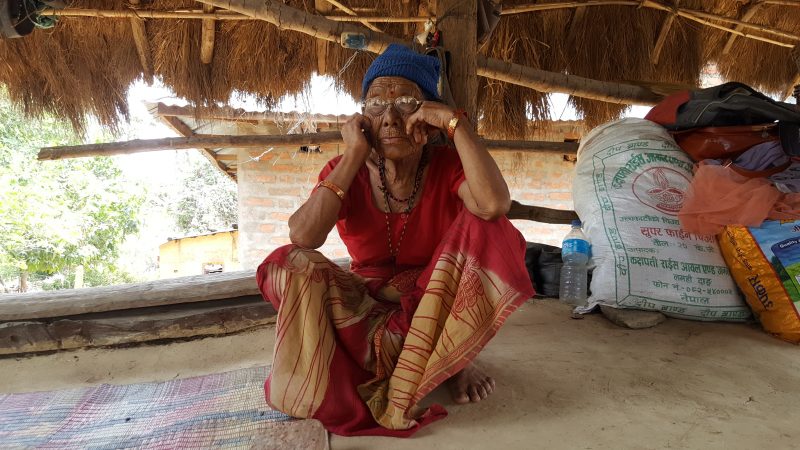
A conversation with Gyani Maiya Sen, one of the last speakers of a dying Nepali language
For years, people knew very little about the Kusunda language of western and central Nepal. The 2011 Census conducted by Nepal’s Central Bureau of Statistics puts the population of Kusundas, a forest tribe of western Nepal, at around 273. To learn more about the language and the culture of the Kusunda people, Global Voices spoke with Gyani Maiya Sen Kusunda — one of only two fluent speakers of the dying Kusunda language.
‘The kings of the forest’
It was hot and humid, the roads were empty, and not even the battery-powered Tuk-Tuk drivers were willing to offer us a ride. With heavy tripods, cameras and other filming equipment, we headed to Gyani Maiya Sen’s house in Kulmor village in Nepal’s Dang district. Gyani Maiya Sen Kusunda, in her early 80s, is one of the only two fluent speakers of the dying Kusunda language. The population of Kusundas is believed to be 273; however, field studies by researchers have shown only 150 of them dispersed in the Dang, Rolpa, Pyuthan, Arghakhanchi, and Surkhet districts of Nepal.
Kusundas have settled in villages after their forefathers spent their lives in jungles and caves as nomadic tribesmen. They would visit the villages only to beg alms, and many Kusundas still feel embarrassed to reveal their surname as they are still treated as ‘people from the jungle’. However, nowadays they have taken Thakuri surnames such as Shahi, Sen, and Khan — surnames connected with the ruling clan of Nepal. Kusundas claim themselves to be ban rajas, the kings of the forest.
[ Read more: Indigenous Nepali Language With Only Two Fluent Speakers Sees Pages of Hope in Newly Launched Dictionary ]
Kusunda language is an isolated language which means it is not related to any other languages in the world. Unfortunately, it is also defined by a younger generation, that has stopped speaking it — leaving the language to slowly fade out as the older generations pass away. Besides Gyani Maiya, her sister Kamala, in her early 50s, is another fluent speaker of the language from their community.
Uday Raj Aaley, a researcher devoted to reviving the Kusunda language, also speaks Kusunda language. However, Gyani Maiya fears whether her granddaughter Rakshya will ever speak her mother tongue and keep the tradition alive. When we met Gyani Maiya, she was busy peeling green mangoes together with her granddaughter. She was teaching her granddaughter to peel, slice and dry the mangoes for future use but unfortunately, they were talking in Nepali.
‘The kings of the forest’
It was hot and humid, the roads were empty, and not even the battery-powered Tuk-Tuk drivers were willing to offer us a ride. With heavy tripods, cameras and other filming equipment, we headed to Gyani Maiya Sen’s house in Kulmor village in Nepal’s Dang district. Gyani Maiya Sen Kusunda, in her early 80s, is one of the only two fluent speakers of the dying Kusunda language. The population of Kusundas is believed to be 273; however, field studies by researchers have shown only 150 of them dispersed in the Dang, Rolpa, Pyuthan, Arghakhanchi, and Surkhet districts of Nepal.
Kusundas have settled in villages after their forefathers spent their lives in jungles and caves as nomadic tribesmen. They would visit the villages only to beg alms, and many Kusundas still feel embarrassed to reveal their surname as they are still treated as ‘people from the jungle’. However, nowadays they have taken Thakuri surnames such as Shahi, Sen, and Khan — surnames connected with the ruling clan of Nepal. Kusundas claim themselves to be ban rajas, the kings of the forest.
[ Read more: Indigenous Nepali Language With Only Two Fluent Speakers Sees Pages of Hope in Newly Launched Dictionary ]
Kusunda language is an isolated language which means it is not related to any other languages in the world. Unfortunately, it is also defined by a younger generation, that has stopped speaking it — leaving the language to slowly fade out as the older generations pass away. Besides Gyani Maiya, her sister Kamala, in her early 50s, is another fluent speaker of the language from their community.
Uday Raj Aaley, a researcher devoted to reviving the Kusunda language, also speaks Kusunda language. However, Gyani Maiya fears whether her granddaughter Rakshya will ever speak her mother tongue and keep the tradition alive. When we met Gyani Maiya, she was busy peeling green mangoes together with her granddaughter. She was teaching her granddaughter to peel, slice and dry the mangoes for future use but unfortunately, they were talking in Nepali.
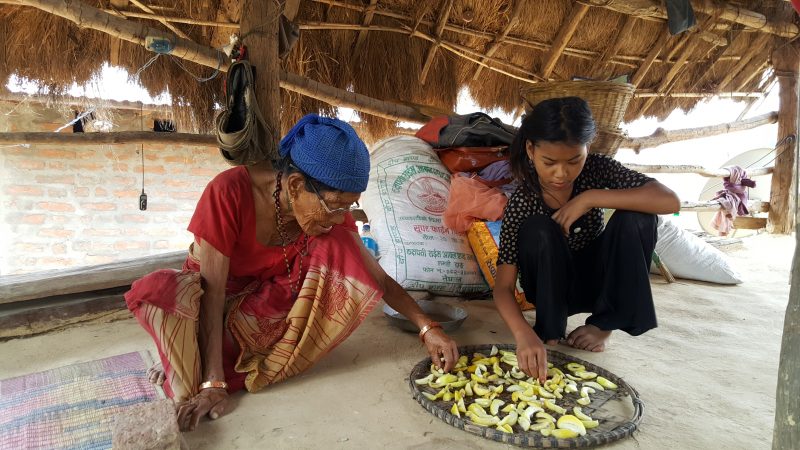
Gyani Maiya with her grand-daughter
No hooves, only claws
As we started talking to Gyani Maiya and she started telling us about their culture and tradition, a stray cow entered the barn. She suddenly rose from her seat, climbed down the ‘lisno’ (a wooden log shaped into a ladder), and shooed away the bovine. When she returned back, she talked to us about Kusunda food habits. She said, “Kusundas avoid animals with hooves but love eating ones with claws.” They wouldn’t even touch cattle including goats and pigs. They would neither kill a deer nor eat venison which shows how they co-exist with nature.
However, they love eating birds, a pheasant being their favorite. And the monitor lizard is their preferred hunt. It's so special that it has become a part of the bridal ceremony, as they need to present its egg, meat, clothes and of course some money to the would-be bride's family. If they can’t find a monitor lizard egg, the initial conversation can’t happen between the interested parties. And no monitor lizard meat means ‘no marriage’ at all.
No hooves, only claws
As we started talking to Gyani Maiya and she started telling us about their culture and tradition, a stray cow entered the barn. She suddenly rose from her seat, climbed down the ‘lisno’ (a wooden log shaped into a ladder), and shooed away the bovine. When she returned back, she talked to us about Kusunda food habits. She said, “Kusundas avoid animals with hooves but love eating ones with claws.” They wouldn’t even touch cattle including goats and pigs. They would neither kill a deer nor eat venison which shows how they co-exist with nature.
However, they love eating birds, a pheasant being their favorite. And the monitor lizard is their preferred hunt. It's so special that it has become a part of the bridal ceremony, as they need to present its egg, meat, clothes and of course some money to the would-be bride's family. If they can’t find a monitor lizard egg, the initial conversation can’t happen between the interested parties. And no monitor lizard meat means ‘no marriage’ at all.
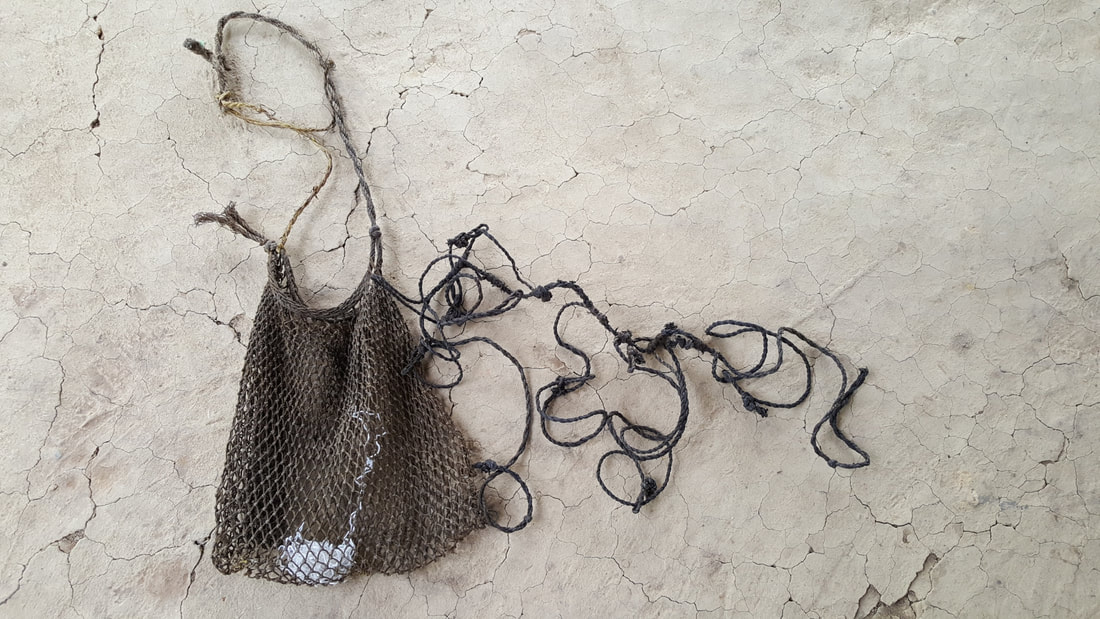
Bag and snare
Still hunting and gathering
She then unpacked a tangled bulk of cords. The mesh of cords was a snare to trap jungle fowls and bag meant to carry the trapped birds. Made from cords extracted from wild creepers, the snare is called ‘aant‘ and the bag is called ‘aamji‘ in Kusunda language. The Kusundas tie the snare between two trees, hide nearby and make sounds like pheasants by putting cycas leaves between their lips. As the birds pass through the trees, they get trapped and then they catch and carry those birds in this bag with perforations.
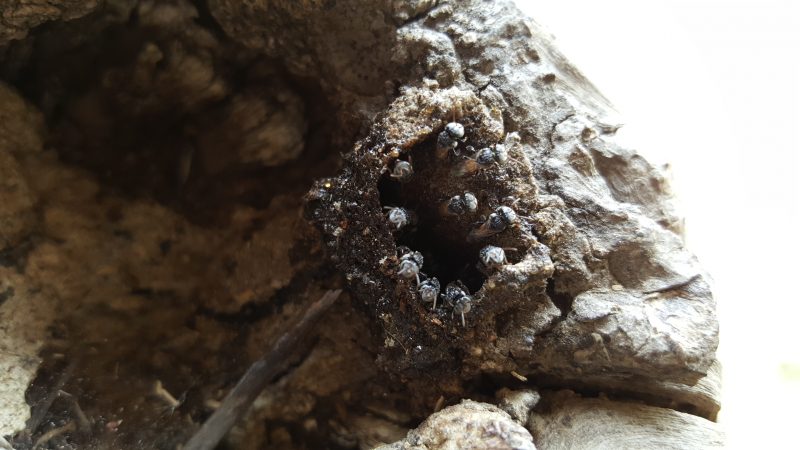
While we were busy documenting the special words of Kusunda language, I could see a swarm of tiny insects heading to a small hole in a wooden log. Neither honey bees nor flies, they are called ‘putka’ according to Gyani Maiya and they yield honey-like sweet substance.
Finally, Gyani Maiya showed us her barn. She had planted yams in every nook and cranny. With a help of a small spade, she unearthed some of them and put them in the aamji. For a woman of above 80, she was still a strong figure. And above all, her commanding tone was the evidence of the aura she might have carried around when she was young — powerful like a ‘queen of the jungle’.
Still hunting and gathering
She then unpacked a tangled bulk of cords. The mesh of cords was a snare to trap jungle fowls and bag meant to carry the trapped birds. Made from cords extracted from wild creepers, the snare is called ‘aant‘ and the bag is called ‘aamji‘ in Kusunda language. The Kusundas tie the snare between two trees, hide nearby and make sounds like pheasants by putting cycas leaves between their lips. As the birds pass through the trees, they get trapped and then they catch and carry those birds in this bag with perforations.
While we were busy documenting the special words of Kusunda language, I could see a swarm of tiny insects heading to a small hole in a wooden log. Neither honey bees nor flies, they are called ‘putka’ according to Gyani Maiya and they yield honey-like sweet substance.
Finally, Gyani Maiya showed us her barn. She had planted yams in every nook and cranny. With a help of a small spade, she unearthed some of them and put them in the aamji. For a woman of above 80, she was still a strong figure. And above all, her commanding tone was the evidence of the aura she might have carried around when she was young — powerful like a ‘queen of the jungle’.
Putka
__________________________________________________________________________________________________________________________________________________________________________
Gyani Maiya was also the subject of an ealier BBC report uploaded on 12 May 2012:
Nepal's mystery language on the verge of extinction
By Bimal Gautam BBC News, Nepal
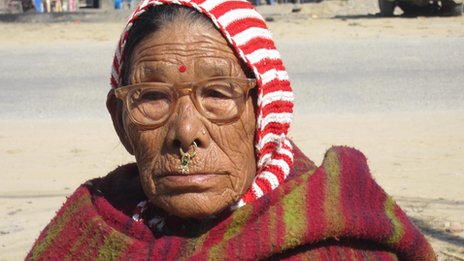
Gyani Maiya Sen, a 75-year-old woman from western Nepal, can perhaps be forgiven for feeling that the weight of the world rests on her shoulders. She is the only person still alive in Nepal who fluently speaks the Kusunda language. The unknown origins and mysterious sentence structures of Kusunda have long baffled linguists. As such, she has become a star attraction for campaigners eager to preserve her dying tongue.
Madhav Prasad Pokharel, a professor of linguistics at Nepal's Tribhuwan University, has spent a decade researching the vanishing Kusunda tribe. Professor Pokharel describes Kusunda as a "language isolate", not related to any common language of the world.
"There are about 20 language families in the world," he said, "among them are the Indo-European, Sino-Tibetan and Austro-Asiatic group of languages.
"Kusunda stands out because it is not phonologically, morphologically, syntactically and lexically related to any other languages of the world.
'Very sad' He warns that if the Kusunda language becomes extinct, "a unique and important part of our human heritage will be lost forever".
Even if some of the lofty intellectual arguments for preserving the Kusunda language are lost on Ms Sen, she is acutely aware of how its demise affects her personally.
"Fortunately I can also speak Nepali, but I feel very sad for not being able to speak my own language with people from my own community," she said.
"Although there are still other people from the Kusunda tribe still alive, they neither understand nor speak the language.
"Other Kusunda people... can only speak a few Kusunda words, but can't communicate [fully] in the language."
Ms Sen fears there will be no-one to speak the Kusunda language after her death.
"The Kusunda language will die with me," she reflects, while lamenting the failure of the government and academics to help transfer the language to the next generation.
Although no detailed figures are available, the Central Bureau of Statistics says that only about 100 Kusunda tribespeople remain - but only Ms Sen can speak the language fluently.
A few years ago, there were two other people - from a mid-western Nepalese village - who spoke the Kusunda language fluently. They were Puni Thakuri and her daughter Kamala Khatri. But since then Puni Thakuri has died and Kamala has left the country in search of a job.
Ms Sen - despite her age - still ekes out a living as a stone-crusher. But outside of the workplace she finds that she is increasingly in demand from linguistics students wanting to learn the Kusunda language with her help. They are documenting it in a bid to keep this rare language alive.
Researchers have so far identified three vowels and 15 consonants in the Kusunda language.
Threat to tribe
The Kusunda tribe to which Ms Sen belongs is nomadic. As hunters and gatherers, they live in huts in the jungle and carry bows and arrows to hunt wild animals.
While the males of the tribe hunt, women and children stay at home and search for wild fruits.
The Kusunda - a short and sturdy people - refer to themselves by the word "myak" in their language. They kill monitor lizards ("pui") and wild fowls ("tap").
Linguists and tribal campaigners are now demanding that the government introduce specific programmes to uplift the Kusunda tribe and protect their language.
But no such policy is on the cards, at least in immediate future.
"We do not have any specific programme to preserve this language," admitted Narayan Regmi, spokesperson of the Ministry of Culture.
The National Ethnographic Museum had meanwhile conducted a study on 10 different Nepalese ethnic groups including the Kusunda.
Its research has reached a grim conclusion. The entire Kusunda tribe is on the verge of disappearing along with its last fluent speaker in Nepal.
__________________________________________________________________________________________________________________________________________________________________________
Gyani Maiya was also the subject of an ealier BBC report uploaded on 12 May 2012:
Nepal's mystery language on the verge of extinction
By Bimal Gautam BBC News, Nepal
Gyani Maiya Sen, a 75-year-old woman from western Nepal, can perhaps be forgiven for feeling that the weight of the world rests on her shoulders. She is the only person still alive in Nepal who fluently speaks the Kusunda language. The unknown origins and mysterious sentence structures of Kusunda have long baffled linguists. As such, she has become a star attraction for campaigners eager to preserve her dying tongue.
Madhav Prasad Pokharel, a professor of linguistics at Nepal's Tribhuwan University, has spent a decade researching the vanishing Kusunda tribe. Professor Pokharel describes Kusunda as a "language isolate", not related to any common language of the world.
"There are about 20 language families in the world," he said, "among them are the Indo-European, Sino-Tibetan and Austro-Asiatic group of languages.
"Kusunda stands out because it is not phonologically, morphologically, syntactically and lexically related to any other languages of the world.
'Very sad' He warns that if the Kusunda language becomes extinct, "a unique and important part of our human heritage will be lost forever".
Even if some of the lofty intellectual arguments for preserving the Kusunda language are lost on Ms Sen, she is acutely aware of how its demise affects her personally.
"Fortunately I can also speak Nepali, but I feel very sad for not being able to speak my own language with people from my own community," she said.
"Although there are still other people from the Kusunda tribe still alive, they neither understand nor speak the language.
"Other Kusunda people... can only speak a few Kusunda words, but can't communicate [fully] in the language."
Ms Sen fears there will be no-one to speak the Kusunda language after her death.
"The Kusunda language will die with me," she reflects, while lamenting the failure of the government and academics to help transfer the language to the next generation.
Although no detailed figures are available, the Central Bureau of Statistics says that only about 100 Kusunda tribespeople remain - but only Ms Sen can speak the language fluently.
A few years ago, there were two other people - from a mid-western Nepalese village - who spoke the Kusunda language fluently. They were Puni Thakuri and her daughter Kamala Khatri. But since then Puni Thakuri has died and Kamala has left the country in search of a job.
Ms Sen - despite her age - still ekes out a living as a stone-crusher. But outside of the workplace she finds that she is increasingly in demand from linguistics students wanting to learn the Kusunda language with her help. They are documenting it in a bid to keep this rare language alive.
Researchers have so far identified three vowels and 15 consonants in the Kusunda language.
Threat to tribe
The Kusunda tribe to which Ms Sen belongs is nomadic. As hunters and gatherers, they live in huts in the jungle and carry bows and arrows to hunt wild animals.
While the males of the tribe hunt, women and children stay at home and search for wild fruits.
The Kusunda - a short and sturdy people - refer to themselves by the word "myak" in their language. They kill monitor lizards ("pui") and wild fowls ("tap").
Linguists and tribal campaigners are now demanding that the government introduce specific programmes to uplift the Kusunda tribe and protect their language.
But no such policy is on the cards, at least in immediate future.
"We do not have any specific programme to preserve this language," admitted Narayan Regmi, spokesperson of the Ministry of Culture.
The National Ethnographic Museum had meanwhile conducted a study on 10 different Nepalese ethnic groups including the Kusunda.
Its research has reached a grim conclusion. The entire Kusunda tribe is on the verge of disappearing along with its last fluent speaker in Nepal.