| linguae |
|
QUESTIONS ARISING FROM 95th MEETING – 16/11/18
Food items ordered included melongēna contūsa (baigan bharta, mashed aubergine or egg-plant), carnēs tanduriae mixtae (tandoori mixed grill), caseus cum spīnāchiā (sag paneer), gallīnācea butyrāta (buttered chicken), batātae cum brassicā Pompēiānā (alu gobi), cicera arōmatica (chana masala, spiced chickpeas), iūs arōmaticum lentium (dal tarka, spiced lentil soup), pīsa cum caseō (muttor paneer, peas and cheese), orӯza (rice), pānis Persicus (nan, Persian-style bread) and vīnum rubrum. We alse received complimentary pānis tenuis (papadom) and tubī vernālēs (spring rolls).
Food items ordered included melongēna contūsa (baigan bharta, mashed aubergine or egg-plant), carnēs tanduriae mixtae (tandoori mixed grill), caseus cum spīnāchiā (sag paneer), gallīnācea butyrāta (buttered chicken), batātae cum brassicā Pompēiānā (alu gobi), cicera arōmatica (chana masala, spiced chickpeas), iūs arōmaticum lentium (dal tarka, spiced lentil soup), pīsa cum caseō (muttor paneer, peas and cheese), orӯza (rice), pānis Persicus (nan, Persian-style bread) and vīnum rubrum. We alse received complimentary pānis tenuis (papadom) and tubī vernālēs (spring rolls).
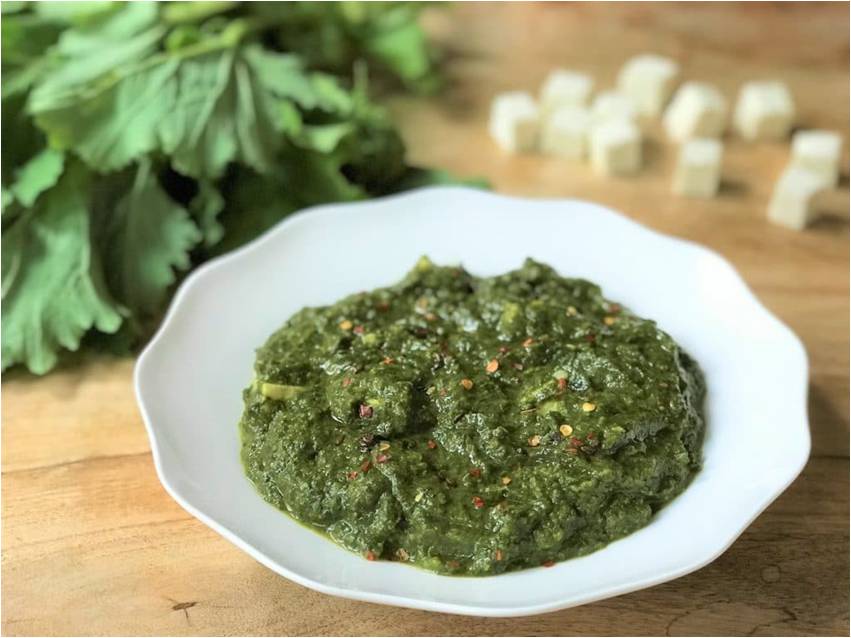
Caseus cum spīnāchiā
https://pipingpotcurry.com/saag-paneer-pressure-cooker/
The various words for `aubergine’ (茄子.botanical name: solānum melongēna). which is related to both the potato (sōlānum tuberōsum, batāta) and the tomato (lycopersicum), have been discussed several times before but the compex etymology is repeated here for new readers (and foregetful old ones!). This vegetable, which was probably domesticated independently in East and South Asia and brought into Europe in the early Middle Ages by the Arabs, was known in Sanskrit as vātiṅgaṇa (वातिङ्गण), most likely a Dravidian loan word, which become baigan (बैंगन )in Hindi and bhantaa (भन्टा) in Nepali. The Sanskrit became in Persian bādinjān, which was transformed in Byzantine Greek into μελιτζάνα melitzána under the influence of the Greek μελανο- 'black'. This in turn was adopted into Latin as melongēna. The Arabs also borrowed the Persian word and this, prefixed by the article `al’, gave Catalan alberginia, whence the French and British English names. The Italians changed the Latin into melanzana, and re-interpreted this as mela insana, whence an obsolete English name for the vegetable – mad-apple. The Americans boringly broke the chain by calling it just `egg plant’. Finally, the Indian English name brinjal is a back-formation from the Portuguese berinjela! For more details see https://en.wikipedia.org/wiki/Eggplant#Names_and_etymology
For `mashed’ we have in the past used contūsus, -a, -um, the perfect participle of contundo (-ere, -tūī, -tūsum), `pound into pieces’ but another possibility is contrīta (from conterō, -ere, -trīvī, -trītum), `to crumble, rub off, wear out, pass (time). A third option is pulticula (`pap, gruel’) plus the genitive of the the food involved.
There is some confusion over the length of the middle vowel in orӯza, which Eugene disovered after the meeting is shown short in Forcellini’s pioneering lexicon and in the contemporary Collins and Traupman dictionaries but long in Taupman’s own Conversational Latin as well as in Lewis & Short. The problem is that the consonant z, which only occurred in Greek loan words, was always pronounced double between vowels so the second syllable of the word counted long whether it was pronounced rӯz or ryz. No conclusion, therefore, can be drawn about the vowel’s length from the poet Horace’s use of orӯzae at the end of a hexameter line, which always had to have a long syllable in penultimate position.
The Latin word is a simple transliteration of Greek ὄρυζα (oruza) which in turn derives ultimately from Sanskrit vrihi, perhaps via Old Persian brizi. In Roman times the grain was not a staple food but an expensive import used for medicinal purposes: a kind of rice pudding was given to settle a sick stomach, much as congee is sometimes used today. Horace’s line (Sermones 2:3, 115) refers to a doctor’s recommendation to take (at a price!) a tisanārium orӯzae (decoction of rice). Rice has, however, even been found stored in Roman camps in Germany,
The Asian variety of rice (Oryza sativa) appears to have been first domesticated in China, probably in the Pearl River region, though the Yangtze Valley was until more recently thought more likely and an earlier study suggested an origin on the southern slopes of the Himalayas! The Romans probably got a small amount of the cereal from Egypt or the Middle East but even in those regions it was not grown on a large scale until the Islamic period. For more details on this, see https://en.wikipedia.org/wiki/Rice#History_of_domestication_and_cultivation
We also briefly touched on the best term for `potato’, for which we had originally been using solānum, a word which in classical Latin refers to nightshade and as a modern botanical term covers a wide range of vegetables. We now prefer batāta, a Carib Indian word which became patata in Spanish, It originally referred to the sweet potato but soon extended to the common white potato also (see the discussion for the 29 December 2017 meeting.)
We discussed briefly both our own favourite food and also Roman dishes which are now rarely if ever eaten. Some vocabulary for this is given in the handout attached below. A particular ancient favoiurite was dormouse (glis, glīris m), cooked or served with honey and, as Pat pointed out, probably a seasonal dish, enjoyed in the autumn when the animal was at its fattest just before hibernation. They were bred in captivity in a specially constructed glīrārium.
A lot of information on Roman eating habits is included in the reader Ciceronis Filius some of which has been read in previous Circulus meetings. The whole book, plus annotated versions of the sections we covered, can be downloaded from https://linguae.weebly.com/circulus-latinus-honcongensis.html and food and cooking are dealt with on pages 23-26 of the printed text (page 19 onwards in the first section of the annotated Word file). The detailed description of the production of garum, the famous (or notorious?) fermented fish sauce was discussed in the November 2016 meeting. For the resurrection of this delicacy in modern Spain see
http://www.bbc.com/travel/story/20171011-the-ancient-condiment-that-came-back-from-the-dead
but note that, despite the researchers’s insistence that the product was healthy, it may have been responsible for spreading tapeworm infection across the Roman Empire:
https://www.cambridge.org/core/journals/parasitology/article/human-parasites-in-the-roman-world-health-consequences-of-conquering-an-empire/6464BDBB5D4B8EC0B08C503B6ECD1B7B
Aselya pointed out that Roman cuisine had been compared to that of South-East Asia, and checking the record revealed that Don, currently in Europe, had in September 2016 referred to a Vietnamese dish sauce he felt resembled garum. Both of these, like soy sauce, contain a lot of monosodium glutamate and are characterised by the resultant umami flavour (see https://en.wikipedia.org/wiki/Umami and https://en.wikipedia.org/wiki/Garum ).
There was also brief discussion of the Latin for `cheese’ and `chicken’. For the former there is the classical caseus, from which the name of the casein family of proteins found in milk is derived, and the vulgar Latin fōrmāticum, the origin of French fromage, and Italian formaggio. The word fōrmāticum is itself derived from the verb fōrmō, reflecting the fact that cheese can be viewed as milk given a definite shape and form. We speculated whether galllīna (the bird itself) and gallīnācea (its meat) might be from Greek, but it seems in that language a chicken was normally referred to by the general word for `bird’, ornis, ornithos The Latin word is a modification of gallus (cock),which Lewis & Short links with garrīre (to chatter), Greek γῆρυς (gerus, speech) and English call, all derive from the Proto-Indo-European root *gal- (shout)
One modern dish anticipated by the Romans appears may have been the humble burger (būbula concīsa in neo-Latin), at least if the isicia omentata described by `Apicius’ (the supposed author of the oldest collection of Roman recipes) is correctly identified as such (see https://www.epicurus.com/food/recipes/isicia-omentata-a-kind-of-roman-burgers/4933/). The word i(n)sicium or i(n)sicia appears to refer to mince meat but Apicius’ original Latin (at http://www.thelatinlibrary.com/apicius/apicius2.shtml) seems to be describing a kind of sausage rather than a meat patty.
Eugene had been very active producing glossaries of words for food. These include lists of English descriptions of Indian dishes (Nominum Anglicorum ferculorum Indicorum), Latin translations of the Indian names (Elenchus Ferculorum Indicorum), which is included below, and a longer list of Latin words and phrases (Food.docx) connected with cooking and eating in general. In the last of these entries which are not found in classical Latin are highlighted in green. All three lists can be, plus the more general Circulus Vocabulary can be downloaded as separate files from the Circulus web page: https://linguae.weebly.com/circulus-latinus-honcongensis.html
The subject of food led on to the question of which animals could be eaten in Hong Kong, which could legally be bought and sold and which were native to the territory, Malcolm remembered watch a policeman arrempt to arrest an old woman who was illegally selling owls and then get bitten by an ungrateful owl he had attempted to rescue. Malcolm had himself once kept a hedgehog as a pet, burying it near a mountain top when it eventually passed away. Hedghogs do not appear to be among Hong Kong’s natural fauna, but a large variety of animals make their home here. Some details of our wildlfe can be found at https://linguae.weebly.com/hong-kong-countryside.html
https://pipingpotcurry.com/saag-paneer-pressure-cooker/
The various words for `aubergine’ (茄子.botanical name: solānum melongēna). which is related to both the potato (sōlānum tuberōsum, batāta) and the tomato (lycopersicum), have been discussed several times before but the compex etymology is repeated here for new readers (and foregetful old ones!). This vegetable, which was probably domesticated independently in East and South Asia and brought into Europe in the early Middle Ages by the Arabs, was known in Sanskrit as vātiṅgaṇa (वातिङ्गण), most likely a Dravidian loan word, which become baigan (बैंगन )in Hindi and bhantaa (भन्टा) in Nepali. The Sanskrit became in Persian bādinjān, which was transformed in Byzantine Greek into μελιτζάνα melitzána under the influence of the Greek μελανο- 'black'. This in turn was adopted into Latin as melongēna. The Arabs also borrowed the Persian word and this, prefixed by the article `al’, gave Catalan alberginia, whence the French and British English names. The Italians changed the Latin into melanzana, and re-interpreted this as mela insana, whence an obsolete English name for the vegetable – mad-apple. The Americans boringly broke the chain by calling it just `egg plant’. Finally, the Indian English name brinjal is a back-formation from the Portuguese berinjela! For more details see https://en.wikipedia.org/wiki/Eggplant#Names_and_etymology
For `mashed’ we have in the past used contūsus, -a, -um, the perfect participle of contundo (-ere, -tūī, -tūsum), `pound into pieces’ but another possibility is contrīta (from conterō, -ere, -trīvī, -trītum), `to crumble, rub off, wear out, pass (time). A third option is pulticula (`pap, gruel’) plus the genitive of the the food involved.
There is some confusion over the length of the middle vowel in orӯza, which Eugene disovered after the meeting is shown short in Forcellini’s pioneering lexicon and in the contemporary Collins and Traupman dictionaries but long in Taupman’s own Conversational Latin as well as in Lewis & Short. The problem is that the consonant z, which only occurred in Greek loan words, was always pronounced double between vowels so the second syllable of the word counted long whether it was pronounced rӯz or ryz. No conclusion, therefore, can be drawn about the vowel’s length from the poet Horace’s use of orӯzae at the end of a hexameter line, which always had to have a long syllable in penultimate position.
The Latin word is a simple transliteration of Greek ὄρυζα (oruza) which in turn derives ultimately from Sanskrit vrihi, perhaps via Old Persian brizi. In Roman times the grain was not a staple food but an expensive import used for medicinal purposes: a kind of rice pudding was given to settle a sick stomach, much as congee is sometimes used today. Horace’s line (Sermones 2:3, 115) refers to a doctor’s recommendation to take (at a price!) a tisanārium orӯzae (decoction of rice). Rice has, however, even been found stored in Roman camps in Germany,
The Asian variety of rice (Oryza sativa) appears to have been first domesticated in China, probably in the Pearl River region, though the Yangtze Valley was until more recently thought more likely and an earlier study suggested an origin on the southern slopes of the Himalayas! The Romans probably got a small amount of the cereal from Egypt or the Middle East but even in those regions it was not grown on a large scale until the Islamic period. For more details on this, see https://en.wikipedia.org/wiki/Rice#History_of_domestication_and_cultivation
We also briefly touched on the best term for `potato’, for which we had originally been using solānum, a word which in classical Latin refers to nightshade and as a modern botanical term covers a wide range of vegetables. We now prefer batāta, a Carib Indian word which became patata in Spanish, It originally referred to the sweet potato but soon extended to the common white potato also (see the discussion for the 29 December 2017 meeting.)
We discussed briefly both our own favourite food and also Roman dishes which are now rarely if ever eaten. Some vocabulary for this is given in the handout attached below. A particular ancient favoiurite was dormouse (glis, glīris m), cooked or served with honey and, as Pat pointed out, probably a seasonal dish, enjoyed in the autumn when the animal was at its fattest just before hibernation. They were bred in captivity in a specially constructed glīrārium.
A lot of information on Roman eating habits is included in the reader Ciceronis Filius some of which has been read in previous Circulus meetings. The whole book, plus annotated versions of the sections we covered, can be downloaded from https://linguae.weebly.com/circulus-latinus-honcongensis.html and food and cooking are dealt with on pages 23-26 of the printed text (page 19 onwards in the first section of the annotated Word file). The detailed description of the production of garum, the famous (or notorious?) fermented fish sauce was discussed in the November 2016 meeting. For the resurrection of this delicacy in modern Spain see
http://www.bbc.com/travel/story/20171011-the-ancient-condiment-that-came-back-from-the-dead
but note that, despite the researchers’s insistence that the product was healthy, it may have been responsible for spreading tapeworm infection across the Roman Empire:
https://www.cambridge.org/core/journals/parasitology/article/human-parasites-in-the-roman-world-health-consequences-of-conquering-an-empire/6464BDBB5D4B8EC0B08C503B6ECD1B7B
Aselya pointed out that Roman cuisine had been compared to that of South-East Asia, and checking the record revealed that Don, currently in Europe, had in September 2016 referred to a Vietnamese dish sauce he felt resembled garum. Both of these, like soy sauce, contain a lot of monosodium glutamate and are characterised by the resultant umami flavour (see https://en.wikipedia.org/wiki/Umami and https://en.wikipedia.org/wiki/Garum ).
There was also brief discussion of the Latin for `cheese’ and `chicken’. For the former there is the classical caseus, from which the name of the casein family of proteins found in milk is derived, and the vulgar Latin fōrmāticum, the origin of French fromage, and Italian formaggio. The word fōrmāticum is itself derived from the verb fōrmō, reflecting the fact that cheese can be viewed as milk given a definite shape and form. We speculated whether galllīna (the bird itself) and gallīnācea (its meat) might be from Greek, but it seems in that language a chicken was normally referred to by the general word for `bird’, ornis, ornithos The Latin word is a modification of gallus (cock),which Lewis & Short links with garrīre (to chatter), Greek γῆρυς (gerus, speech) and English call, all derive from the Proto-Indo-European root *gal- (shout)
One modern dish anticipated by the Romans appears may have been the humble burger (būbula concīsa in neo-Latin), at least if the isicia omentata described by `Apicius’ (the supposed author of the oldest collection of Roman recipes) is correctly identified as such (see https://www.epicurus.com/food/recipes/isicia-omentata-a-kind-of-roman-burgers/4933/). The word i(n)sicium or i(n)sicia appears to refer to mince meat but Apicius’ original Latin (at http://www.thelatinlibrary.com/apicius/apicius2.shtml) seems to be describing a kind of sausage rather than a meat patty.
Eugene had been very active producing glossaries of words for food. These include lists of English descriptions of Indian dishes (Nominum Anglicorum ferculorum Indicorum), Latin translations of the Indian names (Elenchus Ferculorum Indicorum), which is included below, and a longer list of Latin words and phrases (Food.docx) connected with cooking and eating in general. In the last of these entries which are not found in classical Latin are highlighted in green. All three lists can be, plus the more general Circulus Vocabulary can be downloaded as separate files from the Circulus web page: https://linguae.weebly.com/circulus-latinus-honcongensis.html
The subject of food led on to the question of which animals could be eaten in Hong Kong, which could legally be bought and sold and which were native to the territory, Malcolm remembered watch a policeman arrempt to arrest an old woman who was illegally selling owls and then get bitten by an ungrateful owl he had attempted to rescue. Malcolm had himself once kept a hedgehog as a pet, burying it near a mountain top when it eventually passed away. Hedghogs do not appear to be among Hong Kong’s natural fauna, but a large variety of animals make their home here. Some details of our wildlfe can be found at https://linguae.weebly.com/hong-kong-countryside.html

The Mogg prepares for take-off, watched by fellow right-wing conservative Boris Johnson and by Labour leader Jeremy Corbyn (The Times, 19/11/2018)
Whether or not as an extension of the wildlife topic, we also briefly considered the notorious Brexiteer, Jacob Rees-Mogg, who is very popular among the UK Conservative Party’s aging membership but derided by many others as `the honourable member for the 18th century’ and also well-known for the exotic names bestowed on his six children: Peter Theodore Alphege, Mary Anne Charlotte Emma, Thomas Wentworth Somerset Dunstan, Anselm Charles Fitzwilliam,, Alfred Wulfric Leyson Pius, and Sixtus Dominic Boniface Christopher. Malcolm, who has himself been in Hong Kong since the seventies, recalled Rees-Mogg working here for a private equity company and being a rather boring individual. One reason for his enthusiasm for British exit from the European Union may be the expectation that a looser regulatory framework would make life easier for his own hedge fund. John discovered after the meeting that Rees-Mogg had attended the same Oxford college as he had done but consoled himself with the thought that every family has its black sheep.
We also mentioned the fact that , whilst salvē/salvēte is normally used on meetng and valē/valēte on taking leave, the two words were both essentially instructions that someone stay in good condition and were sometimes used interchangeably, much as the Italian ciao means both `Hello’ and `Goodbye’. Eugene informed us that ciao actually derives from the Venetian dialect word s-ciao, which itself comes from medieval Latin sclavus, `slave’, also the source of the English word. The Latin term, perhaps needed once servus came to be used with the meaning of `servant’, reflects the fact that Germanic conquests resulted in many of the Slavic inhabitants of Eastern Europe becoming enslaved (see https://en.wikipedia.org/wiki/Ciao and https://www.etymonline.com/word/slave#etymonline_v_23653). The Italian greeting is actually a reduction of vostro s-ciao, `(I am) you slave’, which conveyed a similar idea to English `at your sevice’ or the formula `I remain, sir,your humble servant’ once used at the end of formal letters.
We discussed the Turkic speech family which includes both Turkish itself and a number of languages in Central Asia, Aselya, who is herself a Kazakh, believed that a speaker of Turkish would understand about 20% if listening to Kazakh but around 50% of the more closely related Uzbekh.
Whether or not as an extension of the wildlife topic, we also briefly considered the notorious Brexiteer, Jacob Rees-Mogg, who is very popular among the UK Conservative Party’s aging membership but derided by many others as `the honourable member for the 18th century’ and also well-known for the exotic names bestowed on his six children: Peter Theodore Alphege, Mary Anne Charlotte Emma, Thomas Wentworth Somerset Dunstan, Anselm Charles Fitzwilliam,, Alfred Wulfric Leyson Pius, and Sixtus Dominic Boniface Christopher. Malcolm, who has himself been in Hong Kong since the seventies, recalled Rees-Mogg working here for a private equity company and being a rather boring individual. One reason for his enthusiasm for British exit from the European Union may be the expectation that a looser regulatory framework would make life easier for his own hedge fund. John discovered after the meeting that Rees-Mogg had attended the same Oxford college as he had done but consoled himself with the thought that every family has its black sheep.
We also mentioned the fact that , whilst salvē/salvēte is normally used on meetng and valē/valēte on taking leave, the two words were both essentially instructions that someone stay in good condition and were sometimes used interchangeably, much as the Italian ciao means both `Hello’ and `Goodbye’. Eugene informed us that ciao actually derives from the Venetian dialect word s-ciao, which itself comes from medieval Latin sclavus, `slave’, also the source of the English word. The Latin term, perhaps needed once servus came to be used with the meaning of `servant’, reflects the fact that Germanic conquests resulted in many of the Slavic inhabitants of Eastern Europe becoming enslaved (see https://en.wikipedia.org/wiki/Ciao and https://www.etymonline.com/word/slave#etymonline_v_23653). The Italian greeting is actually a reduction of vostro s-ciao, `(I am) you slave’, which conveyed a similar idea to English `at your sevice’ or the formula `I remain, sir,your humble servant’ once used at the end of formal letters.
We discussed the Turkic speech family which includes both Turkish itself and a number of languages in Central Asia, Aselya, who is herself a Kazakh, believed that a speaker of Turkish would understand about 20% if listening to Kazakh but around 50% of the more closely related Uzbekh.
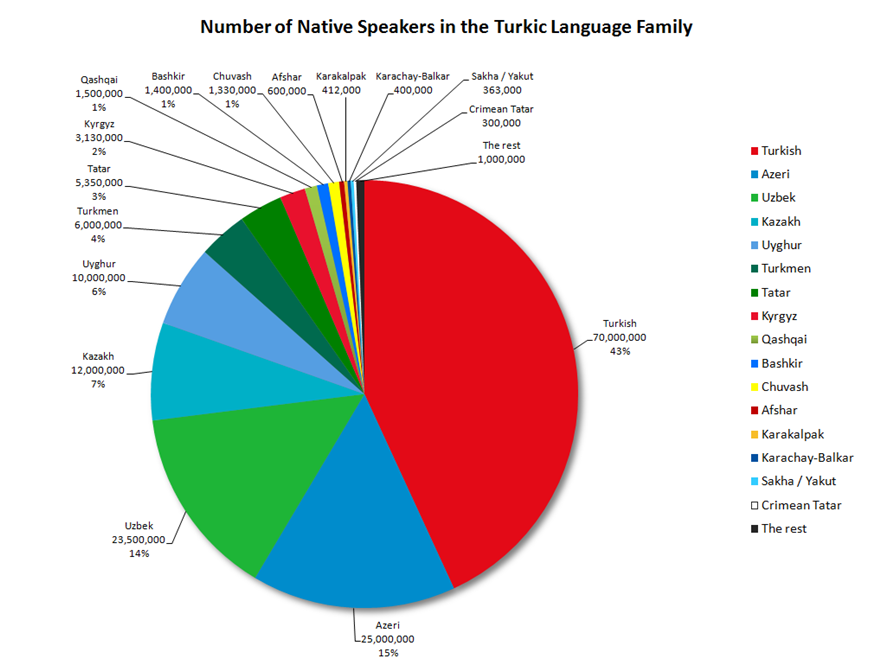
From https://en.wikipedia.org/wiki/Turkic_languages
This led on to consideration of different central Asian peoples and their inter-relationships. The Turks proper moved into their present Anatolian home around the beginning of the 2nd. milennim A.D., having initially moved west as servants and soldiers of Islamic peoples, whose religion they themselves then adopted (see https://en.wikipedia.org/wiki/Turkish_people).
Aselya mentioned the belied that another Turkic people, the Uighurs now under pressure in Sinjiang,
had eliminated the Indo-European Tocharians who had once occupied the area. However, the mainstream view seems to be that, although the Tocharian language died out, populations actually merged rather than earler inhabitants being driven out or massacred (see https://en.wikipedia.org/wiki/Tocharians).
The Huns, invaders from the steppes who terrorised Europe under their leader Attila in the 5th century A.D., are often identified with the Xiong-nu who put similar pressure on China at around the same time but there is no definite proof of this. Very little of the Huns’ original language is known so its relationship to Mongolian or Turkic is uncertain. One recent suggestion is that the Huns originally spoke a language belonging to the Yeniseian family of Siberia but later switched to a Turkic dialect (see https://en.wikipedia.org/wiki/Hunnic_language). Once they entered Europe, they may also have made extensive use of Gothic, an East Germanic language. The claim that the Hungarians (speakers of a Finno-Ugric language) are descendants of the Huns seem to have been first put forward in the 13th century and are largely discounted today (see https://en.wikipedia.org/wiki/Huns).
The decline of the Hunnic Empire in Europe seems to have been the result both of internal struggles and the arrival of other groups from Central Asia. The Huns seem to have adopted other languages quite readily and were probably eventually absorbed by other ethnic groups in Europe.
All the present-day European languages, with the exception of Basque,which has no known relatives, and the Finno-Urgic languages (Hungarian, Finnish, Estonian) and Aselya wondered where Indo-European itself came from. Most linguists believe that languages have changed too much for earlier connections to be discoverable but since the beginning of the 20th century some scholars have argued that Indo-European belongs to a wider grouping known as Nostratic. The proponents of this theory differ among themselves on exactly which languages are members but all argue for the kinship of Indo-European itself, Uralic (i.e. the Finno-Ugtic languages plus ths Samaoyedic ones found in Siberia) and `Altaic’, a family which supposely includes Turkic and Mongolian but whose existence is disputed by many other liguuists. One view of Nostratic (shown in the diagram below, taken from https://en.wikipedia.org/wiki/Nostratic_languages ) makes the three core languages into a `Euroasiatic’ sub-divison and adds Afro-Asiatic (which includes the Semitic grouping– Arabic, Hebrew, Aramaic - and also some north African languages), Kartvelian (a family of languages spoken in the Caucasus) and Dravidian (Tamil and other S. Indian languages).
This led on to consideration of different central Asian peoples and their inter-relationships. The Turks proper moved into their present Anatolian home around the beginning of the 2nd. milennim A.D., having initially moved west as servants and soldiers of Islamic peoples, whose religion they themselves then adopted (see https://en.wikipedia.org/wiki/Turkish_people).
Aselya mentioned the belied that another Turkic people, the Uighurs now under pressure in Sinjiang,
had eliminated the Indo-European Tocharians who had once occupied the area. However, the mainstream view seems to be that, although the Tocharian language died out, populations actually merged rather than earler inhabitants being driven out or massacred (see https://en.wikipedia.org/wiki/Tocharians).
The Huns, invaders from the steppes who terrorised Europe under their leader Attila in the 5th century A.D., are often identified with the Xiong-nu who put similar pressure on China at around the same time but there is no definite proof of this. Very little of the Huns’ original language is known so its relationship to Mongolian or Turkic is uncertain. One recent suggestion is that the Huns originally spoke a language belonging to the Yeniseian family of Siberia but later switched to a Turkic dialect (see https://en.wikipedia.org/wiki/Hunnic_language). Once they entered Europe, they may also have made extensive use of Gothic, an East Germanic language. The claim that the Hungarians (speakers of a Finno-Ugric language) are descendants of the Huns seem to have been first put forward in the 13th century and are largely discounted today (see https://en.wikipedia.org/wiki/Huns).
The decline of the Hunnic Empire in Europe seems to have been the result both of internal struggles and the arrival of other groups from Central Asia. The Huns seem to have adopted other languages quite readily and were probably eventually absorbed by other ethnic groups in Europe.
All the present-day European languages, with the exception of Basque,which has no known relatives, and the Finno-Urgic languages (Hungarian, Finnish, Estonian) and Aselya wondered where Indo-European itself came from. Most linguists believe that languages have changed too much for earlier connections to be discoverable but since the beginning of the 20th century some scholars have argued that Indo-European belongs to a wider grouping known as Nostratic. The proponents of this theory differ among themselves on exactly which languages are members but all argue for the kinship of Indo-European itself, Uralic (i.e. the Finno-Ugtic languages plus ths Samaoyedic ones found in Siberia) and `Altaic’, a family which supposely includes Turkic and Mongolian but whose existence is disputed by many other liguuists. One view of Nostratic (shown in the diagram below, taken from https://en.wikipedia.org/wiki/Nostratic_languages ) makes the three core languages into a `Euroasiatic’ sub-divison and adds Afro-Asiatic (which includes the Semitic grouping– Arabic, Hebrew, Aramaic - and also some north African languages), Kartvelian (a family of languages spoken in the Caucasus) and Dravidian (Tamil and other S. Indian languages).
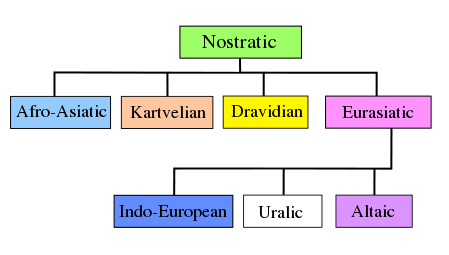
Refusal by most scholars to accept Altaic as a real language family rests on the belief that similarities between Mongolian and Turkish appear to be less common in earlier documents in these languages than in more recent ones, which indicates that they are the result of borrowing rather than of common origin (see https://en.wikipedia.org/wiki/Altaic_languages).
Among the enthusiasts for `super-families’ like Nostratic is Merritt Ruhlen who has spent some time in Hong Kong and who John met about fifteen years ago. Ruhlen has even attempted to reconstruct some words in `Proto-Earth’, the supposed ancestor of all existing languages. This is regarded by most comparaive linguists as completely unscientific and there is also little support for his argument that the endangered Kusunda language of Nepal is related to languages spoken in the Andaman islands, the common ancestor having brought out of Africa by the original migration of modern Homo sapiens (see . https://linguae.weebly.com/kusunda.html)
Malcolm again strongly recommended Christopher Gosscha’s History of Modern Vietnam (see https://www.theguardian.com/books/2016/oct/08/penguin-history-modern-vietnam-christopher-goscha-review) for another enthusiastic endorsement.) He also highly praised Jessye Norman’s performance of the aria `When I am Laid in Earth’ (https://youtu.be/eRyec66Jp2c) from Purcell’s `Dido and Aeneas’, an opera based on Virgil’s story of the doomed love affair. Finally, when John was recommending the Ad Alpēs reader (sse now https://linguae.weebly.com/ad-alpes.html), Malcolm reminded us of the very useful site http://bookconcierge.hk which compares the prices for a particular book on different sites. This shows that the 1927 edition is available from Betterworld Books $328 but for some reason it does not display the 2017 Latinitium edition which includes some corrections.This latest edition is available at the moment on Amazon for only $268.
Among the enthusiasts for `super-families’ like Nostratic is Merritt Ruhlen who has spent some time in Hong Kong and who John met about fifteen years ago. Ruhlen has even attempted to reconstruct some words in `Proto-Earth’, the supposed ancestor of all existing languages. This is regarded by most comparaive linguists as completely unscientific and there is also little support for his argument that the endangered Kusunda language of Nepal is related to languages spoken in the Andaman islands, the common ancestor having brought out of Africa by the original migration of modern Homo sapiens (see . https://linguae.weebly.com/kusunda.html)
Malcolm again strongly recommended Christopher Gosscha’s History of Modern Vietnam (see https://www.theguardian.com/books/2016/oct/08/penguin-history-modern-vietnam-christopher-goscha-review) for another enthusiastic endorsement.) He also highly praised Jessye Norman’s performance of the aria `When I am Laid in Earth’ (https://youtu.be/eRyec66Jp2c) from Purcell’s `Dido and Aeneas’, an opera based on Virgil’s story of the doomed love affair. Finally, when John was recommending the Ad Alpēs reader (sse now https://linguae.weebly.com/ad-alpes.html), Malcolm reminded us of the very useful site http://bookconcierge.hk which compares the prices for a particular book on different sites. This shows that the 1927 edition is available from Betterworld Books $328 but for some reason it does not display the 2017 Latinitium edition which includes some corrections.This latest edition is available at the moment on Amazon for only $268.
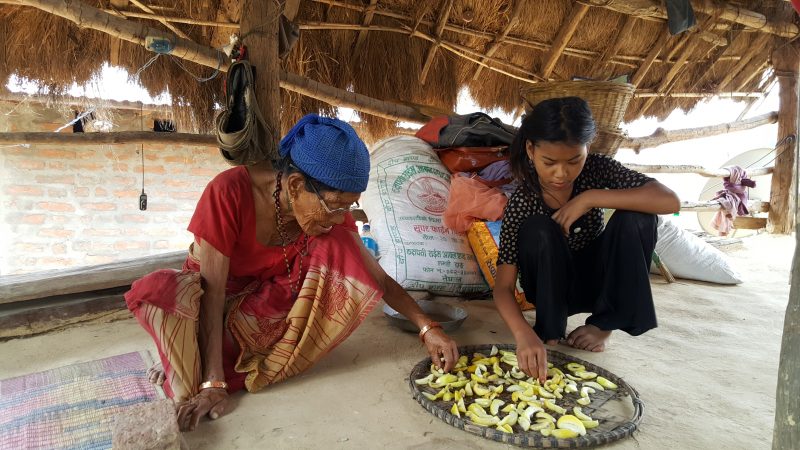
Gyani Maini Sen, one of the last two fluent speakers of Kusunda, with her grand-daughter
