| linguae |
|
QUESTIONS ARISING FROM 147th. MEETING – 30/6/23
(the record of earlier meetings can be downloaded from the main Circulus page as can the version of Ciceronis Filius with illustrations added. The illustrated text of Genesis is available on the Genesis page, of Kepler's Somnium on the Somnium page, of Eutropius' Breviarium on the Eutropius page, of Suetonius' Vita Neronis on the Suetonius page and of Nutting's Ad Alpes on the Ad Alpes page)
Seven of us ordered the usual range of dishes at the Basmati and read chapters 11-15 from Suetonius’; Life of Nero, which includes the statement that Nero allowed the Vestal Virgins to watch athletic contests. As explained in more detail in John’s footnote to the text below, the original Greek ban on women at such events was because the athletes competed in the nude – the word `gymnastics’ derives from the Greek adjective γυμνός (gumnos, naked). There was traditional Roman opposition to nakedness even in an all-male setting but this seems to have disappeared by the end of Tiberius’ reign (37 AD),. Mixed bathing in the public baths was also allowed by that time but segregation of the sexes was again enforced by the Emperor Hadrian.
Suetonius also mentions Nero making Roman matrons undertake roles in one of his festivals, but this was presumably as actesses or musicians rather than as athletes.
We also talked about attitudes to homosexuality in the ancient world. The relationships involved were seen as essentially asymmetrical. For the Greeks, as analysed in great detail in Kenneth Dover’s Greek Homosexuality, an older man (the erastes, `lover’) was ideally supposed to act as mentor to the younger eromenos (`beloved’). The eromenos also owed a duty of respect and care towards the erastes, as exemplified in Achilles’ avenging the death of the older Petroclus in the Iliad. Dover’s book, is available for free download at https://tajakramberger.files.wordpress.com/2013/11/k-_j-_dover_greek_homosexuality_updated_and_witbookfi-org.pdf
Suetonius also mentions Nero making Roman matrons undertake roles in one of his festivals, but this was presumably as actesses or musicians rather than as athletes.
We also talked about attitudes to homosexuality in the ancient world. The relationships involved were seen as essentially asymmetrical. For the Greeks, as analysed in great detail in Kenneth Dover’s Greek Homosexuality, an older man (the erastes, `lover’) was ideally supposed to act as mentor to the younger eromenos (`beloved’). The eromenos also owed a duty of respect and care towards the erastes, as exemplified in Achilles’ avenging the death of the older Petroclus in the Iliad. Dover’s book, is available for free download at https://tajakramberger.files.wordpress.com/2013/11/k-_j-_dover_greek_homosexuality_updated_and_witbookfi-org.pdf
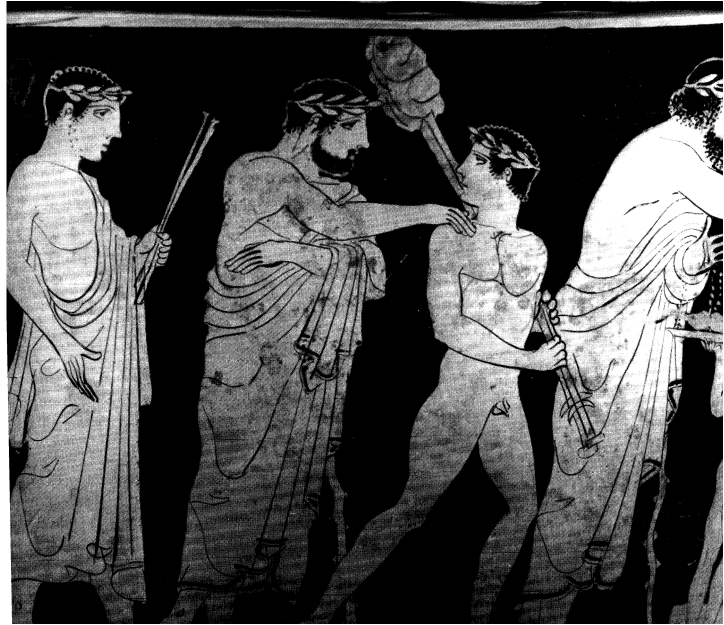
Attic vase painting of an older man making an approach to a younger one at a sacrifice
(illustration R954 in Dover, Greek Homosecuality)
The Romans, who on balance were less tolerant of homosexual behaviour than the Greeks, saw sex between males as involving outright dominance andsubmission and acceptance of the passive role was the main cause of shame. Hence Julius Caesar’s eagerness to deny that he had, as a young man, been the passive partner in a relationship with King Nicomedes of Bithynia. Within the Roman army, gay sex was a capital offence, although older men did nevertheless sometimes prey on their juiors. A relative of Gaius Marius, the general credited with reorganising the army to meet the threat from Germanic invaders at the end of the 2nd century BC, was killed by a young soldier resisting his advances. Marius’s reaction was to reward the soldier. Young officers were also sometimes advised to grow beards as soon as possible to discourage unwelcome attention.
It is well-known that the Emperor Hadrian took a strong interest in young males, particularly with his favourite, Antinous, whom he had deified after his death in mysterious circumstances on the Nile. Marcus Aurelius implicitly rebukes him for this in his Meditationes (see note 41 to the on-line edition of the Scholz-Pavur Latin version at https://linguae.weebly.com/marcus-aurelius.html ) It should be noted, however, as an older man in a relationship with a younger man who was far below him in the social scale, Hadrian’s conduct would have been less shocking than what was alleged of Julius Caesar.
(illustration R954 in Dover, Greek Homosecuality)
The Romans, who on balance were less tolerant of homosexual behaviour than the Greeks, saw sex between males as involving outright dominance andsubmission and acceptance of the passive role was the main cause of shame. Hence Julius Caesar’s eagerness to deny that he had, as a young man, been the passive partner in a relationship with King Nicomedes of Bithynia. Within the Roman army, gay sex was a capital offence, although older men did nevertheless sometimes prey on their juiors. A relative of Gaius Marius, the general credited with reorganising the army to meet the threat from Germanic invaders at the end of the 2nd century BC, was killed by a young soldier resisting his advances. Marius’s reaction was to reward the soldier. Young officers were also sometimes advised to grow beards as soon as possible to discourage unwelcome attention.
It is well-known that the Emperor Hadrian took a strong interest in young males, particularly with his favourite, Antinous, whom he had deified after his death in mysterious circumstances on the Nile. Marcus Aurelius implicitly rebukes him for this in his Meditationes (see note 41 to the on-line edition of the Scholz-Pavur Latin version at https://linguae.weebly.com/marcus-aurelius.html ) It should be noted, however, as an older man in a relationship with a younger man who was far below him in the social scale, Hadrian’s conduct would have been less shocking than what was alleged of Julius Caesar.
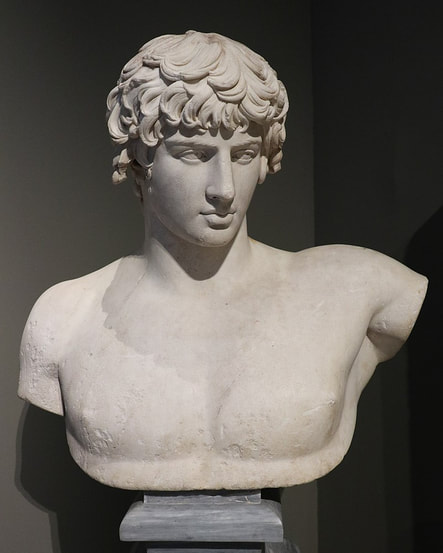
Bust of Antinous
By George E. Koronaios - Own work, CC BY-SA 4.0, https://commons.wikimedia.org/w/index.php?curid=113443066
Hillary had decided to study at the Sapienza University of Rome as this has a higher research ranking than Durham and St.Andrews which had also accepted her. Although an Italian University, Sapienza offers a Latin course with English as the medium of instruction.
By George E. Koronaios - Own work, CC BY-SA 4.0, https://commons.wikimedia.org/w/index.php?curid=113443066
Hillary had decided to study at the Sapienza University of Rome as this has a higher research ranking than Durham and St.Andrews which had also accepted her. Although an Italian University, Sapienza offers a Latin course with English as the medium of instruction.

Sapienza Università di Roma
https://www.uniroma1.it/en
Hilary also mentioned that Suetonius refers to Nero participating in a threesome. She was probably thinking of chapter 26, in which it is claimed the emperor used to dress in an animal skin before assaultung the genitals of men and women tied to stakes and finally allowing himself to be penetrated by one of his freedmen. Nero’s alleged sexual habits, and those of other emperors, are conveniently (and sceptically) itemised at https://alexandermeddings.com/history/ancient-history/vidi-vici-veni-the-sex-lives-of-the-caesars/#Sixth_Point_Header
Monica told us that she had been inspired to learn Latin by reading the Hong Kong commentator Fung Hei Kin’s’馮睎乾十三維度column. This was originally published in the now-defunct Apple Daily but the author, who has moved to the UK, is continuing it on his Facebook Page at https://www.facebook.com/epinoia2020/ She also mentioned some editions of poets (ie.g. the Fasti of Ovid) with Latin text and Chinese translation. A collection of texts with Chinese translations and-or notes is available on the Dickinson College site at https://dco.dickinson.edu/
https://www.uniroma1.it/en
Hilary also mentioned that Suetonius refers to Nero participating in a threesome. She was probably thinking of chapter 26, in which it is claimed the emperor used to dress in an animal skin before assaultung the genitals of men and women tied to stakes and finally allowing himself to be penetrated by one of his freedmen. Nero’s alleged sexual habits, and those of other emperors, are conveniently (and sceptically) itemised at https://alexandermeddings.com/history/ancient-history/vidi-vici-veni-the-sex-lives-of-the-caesars/#Sixth_Point_Header
Monica told us that she had been inspired to learn Latin by reading the Hong Kong commentator Fung Hei Kin’s’馮睎乾十三維度column. This was originally published in the now-defunct Apple Daily but the author, who has moved to the UK, is continuing it on his Facebook Page at https://www.facebook.com/epinoia2020/ She also mentioned some editions of poets (ie.g. the Fasti of Ovid) with Latin text and Chinese translation. A collection of texts with Chinese translations and-or notes is available on the Dickinson College site at https://dco.dickinson.edu/

Chris Y talked about the proliferation of law schools in California (thousands!) against perhaps only 26 in Canada. About half of USA law graduates fail to get law jobs, He also explained that `civil law’ was used as a technical term for code-based systems (as opposed to precedent-based common law). Quebec’s was the last French legal system to move on from the Code Napoleon and both Quebec and Louisiana are still using civil law systems.
The English common law system, which had developed out of older tradition of trial by combat, for many centuries ran in parallel with the ecclesiastical courts. The independence of the church courts was cut back under Henry VIII in the 16th century, but Chris thought they had survived as a separate branch until brought under full state control in the next century. A later chek via Goolge revealed that church courts were actually abolishded in 1641 and although re-instated in 1661, but their functions were progressively reduced. Nevertheless jurisdiction in cases of divorce and probate and over `brawling’ on church properyt was only finally abolished in the 19th century.
Lily brought up the theory of humours – the belief that the body contained a balance of physical substances, each with its corresponding temperament: sanguine, melancholy, choleric and phlegmatic. This theory, which held sway in euroipe down to the 17th century, may have originated in ancient Egypt but was systematised by Greek thinkers, in particular Hippocrates and Galen, who identified four humours with bodily fluds – blood, black bile, yellow bile and phlegm, See the account at https://en.wikipedia.org/wiki/Humorism
The English common law system, which had developed out of older tradition of trial by combat, for many centuries ran in parallel with the ecclesiastical courts. The independence of the church courts was cut back under Henry VIII in the 16th century, but Chris thought they had survived as a separate branch until brought under full state control in the next century. A later chek via Goolge revealed that church courts were actually abolishded in 1641 and although re-instated in 1661, but their functions were progressively reduced. Nevertheless jurisdiction in cases of divorce and probate and over `brawling’ on church properyt was only finally abolished in the 19th century.
Lily brought up the theory of humours – the belief that the body contained a balance of physical substances, each with its corresponding temperament: sanguine, melancholy, choleric and phlegmatic. This theory, which held sway in euroipe down to the 17th century, may have originated in ancient Egypt but was systematised by Greek thinkers, in particular Hippocrates and Galen, who identified four humours with bodily fluds – blood, black bile, yellow bile and phlegm, See the account at https://en.wikipedia.org/wiki/Humorism
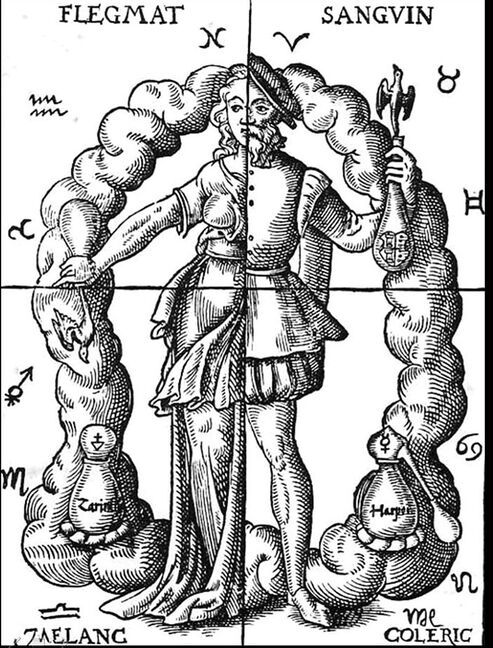
16th century German illustration of the four humours
https://en.wikipedia.org/wiki/Humorism#/media/File:Quinta_Essentia_(Thurneisse)_illustration_Alchemic_approach_to_four_humors_in_relation_to_the_four_elements_and_zodiacal_signs.jpg
https://en.wikipedia.org/wiki/Humorism#/media/File:Quinta_Essentia_(Thurneisse)_illustration_Alchemic_approach_to_four_humors_in_relation_to_the_four_elements_and_zodiacal_signs.jpg
There is a tradition in Europe of calling outsiders by the name of a food they eat, the British, for example, referring to the French as `Frogs’ and the Germans as `Krauts.’ Chris wondered if the French still used used `les rosbifs’ as a label for the British. John thought it was still in vogue when he himself was studying French at secondary school in the 1960s but that was hardly evidence for current usage!
Tanya was interested in a reference in Robert Harris’s Cicero trilology to the consuls being in charge of the state in alternate months. John was doubtful if this was a standard arrangement, but he recalled that in 216 BC the consuls led the army on alternate days. The more cautious of the two
was thus unable to veto his headstrong colleague’s decision to fight a disastrous conventional engagement against Hannibal at Cannae, which resulted in a catastrophic Roman defeat..
There was a brief discussion of the etiquette of kissing, with the suggestion that in some cultures kissing on the cheeks was seen as a sign of equalty whilst you kissed someone beneath you on the cheek. In modern Europe, ghowever, kissing on the cheek is a sign of affection and kissing on the lips definitely sexual, as illustrated later in the year when a furore broke out over a male football official kissing a female player on the lips after the Spanish women’s team’s championship win!
Sam wondered why the closing of the gates of the Temple of Janus, traditionally supposed to have been founded by Rome’s second king, Numa Pompilius, was the official symbol that Rome was at peace, The ancients themselves seem to have been puzzled about this but the commonest view was that the psprit of discord was imprisoned withn the closed temple. The Wikipedia article has the following:
The Gates themselves were the main purpose for the Temple of Janus. The opening and closing of the gates were to symbolize either wartime or peace. The Temple of Janus tied in warfare and religious tradition. It is unanimously held by ancient and modern scholars that the gates were closed in peace and opened in times of war.[6][7][8] While its purpose is agreed upon the reasons behind the openings and closings of the gates are much murkier. Both Virgil and Ennius state that the gates held in Discord and Fury inside the temple during times of peace. Ennius's Annales state "After foul Discord has broken open the iron-clad posts and gates of war".[6] Virgil supports this view with "There are twin gates of War ... Janus the guard does not withdraw from his threshold".[6] Horace does not use prison imagery but can be interpreted as saying peace, or is Janus himself is kept in the temple locked into the temple.[6] This lack of clarity by the Romans themselves demonstrates the fluctuating nature of their mythos-history. However, a Roman viewed the Temple of Janus's gates as having them shut was a time of celebration and of pride for the rulers of Rome. As demonstrated by Caesar Augustus's accounts of shutting the doors three times.[9]
VĪTA NERŌNIS, XI-XV
XĪ. Spectāculōrum plūrima et varia genera ēdidit: iuvenālēs, circēnsēs, scaenicōs lūdōs,
Of-shows very-many and various kinds he-put-on games of Youth circus races stage plays
gladiātōrium mūnus. Iuvenālibus[1] senēs quoque cōnsulārēs anūsque mātrōnās recēpit
gladiatorial contest at-theYouth-games old-men also of-consular-rank and-old married-women he-recruited
ad lūsum. Circēnsibus loca equitī sēcrēta ā cēterīs tribuit commīsitque etiam camēlōrum[2]
for taking-part at-circus-events places for-Knights separate from othets he-assigned and-commissioned also of-camels
quadrīgās. Lūdis, quōs prō aeternitāte imperiī susceptōs appellārī "maximōs" voluit[3], ex
teams-of-four at-games which for Eternity of-the-Empire staged to-be-called `Greatest he-wished from
utrōque ōrdine[4] et sexū plērīque lūdicrās partēs sustinuērunt; nōtissimus eques Rōmānus
each order and sex many in-games parts played a-very-well-known knight Roman
elephantō supersīdēns per catadromum dēcucurrit;[5] inducta Afrānī togātā,[6] quae
on-elephant sitting along tight-rope rode-down [was] staged of-Afranius Roman-comedy which
Incendium īnscrībitur, concessumque ut scaenicī ārdentis domūs supellectilem dīriperent
`The Fire’ is-titled and -allowed-it-was that players of-burning house furniture should-snatch-away
ac sibi habērent; sparsa et populō missilia omnium rērum per omnēs diēs: singula cotīdiē
and for-selves have scattered also for-people presents of-all things through all days one daily
NOTES
[1] These were held in 59, apparently to celebrate the occasion of Nero’s first shaving, as explained further in chapter 12.
[2] Camels were used throughout the Roman Empire, even probably in Britain, as beasts of burden. The Loeb translator plausibly assumes that Nero recited his own compositions.
[3] The Romans used the word lūdī for a range of public performances, including both games in our sense and plays (scaenicī lūdī). There is some inconsistency in the ancient terminology but the regular, annual games were generally known as lūdī Rōmānī and those held for a special occasion magnī lūdī. (see https://en.wikipedia.org/wiki/Ludi_Romani) Nero used the term maximī to show this occasion was particularly special.
[4] That is from both the senatorial and the equestrian order.
[5] The display of rope-walking elephants had apparently been started by the future emperor Galba when he was praetor in about 30 A,D.(Suetonius, Galba, c.6) and Seneca writes of making an elephant walk along a rope (singular) as if it were commonplace (Epist.85.41) Accounts may have been exaggerated and the elephants walked on parallel ropes rather than balancing on one, an interpretation supported by Cassius Dio’s (62:17) use of the plural (ἐλέφας ἀνήχθη ἐς τὴν ἀνωτάτω τοῦ θεάτρου ἁψῖδα, καὶ ἐκεῖθεν ἐπὶ σχοινίων κατέδραμεν ἀναβάτην φέρων, `an elephant was brought up to the highest tier of the theatre and from there ran down on ropes, carrying a rider’). Alternatively, the rope was very thick or catadromus, a Greek loanword, referred to a slide, as κατάδρομος pobably could.
[6] A fābula togāta (`play in a toga’) portrayed Roman life in contrast to the fābulae palliātae of Plautus and Terence, based on Greek originals. No complete example of this genre has survived, but Lucius Afranius, who wrote around the beginning of the 1st centure B.C. was considered its best exponent. Quintilian (c.35 – c.10 A.D.), an influential rhetorician and literary critic, praised his style but objected to plots polluted puerōrum foedīs amōribus, usually undertood to mean `by disgraceful sexual affairs with boys’ . See https://en.wikipedia.org/wiki/Lucius_Afranius_(poet) and, for the suggestion that the reference might be to boys’ love affairs with girls rather than to older men’s relation with boys, Jarrett Welsh’s 2010 Classical Quarterly article at https://www.jstor.org/stable/40984742
mīlia[1] avium cuiusque generis, multiplex penus, tesserae frūmentāriae, vestis, aurum,
thousands of-birds of-every kind of-many-sorts food tickets for-grain clothing gold
argentum, gemmae, margarītae, tabulae pictae, mancipia, iūmenta atque etiam mānsuētae
silver jewels pearls paintings slaves beasts-of-burden and even tamed
ferae, novissimae nāvēs, īnsulae, agrī.
wild-animals brand-new boats apartment-blocks fileds
XII. Hōs lūdōs spectāvit ē prōscaenī[2] fastīgiō. Mūnere, quod in amphitheātrō ligneō regiōne
These games he-watched from of-prosceniun top in-gladiatorial-show which in amphitheater wooden in-region
Mārtiī campī intrā annī spatium fabricātō dedit, nēminem occīdit, nē noxiōrum quidem.
of-Mars of-Field within of-year space constructed he-gave nobody he-killed not of-criminals even
Exhibuit autem ad ferrum[3] etiam quadringentōs senātōrēs sēscentōsque equitēs Rōmānōs et
He-put-on-show also for iron also four-hundred sneators and-six-hundred knights Roman and
quōsdam fortūnae atque exīstimātiōnis integrae, ex īsdem ōrdinibus cōnfectōrēs quoque
certain-people of-wealth and reputation unblemished from same orders slayers also
ferārum et varia harēnae ministeria. Exhibuit et naumachiam marīnā aquā innantibus bēluīs;
of-wild-beasts and various of-arena functionaries he-put-on also naval-battle with-sea water with-swimming beasts
item pyrrichās[4] quāsdam ē numerō ephēbōrum,[5] quibus post ēditam operam diplōmata
also pyrric-dances certain from number of-ephebes to-whom after performed work certificates
cīvitātis Rōmānae singulīs optulit. Inter pyrricharum argūmenta taurus Pāsiphaam ligneō
of-citizenship Roman to-each he-offered among of-pyrric-dances scenes bull Pasiphae in-wooden
iuvencae simulācrō abditam iniit, ut multī spectantium crēdidērunt; Īcarus prīmō statim
of-heifer replica hidden entered as many of-those-watching believed Icarus at-first immediately
cōnātū iuxtā cubiculum eius dēcidit ipsumque cruōre respersit.[6] Nam perrārō praesidēre,
attempt next-to box his fell and-[Nero]-himself with-blood splattered for very-rarely he-presided
NOTES
[1] singula..mīlia is literally `individually-distributed thousands’, ie. a thousand each day.
[2] The Greek προσκήνιον literally means `[that which is] in front of the (tent)’, referring to the tent (σκηνή ) from which the actors emerged in the earliest theatres. The word later came to mean either the stage itself or a screen which was placed in front of the tent and later developed into the elaborate stone structure that formed a backdrop in Hellenistic and Roman theatres (see LSJ s.v. and Smith’s Dict. at https://www.perseus.tufts.edu/hopper/text?doc=theatrum-cn&fromdoc=Perseus%3Atext%3A1999.04.0063 ) Suetonius almost certainly here means bythe Greek word the structure at the back of the stage but, as Latin scaena (σκηνή ) was used for the stage itself, prōscaenium seems also sometimes to have referred to the wall at the front of the stage and the phrase scaenae frōns (forehead of the stage) been used instead for the backdrop (see https://en.wikipedia.org/wiki/Proscenium.)
[3] i.e. to fight with iron weapons like gladiators. Traditional opinion among the Roman elite regarded both fighting as a gladiator and performing on stage as disreputable activities and both Nero’s personal performances and his making high-status Romans greatly angered the aristocracy even if the lower classes enjoyed the show! See John Mouratidis, `Nero: The Artist, the Athlete and His Downfall’, Journal of Sport History, 12(1), 1985, pp. 5-20, https://www.jstor.org/stable/43606900.
[4] A pyrricha was originally a Greek war dance with weapons but it came later to refer to include also dances acting out scenes from mythology.
[5] Ephebus or ephebe was both a general term for a male Greek adolescent and a specific one for youngsters between the ages of 18 to 20 undergoing organised military training. The Loeb editor notes that training of that sort survived on the island of Capri in the Bay of Naples, but, as all free-born Italians were by this time Roman citizens, Nero’s performers were probably from Greece proper.
[6] Pasiphae, the wife of Minos, was made by Neptune to lust after a bull, which her husband had failed to sacrifice to the god. She used a wooden casing in the shape of a cow to trick the animal into mating with her. Suetonius is, however, right to doubt whether the animal in the theatre coupled with a human inside the stage prop. Icarus fell to his death when the sun melted the wax in the wings his father had made so they could escape from Crete. Unless the death on stage was an accident, the actor playing him would have been a condemned criminal. Nero’s cubiculum was a box for the imperial party.
cēterum accubāns parvīs prīmum forāminibus, deinde tōtō podiō[1] adapertō spectāre
but lying-nearby through-small at- first holes then with-whole balcony opened-up to-watch
cōnsuēverat. 3. Īnstituit et quīnquennāle certāmen prīmus omnium Rōmae mōre Graecō
he-was-accustomed he-established also quinquennial contest first of-all at-Rome in-manner Greek
triplex, mūsicum gymnicum equestre, quod appellāvit Nerōnia;[2] dēdicātīsque thermīs atque
triple nusical gymnastic equestrian which he-called the-Neronia and-haing-been-dedicated baths and
gymnasiō[3] senātuī quoque et equitī oleum praebuit. Magistrōs tōtō certāminī praeposuit
gymnasium to-senate also and knights oil he-provided as-masters for-whole contest he-placed-in-charge
cōnsulārēs sorte, sēde praetōrum. Deinde in orchēstram senātumque dēscendit et ōrātiōnis
ex-consuls by-lot in-seat of-praetors then into orchestra and-senate he-descended and of-oratory
quidem carminisque Latīnī corōnam, dē quā honestissimus quisque contenderat, ipsōrum
indeed and-verse Latin crown for which most-eminent-person each had-striven of-these-themselves
cōnsēnsū concessam sibi recēpit, citharae autem ā iūdicibus ad sē dēlātam adōrāvit ferrīque
consent granted for-himself he-accepted of-lyre[prize] however by judges to-him brought he-worshipped and-to-be-taken
ad Augustī statuam iussit. Gymnicō, quod in Saeptīs[4] edēbat, inter būthysiae apparātum
to of-Augustus statue he-ordered at-gymnastic-contest which in Saepta he-gave amidst of-oxen-sacrifice splendour
barbam prīmam posuit conditamque in auream pyxidem et pretiōsissimīs margarītīs
beard first he-shaved and-laid in golden cask and with-most-precious pearls
adōrnātam Capitōliō cōnsecrāvit. Ad āthlētārum spectāculum invītāvit et virginēs Vestālēs,
adorned on-Capitol he-consecrated to of-athletes display he-invited also virgins Vestal
quia Olympiae quoque Cereris sacerdōtibus spectāre concēditur.[5]
because at-Olympia also of-ceres to-priesrtesses to-watch it-is-allowed
NOTES
[1] The podium, on part of which the emperor’s box was built, was the top of the wall between the spectators and the arena.
[2] The Neronia were instituted in 60 A.D. and intended to be held every four years (Suetonius uses quīnquennāle because he includes the games at both the beginning and end of a cycle). They did not survive their founder. See J. D. P. Bolton, `Was the Neronia a Freak Festival?’ The Classical Quarterly, 42(3/4 ), 1948, pp. 82-90, https://www.jstor.org/stable/636569 The term mūsicum covered prose and poetry as well as music in our sense,
[3] Nero constructed the Thermae Nerōnis and an adjacent gymnasium on the Campus Martius. The boaths were restored by the emperor Alexander Severus in the 3rd century and then known as the Thermae Alexandīnae. The site is covered over by modern buildings but some of its pillars were re-used in restoration of the neaby Pantheon in the 17th century and two others placed against the wall of the church of Sant’Eustachio. See https://en.wikipedia.org/wiki/Baths_of_Nero
[4] The Saepta Julia was a buiding planned by Julius Caesar to replace an older precint on the Campus Martius whgere citizens gathered to cast their votes. Completed under Augustus, it was no longer needed for its original purpose when Tiberius transferred elections from the popular assemblies to the senate. See the article from Platner’s Topographical Dictionary of Rome (1929): https://penelope.uchicago.edu/Thayer/E/Gazetteer/Places/Europe/Italy/Lazio/Roma/Rome/_Texts/PLATOP*/Saepta_Julia.html
[5] Women were not normally allowed to watch Greek athletic contests, mainly because the athletes competed in the nude. Under the republic, the Romans disapproved strongly of public nudity, even in all-male settings, but contestants at the Greek-style games at the Augustalia, a festival inaugurated by Augustus in 2 A.D., may have been naked, which would esplain the prohibition on women attending these. Nigel B. Crowther, (`Nudity and Morality: Athletics in Italy’, The Classical Journal 6(2),1980 -81, pp. 119-123 https://www.jstor.org/stable/3297374) believes that nudity in sports was accepted by the end of Tiberius’reign (37 A.D.). Although Augustus is said to have ordered the execution of some men for being naked in front of his wife, later un the 1st century A.D. nude bathing with men and women together became acceptable. However, Hadrian, who reigned from 117 to 138, ordered separation of the sexes.
XIII. Nōn immeritō inter spectācula ab eō ēdita et Tīridātīs[1] in urbem introitum rettulerim.
Not without-reason among spectacle by him put-on also of-Tiridates into city entrance I-may-relate
Quem Armeniae rēgem magnīs pollicitātiōnibus sollicitātum, cum dēstinātō per ēdictum diē
him of-Armenia king with-great promises induced when on-fixed by proclamation day
ostēnsūrus populō propter nūbilum distulisset, prōdūxit quō opportūnissimē potuit, about-to-display to-people because of-cloudy-weather he-had-postponed he-produced as-soon-as he-could
dispositīs circā Forī templa armātīs cohortibus, curūlī[2] residēns apud rōstra triumphantis
having-been-stationed around of-forum temples armed cogorts on-curile-chair sitting at rostra of-one-triumphing
habitū inter signa mīlitāria atque vēxilla. Et prīmō per dēvexum pulpitum subeuntem admīsit
clothing among standards milirary and flags and first along sloping platform coming-up he-received
ad genua adlevātumque dextrā exōsculātus est, dein precantī tiārā dēductā diadēma inposuit,
at knees and-raised-up with right-hand kissed then on-him-supplicating with-turban removed diadem placed
verba supplicis interpretāta praetōriō virō multitūdinī prōnūntiante; perductum inde in
words of-suppliant translated with-of-praetorian-rank man to-crowd proclaiming [him] led then into
theātrum ac rūrsus supplicantem iuxtā sē latere dextrō conlocāvit. Ob quae Imperātor[3]
theatre and again supplicating next-to himself on-side right he-placed got thi as-imperator
cōnsalūtātus, laureā in Capitōlium lāta, Iānum geminum[4] clausit, tamquam nūllō residuō bellō.
hailed with-laurel-wreath to Capitol brought Janus double he-closed as with-no remaining war
XIV. Cōnsulātus quattuor gessit: prīmum bimenstrem, secundum et novissimum sēmēnstrēs,
Consulships four he-held first of-two-months second and last of-six-months
tertium quadrimenstrem; mediōs duōs continuāvit, reliquōs inter annua spatia variāvit.[5]
third of-four-months middle two he-held-consecutively others among of-as-year intervals he-varied
NOTES
[1] Tiridates, the brother of the king of Parthia, had been driven out of the buffer kingdom of Armenia by a Roman army but in 68 Nero allowed him to retain his throne in return for recognition of Roman suzerainty.
[2] A chair inlaid with ivory on which a seniot magistrate traditionally sat.
[3] Literally meaning `giver of commands’, imperātor might mean simply `general’, `emperor’ or (as here), `conquering general.’
[4] The twin doors of the temple of Janus in the Forum remained open as long as Rome was at war.
[5] A rather odd way to say `he held after intervals of a year.’ Nero was consul in 55, 57, 58 and 60.
XV. In iūris dictiōne postulātōribus nisi sequentī diē ac per libellōs nōn temerē[1] respondit.
In of-justice administration to-plaintiffs except on-following day and through writing hardly ever he-replied
Cognōscendī mōrem eum tenuit, ut continuīs āctiōnibus omissīs singillātim quaeque
Of-investigation manner this he-maintained that with-continous presentations disallowed one-by-one each[of-the-details]
per vicēs ageret.[2] Quotiēns autem ad cōnsultandum sēcēderet, neque in commūne quicquam
by turns he-dealt-with whenever moreover for consultation he-withdrew neither in common anything neque prōpalam dēlīberābat, sed [et][3] cōnscrīptās ab ūnō quōque sententiās tacitus ac sēcrētō
nor openly he-used-to-deliberate but written by one each opinions in-silence and secretly
legēns, quod ipsī libuisset perinde atque plūribus idem vidērētur prōnūntiābat. 2. In
reading what himself had-pleased just-as if to-majority same-thing seemed-right he-would-announce into
cūriam lībertīnōrum fīliōs diū nōn admīsit; admissīs ā priōribus prīncipibus honōrēs
senate-house of-freedmen sons for-a-long-time not he-admitted to-those-admitted by earlier emperors offices
dēnegāvit.[4] Candidātōs, quī suprā numerum essent, in sōlācium dīlātiōnis ac morae
he-denied candidates who above number [of-vacancies] were in consolation of-postponement and delay
legiōnibus[5] praeposuit. Cōnsulātum in sēnōs plērumque mēnsēs dedit. Dēfūnctōque circā
of-legions he-put-in-charge consulship for each-for-six generally months he-gave and-having-died around 1st
Kal. Ian. alterō ē cōnsulibus nēminem substituit improbāns exemplum vetus Canīnī Rebilī
1st January one from consuls nobody he-substituted disasapproving example old of-Caninius Rebilus
ūnō diē cōnsulis.[6] Triumphālia ōrnāmenta[7] etiam quaestōriae dignitātis et nōnnūllis ex
for-one day consul triumphal honours even [to-those-]of-quaestorial rank and to-some from
equestrī ōrdine tribuit nec utique dē causā mīlitārī. Dē quibusdam rēbus ōrātiōnēs ad
equestrian order he-awarded and-not exclusively for reason military about certain things speeches to
senātum missās praeteritō quaestōris officiō per cōnsulem plērumque recitābat.[8]
Senate sent in-past of-quaestor with-duty though consul generally he-used-to-deliver
NOTES
[1] nōn temerē means liteally `not rashly’ but is functionally equivalent to `not easily’ or `hardly ever.’ Nero almost always took time to consider cases carefully,
[2] Instead of allowing each side to present its full case in one go, he required them to raise one point at a time, allowing the other side to reply immediately,
[3] The `et’ is probably a copyist’s mistake.
[4] Nero perhaps acted out of regard for elite resentment of the success of freedmen and their families.
[5] Dative object with a compound verb. Tacitus (Ann.XIV.28) records three such appointments when there were fifteen candidates for the twelve annual praetorships.
[6] Caesar’s appointment of Gaius Caninius Rebilus, one of his former officers, to complete the term of a consul who had died on the last day of 45 B.C.is sarcastically recounted in a letter of Cicero’s: “At one o'clock, Caesar announced the election of a consul to serve until 1 January, the next morning. So I can inform you that in Caninius' consulship, no one had lunch. Still, nothing untoward occurred while he was consul: such was his vigilance that throughout his consulship, he did not sleep a wink.”(Ad Fam. VII.30) https://penelope.uchicago.edu/~grout/encyclopaedia_romana/miscellanea/trivia/consul.html
[7] From Augustus’ time, full triumphs with a procession through the city were only for members of the imperial family but others could be granted the dress and other privileges of a triumphing general.
[8] Nero had his speeches read for him by a consul rather than a quaestor, who was a magistrate of lower rank. The phrase dē quibus rēbus might have been a copyist’s sub-title which was accidentally incorporated in the main text.

_illustration_Alchemic_approach_to_four_humors_in_relation_to_the_four_elements_and_zodiacal_signs.jpg)