| linguae |
|
EUTROPIUS - BREVIARIUM HISTORIAE ROMANAE
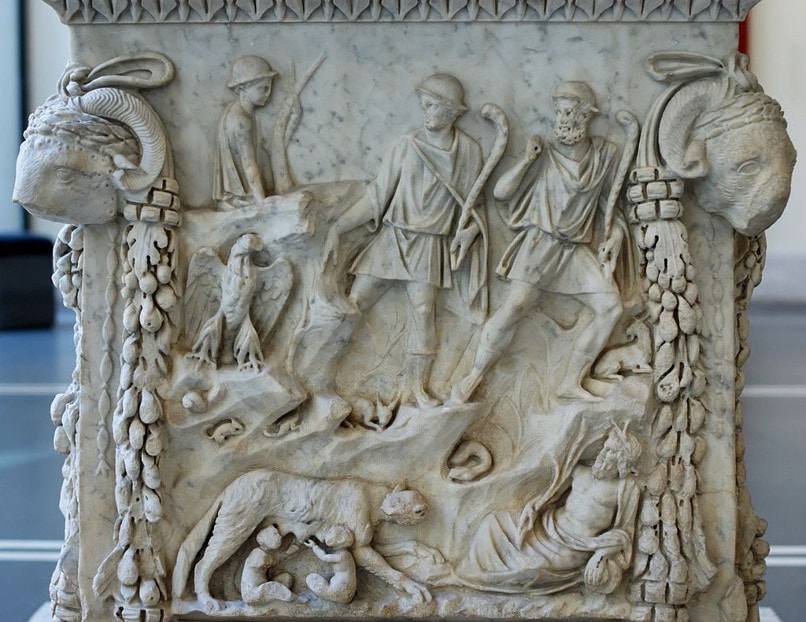
Romulus and Remus with the Lupercal (`wolf-cave’) at the foot of the Palatine where they were believed to have been fed by a wolf as infants (early 2nd cent. A.D.)
https://commons.wikimedia.org/wiki/File:Altar_Mars_Venus_Massimo.jpg
https://commons.wikimedia.org/wiki/File:Altar_Mars_Venus_Massimo.jpg
Eutropius probably wrote his summary of Roman history in winter 369-370 A.D. at the request of Valens, the ruler of the eastern half of the empire since 364. His work covered the period from the foundation of the city, traditionally placed in 753 B.C., up till Valens' own accession. For events before his own lifetime, he relied principally on Livy and then probably on a lost work conventionally known as the Kaisergeschichte ("History of the Emperors"), which the German scholar Alexander Enmann plausibly argued lay behind the commonalities between Eutropius's own account and those of some of his contemporaries.
Valens and Eutropius's purpose was to boost Romans' confidence in their imperial destiny in preparation for another round in the struggle with Persia and there is thus a great emphasis on military triumphs. In addition, Eutropius, who was himself a senator at a time when the institution was regaining importance, shared the strong bias in favoyur of the senatorial aristocracy which characterised most of his sources. This led him to ignore important developments such as the reform efforts of the Gracchi brothers in 133-121 B.C., and also to heap fulsome praise on the dictator Sulla, who tried to shore up senatorial supremacy in the early 1st century B.C., and to denigrate his populist rival Marius. Eutropius also often ignored disasters in the reigns of emperors he admired, not mentioning the destruction of three legions by the Germans in 9 A.D. in his account of Augustus, and omitting the eruption of Vesuvius in 79 A.D. in his eulogistic portrayal of Titus'reign. Nonetheless, his straightforward Latin style have long made him a favourite choice for reading by those who have just completed a foundation course in the language.
This page is planned to make available the full text of the Breviarium with a word-for-word interlinear translation, notes and illustrations. A complete translation in idiomatic English is provided by H.W.Bird in his The Breviarium Ab Urbe Condita of Eutropius, which also contains an extensive introduction and notes; this can be partially previewed on the Internet and is also available from Book Depository and Amazon. Detailed notes are also provided in Hazzard's 1898 school edition, which can be freely downloaded from the Internet Archive. My own notes draw partly on both Bird and Hazzard as well as on more recent materials. Eutropius's own dates and those which Hazzard and I give are mostly traditional ones based on the Varronian chronology. However, because of an over-correction for missing entries in the lists of consuls which Varro depended on, these may generally be four years too high before the mid-4th century B.C; see Jona Lendering’s discussion at https://www.livius.org/articles/concept/varronian-chronology/. Thus, for example, the capture of Rome by the Gallic Senones, conventionally dated to 390 B.C. probably actually occurred in 387/386.
For Varro's life and works see the short essay on the Latinitium site and, for the sequence of consuls, which depends partly on his research and the earlier efforts of Atticus, the Wikipedia `List of Roman consuls'. This references T.J. Cornell, The Beginnings of Rome (London: Routeledge, 1995), pp. 399-402 and Gary Forsythe, A Critical History of Early Rome (Berkeley: University of California Press, 2006), pp. 368-70 and is slightly inconsistent with Lendering's account. Forsythe's succinct summary of the issue is in the appendix (`Early Roman Chronology') to his book and this can be accessed by searching in the preview on Amazon.
Other relevant resources on the Internet include John Selby Watson's annotated translation (1853). There is also a reading od part of book 2 (with rolling text and translation displayed on screen by Evan der Millner though the pronunciation is not quite as good as in the speakers own later materials.
The recordings accompanying my own translation have been rapidly made without any rehearsal or re-takes and are intended only as a rough guide to pronunciation . Note that in chapter 9 of Book 1 the oe of coercēret have been wrongly pronounced as a diphthong, when co is in fact a separate syllable and that in one or two places in other books cīvīle has been stressed incorrectly on the first rather than the second syllable. The recording of chapters 6-16 of Book 6 was made from Hazzard's text which differs slightly from the 1887 Teubner edition downloaded from the www.thelatinlibrary.com text and used in the Word files. In particular, Hazzard sometimes retains an original Greek accusative in -ēn where Teubner standardizes on Latin -em. In Book 8 chapter 3, Persidis (stressed on the first syllable) is wrongly pronounced as *Persīdis (stressed on the second),
Valens and Eutropius's purpose was to boost Romans' confidence in their imperial destiny in preparation for another round in the struggle with Persia and there is thus a great emphasis on military triumphs. In addition, Eutropius, who was himself a senator at a time when the institution was regaining importance, shared the strong bias in favoyur of the senatorial aristocracy which characterised most of his sources. This led him to ignore important developments such as the reform efforts of the Gracchi brothers in 133-121 B.C., and also to heap fulsome praise on the dictator Sulla, who tried to shore up senatorial supremacy in the early 1st century B.C., and to denigrate his populist rival Marius. Eutropius also often ignored disasters in the reigns of emperors he admired, not mentioning the destruction of three legions by the Germans in 9 A.D. in his account of Augustus, and omitting the eruption of Vesuvius in 79 A.D. in his eulogistic portrayal of Titus'reign. Nonetheless, his straightforward Latin style have long made him a favourite choice for reading by those who have just completed a foundation course in the language.
This page is planned to make available the full text of the Breviarium with a word-for-word interlinear translation, notes and illustrations. A complete translation in idiomatic English is provided by H.W.Bird in his The Breviarium Ab Urbe Condita of Eutropius, which also contains an extensive introduction and notes; this can be partially previewed on the Internet and is also available from Book Depository and Amazon. Detailed notes are also provided in Hazzard's 1898 school edition, which can be freely downloaded from the Internet Archive. My own notes draw partly on both Bird and Hazzard as well as on more recent materials. Eutropius's own dates and those which Hazzard and I give are mostly traditional ones based on the Varronian chronology. However, because of an over-correction for missing entries in the lists of consuls which Varro depended on, these may generally be four years too high before the mid-4th century B.C; see Jona Lendering’s discussion at https://www.livius.org/articles/concept/varronian-chronology/. Thus, for example, the capture of Rome by the Gallic Senones, conventionally dated to 390 B.C. probably actually occurred in 387/386.
For Varro's life and works see the short essay on the Latinitium site and, for the sequence of consuls, which depends partly on his research and the earlier efforts of Atticus, the Wikipedia `List of Roman consuls'. This references T.J. Cornell, The Beginnings of Rome (London: Routeledge, 1995), pp. 399-402 and Gary Forsythe, A Critical History of Early Rome (Berkeley: University of California Press, 2006), pp. 368-70 and is slightly inconsistent with Lendering's account. Forsythe's succinct summary of the issue is in the appendix (`Early Roman Chronology') to his book and this can be accessed by searching in the preview on Amazon.
Other relevant resources on the Internet include John Selby Watson's annotated translation (1853). There is also a reading od part of book 2 (with rolling text and translation displayed on screen by Evan der Millner though the pronunciation is not quite as good as in the speakers own later materials.
The recordings accompanying my own translation have been rapidly made without any rehearsal or re-takes and are intended only as a rough guide to pronunciation . Note that in chapter 9 of Book 1 the oe of coercēret have been wrongly pronounced as a diphthong, when co is in fact a separate syllable and that in one or two places in other books cīvīle has been stressed incorrectly on the first rather than the second syllable. The recording of chapters 6-16 of Book 6 was made from Hazzard's text which differs slightly from the 1887 Teubner edition downloaded from the www.thelatinlibrary.com text and used in the Word files. In particular, Hazzard sometimes retains an original Greek accusative in -ēn where Teubner standardizes on Latin -em. In Book 8 chapter 3, Persidis (stressed on the first syllable) is wrongly pronounced as *Persīdis (stressed on the second),

|
|
| ||||||
|
| ||||

|
| ||||
|
|
| ||||||||||||||||||||||||||||||||||||||
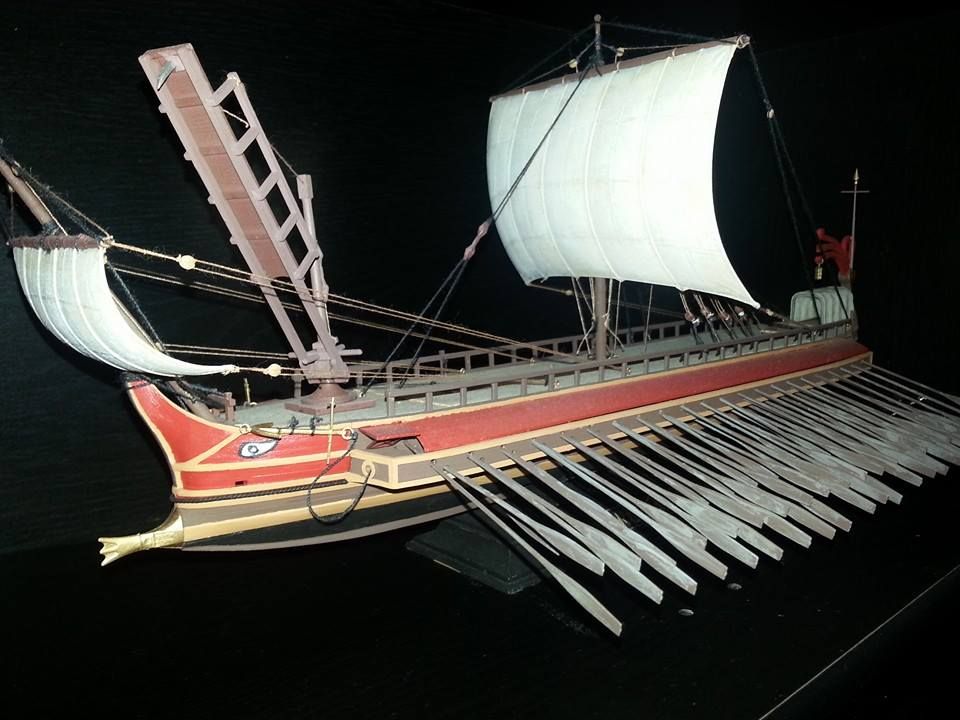
Roman warship with corvus (boarding bridge) and rostrum (battering ram) as used in the early stages of the 1st Punic War (264-241 B.C.) (Book 2)
Uploaded by Jeh Bruce, https://www.pinterest.com/pin/430867889325929458/
Uploaded by Jeh Bruce, https://www.pinterest.com/pin/430867889325929458/
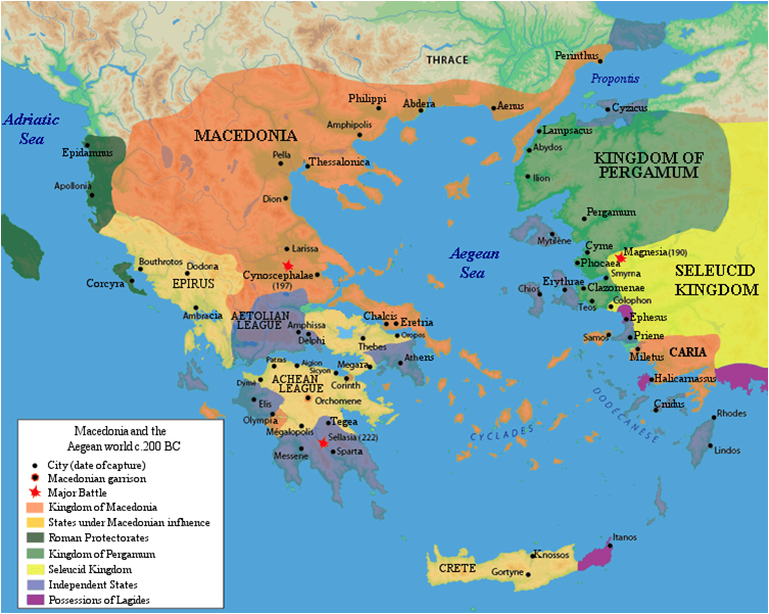
Macedonia and nighbours at the start of the 2nd. Macedonian War (areas in purple subject to the Ptolemaic (Lagid) dynasty of Egypt)
https://www.ancient.eu/image/4575/achaean-league-c-200-bce/
https://www.ancient.eu/image/4575/achaean-league-c-200-bce/
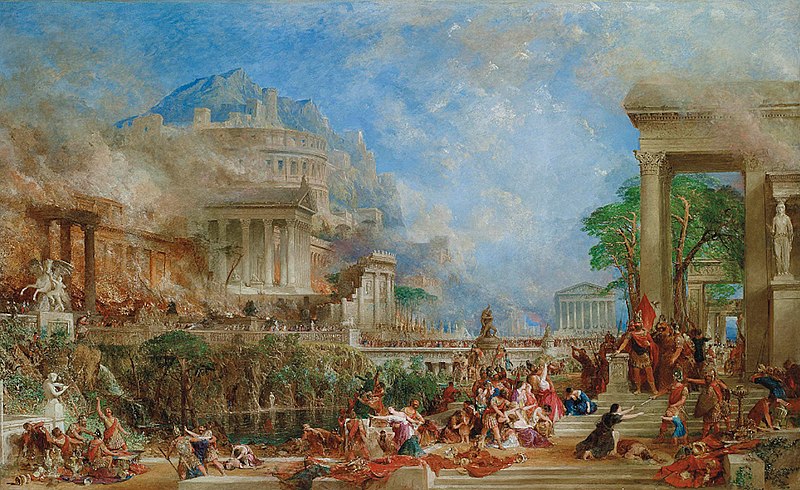
The Sack of Corinth (146 B.C.) as imagined by Thomas Allon (1872)
https://commons.wikimedia.org/wiki/File:The_Sack_of_Corinth_by_Thomas_Allom.jpg
https://commons.wikimedia.org/wiki/File:The_Sack_of_Corinth_by_Thomas_Allom.jpg
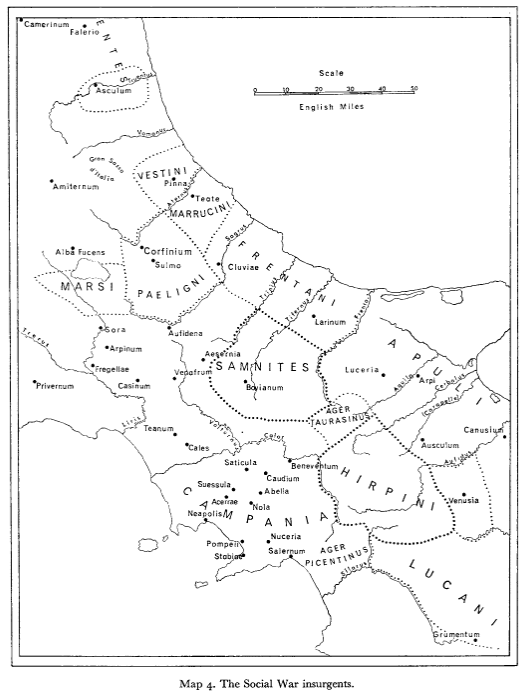
Ethnic groups who revolted against Rome in the Social War (91-88 B.C.)
From Salmon, Samnium and the Samnites
From Salmon, Samnium and the Samnites
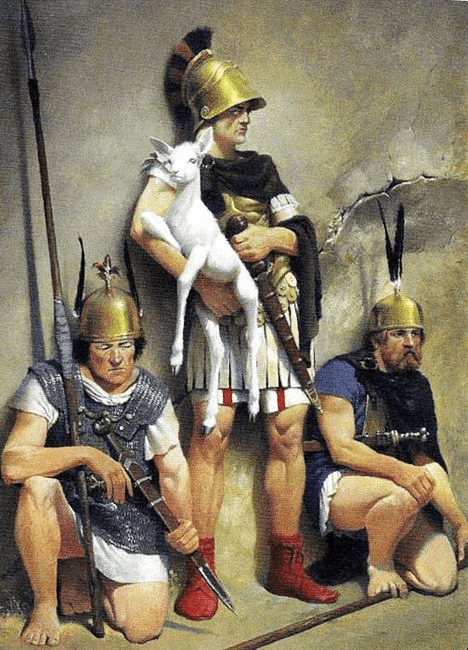
Quintus Sertorius, who held extensive territory in Spain against the Roman government in the 70's B.C., with the white deer supposed to bring him messages from the goddess Diana
https://arrecaballo.es/edad-antigua/guerras-civiles-romanas/quinto-sertorio-en-hispania/
https://arrecaballo.es/edad-antigua/guerras-civiles-romanas/quinto-sertorio-en-hispania/
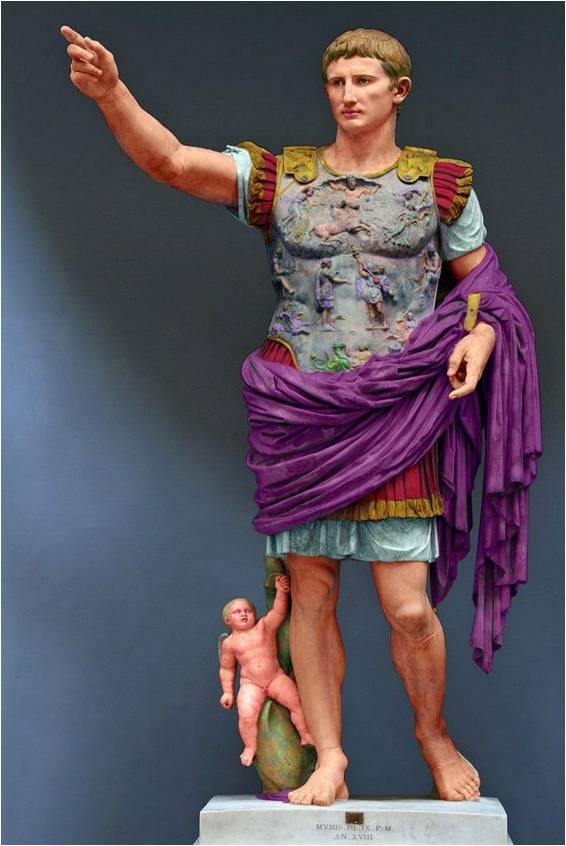
Statue of Augustus from Livia's villa at Prima Porta with colouring conjecturally restored (Book 6)
https://www.reddit.com/r/Colorization/comments/6qsdjq/augustus_caesar/?utm_source=ifttt
https://www.reddit.com/r/Colorization/comments/6qsdjq/augustus_caesar/?utm_source=ifttt
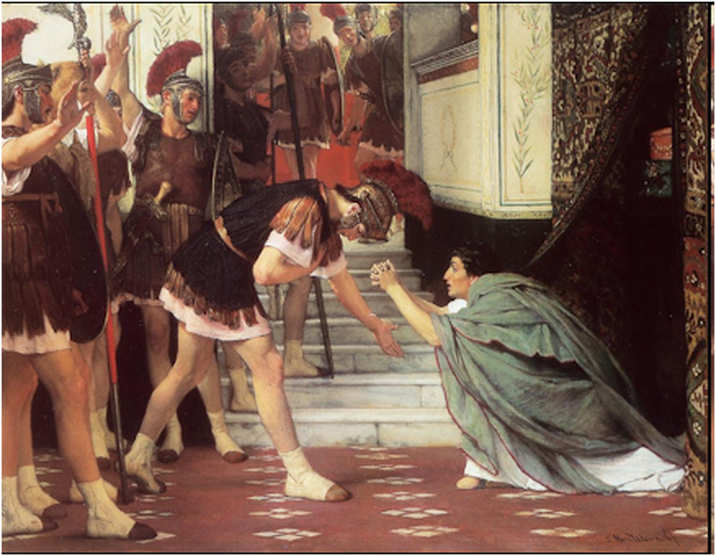
Claudius discovered hiding after the assassination of Caligula (Book 7)
https://www.ancient-origins.net/history-famous-people/praetorian-guards-serve-and-protect-roman-emperors-most-time-004230
https://www.ancient-origins.net/history-famous-people/praetorian-guards-serve-and-protect-roman-emperors-most-time-004230
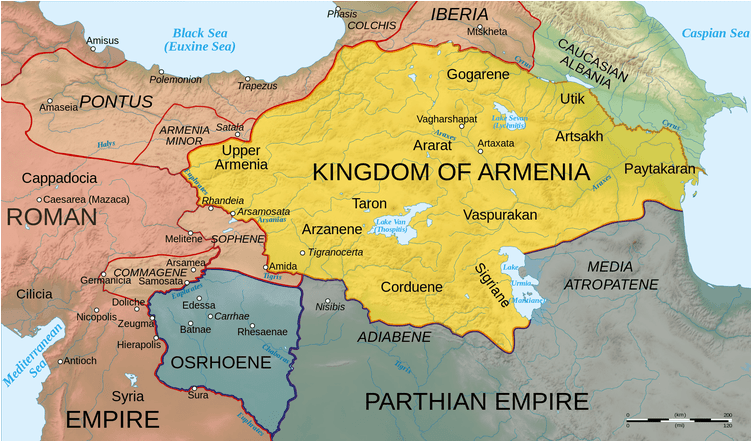
Trajan’s theatre of operations in 114-115 (Book 8)
http://history-moments.com/roman-empire/emperor-trajan-the-impossible-dream/
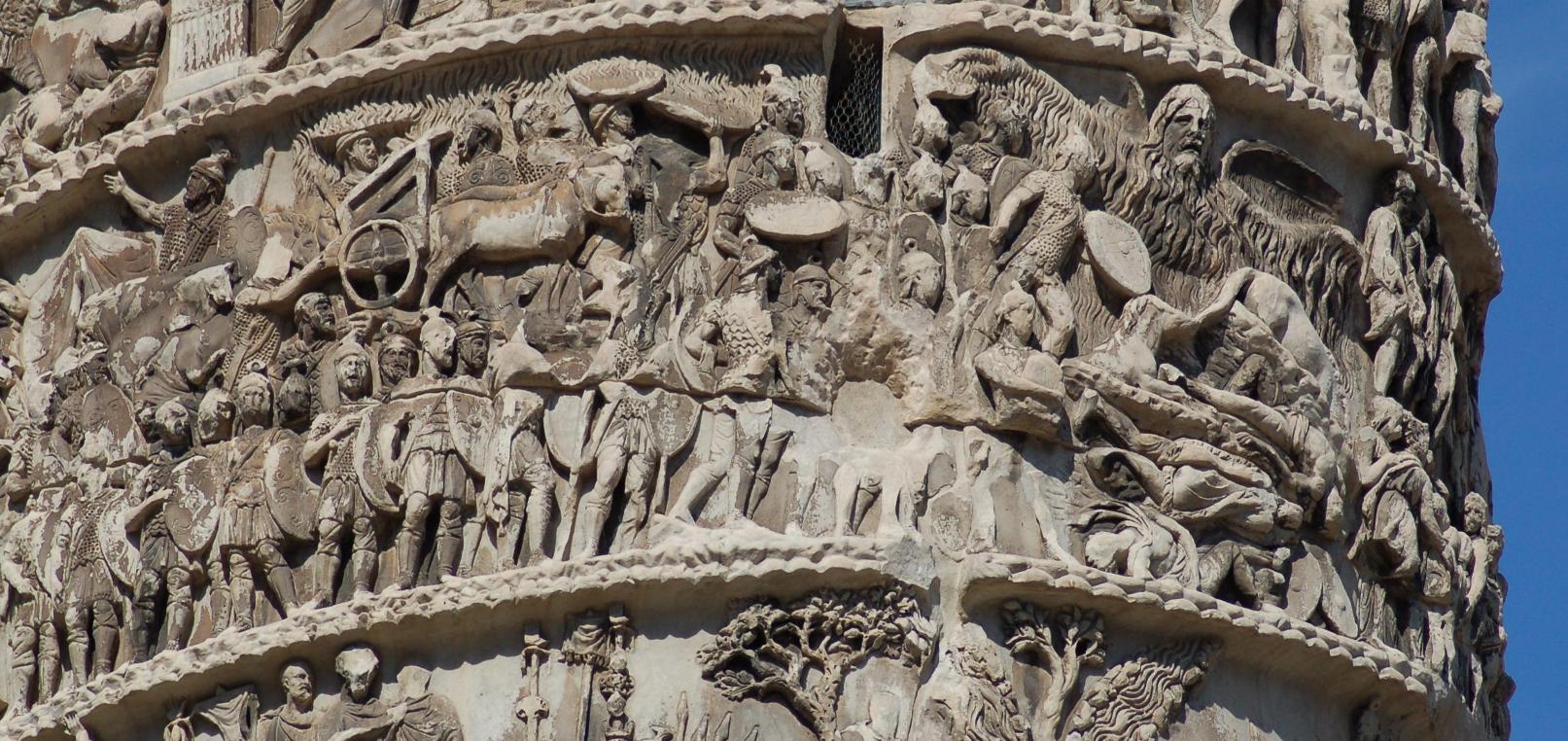
The `Miracle of the Rain' which supposedly saved a Roman legion surrounded by the enemy on the Danube in 173 A.D. (detail from the Column of Marcus Aurelius in Rome) (Book 8)
https://en.wikipedia.org/wiki/Marcomannic_Wars#/media/File:Miracolo_della_Pioggia.JPG
https://en.wikipedia.org/wiki/Marcomannic_Wars#/media/File:Miracolo_della_Pioggia.JPG

Looking south from the site of Trimontium, the Roman camp in the Tweed Valley which was probably the supply base for Septimius Severus's Caledonian campaigns in 208-210 A.D. (Book 8)
https://lsaclassics.com/2017/09/08/trimontium-a-roman-gem/
https://lsaclassics.com/2017/09/08/trimontium-a-roman-gem/
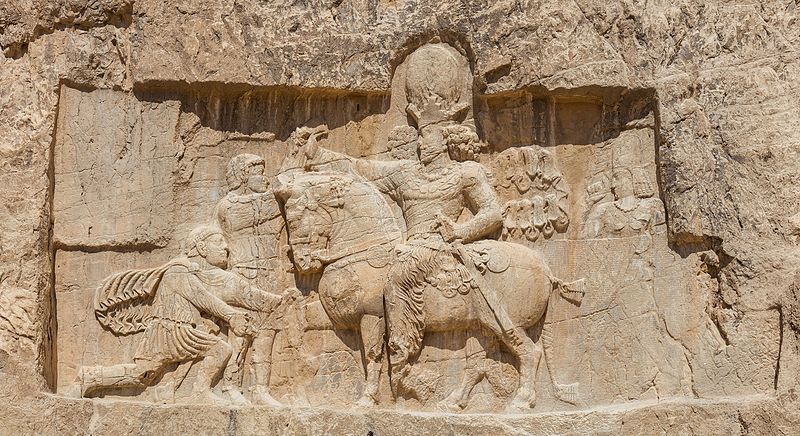
Rock carving at Naqsh-e-rostam in Iran showing Emperors Philip the Arab (244-49) and Valerian (253-60) submitting to King Shapor I of Persia (Book 9)
https://commons.wikimedia.org/wiki/File:Naghsh-e_rostam,_Ir%C3%A1n,_2016-09-24,_DD_12.jpg
https://commons.wikimedia.org/wiki/File:Naghsh-e_rostam,_Ir%C3%A1n,_2016-09-24,_DD_12.jpg
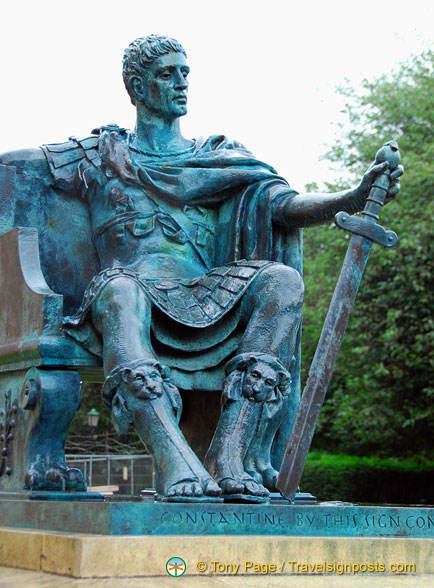
Statue in the grounds of York Minster (Cathedral) of Constantine the Great, proclaimed emperor at Eboracum (York) in 306 (Book 10)
http://www.travelsignposts.net/destination/EnglandWales/York/Statue-of-Constantine-York_AJP6266
http://www.travelsignposts.net/destination/EnglandWales/York/Statue-of-Constantine-York_AJP6266



