linguae
  • HOME
    • SITE MAP
    • MUSIC LINKS
    • PUBLICATIONS
    • CULTURAL ACTIVITY
    • WORDCHAMP
    • SELF-ACCESS LANGUAGE TEXTBOOKS
    • OPERA WORKSHOPS
    • EUROPEAN LANGUAGES IN HONG KONG
  • LATIN & GREEK
    • CIRCULUS LATINUS HONCONGENSIS >
      • ILIAS LATINA
      • ORATIO HARVARDIANA 2007
      • NOMEN A SOLEMNIBUS
      • CARMINA MEDIAEVALIA
      • BACCHIDES
      • LATIN & ANCIENT GREEK SPEECH ENGINES
      • MARCUS AURELIUS
      • ANGELA LEGIONEM INSPICIT
      • REGINA ET LEGATUS
      • HYACINTHUS
      • LATINITAS PONTIFICALIS
      • SINA LATINA >
        • HISTORIARUM INDICARUM
      • MONUMENTA CALEDONICA
      • HISTORIA HONCONGENSIS
      • ARCADIUS AVELLANUS
      • LONDINIUM
      • ROMAN CALENDAR
      • SOMNIUM
      • CIRCULUS VOCABULARY
      • HESIOD
      • CONVENTUS FEBRUARIUS (I)
      • CONVENTUS FEBRUARIUS (II)
      • CONVENTUS MARTIUS
      • CONVENTUS APR 2018
      • CONVENTUS APRILIS
      • CONVENTUS MAIUS
      • CONVENTUS IUNIUS
      • CONVENTUS IULIUS
      • CONVENTUS SEPT 2017
      • CONVENTUS OCT 2017
      • CONVENTUS NOV 2017
      • CONVENTUS DEC 2017
      • CONVENTUS DEC 2017 (II)
      • CONVENTUS JAN 2018
      • CONVENTUS FEB 2018
      • CONVENTUS MAR 2018
      • CONVENTUS MAIUS 2018
      • CONVENTUS IUN 2018
      • CONVENTUS IUL 2018
      • CONVENTUS SEPT 2018
      • CONVENTUS OCT 2018
      • CONVENTUS NOV 2018
      • CONVENTUS DEC 2018
      • CONVENTUS NATIVITATIS 2018
      • CONVENTUS IAN 2019
      • CONVENTUS FEB 2019
      • CONVENTUS MAR 2019
      • CONVENTUS APR 2019
      • CONVENTUS MAIUS 2019
      • CONVENTUS IUN 2019
      • CONVENTUS IULIUS 2019
      • CONVENTUS SEP 2019
      • CONVENTUS OCT 2019
      • CONVENTUS NOV 2019
      • CONVENTUS DEC 2019
      • CONVENTUS JAN 2020
      • CONVENTUS FEB 2020
      • CONVENTUS MAR 2020
      • CONVENTUS APR 2020
      • CONVENTUS IUL 2020
      • CONVENTUS SEP 2020 (I)
      • CONVENTUS SEPT 2020 (II)
      • CONVENTUS OCT 2020
      • CONVENTUS NOV 2020
      • CONVENTUS IAN 2021
      • CONVENTUS IUN 2021
      • CONVENTUS IULIUS 2021
      • CONVENTUS AUG 2021
      • CONVENTUS SEPT 2021
      • CONVENTUS OCT 2021
      • CONVENTUS NOV 2021
      • CONVENTUS FEB 2022 (1)
      • CONVENTUS FEB 2022 (2)
      • CONVENTUS MAR 2022
      • CONVENTUS APRILIS 2022
      • CONVENTUS MAIUS 2022
      • CONVENTUS IUN 2022
      • CONVENTUS IUL 2022
      • CONVENTUS SEP 2022
      • CONVENTUS OCT 2022
      • CONVENTUS NOV 2022
      • CONVENTUS DEC 2022
      • CONVENTUS IAN 2023
      • CONVENTUS FEB 2023
      • CONVENTUS MARTIUS 2023
      • CONVENTUS APRIL 2023
      • CONVENTUS MAIUS 2023
      • CONVENTUS IUN 2023
      • CONVENTUS IUL 2023
      • CONVENTUS SEP 2023
      • CONVENTUS OCT 2023
      • CONVENTUS IAN 2024
      • CONVENTUS MARTIUS (I) 2024
      • CONVENTUS OCT 2025
    • RES GRAECAE >
      • GREEK MUSIC
    • IN CONCLAVI SCHOLARI >
      • LATIN I
      • LATIN I (CAMBRIDGE)
      • LATIN II (CAMBRIDGE)
      • LATIN II
      • LATIN III
      • LATIN IV
      • LATIN V
      • LATIN VI
      • LATIN VII
      • LATIN TEENAGERS I
      • LATIN TEENAGERS II
      • LATIN TEENAGERS III
      • LATIN TEENAGERS IV
      • LATIN TEENAGERS V
      • LATIN TEENAGERS VI
      • LATIN TEENAGERS VII
      • LATIN TEENAGERS VIII
      • LATIN TEENAGERS IX
      • LATIN TEENAGERS X
      • LATIN TEENAGERS XI
      • LATIN SPACE I
      • LATIN SPACE II
      • LATIN SPACE III
      • LATIN SPACE IV
    • CARPE DIEM
    • INITIUM ET FINIS BELLI
    • EPISTULA DE EXPEDITIONE MONTANA
    • DE LATINE DICENDI NORMIS >
      • CONVENTICULUM LEXINTONIANUM
    • ANECDOTA VARIA
    • RES HILARES
    • CARMINA SACRA
    • CORVUS CORAX
    • SEGEDUNUM
    • VIDES UT ALTA STET NIVE
    • USING NUNTII LATINI
    • FLASHCARDS
    • CARMINA NATIVITATIS
    • CONVENTUS LATINITATIS VIVAE >
      • SEMINARIUM OTTILIENSE
    • CAESAR
    • SUETONIUS
    • BIBLIA SACRA
    • EUTROPIUS
    • CICERO
    • TACITUS
    • AFTER THE BASICS
    • AD ALPES
    • LIVY
    • PLINY
    • OVID
    • AENEID IV
    • AENEID I
    • QUAE LATINITAS SIT MODERNA
  • NEPALI
    • CORRECTIONS TO 'A HISTORY OF NEPAL'
    • BABURAM ACHARYA AWARD ADDRESS
    • GLOBAL NEPALIS
    • NEPALESE DEMOCRACY
    • CHANGE FUSION
    • BRIAN HODGSON
    • KUSUNDA
    • JANG BAHADUR IN EUROPE
    • ANCESTORS OF JANG
    • SINGHA SHAMSHER
    • RAMESH SHRESTHA
    • RAMESH SHRESTHA (NEPALI)
    • NEPALIS IN HONG KONG
    • VSO REMINISCENCES
    • BIRGUNJ IMPRESSIONS
    • MADHUSUDAN THAKUR
    • REVOLUTION IN NEPAL
    • NEPAL 1964-2014
    • BEING NEPALI
    • EARTHQUAKE INTERVIEW
    • ARCHIVES IN NEPAL
    • FROM THE BEGINNING
    • LIMITS OF NATIONALISM
    • REST IS HISTORY FOR JOHN WHELPTON
    • NEPAL-INDIA-CHINA
    • LIMPIYADHURA AND LIPU LEKH
    • BHIMSEN THAPA AWARD LECTURE
    • HISTORICAL FICTION
    • READING GUIDE TO NEPALESE HISTORY
    • LANGUAGES OF THE HIMALAYAS
    • REVIEW OF LAWOTI (2007)
    • जंगबहादुर बेलायतसँग नमिलेको भए
    • ROYAL MASSACRE
  • ROMANCE LANGUAGES
    • FRENCH >
      • CHARLES DE GAULLE
      • CHOCOLATE BEARS
      • FRENCH LITERATURE IN THE ANGLOSPHERE
    • SPANISH & ITALIAN
  • English
    • VIETNAM REFLECTIONS
    • GRAMMAR POWERPOINTS
    • PHONETICS POWERPOINTS
    • MAY IT BE
    • VILLAGE IN A MILLION
    • ENGLISH RHETORIC
    • BALTIC MATTERS
    • SHORT STORIES QUESTIONS
    • WORD PLAY
    • SCOTS
    • INTERNATIONAL SCHOOLS
    • STORY OF NOTTINGHAM
    • MEET ME BY THE LIONS
    • MNEMONICS
    • ALTITUDE
    • KREMLIN'S SUICIDAL IMPERIALISM
    • CLASSROOM BATTLEFIELD
    • MATHEMATICS AND HISTORICAL LINGUISTICS
    • OLD TESTAMENT INJUNCTIONS
    • KUIRE ORIGINS
    • BALTI
    • CUBA
    • JINNAH AND MODERN PAKISTAN
    • ENGLISH IS NOT NORMAL
  • HKAS
    • ACQUISITION OF HONG KONG
    • RACISM IN HONG KONG
    • HONG KONG POLITICS 2019-
    • MEDIAN INCOMES IN HONG KONG
    • CHARACTER WARS
    • HONG KONG COUNTRYSIDE
    • BASMATI MENU
    • NON-CHINESE IN THE LOCAL SCHOOL SYSTEM
    • TYPHOON MANGKHUT

​The Hong Kong Anthropological Society

Picture
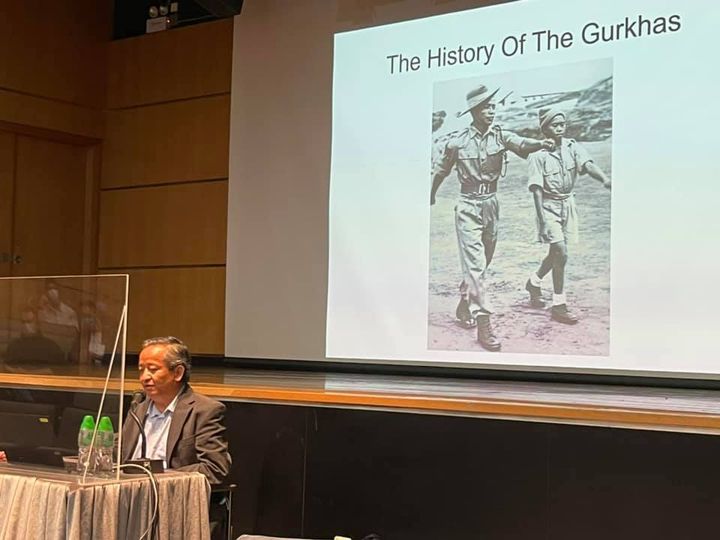
Tim Gurung speaking to the Society in October 2021 on the history of `the Gukhas', men from the hills of Nepal who have fought for Britain over the last 200 years and whose children and granchildren form the bulk of Hong Kong's Nepali community

Details of upcoming talks, to which all are welcome, and other activities are posted here.  After each talk, those attending are invited to a self-paying dinner at the Chiu Chow City restaurant across the square from the Hong Kong History Museum, where discussion can be continued informally.
​
​For fuller information on the society's activities (including archived abstracts of all talks since 1996) visit the HKAS website.
  Versions of Candy Yu's presentation on the Manila hostage crisis  and Wu Liang's on seafarers can be read on-line in the Hong Kong Anthropologist. The PowerPoint presentation of John Whelpton's January 2012 talk on Christianity in Nepal can be downloaded from the Nepal page on his site.

Market Towns of the New Territories
An anthropological lecture by Patrick HASE
Friday, 1 May at 7:00 p.m.
Hong Kong Museum of History
Lecture Hall, Ground Floor, 100 Chatham Road South, Tsim Sha Tsui


This lecture will discuss the foundation and growth of market towns in the New Territories, looking at their plans, society, and economy in the period up to 1911, and their relationship with the city of Hong Kong. It will show that the oldest of the market-towns were Kowloon City, Tai Po, and Yuen Long, in existence from the twelfth century, while others such as Shataukok and Ma Wan date only from the nineteenth century. The relationships of these towns with the rural societies they served will be looked at, discussing those market-towns founded by the surrounding villages, and distinguishing them from those founded by groups of merchants. The lecture will also explore the traditional management systems of these towns, and will consider traditional local industries (salt-working, boat-building, rattan-weaving, leather-tanning, refining of spirits, the trade in salt-fish and firewood, etc.), as well as epidemics of typhoid and plague, and outbreaks of disastrous fires. The lecture will be copiously illustrated by plates and maps.

Dr. Patrick HASE is a local historian, and has been working on the history and historical anthropology of the New Territories since his arrival in Hong Kong in 1972. He is Past President of the Royal Asiatic Society, Hong Kong Branch. His most recent books are Settlement, Life and Politics: Understanding the Traditional New Territories CityU Press, 2020, and Villages and Market Towns in Hong Kong: Settlement and History, Chinese University Press, 2025 (also published in Chinese as 香港的村落與墟鎮:聚落與歷史, Chung Hwa, 2025). He is currently working on a book on Village Scholars and Traditional Village Scholarship and Education.

For more information, please contact [email protected], www.cuhk.edu.hk/ant/hkas, www.facebook.com/hkanthro,@HKASTalks
Picture
Northern Sham Shui Po from Sheung Wai Hill (1898)
      (Villages and Market Towns in Hong Kong, plate 32)
                                              PAST TALKS
​Two Stone Lion Deities in a Chinese Village:

A Hydro-Cosmopolitical Account

An anthropological lecture by Youping NIE
Friday, 10 April at 7:00 p.m.
Hong Kong Museum of History

Lecture Hall, Ground Floor, 100 Chatham Road South, Tsim Sha Tsui


The stone lion is a widespread spiritual symbol found across the rural Dongting Lake basin in the middle Yangtze region. Drawing on ethnographic data obtained from 2017 to 2022, this lecture explores the intersection between a pair of stone lions, climate change, and state governance in a Chinese village. It delineates how these lions transitioned from water deities protecting against flooding to no more than generic stones during the Cultural Revolution. During the shift, one lion was submerged in the river it once tended. Amidst worsening droughts in the decades since, the remaining lion has been seen as a malicious spirit. Villagers believe that misfortune will befall their families if the surviving lion’s gaze falls upon their farmhouses, and villagers repeatedly relocate the lion to avoid being watched. The interplay between the villagers and the stone lions mirrors growing anxieties and uncertainties over intensifying climate challenges in contemporary rural China.

Youping NIE earned her PhD in anthropology from the Chinese University of Hong Kong. Her research examines the intersection between local cosmology, climate challenges, and state governance in Central China.

                 For more information, please contact [email protected], www.cuhk.edu.hk/ant/hkas,         
​                                                         www.facebook.com/hkanthro,@HKASTalks
Picture
View over Dongting Lake
https://www.chinatoursnet.com/zhangjiajie-travel-guide/attraction/dongting-lake.html​

​                                             
How to Trust Strangers? Knowledge and Solidarity in the HK Quarantine Support Group
An anthropological lecture by Tim ROSENKRANZ
Friday, 20 March at 7:00 p.m.
Hong Kong Museum of History
Lecture Hall, Ground Floor, 100 Chatham Road South, Tsim Sha Tsui


During the three years of the COVID-19 pandemic, from 2020 – 23, people in Hong Kong lived with sometimes daily changing quarantine policies, testing requirements, and travel restrictions. In a confusing and often contradicting daily barrage of government press releases and announcements, media coverage, and social media discussions, staying informed became a frustrating task and routine. In these times, over 100,000 residents of Hong Kong and people who needed to come to Hong Kong turned towards the HK Quarantine Support Group. This Facebook group offered crowd-sourced support and information for matters of travel restrictions, testing requirements, hotel bookings, and vaccine documentation. This talk explores how people come to trust strangers and those they never meet in-person; and how they collectively create knowledge online. Based on an online ethnography of the HK Support group from 2020 – 2023, I examine various processes of solidarity formation as well as the interactive practices and hierarchies of knowledge-production within the group. I show how this online community manifested and transformed through three years COVID of policies in Hong Kong and how the group both challenges and reaffirms notions of official expertise.

Tim ROSENKRANZ is a Lecturer in Anthropology at the Chinese University of Hong Kong. His research focuses on the study of organizations as sites and professionals as actors of social, cultural, and economic change. His current project explores the practices of communal knowledge-production online
​

For more information, please contact [email protected], www.cuhk.edu.hk/ant/hkas,
www.facebook.com/hkanthro, @HKASTalks
Picture
Enforcing lockdown in Jordan, January 2021 
https://www.japantimes.co.jp/news/2021/01/23/asia-pacific/hong-kong-imposes-citys-first-covid-19-lockdown-kowloon-area/ 
The books that did not close:
Survival and revival of Naxi pictographs in southwest China


An anthropological lecture by Duncan POUPARD
Friday, 6 February at 7:00 p.m.
Hong Kong Museum of History
Lecture Hall, Ground Floor, 100 Chatham Road South, Tsim Sha Tsui


Picture writing and hieroglyphs are often seen as writing technologies that belong firmly to the past. But what does it mean to write in pictures, and how can a tradition of "picture writing" survive into the present day? From the 1920s to the mid-20th century, the botanist/anthropologist Joseph Rock was the first to seriously study the Naxi pictographs of southwest China, a tradition he thought would disappear if he did not record it. In 1952 he made a dire prediction: “A very few years more and the Na-khi books will be undecipherable…they will remain closed books, no Rosetta stone would prove of value.”
But three quarters of a century later and the books remain open. This unusual writing system has survived in different forms: supported by tourism in Lijiang, the cultural capital of the Naxi people, and revived amongst the remaining ritual specialists of the remote mountain villages in the extended Himalayas. The writing is now touted as the world's “last surviving pictographs.” This talk will show how scholars and local specialists come together to preserve ancient traditions, but also how those traditions are changing with the times.

Duncan POUPARD is Associate Professor in the Department of Translation, the Chinese University of Hong Kong. His research focuses on the translation, transmission and preservation of minority writing and literature in China, specifically of the Naxi people and their unusual ritual texts. He is the author of A Pictographic Naxi Origin Myth from Southwest China (2023, Leiden University Press).

For more information, please contact [email protected], www.cuhk.edu.hk/ant/hkas, www.facebook.com/hkanthro, @HKASTalks
Picture
Naxi Dongba manuscript in the Leiden University collection
https://www.library.universiteitleiden.nl/news/2023/05/online-exhibition---the-worlds-last-picture-writing-naxi-dongba-manuscripts
Re-examining Hong Kong’s identity
through RedNote


An anthropological lecture by JIA JIA
Friday, 16 January at 7:00 p.m.
Hong Kong Museum of History
Lecture Hall, Ground Floor, 100 Chatham Road South, Tsim Sha Tsui


In the mid-2020s, Hong Kong continues to grapple with the socioeconomic aftermath of the COVID-19 pandemic and increased integration with mainland China. This talk explores the contrasts between the Special Administrative Region (SAR) leaders' efforts to recentre Hong Kong as a global financial hub and the organic, decentralising forces driven by geopolitical dynamics, fragmented mediascapes, and liberal ideologies of the 21st century. Drawing on observations of contents on the RedNote social app since 2023, when the city reopened, in this talk I will review the research and analysis conducted while writing my book Reimagine Hong Kong and will discuss how Hong Kong's identity is constantly reshaped from the viewpoints of local citizens, mainlanders, and Western perspectives, amid Greater Bay Area demographic shifts. What defines Hong Kong as a city? Is Hong Kong nowhere or is Hong Kong now here?

JIA JIA is a cultural theorist, columnist, speaker, and independent researcher. He authored Reimagine Hong Kong (Austin Macauley Publishers, 2025). With a series of poems, Jia Jia is one of the artists of After Sunset, a cultural project involving Hong Kong’s cultural heritage.

For more information, please contact [email protected], www.cuhk.edu.hk/ant/hkas,
www.facebook.com/hkanthro, @HKASTalks
Picture
Seeking the origins of the Chinese Writing System: a Sociolinguistic Perspective 

An anthropological lecture by Benjamin K. TSOU
Friday,  12 December at 7:00 p.m.
Hong Kong Museum of History
Lecture Hall, Ground Floor, 100 Chatham Road South, Tsim Sha Tsui


This talk will explore the development of the Chinese writing system. Chinese civilization is recognized as five thousand years old but the Chinese writing system appeared only three millennia ago as serial symbols inscribed on oracle bones. Recently, significantly earlier dating has been suggested. This has been based on: (1) evidence of extensive urban development and hierarchical complexity, making serious record keeping essential, and (2) the encoding of matriarchy, cowry shells, and perhaps extinct elephantine mammals within the logographic radical framework of the Chinese writing system. These provide factors for comparison with languages which evolved as phonological writing systems, as this talk will explicate.

Benjamin K. TSOU is Emeritus Professor in Language Information Sciences at City University of Hong Kong. He works primarily on Chinese language and cultural changes. 
 
There is no need to register or RSVP, as seats for the talk are allocated on a first-come, first-served basis. The seating capacity of the lecture hall is 139. The door opens at 6:45PM. The talk will start on time at 7PM.
Yin and Yang Residences in Hong Kong
An anthropological lecture by Andrew B. KIPNIS and Yuki WOO
Friday, 7 November at 7:00 p.m.
Hong Kong Museum of History
Lecture Hall, Ground Floor, 100 Chatham Road South, Tsim Sha Tsui


This paper examines the ways in which Cantonese speaking people in Hong Kong metaphorically compare residences for the living (Yang residences, 阳宅) and residences for the dead (Yin residences, 阴宅). We focus on domains as varied as real estate markets; shelter, comfort and safety; familial sentiments; and invocations of ancestral homes. We depict the ways in which the metaphorical comparison has held despite rapid shifts in the forms of housing for the living and bodily disposal for the dead. We further consider the possibilities for the future evolution or even complete disappearance of this form of metaphorical comparison. This form of metaphorical comparison and the practices associated with it are continually evolving and the causes of this evolution have more to do with the emotional dynamics of family relationships than “belief” and “tradition.”

This work was supported by a General Research Fund grant from the Hong Kong Research Grants
Council, GRF14601022.

Andrew B. KIPNIS is a Research Professor of Anthropology at The Chinese University of Hong Kong. His latest book, The Funeral of Mr. Wang: Life, Death, and Ghosts in Urbanizing China, is open access and available for free download at https://www.ucpress.edu/books/the-funeral-of-mr-wang/paper
Yuki WOO is a Research Assistant at The Chinese University of Hong Kong.


For more information, please contact [email protected], www.cuhk.edu.hk/ant/hkas,
www.facebook.com/hkanthro, @HKASTalks

Picture
Tombstone at Happy Valley Cemetery (​https://www.hkcemetery.org/learngallery)
40 Years of Archaeology in Hong Kong
An anthropological lecture by William MEACHAM
Friday, 3 October at 7:00 p.m.
Hong Kong Museum of History
Lecture Hall, Ground Floor, 100 Chatham Road South, Tsim Sha Tsui


Archaeologist William Meacham will describe his involvement in the important formative period of modern archaeology in Hong Kong. His discovery of the site at Sham Wan on Lamma in 1971 provided the impetus to a multi-disciplinary approach. As luck would have it, due to its deep stratigraphy, the site turned out to be most important in constructing a prehistoric chronology for the territory. Several other major sites that he excavated will be discussed, including Chek Lap Kok, Sha Po Tsuen on Lamma, and Yung Long at Deep Bay. His talk will also describe how the “missing link” of 700 years in local history between the Han and Sung eras was revealed. William Meacham has lived in Hong Kong since 1970, serving as Chairman of the HK Archaeological Society (1985-96) and Hon. Research Fellow at the Centre of Asian Studies, HKU (1986-2012). Among his publications are several site monographs, Rock Carvings in Hong Kong and The Archaeology of Hong Kong (HKU Press, 2009).
.
For more information, please contact [email protected], www.cuhk.edu.hk/ant/hkas,
www.facebook.com/hkanthro, @HKASTalks

Picture
Sham Wan, Lamma
https://droneandslr.com/travel-blog/hong-kong/sham-wan-beach-lamma-island/​
Wandering Ghosts of National Forefathers:
Gender Politics of Transnational Commemoration of WWII in Asia

An anthropological lecture by Jacqueline Zhenru LIN
Friday, 5 September at 7:00 p.m. sharp
Hong Kong Museum of History
Lecture Hall, Ground Floor, 100 Chatham Road South, Tsim Sha Tsui


As the People’s Republic of China prepares to celebrate the 80th anniversary of the end of the Second World War, over 100,000 remains of Chinese fallen soldiers have been displaced in the former China-Burma-India Theatre. This talk focuses on how these war dead breathe new life in a historical redress movement led by grassroots memory activism in the PRC, involving transnational collaboration with the offspring of WW2 soldiers in Myanmar. In their quest for justice for the wandering ghosts, these activists have been organizing exhumation, repatriation, and commemoration activities since the early 2010s. By emphasizing the cooperation and conflicts between activists from the PRC and the descendants of WWII soldiers in Myanmar, this study explores how the intersection between gender and nationalism shapes the relationships between the living and the dead, the transnational memory network, and the power dynamics between the state and society in war commemoration.

Jacqueline Zhenru LIN is a research assistant professor at the Centre for China Studies, Chinese University
of Hong Kong. Her research delves into war memories, gender, nationalism, NGO development, and online
charities in China

​
For more information, please contact [email protected], www.cuhk.edu.hk/ant/hkas,
www.facebook.com/hkanthro, @HKASTalks
Picture
The India-Burma-China theatre in WWII
(from Linh D. Vu, `Dealing with the Dead in the Cina-burnma-India-Theatre',

https://www.academia.edu/127296938/Dealing_with_the_Dead_in_the_China_Burma_India_Theater )
Taking Pictures of Snakes at Midnight: an Anthropological Perspective
An anthropological lecture by Ryan Xin XIE
Friday, 22 August at 7:00 p.m. sharp
Hong Kong Museum of History
Lecture Hall, Ground Floor, 100 Chatham Road South, Tsim Sha Tsui

The widespread availability of social media technology in Hong Kong enables both amateur and professional photographers engaging with nature to share their observations in visually appealing ways. What do images of wild animals mean to achieve? Based on twelve months of ethnographic fieldwork among nature enthusiasts in Hong Kong, this talk places photographs of wild animals such as snakes at the centre of the complex relationships between humans and nature. It examines the cultural narratives of wildlife photographs in promoting an ecological perspective of urban environments and fostering empathy for human-animal coexistence.

Ryan Xin XIE is a PhD candidate in the Department of Anthropology at the Chinese University of Hong Kong. Her research focuses on the intersections of urban wildness, power/knowledge, embodied cognition, and human-animal relations in urban China.
Picture
Photo: William Sargent handles a snake. Image by Adam Francis.
Will We Ever Have a Global Anthropology?

An anthropological lecture by Gordon MATHEWS
Friday, 18 July at 7:00 p.m. sharp
Hong Kong Museum of History
Lecture Hall, Ground Floor, 100 Chatham Road South, Tsim Sha Tsui

In the late 19th century, the founders of anthropology Morgan and Tylor postulated that the United States and Europe were at the high point of contemporary civilization, with other societies in the world at various stages behind them in “savagery” and “barbarism.” Anthropologists in later decades wholly repudiated these ethnocentric views, but today we are living them out again, not intellectually but institutionally. Because of the increasing importance of global university rankings and citation indexes, anthropologists around the world are increasingly being forced to write in English for top-ranked Anglo-American journals if they want to keep their jobs and get promoted. This is Morgan and Tylor all over again: “West is Best.”
In this talk, Gordon Mathews examines the prospects for whether anthropology can become a discipline not of the rich studying the poor of the world and the poor intellectually emulating the rich, but rather a truly global discipline. When can we have an anthropology not just for the West but for the world? This process is already underway; the future of anthropology as a discipline depends upon its success.

Gordon MATHEWS, Emeritus Professor of Anthropology at the Chinese University of Hong Kong, is Chair
of the World Council of Anthropological Associations and Co-Chair of the World Anthropological Union.


For more information, please contact [email protected], www.cuhk.edu.hk/ant/hkas,
www.facebook.com/hkanthro, @HKASTalks
Hong Kong Ghost Signs: Summoning Characters from our City’s Past

An anthropological lecture by Ben MARANS & Billy POTTS
Friday, 6 June at 7:00 p.m.
Hong Kong Museum of History

Lecture Hall, Ground Floor, 100 Chatham Road South, Tsim Sha Tsui

The story of Hong Kong is told through a visual cacophony of unique signage - hand-written calligraphy, vibrant colours, and creative characters. While many fixate on Hong Kong’s well-known, at-risk neon signs, few recognize the abundance of Ghost Signs - defunct signage from times past that remain a tangible trace of the communities that have changed or disappeared amidst Hong Kong’s rapid (re)development. These signs are left behind by businesses, public institutions, and communities that have moved along or disappeared altogether. They can be hand-painted, terrazzo, acrylic, wood, metal, or other materials, still in their original location yet sometimes obscured by new signs, air conditioning units, and even laundry being hung out to dry.
Chronicling the people, places and cultures that came before, Hong Kong Ghost Signs is the first to apply an extensive urban archaeological lens to Hong Kong in both the English and Chinese speaking worlds, leading to a greater understanding of our ever-changing city where calligraphers, sign installers, and the communities they served have left unique marks of a disappearing way of life. With photographs by Ben Marans and research by Billy Potts, hundreds of Ghost Signs from across the city and the Greater Bay Area have been documented to date. Coming soon will be an interactive web app, walking tours, and a book, all aimed at sharing these treasures. Our goal is to educate, to inspire, and to engage a community of Ghost Sign Hunters to hit the streets, explore Hong Kong’s vibrant neighbourhoods, and help capture and celebrate the stories of this place we call home.
See more of our work at https://www.instagram.com/hkghostsigns/ Special thanks to The Design Trust and the Lord Wilson Heritage Trust for their generous support of our work.

Billy POTTS is a Hong Kong-born writer and designer noted for his impactful work and cultural journalism focusing on Hong Kong's rich heritage. Founder of the consultancy Handsome Co., Potts emphasizes storytelling through design and advocates for the preservation of local culture.

Ben MARANS is a Canadian photographer who has been documenting Hong Kong with a camera, a strong sense of curiosity, and an empathetic approach to connecting with his subjects. Ben’s work as a photojournalist has been published locally and abroad, and he works with clients in the NGO and corporate sectors to tell stories through impactful visual imagery.


Picture
A shoe company's sign in Yau Ma Tei in 1966 (r.) and again in 1972 (l.)
https://zolimacitymag.com/hong-kong-haunted-ghost-signs/ 
​
The Sport Industries in the Neoliberal Age
and the Reconfiguration of the Future in the Global South


An anthropological lecture by Niko BESNIER
Friday, 16 May 2025 at 7:00 p.m.
Hong Kong Museum of History

Lecture Hall, Ground Floor, 100 Chatham Road South, Tsim Sha Tsui

Sports industries have undergone radical transformations since the 1980s, when the neo-liberalism conceived by the inter-war Vienna School became a political reality. Now under the power of private television channels, mainstream sports have sought out new sporting talent in increasingly distant lands, stimulating hopes of economic success and sporting glory among young men in the countries of the Global South, where economies had collapsed and the economic restructuring ordered by major donors had eroded labor markets. But these hopes collide with the much more frequent reality of failure, exploitation, and disappointment. Multi-sited ethnographic work carried out by the GLOBALSPORT research team on football players in Senegal and Cameroon, rugby players in Fiji and Senegalese wrestlers highlight the effects of neoliberal capitalism on bodies and futures in sports and contexts that are very different indeed.


Niko BESNIER is Adjunct Professor of Anthropology at La Trobe University in Melbourne (Australia) and in the Spring Semester 2025 Visiting Professor at Chinese University of Hong Kong. He has taught at numerous institutions in Europe,
the United States, Australia, New Zealand, Brazil, and Japan. He is the author of numerous articles and 12 books on globalization, migration, the body, sex and gender, economic relations, and language, and he is currently developing a research programme on the economics and politics of “wellness.” He has conducted ethnographic fieldwork in the Pacific Islands, Japan, and the United States. In 2012–17, with funding from the European Research Council, he directed a large
multi-sited project on the migration of professional athletes. In 2015–19, he served as Editor-in-Chief of the journal
American Ethnologist.
Summoning up the Forces of the Environment: Glaciers, Deities, Ancestors,
and Treasures in Pilgrimage and Healing in East Tibet


An anthropological lecture by Anna SEHNALOVA
Friday, 25 April 2025 at 7:00 p.m.
Hong Kong Museum of History

Lecture Hall, Ground Floor, 100 Chatham Road South, Tsim Sha Tsui

The talk explores landscape and ancestor cosmologies in East Tibet. Local communities and their leaders in East Tibet are intimately bound to land and landscape in all its diversity, and especially to the hierarchically highest non-human actors, which can at the same time be perceived as their own human ancestors of both distant and recent past. These cosmologies have over centuries been in interactions with another, universal and transregional cosmological system – Buddhism.
Furthermore, in recent decades, they have significantly shaped local reactions within the political and economic environment of the modern Chinese state. This talk explores how all these different forces interact in shaping Eastern Tibetan cosmologies today.

Anna SEHNALOVA is a Postdoctoral Fellow at the Research Institute for the Humanities, the Chinese University of Hong Kong.
Picture
The Gnyan po G.yu rtse  ('Powerful one of the turquoise peak') mountain range
Chinese Men and White Women Couples in Hong Kong: Managing and Challenging Social and Family Expectations

An anthropological lecture by Gabriella ANGELINI
Friday, 28 February 2025 at 7:00 p.m.
Hong Kong Museum of History
Lecture Hall, Ground Floor, 100  Chatham Road South, Tsim Sha Tsui

 
Hong Kong has a long history of “interracial” relationships and has been home to a significant population of Eurasians. This history together with the city’s global status makes romantic couples involving Chinese men and White women relatively more common than in other places, especially in recent years. Still, due to historical legacies and media representation, such couples draw attention in public spaces because their race and gender pairing defies established dating patterns. Similarly, in the context of family relationships, the reactions of family members can vary significantly—ranging from excitement to opposition—depending on various factors, such as class position or cultural backgrounds. In this talk, Gabriella Angelini will explore these issues by sharing a few case studies from her 12-month research in Hong Kong and drawing from her personal experiences.
 
Gabriella ANGELINI is an Anthropology PhD student at the Chinese University of Hong Kong. Due to her life trajectory and experiences studying, living, and working abroad, her research interests include migration, “mixed” families, identity formation, and the intersectionality of race, gender, class, and cultural hierarchies.


Picture
Gabriella Angelini

​The Ayurvedic Health Industry:

Beyond Medicine, Beyond Tradition, Beyond Asia

 
An anthropological lecture by Venera KHALIKOVA
Friday, 28 March 2025 at 7:00 p.m.
Hong Kong Museum of History
Lecture Hall, Ground Floor, 100 Chatham Road South, Tsim Sha Tsui
 
Ayurveda is a South Asian tradition of health and longevity. In academic and popular discourse, it is often described as a traditional, indigenous, and alternative medicine, yet these designations misrepresent the fact that Ayurveda also exists in a form of a large, innovative, and lucrative industry with significant influence both within and beyond Asia. This industry encompasses multiple market sectors and products: from classical or reformulated branded pharmaceuticals to food and beverages, personal care products, spa, restaurants, household cleaning, textiles, dyes, and biofertilizers. These commodities are not strictly medical yet invoke and capitalize on the Ayurvedic medical knowledge.
In this talk, I examine Ayurveda as a brand-oriented, transnational, and profit-driven industry, particularly focusing on its expansion beyond the domain of “medicine.” By documenting various forms, infrastructures, technologies, stakeholders, policies, and ideologies of the Ayurvedic industry, I show how it intersects with geopolitics, big business, and Global Health.  I also ask, what is at stake when the labels of “Ayurveda” find their way into everything from the chic to the trivial? What are the political, economic, and cultural regimes that facilitate such possibilities? And do these market transgressions betray the indigenous principles, or finally challenge the previously narrowly “medical” approaches to Ayurvedic knowledge?
 
Venera KHALIKOVA is Assistant Professor at the Chinese University of Hong Kong. She is a cultural anthropologist researching alternative medicine in India and the transnational migration of South Asians in Hong Kong. Her work has been funded by the Wenner-Gren Foundation, the Andrew Mellon Foundation, and the University Grants Committee of Hong Kong, and appeared in Medical Anthropology, Journal of Asian Studies, and Food, Culture, and Society, among others.
 
 For more information, please contact [email protected], www.cuhk.edu.hk/ant/hkas, www.facebook.com/hkanthro or @HKASTalks
​
Picture
Venera Khalikova

Hong Kong Anthropologist

Issues of this on-line journal, with a special emphasis on presenting the work of younger anthropologists, can be downloaded here.

Powered by Create your own unique website with customizable templates.