| linguae |
|
QUESTIONS ARISING FROM 87th. MEETING – 28/2/18
(the record of earlier meetings can be downloaded from the main Circulus page. The illustrated text of Genesis is available on the Genesis page)
Food consumed included the old stand-by māpōdaufum (麻婆豆腐, i.e.. bean curd with chili and a little mincemeat in sauce), which, as discussed some months back, could more classically but also more clumsily be rendered caseus fabārius anūs maculātae (`speckled old woman’s bean cheese’) or daufum cum capiscō carneque (`tofu with pepper and meat’). We also ordered carnēs assae variae (assorted roast meat), squilla cum brassicā Italicā (shrimp with broccoli), gallīnācea cum limōne (chicken in lemon) and collӯra Singapurēnsis (星洲炒米, Singapore noodles) plus other holera (vegetables) and orӯza (rice). As the City Chinese Restaurant under its new managementvstill has no alcohol licence we brought our own vīnum rubrum, for which had to pay pecūnia lagoenālis (corkage, literally`bottle money’).
We discussed the curent controversy over the constitutional change removing the two-term limit on Xi Who Must Be Obeyed’s tenure as head of state. This has apparently sent mainland digital censors into overdrive, with `Winnie the Pooh’ .being blocked in Internet searches because of the famous cartoons lampooning Xi’s meetings with Barack Obama and Shinzo Abe.
We discussed the curent controversy over the constitutional change removing the two-term limit on Xi Who Must Be Obeyed’s tenure as head of state. This has apparently sent mainland digital censors into overdrive, with `Winnie the Pooh’ .being blocked in Internet searches because of the famous cartoons lampooning Xi’s meetings with Barack Obama and Shinzo Abe.


`Pooh Bear’ and friends
We touched on one or two minor issues of grammar and pronunciation. The middle vowel in the genitive singular of the pronoun ille can be either short or long (resulting in the stress falling on the first or the middle syllable respectively) and we were unsure which was the commoner. A check on the first twelve Ovidian examples generated by the `ille site:www.thelatinlibrary.com’ search string produced seven instances of illīus and five of illius. With the pair occīdō and occidō the change in vowel length transforms the meaning, the former verb meaning kill and the latter `fall, die’. As the Eton Scholarship Vocabulary does not use macrons or give meanings, John pointed out that we could not be sure which verb(s) they intended to include but, of course, we teach both anyway. Before everyone else arrived Pat and John had discussed whether the vocative of Iōhannēs should be Iōhannēs or Iōhannē, The latter is the original Greek form and is sometimes used in Latin but Iōhannēs is also allowed. This is in line with the frequent practice with Greek loans, both the original Greek case endings and .alternative Latinised ones being in use, so, for example, Hippomenēs in the accusative could be either Hippomenēn of Hippomenem. Ovid almost always prefers the Greek forms but one can guess that on the Roman street the Latinized endings were commoner. Iōhannēs is, of course, derived from Hebrew Yochanan and other Hebrew nouns are also treated inconsistently, often used as indeclinables but sometimes nativized: the form Ādam can be employed in any case but there is also a genitive Ādae and a fully naturalised 2nd. declension noun Ādāmus, -ī m. On the other hand Iēsus (Jesus) is the only form found for the nominative and all the other cases are Iēsū except for accusative Iēsum
There was a brief discussion of the comparative difficulty of Greek and Latin and also of provision for studying them. John noted that in Hong Kong Greek was available both at the ISF Academy and at HKUST, with the focus in the latter case being on New Testament Greek, which is also taught in seminaries. Latin is available at ISF and in some international schools, including the Kellet School in Kowloon Bay, where John taught for a term three years ago, the German-Swiss and the French School. In the UK, Latin can be taken in about a fifth of secondary schools, but sometimes as an extra-curricular activity rather than part of the regular timetable. In contrast, school Greek is virtually dying outside the independent sector and at university level often has to be taught from scratch like Sanskrit or Akkadian. Valerie noted that at Eton the standard expected in the King’s Scholarship Exam was very high and in some respects approaching AS level. John had been under the impression that, although Eton set its own exam papers, the actual syllabus was identical to that of scholarship level at Common Entrance but Valerie explained this was not the case.
Pat mentioned again the poet Catullus, whose famously `obscene’ lines in Poem 16 and their role in a London court case were discussed last month. His Amores 1.5, erotic rather than obscene, was read in our October 2012 meeting (see QUESTIONS ARISING – II, downloadable from the Circulus page (https://linguae.weebly.com/circulus-latinus-honcongensis.html, translation and commentary at. http://dcc.dickinson.edu/ovid-amores/amores-1-5). There is a Powerpoint presentation on the poet’s short life (he died at the age of 30 in 54 B.C.) which also includes some additional examples of his poetry and can be downloaded from https://linguae.weebly.com/latin--greek.html
We read chapters 14 and 15 of Genesis (see text below), and, as usual, noted that Jerome’s Latin did not always accurately reflect the Hebrew. Among us only Maureen had formally studied Hebrew but the resources on the web enable anyone to check against a Hebrew text with interlinear translation. One error is the translation of a phrase meaning `oaks of Mamre’ as convallem Mambre (`plain of Mambre’)
Chapter 14 describes how Abraham defeated the forces of five kings in a battle near Damascus, released his nephew Lot and recovered the booty taken from the kings of Sodom and other cities around the Dead Sea. The historicity of the account is in doubt, partly because his adversaries are said to include not only Elamites and Hittites, people who were important actors in the 2nd. millennium B.C., but also the kingdom of Pontos, which did not come into being until much later.
The chapter includes an account of the meeting after the battle between Abraham and Melchisedech, the king of Salem, the future Jerusalem, who was also a priest. Jerome makes Melchisedech’s `offering bread and wine’ a consequence of his priestly role, thus implying that the offering was to God, prefiguring the Christian Eucharist. However the connective in the Hebrew has no suggestion of causality so Melchisedech may simply have been bringing refreshments to Abraham and his followers.
Both the Hebrew and the Vulgate refer to a gift of `one tenth of everything’ without making it explicit which of the two men was the giver and which the recipient but it is more plausible that Abraham was making a donation to Melchisedech and Maureen pointed out that this is certainly the interpretation in the Epistle to the Hebrews. The passage seems, therefore, to be the earliest Biblical example of `tithing’, although explicit instruction on this as a religious obligation are only given in Leviticus
Chapter 15 includes the divine promise to Abraham that his descendants will possess the land from the Nile to the Euphrates and lists out peoples whose territory they will take over, including the Hittites. The reference in the latter case must be to those Hittites living in what is now Syria and Lebanon, not in the Anatolian heartland.
We touched on one or two minor issues of grammar and pronunciation. The middle vowel in the genitive singular of the pronoun ille can be either short or long (resulting in the stress falling on the first or the middle syllable respectively) and we were unsure which was the commoner. A check on the first twelve Ovidian examples generated by the `ille site:www.thelatinlibrary.com’ search string produced seven instances of illīus and five of illius. With the pair occīdō and occidō the change in vowel length transforms the meaning, the former verb meaning kill and the latter `fall, die’. As the Eton Scholarship Vocabulary does not use macrons or give meanings, John pointed out that we could not be sure which verb(s) they intended to include but, of course, we teach both anyway. Before everyone else arrived Pat and John had discussed whether the vocative of Iōhannēs should be Iōhannēs or Iōhannē, The latter is the original Greek form and is sometimes used in Latin but Iōhannēs is also allowed. This is in line with the frequent practice with Greek loans, both the original Greek case endings and .alternative Latinised ones being in use, so, for example, Hippomenēs in the accusative could be either Hippomenēn of Hippomenem. Ovid almost always prefers the Greek forms but one can guess that on the Roman street the Latinized endings were commoner. Iōhannēs is, of course, derived from Hebrew Yochanan and other Hebrew nouns are also treated inconsistently, often used as indeclinables but sometimes nativized: the form Ādam can be employed in any case but there is also a genitive Ādae and a fully naturalised 2nd. declension noun Ādāmus, -ī m. On the other hand Iēsus (Jesus) is the only form found for the nominative and all the other cases are Iēsū except for accusative Iēsum
There was a brief discussion of the comparative difficulty of Greek and Latin and also of provision for studying them. John noted that in Hong Kong Greek was available both at the ISF Academy and at HKUST, with the focus in the latter case being on New Testament Greek, which is also taught in seminaries. Latin is available at ISF and in some international schools, including the Kellet School in Kowloon Bay, where John taught for a term three years ago, the German-Swiss and the French School. In the UK, Latin can be taken in about a fifth of secondary schools, but sometimes as an extra-curricular activity rather than part of the regular timetable. In contrast, school Greek is virtually dying outside the independent sector and at university level often has to be taught from scratch like Sanskrit or Akkadian. Valerie noted that at Eton the standard expected in the King’s Scholarship Exam was very high and in some respects approaching AS level. John had been under the impression that, although Eton set its own exam papers, the actual syllabus was identical to that of scholarship level at Common Entrance but Valerie explained this was not the case.
Pat mentioned again the poet Catullus, whose famously `obscene’ lines in Poem 16 and their role in a London court case were discussed last month. His Amores 1.5, erotic rather than obscene, was read in our October 2012 meeting (see QUESTIONS ARISING – II, downloadable from the Circulus page (https://linguae.weebly.com/circulus-latinus-honcongensis.html, translation and commentary at. http://dcc.dickinson.edu/ovid-amores/amores-1-5). There is a Powerpoint presentation on the poet’s short life (he died at the age of 30 in 54 B.C.) which also includes some additional examples of his poetry and can be downloaded from https://linguae.weebly.com/latin--greek.html
We read chapters 14 and 15 of Genesis (see text below), and, as usual, noted that Jerome’s Latin did not always accurately reflect the Hebrew. Among us only Maureen had formally studied Hebrew but the resources on the web enable anyone to check against a Hebrew text with interlinear translation. One error is the translation of a phrase meaning `oaks of Mamre’ as convallem Mambre (`plain of Mambre’)
Chapter 14 describes how Abraham defeated the forces of five kings in a battle near Damascus, released his nephew Lot and recovered the booty taken from the kings of Sodom and other cities around the Dead Sea. The historicity of the account is in doubt, partly because his adversaries are said to include not only Elamites and Hittites, people who were important actors in the 2nd. millennium B.C., but also the kingdom of Pontos, which did not come into being until much later.
The chapter includes an account of the meeting after the battle between Abraham and Melchisedech, the king of Salem, the future Jerusalem, who was also a priest. Jerome makes Melchisedech’s `offering bread and wine’ a consequence of his priestly role, thus implying that the offering was to God, prefiguring the Christian Eucharist. However the connective in the Hebrew has no suggestion of causality so Melchisedech may simply have been bringing refreshments to Abraham and his followers.
Both the Hebrew and the Vulgate refer to a gift of `one tenth of everything’ without making it explicit which of the two men was the giver and which the recipient but it is more plausible that Abraham was making a donation to Melchisedech and Maureen pointed out that this is certainly the interpretation in the Epistle to the Hebrews. The passage seems, therefore, to be the earliest Biblical example of `tithing’, although explicit instruction on this as a religious obligation are only given in Leviticus
Chapter 15 includes the divine promise to Abraham that his descendants will possess the land from the Nile to the Euphrates and lists out peoples whose territory they will take over, including the Hittites. The reference in the latter case must be to those Hittites living in what is now Syria and Lebanon, not in the Anatolian heartland.
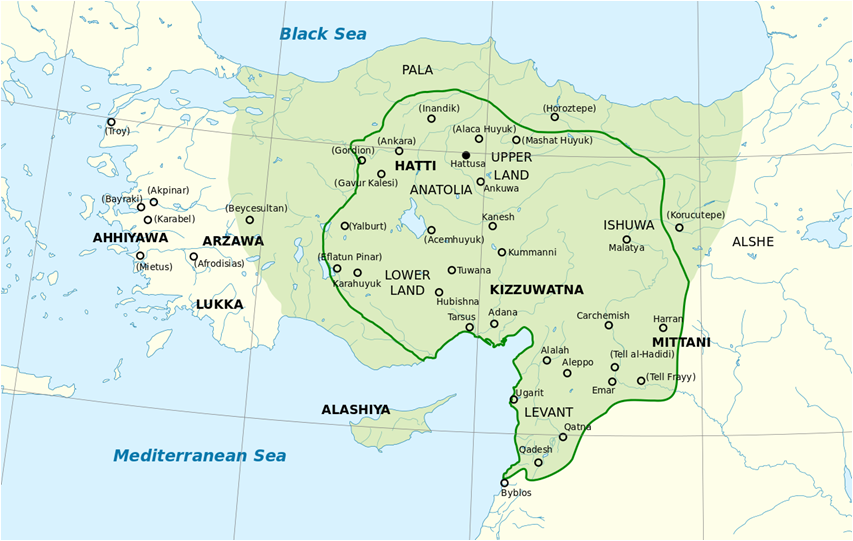
The Hittite empire at its greatest extent (c.1350-1300)
https://en.wikipedia.org/wiki/Hittites#/media/File:Map_Hittite_rule_en.svg
The covenant with Abraham also includes a prophecy of 400 years in exile, corresponding roughly with the 430 years which, on the traditional chronology, the Jews spent in bondage in Egypt. This time span is equated with four generations, perhaps because of the longer life spans attributed to early figures in the Bible. On the same traditional chronology the Exodus took place around 1400 B.C. but, though we did not go on to discuss this issue at the meeting, many scholars now believe that the story of a Jewish invasion and conquest of Canaan from the south is not historical, and that Jewish ethnic identity emerged out of the existing population of the region.
When some people had already left Tanya recommended the for second-language learners the Pleco Chinese dictionary which can be downloaded to Android devices via Google Play and, among other things, provides optical character recognition, so that meanings prop up simply by pointing your phone’s camera at a text. More details at https://www.pleco.com/products/pleco-for-android/
https://en.wikipedia.org/wiki/Hittites#/media/File:Map_Hittite_rule_en.svg
The covenant with Abraham also includes a prophecy of 400 years in exile, corresponding roughly with the 430 years which, on the traditional chronology, the Jews spent in bondage in Egypt. This time span is equated with four generations, perhaps because of the longer life spans attributed to early figures in the Bible. On the same traditional chronology the Exodus took place around 1400 B.C. but, though we did not go on to discuss this issue at the meeting, many scholars now believe that the story of a Jewish invasion and conquest of Canaan from the south is not historical, and that Jewish ethnic identity emerged out of the existing population of the region.
When some people had already left Tanya recommended the for second-language learners the Pleco Chinese dictionary which can be downloaded to Android devices via Google Play and, among other things, provides optical character recognition, so that meanings prop up simply by pointing your phone’s camera at a text. More details at https://www.pleco.com/products/pleco-for-android/
Genesis
Chapter 14
1 Factum est autem in illō tempore, ut Amraphel rēx Senaar, et Arioch rēx Pontī, et
done it-was moreover in that time that Amraphel king of-Senaar and Arioch king of-Pontos and
Chedorlahomor rēx Elamitārum, et Thadal rēx gentium[1]
Chodorlaomor king of-Elamites and Thadal king of-nations
2 inīrent bellum contrā Bara regem Sodomōrum, et contrā Bersa rēgem Gomorrhæ, et
went-into war against Bara king of-Sodom and against Bersa king of-Gomorrha and
contrā Sennaab rēgem Adamæ, et contrā Semeber rēgem Seboim, contrāque rēgem
against Sennaab king of-Adamah and against Semeber king of-Seboim and-against king
Balæ, ipsa est Segor.[2]
of-Bala itself is Segor
3 Omnēs hī convēnērunt in vallem Silvestrem,[3] quæ nunc est mare salis.
All these converged into valley Wooded which now is sea of-salt
4 Duodecim enim annīs serviērunt Chodorlahomor, et tertiōdecimō annō recessērunt
during- twelve for years they-served Chedorlaomor and in-thirteenth year withdrew
ab eō.
from him
5 Igitur quartōdecimō annō vēnit Chodorlahomor, et rēgēs quī erant cum eō:
Therefore in-fourteenth year came Chedorlaomor and kings who were with him
percussēruntque Raphaim in Astarothcarnaim,[4] et Zuzim[5] cum eīs, et Emim,[6]
and-struck Raphaim in Asteroth Kanaim and the Zuzim with them and Emim
NOTES
[1] Senaar (or Shinar) is the region around Babylon, `Pontus’ (the name of a much later kingdom on the south shore of the Black Sea) a misleading translation by Jerome of Hebrew Ellasar (i.e. Larsa, later Senkereh, on the Euphrates in sothern Babylonia) and the Elamites a people who at one time controlled southern Iran and part of Iraq and briefly controlled Babylon itself in the 12th century B.C. (see https://en.wikipedia.org/wiki/Elam). The Elamite language is generally believed to be an isolate but an attempt has been made to link it with the Dravidian languages of southern India. The five kings have not been securely identified but the name Chedorlaomer is clearly Elamite Kudurlagamar (`servant of [the goddess]Lagamar’, Amraphel was at one time thought to be the Babylonian lawgiver Hammurabi (reigned 1792 to 1750 B.C.), Arioch equated with Eri-Aku, also known as Rin-Sin, a king of Larsa in 1822-1763 B.C. , and Thadal with `Tudhaliya’ the name of one or more Hittite rulers in Asia Minor. There is no consensus on when, or whether, kings with these or similar names could have acted together and it is possible that a Jew in exile in Babylon in the 6th century B.C. simply put together various names he came across in cuneiform tablets. See the detailed accounts at https://en.wikipedia.org/wiki/Battle_of_Siddim and https://en.wikipedia.org/wiki/Chedorlaomer for more information (and more confusion?).
[2] The kings listed in their alliance are otherwise unknown. Only the site of Zoar (Segor) is agreed.
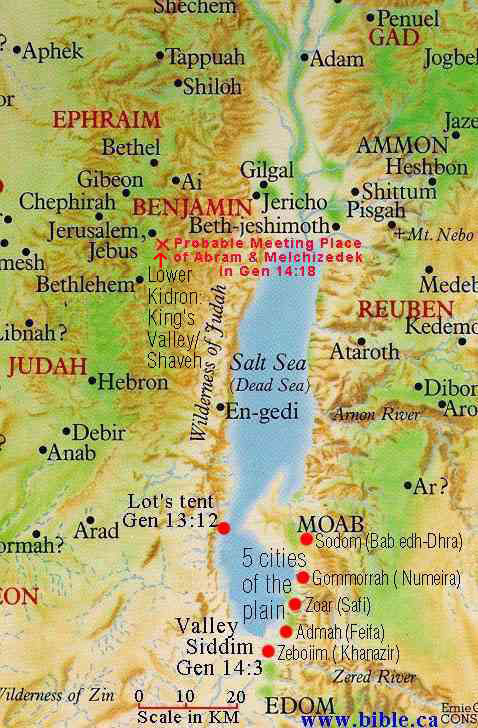
[3] The Hebrew has Siddiym, indicating flat rather than wooded land. The Siddim valley was supposedly flooded to form the southern section of the Dead Sea (`Sea of Salt’), though it is uncertain whether the author of the passage believed that Sodom and Gomorrah and the other `cities of the plain’ themselves lay under water. See the two maps below.
[4] The Raphaim or Raphites were among the original inhabitants of Cannaan and were supposedly of gigantic stature. The word also seems to have been used for the spirits of the dead (particularly dead kings (see https://en.wikipedia.org/wiki/Rephaite). Astarothcarnaim (or `Ashteroth Karnaim’, i.e `The Horns of (Phoenician fertility goddess) Astarte’) is probably the ruined site of Tel Ashtara, situated in Syria about 20 miles east of the Sea of Galilee (https://en.wikipedia.org/wiki/Tell_Ashtara). This city was the capital of the region of Bashan (the Golan Heights and adjoining territory) until its collapse, when neighbouring Karnaim (modern Al-Shaykh Saad) took over the role (see https://en.wikipedia.org/wiki/Al-Shaykh_Saad).
[5] The name Zuzim may be connected to a root meaning `restless’ or `roaming’. See https://en.wikipedia.org/wiki/Zuzim_(biblical_people)
[6] The Emim were another supposedly tall, aboriginal tribe.
in Save Cariathaim[1]
in Shaveh-kirathaim
6 et Chorræōs in montibus Seir, usque ad Campestria Pharan, quæ est in sōlitūdine.[2]
and the Horites in the-mountains Seir up to plain of-Pharan which is in desert
7 Reversīque sunt, et vēnērunt ad fontem Misphat,[3] ipsa est Cades: et percussērunt
and-returned AUX and came to spring of-Misphat itself is Cades and they-struck
omnem regiōnem Amalecitārum, et Amorrhæum, quī habitābat in Asasonthamar.[4]
whole region of-Amalekhites and Amorrhaeus who lived in Asasonthamar
8 Et ēgressī sunt rēx Sodomōrum, et rēx Gomorrhæ, rēxque Adamæ, et rēx Seboim,
And went-out AUX king of-Sodom and king of-Gomorrha and –king of-Adamah and king of-Seboim
necnōn et rēx Balæ, quæ est Segor: et dīrēxērunt aciem contrā eōs in valle Silvestrī:
additionally also king of-Bala which is Segor and they-drew-up battle-line against them in valley Wooded
9 scīlicet adversus Chodorlahomor rēgem Elamitārum, et Thadal rēgem Gentium, et
namely against Chedorlaomor king of-Elamites and Thadal king of-nations and
Amraphel rēgem Sennaar, et Arioch rēgem Pontī: quattuor rēgēs adversus quīnque.
Amraphel king of-Sennaar and Arioch king of-Pontos four kings against five
NOTES
[1] Probably modern Kureyet, in Reben 10 miles east of the Dead Sea
[2] The Horites were a tribe living in the Seir mountains between the Dead Sea and the Gulf of Aqaba. Campestria Pharan represents Hebrew El-paran, probably the town of Eilat, el meaning a tree of some sort and paran referring to the desert stretching west towards Egypt.
[3] Hebrew En-mishpat, i.e `Fountain of Judgement’, an ealier name for Kadeshbarnea identified usually with Ein el-Qudeirat, south of Beersheba in the Negev/Sinai desert (see map on page 49).
[4] Jerome uses the singular Amorrhaeus (`the Amorite’) whilst the Hebrew and the Geeek have plurals (`the Amorites’). This group, described elsewhere in the Old Testament as part of the Raphaim (see above), were a mountain people whose territory lay west and east of the Jordan but the name also seems to have been used for Canaanites in general. The Amalekites (also kown collectively as `Amalec’/`Amalek’) were desert nomads who had supposedly attacked the Israelites in Sinai during the Exodus and who were destroyed by Saul, a genocide used later by Christians to justify massacres at Jerusalem and elsewhere (see http://linguae.weebly.com/nomen-a-solemnibus.html). Asasonthamer (Hazazon-tamar) is usually identified with Engedi, an oasis on the west shore of the Dead Sea.
10 Vallis autem Silvestris habēbat puteos multōs bitūminis. Itaque rēx Sodomōrum, et
Valley moreover Wooded had pits many of-bitumen and-so king of-Sodom and
Gomorrhæ, terga vertērunt, cecidēruntque ibi: et qui remānserant, fūgērunt ad montem
of-Gomorrha backs turned and-fell there and those-who had-survived fled to mountain
11 Tulērunt autem omnem substantiam Sodomōrum et Gomorrhæ, et ūniversa quæ ad
They-took moreover whole property of-Sodom and of-Gomorrha and all-things which to
cibum pertinent, et abiērunt:
food pertain and went-away
12 necnōn et Lot, et substantiam ejus, fīlium frātris Ābram, quī habitābat in Sodomīs.[1]
additionally also Lot and property his son of-brother of-Abram who lived in Sodom
13 Et ecce ūnus, qui ēvāserat, nūntiāvit Ābram Hebræō,[2] quī habitābat in convalle
And behold one who had-escaped announced to-Abram the-Hebrew who lived in valley
Mambre Amorrhæī, frātris Escol, et frātris Aner: hī enim pepigerant fœdus cum Ābram
of-Mamre the-Amorite brother-of- Escol and brother of-Aner these for had-made alliance with Abram
14 Quod cum audīsset Ābram, captum vidēlicet Lot frātrem suum,[3] numerāvit
Which when had-heard Abram captured namely Lot brother his counted-off
expeditōs vernāculōs suōs trecentōs decem et octō: et persecūtus est usque Dan.[4]
made-ready slaves-born-in-household his three-hundred ten and eight and pursued AUX up-to Dan,
15 Et dīvīsīs socīis,[5] irruit super eōs nocte: percussitque eōs, et persecūtus est eōs
And divided with-allies rushed-in onto them by-night and-he-struck them and pursued AUX them
usque Hoba,[6] quæ est ad lævam Damascī.
as-fa-as Hobah which is to left of-Damascus
NOTES
[1] The verb tulērunt has to be understood here from the previous clause,
[2] Hebraeus is a transliteration of ib-ree, `descendant of Eber’.
[3] captum …frātrem suum is an accusative and infinitive clause, with esse, as often. omitted
[4] Dan (earlier known as Laish) has been identified with Tel Dan (Tell el-Qadi in Arabic) in the extreme-north of present-day Israel. See https://en.wikipedia.org/wiki/Dan_(ancient_city)
[5] Dīvīsīs sociīs is an ablative absolute (`with his allies divided’, i.e. `after dividing his allies’
[6] Hobah, not mentioned elsewhere, was somewhere north of Damascus as directions in Biblical Hebrew are from the perspective of someone facing east.
16 Redūxitque omnem substantiam, et Lot frātrem suum cum substantiā illīus,
And-he-brought-back all the-property and Lot brother his with property his
mulierēs quoque et populum.
women also and people
17 Ēgressus est autem rēx Sodomōrum in occursum ejus postquam reversus est ā
Went-out AUX moreover king of-Sodom into meeting of-him after returned he-is from
cæde[1] Chodorlahomor, et rēgum qui cum eō erant in valle Save,[2] quæ est vallis rēgis.
slaughter of-Chedorlaomer and of-kings who with him were in valley of-Save which is valley of-king
rēgis.
of-king
18 At vērō Melchisedech[3] rēx Salem, prōferēns pānem et vīnum, erat enim sacerdos
But indeed Melchisedech king of-Salem offering bread and wine was for priest
Deī altissimī,
of-God most-high
19 benedīxit eī, et ait: Benedictus Ābram Deō excelsō[4], quī creāvit cælum et terram:
gave-blessing to-him and said Blessed [be] Abram to-God on-high who created heaven and earth
20 et benedictus Deus excelsus, quō protegente, hostēs in manibus tuīs sunt. Et dedit
And blessed [be] God on-high with-whom protecting enemy in hands your are and he-gave
eī decimās ex omnibus.[5]
to-him tenths out of-everything
21 Dīxit autem rēx Sodomōrum ad Ābram: Dā mihi animās, cētera tolle tibi.
Said moreover king of-Sodom to Abram Give me the-persons other-things take for-yourself
22 Quī respondit eī: Levō manum meam[6] ad Dominum Deum excelsum
He replied to-him I-raise hand my to Lord God on-high
possessōrem cælī et terræ,
possessor of-heaven and of-earth
23 quod a fīlō subtegminis usque ad corigiam caligæ, nōn accipiam ex omnibus quæ
that from thread of-yarn right-up to lace of-shoe not I-will-accept from all-things which
NOTES
[1] The Hebrew word means `striking’ as well as `kiling’ so it is unclear if Chedorlaomer himself died.
[2] `The Valley of the Plain’ (Shaveh) which was close to Salem (Jerusalem).
[3] The Hebrew name is malki-sedeq (`my king is righteousness’) but by the time of the Greek Septuagint (3rd century B.C.) this was reinterpreted as `king of righteousness; and he is seen in Psalm 110 as prefiguring the messiah and in the Epistle to the Hebrews as associated with Christ and possessing an eternal priesthood. The Vulgate’s use of enim, asserting a causal link between his priestly status and the presenting of bread and wine, but the Hebrew conjunction just means `and’, so the offering is probably not one to God but just a present to tired and thirsty soldiers (see https://en.wikipedia.org/wiki/Melchizedek and https://en.wikipedia.org/wiki/Melchizedek ). Salem (Hebrew shalem, `peaceful’) was an early name for Jerusalem.
[4] i.e.`let Abram be commended to God.’
[5] Whether the gift was from Abraham to Melchisedech or vice-versa is left unclear in the Latin as also in the Greek and Hebrew. As the whole incident seems out of place in an account of the conversation between Abraham and the king of Sodom, it may be a later addition to the narrative.
[6] Levō manum meam:`I raise my hand to swear’
tua sunt, ne dīcās: Ego dītāvī Ābram:
yours are lest you-should-say `I made-rich Abram.’
24 exceptīs his, quæ comēdērunt juvenēs, et partibus virōrum, quī vēnērunt mēcum,
excepted those-things which ate the-young-men and the-shares of-the-men who came with-me
Aner, Escol et Mambre: istī accipient partēs suās.
Aner Escol and Mamre they will-accept shares their
Chapter 15
1 Hīs itaque trānsāctīs, factus est sermō Dominī ad Ābram per vīsiōnem dīcēns:
with-these-things and-so carried-out made was speech of-lord to Abram through a-vision saying
Nōlī timēre, Ābram: ego prōtector tuus sum, et mercēs tua magna nimis.
Do-not be-afraid Abram I protector your am and profit your great exceeding
2 Dīxitque Ābram: Domine Deus, quid dabis mihi? ego vādam absque līberīs, et
And-said Abram Lord God what will-you-give to-me I s hall-depart without children and
fīlius prōcūrātōris domūs meæ iste Damascus Eliezer.[1]
son of-steward of-house my that Damascene Eliezer
3 Addiditque Ābram: Mihi autem nōn dedistī sēmen, et ecce vernāculus meus, hærēs
and-added Abram to-me however not you-have-given seed and behold house-born-slave my heir
erit.
will-be
4 Statimque sermō Dominī factus est ad eum, dīcens: Non erit hic hærēs[2] tuus, sed
And-at-once talk of-Lord made was to him saying not will-b e he heir your but
qui ēgrediētur de uterō tuō, ipsum habēbis hærēdem.
he-who shall-come from abdomen your that-one you-will-have as-heir
5 Ēdūxitque eum forās, et ait illī: Suscipe cælum, et numerā stellas, si potes. Et dīxit
and-he-brought him out and said tohim look-up-at sky and count stars if you-can and he-said
eī: Sīc erit sēmen tuum.
to-him thus will-be seed your
6 Crēdidit Ābram Deō, et reputātum est illī ad jūstitiam.[3]
Trusted Abram in-God and counted it-was for-him to righteousness
7 Dīxitque ad eum: Ego Dominus quī ēdūxī tē dē Ur Chaldæōrum ut darem tibi terram
And-he-said to him I (am) the-Lord who brought you from Ur of-the-Chaldees so-that I-might-give you land
istam, et possīderēs eam.
that and you-might-possess it
8 At ille ait: Domine Deus, unde scīre possum quod possessūrus sim eam?
But he said Lord God from-where to-know I-can that going-to-possess I-am it
9 Et respondēns Dominus: Sūme, inquit, mihi vaccam triennem, et capram trīmam,
And replying the-Lord take he-said for-me cow of-three-years and she-goat thee-years-old
et arietem annōrum trium, turturem quoque et columbam.
and ram of-years three turtle-dove also and dove
NOTES
[1] vadam is future tense but the sense of the Hebrew and the Greek is really `I am (going)’. In the final clause of the verse, the verb est has to be understood: `and the son of the steward [sc and thus my likely successor] is Eliezer of Damascus.
[2] The earlier spelling was hērēs and this alternative was apparently established after the original diphthong ae became a simple vowel identical in pronunciation with e.
[3] i.e God took his attitude as proof that he was a righteous man,
10 Quī tollēns ūniversa hæc, dīvīsit ea per medium, et utrāsque partēs contrā sē
He taking all these divided them through middle and both parts opposite him
altrinsecus posuit; avēs autem nōn dīvīsit.
on-both-sides he-put birds however not he-divided
11 Dēscendēruntque volucrēs super cadāvera, et abigēbat eās Ābram.
And-descended birds on bodies and kept-driving-away them Abram
12 Cumque sōl occumberet, sopor irruit super Ābram, et horror magnus et tenēbrōsus
And-when sun was-setting drowsiness rushed-in upon Abram and dread great and dark
invāsit eum.
invaded him
13 Dictumque est ad eum: Scītō prænōscēns quod peregrīnum futūrum sit sēmen tuum
And-said it-was to him know having-foreknowledge that stranger going-to-be is seed your
in terrā nōn suā, et subjicient eōs servitūtī, et affligent quadringentīs annīs.
in land not own and they-shall-throw them into-servitude and will-afflict for-four-hundred years
14 Vērumtamen gentem, cui servītūrī sunt, ego jūdicābō: et post hæc ēgredientur
But-indeed nation to-which going-to-be slaves they-are I will-judge and after these-things they-will-go-out
cum magnā substantiā.
with great wealth
15 Tū autem ībis ad patrēs tuōs in pāce, sepultus in senectūte bonā.
you however will-go to fathers your in peace buried in old-age fine
16 Generātiōne autem quartā revertentur hūc: necdum enim complētæ sunt inīquitātēs
In-generation however fourth they-will-return here not-yet for complete are sins
Amorrhæōrum usque ad præsēns tempus.[1]
of-the-Amorites up to present time.
17 Cum ergō occubuisset sōl, facta est cāligō tenebrōsa, et apparuit clībanus fūmāns,
When therefore had-set sun made was darkness gloomy and appeared furnace smoking
et lampas ignis trānsiēns inter dīvīsiōnēs illās.[2]
And lamp of-fire moving-across between divisions those
18 In illō diē pepigit Dominus fœdus cum Ābram, dīcēns: Sēminī tuō dabō terram
On that day made the-Lord covenant with Abram saying to-seed your I-will-give land
hanc ā fluviō Ægyptī usque ad fluvium magnum Euphrātēn,
this from river of-Egypt up to river great Euphrates
19 Cinæōs, et Cenezæōs, Cedmonæōs,[3]
Kenites and Kenizzites Kadmonites
NOTES
[1] If this verse was written by the same author as 15.14, each of the four generations must be 100 years. The point of the second clause is that the indigenous inhabitants must commit more sins before they are worthy of the punihsment God will inflict upon them during the Israelite conquest!
[2] Referring to the two halves into which Abram had divided the offerings.
[3] The Kenites were a tribe originally living in southern Cannaan but later dispersing over a wide area and always friendly to the Jews. The Kenizites were another southern group and later absorbed into the tribe of Judah. The Kadmonites probably lived on the eastern fronties of Palestine. See commentaries at http://biblehub.com/commentaries/genesis/15-19.htm
20 et Hethæōs, et Pherezæōs, Raphaim quoque,[1]
and Hittites and Perizzites Raphaim also
21 et Amorrhæōs, et Chananæōs, et Gergesæōs, et Jebusæōs.[2]
and Amorites and Canaanites and Girgasites and Jebusites
NOTES
[1] The Hittites, who spoke an Indo-Europen language, founded an empire in Asia Minor (modern Tturkey) which was at its height in the 14th century B.C. For the Raphaim and Perizzites see notes 126 and 135 (on Gen 13.7 and 14.5)
[2] For the Amorites, see n.139 above. Nothing definite is known about the Girgasites but the Jebusites occupied the site of Jersusalem until the time of David.
Chapter 14
1 Factum est autem in illō tempore, ut Amraphel rēx Senaar, et Arioch rēx Pontī, et
done it-was moreover in that time that Amraphel king of-Senaar and Arioch king of-Pontos and
Chedorlahomor rēx Elamitārum, et Thadal rēx gentium[1]
Chodorlaomor king of-Elamites and Thadal king of-nations
2 inīrent bellum contrā Bara regem Sodomōrum, et contrā Bersa rēgem Gomorrhæ, et
went-into war against Bara king of-Sodom and against Bersa king of-Gomorrha and
contrā Sennaab rēgem Adamæ, et contrā Semeber rēgem Seboim, contrāque rēgem
against Sennaab king of-Adamah and against Semeber king of-Seboim and-against king
Balæ, ipsa est Segor.[2]
of-Bala itself is Segor
3 Omnēs hī convēnērunt in vallem Silvestrem,[3] quæ nunc est mare salis.
All these converged into valley Wooded which now is sea of-salt
4 Duodecim enim annīs serviērunt Chodorlahomor, et tertiōdecimō annō recessērunt
during- twelve for years they-served Chedorlaomor and in-thirteenth year withdrew
ab eō.
from him
5 Igitur quartōdecimō annō vēnit Chodorlahomor, et rēgēs quī erant cum eō:
Therefore in-fourteenth year came Chedorlaomor and kings who were with him
percussēruntque Raphaim in Astarothcarnaim,[4] et Zuzim[5] cum eīs, et Emim,[6]
and-struck Raphaim in Asteroth Kanaim and the Zuzim with them and Emim
NOTES
[1] Senaar (or Shinar) is the region around Babylon, `Pontus’ (the name of a much later kingdom on the south shore of the Black Sea) a misleading translation by Jerome of Hebrew Ellasar (i.e. Larsa, later Senkereh, on the Euphrates in sothern Babylonia) and the Elamites a people who at one time controlled southern Iran and part of Iraq and briefly controlled Babylon itself in the 12th century B.C. (see https://en.wikipedia.org/wiki/Elam). The Elamite language is generally believed to be an isolate but an attempt has been made to link it with the Dravidian languages of southern India. The five kings have not been securely identified but the name Chedorlaomer is clearly Elamite Kudurlagamar (`servant of [the goddess]Lagamar’, Amraphel was at one time thought to be the Babylonian lawgiver Hammurabi (reigned 1792 to 1750 B.C.), Arioch equated with Eri-Aku, also known as Rin-Sin, a king of Larsa in 1822-1763 B.C. , and Thadal with `Tudhaliya’ the name of one or more Hittite rulers in Asia Minor. There is no consensus on when, or whether, kings with these or similar names could have acted together and it is possible that a Jew in exile in Babylon in the 6th century B.C. simply put together various names he came across in cuneiform tablets. See the detailed accounts at https://en.wikipedia.org/wiki/Battle_of_Siddim and https://en.wikipedia.org/wiki/Chedorlaomer for more information (and more confusion?).
[2] The kings listed in their alliance are otherwise unknown. Only the site of Zoar (Segor) is agreed.
[3] The Hebrew has Siddiym, indicating flat rather than wooded land. The Siddim valley was supposedly flooded to form the southern section of the Dead Sea (`Sea of Salt’), though it is uncertain whether the author of the passage believed that Sodom and Gomorrah and the other `cities of the plain’ themselves lay under water. See the two maps below.
[4] The Raphaim or Raphites were among the original inhabitants of Cannaan and were supposedly of gigantic stature. The word also seems to have been used for the spirits of the dead (particularly dead kings (see https://en.wikipedia.org/wiki/Rephaite). Astarothcarnaim (or `Ashteroth Karnaim’, i.e `The Horns of (Phoenician fertility goddess) Astarte’) is probably the ruined site of Tel Ashtara, situated in Syria about 20 miles east of the Sea of Galilee (https://en.wikipedia.org/wiki/Tell_Ashtara). This city was the capital of the region of Bashan (the Golan Heights and adjoining territory) until its collapse, when neighbouring Karnaim (modern Al-Shaykh Saad) took over the role (see https://en.wikipedia.org/wiki/Al-Shaykh_Saad).
[5] The name Zuzim may be connected to a root meaning `restless’ or `roaming’. See https://en.wikipedia.org/wiki/Zuzim_(biblical_people)
[6] The Emim were another supposedly tall, aboriginal tribe.
in Save Cariathaim[1]
in Shaveh-kirathaim
6 et Chorræōs in montibus Seir, usque ad Campestria Pharan, quæ est in sōlitūdine.[2]
and the Horites in the-mountains Seir up to plain of-Pharan which is in desert
7 Reversīque sunt, et vēnērunt ad fontem Misphat,[3] ipsa est Cades: et percussērunt
and-returned AUX and came to spring of-Misphat itself is Cades and they-struck
omnem regiōnem Amalecitārum, et Amorrhæum, quī habitābat in Asasonthamar.[4]
whole region of-Amalekhites and Amorrhaeus who lived in Asasonthamar
8 Et ēgressī sunt rēx Sodomōrum, et rēx Gomorrhæ, rēxque Adamæ, et rēx Seboim,
And went-out AUX king of-Sodom and king of-Gomorrha and –king of-Adamah and king of-Seboim
necnōn et rēx Balæ, quæ est Segor: et dīrēxērunt aciem contrā eōs in valle Silvestrī:
additionally also king of-Bala which is Segor and they-drew-up battle-line against them in valley Wooded
9 scīlicet adversus Chodorlahomor rēgem Elamitārum, et Thadal rēgem Gentium, et
namely against Chedorlaomor king of-Elamites and Thadal king of-nations and
Amraphel rēgem Sennaar, et Arioch rēgem Pontī: quattuor rēgēs adversus quīnque.
Amraphel king of-Sennaar and Arioch king of-Pontos four kings against five
NOTES
[1] Probably modern Kureyet, in Reben 10 miles east of the Dead Sea
[2] The Horites were a tribe living in the Seir mountains between the Dead Sea and the Gulf of Aqaba. Campestria Pharan represents Hebrew El-paran, probably the town of Eilat, el meaning a tree of some sort and paran referring to the desert stretching west towards Egypt.
[3] Hebrew En-mishpat, i.e `Fountain of Judgement’, an ealier name for Kadeshbarnea identified usually with Ein el-Qudeirat, south of Beersheba in the Negev/Sinai desert (see map on page 49).
[4] Jerome uses the singular Amorrhaeus (`the Amorite’) whilst the Hebrew and the Geeek have plurals (`the Amorites’). This group, described elsewhere in the Old Testament as part of the Raphaim (see above), were a mountain people whose territory lay west and east of the Jordan but the name also seems to have been used for Canaanites in general. The Amalekites (also kown collectively as `Amalec’/`Amalek’) were desert nomads who had supposedly attacked the Israelites in Sinai during the Exodus and who were destroyed by Saul, a genocide used later by Christians to justify massacres at Jerusalem and elsewhere (see http://linguae.weebly.com/nomen-a-solemnibus.html). Asasonthamer (Hazazon-tamar) is usually identified with Engedi, an oasis on the west shore of the Dead Sea.
10 Vallis autem Silvestris habēbat puteos multōs bitūminis. Itaque rēx Sodomōrum, et
Valley moreover Wooded had pits many of-bitumen and-so king of-Sodom and
Gomorrhæ, terga vertērunt, cecidēruntque ibi: et qui remānserant, fūgērunt ad montem
of-Gomorrha backs turned and-fell there and those-who had-survived fled to mountain
11 Tulērunt autem omnem substantiam Sodomōrum et Gomorrhæ, et ūniversa quæ ad
They-took moreover whole property of-Sodom and of-Gomorrha and all-things which to
cibum pertinent, et abiērunt:
food pertain and went-away
12 necnōn et Lot, et substantiam ejus, fīlium frātris Ābram, quī habitābat in Sodomīs.[1]
additionally also Lot and property his son of-brother of-Abram who lived in Sodom
13 Et ecce ūnus, qui ēvāserat, nūntiāvit Ābram Hebræō,[2] quī habitābat in convalle
And behold one who had-escaped announced to-Abram the-Hebrew who lived in valley
Mambre Amorrhæī, frātris Escol, et frātris Aner: hī enim pepigerant fœdus cum Ābram
of-Mamre the-Amorite brother-of- Escol and brother of-Aner these for had-made alliance with Abram
14 Quod cum audīsset Ābram, captum vidēlicet Lot frātrem suum,[3] numerāvit
Which when had-heard Abram captured namely Lot brother his counted-off
expeditōs vernāculōs suōs trecentōs decem et octō: et persecūtus est usque Dan.[4]
made-ready slaves-born-in-household his three-hundred ten and eight and pursued AUX up-to Dan,
15 Et dīvīsīs socīis,[5] irruit super eōs nocte: percussitque eōs, et persecūtus est eōs
And divided with-allies rushed-in onto them by-night and-he-struck them and pursued AUX them
usque Hoba,[6] quæ est ad lævam Damascī.
as-fa-as Hobah which is to left of-Damascus
NOTES
[1] The verb tulērunt has to be understood here from the previous clause,
[2] Hebraeus is a transliteration of ib-ree, `descendant of Eber’.
[3] captum …frātrem suum is an accusative and infinitive clause, with esse, as often. omitted
[4] Dan (earlier known as Laish) has been identified with Tel Dan (Tell el-Qadi in Arabic) in the extreme-north of present-day Israel. See https://en.wikipedia.org/wiki/Dan_(ancient_city)
[5] Dīvīsīs sociīs is an ablative absolute (`with his allies divided’, i.e. `after dividing his allies’
[6] Hobah, not mentioned elsewhere, was somewhere north of Damascus as directions in Biblical Hebrew are from the perspective of someone facing east.
16 Redūxitque omnem substantiam, et Lot frātrem suum cum substantiā illīus,
And-he-brought-back all the-property and Lot brother his with property his
mulierēs quoque et populum.
women also and people
17 Ēgressus est autem rēx Sodomōrum in occursum ejus postquam reversus est ā
Went-out AUX moreover king of-Sodom into meeting of-him after returned he-is from
cæde[1] Chodorlahomor, et rēgum qui cum eō erant in valle Save,[2] quæ est vallis rēgis.
slaughter of-Chedorlaomer and of-kings who with him were in valley of-Save which is valley of-king
rēgis.
of-king
18 At vērō Melchisedech[3] rēx Salem, prōferēns pānem et vīnum, erat enim sacerdos
But indeed Melchisedech king of-Salem offering bread and wine was for priest
Deī altissimī,
of-God most-high
19 benedīxit eī, et ait: Benedictus Ābram Deō excelsō[4], quī creāvit cælum et terram:
gave-blessing to-him and said Blessed [be] Abram to-God on-high who created heaven and earth
20 et benedictus Deus excelsus, quō protegente, hostēs in manibus tuīs sunt. Et dedit
And blessed [be] God on-high with-whom protecting enemy in hands your are and he-gave
eī decimās ex omnibus.[5]
to-him tenths out of-everything
21 Dīxit autem rēx Sodomōrum ad Ābram: Dā mihi animās, cētera tolle tibi.
Said moreover king of-Sodom to Abram Give me the-persons other-things take for-yourself
22 Quī respondit eī: Levō manum meam[6] ad Dominum Deum excelsum
He replied to-him I-raise hand my to Lord God on-high
possessōrem cælī et terræ,
possessor of-heaven and of-earth
23 quod a fīlō subtegminis usque ad corigiam caligæ, nōn accipiam ex omnibus quæ
that from thread of-yarn right-up to lace of-shoe not I-will-accept from all-things which
NOTES
[1] The Hebrew word means `striking’ as well as `kiling’ so it is unclear if Chedorlaomer himself died.
[2] `The Valley of the Plain’ (Shaveh) which was close to Salem (Jerusalem).
[3] The Hebrew name is malki-sedeq (`my king is righteousness’) but by the time of the Greek Septuagint (3rd century B.C.) this was reinterpreted as `king of righteousness; and he is seen in Psalm 110 as prefiguring the messiah and in the Epistle to the Hebrews as associated with Christ and possessing an eternal priesthood. The Vulgate’s use of enim, asserting a causal link between his priestly status and the presenting of bread and wine, but the Hebrew conjunction just means `and’, so the offering is probably not one to God but just a present to tired and thirsty soldiers (see https://en.wikipedia.org/wiki/Melchizedek and https://en.wikipedia.org/wiki/Melchizedek ). Salem (Hebrew shalem, `peaceful’) was an early name for Jerusalem.
[4] i.e.`let Abram be commended to God.’
[5] Whether the gift was from Abraham to Melchisedech or vice-versa is left unclear in the Latin as also in the Greek and Hebrew. As the whole incident seems out of place in an account of the conversation between Abraham and the king of Sodom, it may be a later addition to the narrative.
[6] Levō manum meam:`I raise my hand to swear’
tua sunt, ne dīcās: Ego dītāvī Ābram:
yours are lest you-should-say `I made-rich Abram.’
24 exceptīs his, quæ comēdērunt juvenēs, et partibus virōrum, quī vēnērunt mēcum,
excepted those-things which ate the-young-men and the-shares of-the-men who came with-me
Aner, Escol et Mambre: istī accipient partēs suās.
Aner Escol and Mamre they will-accept shares their
Chapter 15
1 Hīs itaque trānsāctīs, factus est sermō Dominī ad Ābram per vīsiōnem dīcēns:
with-these-things and-so carried-out made was speech of-lord to Abram through a-vision saying
Nōlī timēre, Ābram: ego prōtector tuus sum, et mercēs tua magna nimis.
Do-not be-afraid Abram I protector your am and profit your great exceeding
2 Dīxitque Ābram: Domine Deus, quid dabis mihi? ego vādam absque līberīs, et
And-said Abram Lord God what will-you-give to-me I s hall-depart without children and
fīlius prōcūrātōris domūs meæ iste Damascus Eliezer.[1]
son of-steward of-house my that Damascene Eliezer
3 Addiditque Ābram: Mihi autem nōn dedistī sēmen, et ecce vernāculus meus, hærēs
and-added Abram to-me however not you-have-given seed and behold house-born-slave my heir
erit.
will-be
4 Statimque sermō Dominī factus est ad eum, dīcens: Non erit hic hærēs[2] tuus, sed
And-at-once talk of-Lord made was to him saying not will-b e he heir your but
qui ēgrediētur de uterō tuō, ipsum habēbis hærēdem.
he-who shall-come from abdomen your that-one you-will-have as-heir
5 Ēdūxitque eum forās, et ait illī: Suscipe cælum, et numerā stellas, si potes. Et dīxit
and-he-brought him out and said tohim look-up-at sky and count stars if you-can and he-said
eī: Sīc erit sēmen tuum.
to-him thus will-be seed your
6 Crēdidit Ābram Deō, et reputātum est illī ad jūstitiam.[3]
Trusted Abram in-God and counted it-was for-him to righteousness
7 Dīxitque ad eum: Ego Dominus quī ēdūxī tē dē Ur Chaldæōrum ut darem tibi terram
And-he-said to him I (am) the-Lord who brought you from Ur of-the-Chaldees so-that I-might-give you land
istam, et possīderēs eam.
that and you-might-possess it
8 At ille ait: Domine Deus, unde scīre possum quod possessūrus sim eam?
But he said Lord God from-where to-know I-can that going-to-possess I-am it
9 Et respondēns Dominus: Sūme, inquit, mihi vaccam triennem, et capram trīmam,
And replying the-Lord take he-said for-me cow of-three-years and she-goat thee-years-old
et arietem annōrum trium, turturem quoque et columbam.
and ram of-years three turtle-dove also and dove
NOTES
[1] vadam is future tense but the sense of the Hebrew and the Greek is really `I am (going)’. In the final clause of the verse, the verb est has to be understood: `and the son of the steward [sc and thus my likely successor] is Eliezer of Damascus.
[2] The earlier spelling was hērēs and this alternative was apparently established after the original diphthong ae became a simple vowel identical in pronunciation with e.
[3] i.e God took his attitude as proof that he was a righteous man,
10 Quī tollēns ūniversa hæc, dīvīsit ea per medium, et utrāsque partēs contrā sē
He taking all these divided them through middle and both parts opposite him
altrinsecus posuit; avēs autem nōn dīvīsit.
on-both-sides he-put birds however not he-divided
11 Dēscendēruntque volucrēs super cadāvera, et abigēbat eās Ābram.
And-descended birds on bodies and kept-driving-away them Abram
12 Cumque sōl occumberet, sopor irruit super Ābram, et horror magnus et tenēbrōsus
And-when sun was-setting drowsiness rushed-in upon Abram and dread great and dark
invāsit eum.
invaded him
13 Dictumque est ad eum: Scītō prænōscēns quod peregrīnum futūrum sit sēmen tuum
And-said it-was to him know having-foreknowledge that stranger going-to-be is seed your
in terrā nōn suā, et subjicient eōs servitūtī, et affligent quadringentīs annīs.
in land not own and they-shall-throw them into-servitude and will-afflict for-four-hundred years
14 Vērumtamen gentem, cui servītūrī sunt, ego jūdicābō: et post hæc ēgredientur
But-indeed nation to-which going-to-be slaves they-are I will-judge and after these-things they-will-go-out
cum magnā substantiā.
with great wealth
15 Tū autem ībis ad patrēs tuōs in pāce, sepultus in senectūte bonā.
you however will-go to fathers your in peace buried in old-age fine
16 Generātiōne autem quartā revertentur hūc: necdum enim complētæ sunt inīquitātēs
In-generation however fourth they-will-return here not-yet for complete are sins
Amorrhæōrum usque ad præsēns tempus.[1]
of-the-Amorites up to present time.
17 Cum ergō occubuisset sōl, facta est cāligō tenebrōsa, et apparuit clībanus fūmāns,
When therefore had-set sun made was darkness gloomy and appeared furnace smoking
et lampas ignis trānsiēns inter dīvīsiōnēs illās.[2]
And lamp of-fire moving-across between divisions those
18 In illō diē pepigit Dominus fœdus cum Ābram, dīcēns: Sēminī tuō dabō terram
On that day made the-Lord covenant with Abram saying to-seed your I-will-give land
hanc ā fluviō Ægyptī usque ad fluvium magnum Euphrātēn,
this from river of-Egypt up to river great Euphrates
19 Cinæōs, et Cenezæōs, Cedmonæōs,[3]
Kenites and Kenizzites Kadmonites
NOTES
[1] If this verse was written by the same author as 15.14, each of the four generations must be 100 years. The point of the second clause is that the indigenous inhabitants must commit more sins before they are worthy of the punihsment God will inflict upon them during the Israelite conquest!
[2] Referring to the two halves into which Abram had divided the offerings.
[3] The Kenites were a tribe originally living in southern Cannaan but later dispersing over a wide area and always friendly to the Jews. The Kenizites were another southern group and later absorbed into the tribe of Judah. The Kadmonites probably lived on the eastern fronties of Palestine. See commentaries at http://biblehub.com/commentaries/genesis/15-19.htm
20 et Hethæōs, et Pherezæōs, Raphaim quoque,[1]
and Hittites and Perizzites Raphaim also
21 et Amorrhæōs, et Chananæōs, et Gergesæōs, et Jebusæōs.[2]
and Amorites and Canaanites and Girgasites and Jebusites
NOTES
[1] The Hittites, who spoke an Indo-Europen language, founded an empire in Asia Minor (modern Tturkey) which was at its height in the 14th century B.C. For the Raphaim and Perizzites see notes 126 and 135 (on Gen 13.7 and 14.5)
[2] For the Amorites, see n.139 above. Nothing definite is known about the Girgasites but the Jebusites occupied the site of Jersusalem until the time of David.
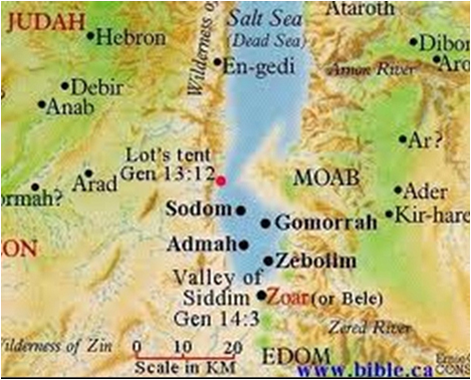
A rival theory for the sites of the four cities later destroyed
http://www.bible.ca/maps/maps-dead-sea-gen14.jpg
http://www.bible.ca/maps/maps-dead-sea-gen14.jpg