| linguae |
|
SOMNIUM
Johannes Kepler's Somnium seu Opus Posthimumum de Astronomia Lunari combines a fantasy narrative of a voyage to the moon with a highly detailed account of the apparent movements of heavenly bodies as seen from there. Written over a number of years and published after his death by his son Ludwig in 1635, it includes Kepler's own technical annnotations, which make up more than half the work. The clearest Latin text is the 1858 edition available at https://archive.org/details/operaomniaedidit81kepluoft Kepler scholar Edward Rosen produced the best translation so far available, including all Kepler's notes and others by the editor himself. Although there is a preview available on Google books at https://books.google.com.hk/books?id=OdCJAS0eQ64C this only includes the narrative itself (with one or two gaps) and about a third of the astronomer's notes. Both notes and story are translated in full – though not always reliably – by Falardeau at https://dspace2.creighton.edu/xmlui/handle/10504/109241 Tom Metcalfe provides a chunked Latin text with following English translation for just under half of the story at https://somniumproject.wordpress.com/somnium/
The Word file below contains the Latin text of the main story (excluding Kepler's own notes) with interlinear translation, explanatory notes of my own and illustrations, with the earlier chapter divisions corresponding to those of Tom Metcalfe. Recordings of the story are being added as is a corrected copy of the text on this web-page itself. The numbers in the text preceded by `^' (^1, ^2 etc.) are indicators to Kepler's own footnoted which may be added later. The number in blue refer to my own notes below each section of the text.

|

| ||||
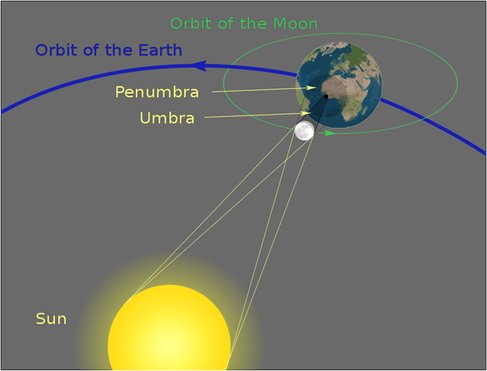
Solar Eclipse (corresponding to an eclipse of Volva (the earth) for an observer on Levania (the moon))
From https://en.wikipedia.org/wiki/Solar_eclipse#/media/File:Geometry_of_a_Total_Solar_Eclipse.svg
From https://en.wikipedia.org/wiki/Solar_eclipse#/media/File:Geometry_of_a_Total_Solar_Eclipse.svg
SOMNIUM
I. Cum annō 1608 fervērent dissidia inter frātrēs Imp. Rudolphum et Matthiam
When in-year 1608 were-raging quarrels between brothers Emperor Rudolph and Matthias
Archiducem,[1] eōrumque actiōnēs vulgō ad exempla referrent[2] ex historiā Bohemicā
arch-duke and-their actions commonly to precedents referred form history Bohemian
petīta, ego pūblicā vulgī cūriōsitāte excitus ad Bohemica legenda[3] animum appulī.
sought I by-public of-masses curiosity aroused to Bohemian-things being—read mind applied
Cumque incidissem in historiam Libussae[4] virāginis,[5] arte magicā celebrātissimae,
And-when I-had-fallen into story of-Libussa virago from-art magic most-famous
factum quādam nocte, ut post contemplātiōnem sīderum et Lūnae lectō compositus
it-came-about on-a-certain night that after contemplation of-stars and of-moon on-bed placed
altius obdormiscerem , atque mihi per somnum vīsus sum librum ex nūndīnis allātum
quite-deeply I-fell-asleep and to-myself in sleep seem I-did book from market brought
perlegere, cujus hic erat tenor:
to-read-through of-which this was content
II.Mihi Duracōtō 1 nōmen est, patria Islandia ^2, quam veterēs Thūlēn[6] dīxēre,[7]
To-me Duracotus name is country Iceland which ancients Thule called
māter erat Fiolxhildis [8]^3, quae nuper mortua [9]^4, scrībendī mihi peperit licentiam,
mother was Fiolxhilde who recently dead of-writing for-me has-brought permission
cujus reī cupiditāte prīdem arsī. Dum vīveret, hoc diligenter ēgit, nē scrīberem ^5.
of-which thing from-desire earlier I-burned while she-lived this diligently she-secured that-not I-should-write
Dīcēbat enim, multōs esse perniciōsōs ōsōres artium ^6 quī quod prae hebetūdine
She-said for many to-be pernicious haters of-arts who what from slowness
[1] Rudolph II, a member of the Habsburg dynasty, was Holy Roman Emperor from 1576 to 1612. Hungary was part of his dominions but after its people, exhausted by a never-ending war against Turkey, revolted, his family in 1605 forced him to put his brother, Archduke Matthias, in charge of Hungarian affairs. In 1608, after Rudolph opposed Matthias’s concessions to the Turks and the Hungarian rebels, his brother forced him to cede the thrones of both Hungary and Austria to him. See https://en.wikipedia.org/wiki/Rudolf_II,_Holy_Roman_Emperor Matthias also assisted Bohemian (i.e. Czech) Protestant rebels against Rudolph and supplanted him as King of Bohemia in 1611. Rudolph had a great interest in astrology and both Kepler and Tycho Brahe enjoyed his patronage.
[2] Taking actionēs as subject, this means that their actions caused people to recall events in Bohemia. Alternatively, actiōnēs is object and the subject is `they’ (people in general) implicit in referrent .
[3] Bohemica legenda: gerundive phrase, most naturally translated into English with a gerund: `reading Bohemian material’
[4] Libussa was a mythical Czech ruler who had faced a revolt by males.
[5] The word virāgō (a war-like, heroic woman) has been used in literary English and is also the name of a well-known feminist publish company (https://www.virago.co.uk/)
[6] Thūlē is described in classical authors as an island in the far north of Europe and this is generally taken as a reference to Iceland or to Mainland, the largest island in the Shetlands.
[7] dīxēre = dīxērunt.
[8] Kepler, whose own mother was accused of witchcraft in 1620, explains he combined the name `Fiolx’ for places in Iceland on an old map and the `hilda’ element in names such as `Brunhilda’. `Fiolx’’ might be a misreading of `fjörđr’ (`fjord’)
[9] English would prefer an abstract subject: `whose recent death’.
mentis nōn capiunt, id calumnientur lēgēsque fīgant injūriōsās hūmānō generī ^7;
of-mind not understand that they-slander and-laws fix injurious to-human race
quibus sānē lēgibus nōn paucī damnātī ^8 Heclae[1] vorāginibus fuerint absorptī [2]^9.
by-which indeed laws not few condemned of-Hekla by-chasms were absorbed
Quod nōmen esset patrī meo ^10 ipsa nunquam dīxit, piscātōrem fuisse et centum
What name was to-father my she-herself never said fisherman to-have-been and hundred
quīnquāgintā annōrum senem dēcessisse perhibēbat, mē tertium aetātis annum agente,
fifty of-years old-man to-have-died she-used-to-maintain with-me third of-age year doing
cum ille septuāgēsimum plūs minus annum in suō vīxisset mātrimōniō ^11. Prīmīs
when he seventieth more less year in his had-lived marriage in-first
pueritiae annīs māter mē manū trahēns interdumque humerīs sublevāns crebrō
of-childhood years mother me by-hand pulling and-sometimes on-shoulder lifting-up frequently
addūcere est solita in humiliōra juga montis Heclae ^12, praesertim circā festum dīvī
to-take was accustomed onto lower ridges of-Mount Hekla especially around feast of-godly
Joannis,[3] quandō Sol tōtīs 24 hōrīs[4] cōnspicuus noctī nūllum relinquit locum ^13.
John when sun for-all 24 hours visible for-night no left place
Ipsa herbās nōnnūllās legēns multīs caeremōniīs domīque coquēns ^14 sacculōs
She-herself herbs some picking with-many rituals and-at-home cooking little-sacks
factitābat ex pellibus caprīnīs , quōs īnflātōs ad vīcīnum portum venum importāns prō
she-used-to-make from skins of-goats which filled to neighbouring port for-sale carrying for
nāvium patrōnīs ^15 victum hōc pactō sustentābat.
ships’ captains living by-this arrangement she-used-to-earn
[1] Hekla, a large volcano in the south of Iceland, known in the Middle Ages as the `Gateway to Hell.’ Kepler himself in his note 2 mentions the idea that Hekla was actually the gateway to Purgatory, a notion probably derived from the writings of the 16th century Swedish bishop Olaus Magnus (see Rosen, Kepler’s Somnium pg, 48, fn,76, https://books.google.com.hk/books?id=OdCJAS0eQ64C )
[2] fuerint absorptī (with perfect subjunctive of the auxiliary verb itself) is an alternative to the more usual sint absorptī (present subjunctive auxiliary producing the perfect subjunctive verb phrase). The subjunctive is required by the subordinate clauses within reported speech.
[3] The Feast of the Birth of St. John the Baptist on 24 June.
[4] hōrīs: ablative plural for length of time, instead of classical accusative, is also found in the Vulgate.
I. Cum annō 1608 fervērent dissidia inter frātrēs Imp. Rudolphum et Matthiam
When in-year 1608 were-raging quarrels between brothers Emperor Rudolph and Matthias
Archiducem,[1] eōrumque actiōnēs vulgō ad exempla referrent[2] ex historiā Bohemicā
arch-duke and-their actions commonly to precedents referred form history Bohemian
petīta, ego pūblicā vulgī cūriōsitāte excitus ad Bohemica legenda[3] animum appulī.
sought I by-public of-masses curiosity aroused to Bohemian-things being—read mind applied
Cumque incidissem in historiam Libussae[4] virāginis,[5] arte magicā celebrātissimae,
And-when I-had-fallen into story of-Libussa virago from-art magic most-famous
factum quādam nocte, ut post contemplātiōnem sīderum et Lūnae lectō compositus
it-came-about on-a-certain night that after contemplation of-stars and of-moon on-bed placed
altius obdormiscerem , atque mihi per somnum vīsus sum librum ex nūndīnis allātum
quite-deeply I-fell-asleep and to-myself in sleep seem I-did book from market brought
perlegere, cujus hic erat tenor:
to-read-through of-which this was content
II.Mihi Duracōtō 1 nōmen est, patria Islandia ^2, quam veterēs Thūlēn[6] dīxēre,[7]
To-me Duracotus name is country Iceland which ancients Thule called
māter erat Fiolxhildis [8]^3, quae nuper mortua [9]^4, scrībendī mihi peperit licentiam,
mother was Fiolxhilde who recently dead of-writing for-me has-brought permission
cujus reī cupiditāte prīdem arsī. Dum vīveret, hoc diligenter ēgit, nē scrīberem ^5.
of-which thing from-desire earlier I-burned while she-lived this diligently she-secured that-not I-should-write
Dīcēbat enim, multōs esse perniciōsōs ōsōres artium ^6 quī quod prae hebetūdine
She-said for many to-be pernicious haters of-arts who what from slowness
[1] Rudolph II, a member of the Habsburg dynasty, was Holy Roman Emperor from 1576 to 1612. Hungary was part of his dominions but after its people, exhausted by a never-ending war against Turkey, revolted, his family in 1605 forced him to put his brother, Archduke Matthias, in charge of Hungarian affairs. In 1608, after Rudolph opposed Matthias’s concessions to the Turks and the Hungarian rebels, his brother forced him to cede the thrones of both Hungary and Austria to him. See https://en.wikipedia.org/wiki/Rudolf_II,_Holy_Roman_Emperor Matthias also assisted Bohemian (i.e. Czech) Protestant rebels against Rudolph and supplanted him as King of Bohemia in 1611. Rudolph had a great interest in astrology and both Kepler and Tycho Brahe enjoyed his patronage.
[2] Taking actionēs as subject, this means that their actions caused people to recall events in Bohemia. Alternatively, actiōnēs is object and the subject is `they’ (people in general) implicit in referrent .
[3] Bohemica legenda: gerundive phrase, most naturally translated into English with a gerund: `reading Bohemian material’
[4] Libussa was a mythical Czech ruler who had faced a revolt by males.
[5] The word virāgō (a war-like, heroic woman) has been used in literary English and is also the name of a well-known feminist publish company (https://www.virago.co.uk/)
[6] Thūlē is described in classical authors as an island in the far north of Europe and this is generally taken as a reference to Iceland or to Mainland, the largest island in the Shetlands.
[7] dīxēre = dīxērunt.
[8] Kepler, whose own mother was accused of witchcraft in 1620, explains he combined the name `Fiolx’ for places in Iceland on an old map and the `hilda’ element in names such as `Brunhilda’. `Fiolx’’ might be a misreading of `fjörđr’ (`fjord’)
[9] English would prefer an abstract subject: `whose recent death’.
mentis nōn capiunt, id calumnientur lēgēsque fīgant injūriōsās hūmānō generī ^7;
of-mind not understand that they-slander and-laws fix injurious to-human race
quibus sānē lēgibus nōn paucī damnātī ^8 Heclae[1] vorāginibus fuerint absorptī [2]^9.
by-which indeed laws not few condemned of-Hekla by-chasms were absorbed
Quod nōmen esset patrī meo ^10 ipsa nunquam dīxit, piscātōrem fuisse et centum
What name was to-father my she-herself never said fisherman to-have-been and hundred
quīnquāgintā annōrum senem dēcessisse perhibēbat, mē tertium aetātis annum agente,
fifty of-years old-man to-have-died she-used-to-maintain with-me third of-age year doing
cum ille septuāgēsimum plūs minus annum in suō vīxisset mātrimōniō ^11. Prīmīs
when he seventieth more less year in his had-lived marriage in-first
pueritiae annīs māter mē manū trahēns interdumque humerīs sublevāns crebrō
of-childhood years mother me by-hand pulling and-sometimes on-shoulder lifting-up frequently
addūcere est solita in humiliōra juga montis Heclae ^12, praesertim circā festum dīvī
to-take was accustomed onto lower ridges of-Mount Hekla especially around feast of-godly
Joannis,[3] quandō Sol tōtīs 24 hōrīs[4] cōnspicuus noctī nūllum relinquit locum ^13.
John when sun for-all 24 hours visible for-night no left place
Ipsa herbās nōnnūllās legēns multīs caeremōniīs domīque coquēns ^14 sacculōs
She-herself herbs some picking with-many rituals and-at-home cooking little-sacks
factitābat ex pellibus caprīnīs , quōs īnflātōs ad vīcīnum portum venum importāns prō
she-used-to-make from skins of-goats which filled to neighbouring port for-sale carrying for
nāvium patrōnīs ^15 victum hōc pactō sustentābat.
ships’ captains living by-this arrangement she-used-to-earn
[1] Hekla, a large volcano in the south of Iceland, known in the Middle Ages as the `Gateway to Hell.’ Kepler himself in his note 2 mentions the idea that Hekla was actually the gateway to Purgatory, a notion probably derived from the writings of the 16th century Swedish bishop Olaus Magnus (see Rosen, Kepler’s Somnium pg, 48, fn,76, https://books.google.com.hk/books?id=OdCJAS0eQ64C )
[2] fuerint absorptī (with perfect subjunctive of the auxiliary verb itself) is an alternative to the more usual sint absorptī (present subjunctive auxiliary producing the perfect subjunctive verb phrase). The subjunctive is required by the subordinate clauses within reported speech.
[3] The Feast of the Birth of St. John the Baptist on 24 June.
[4] hōrīs: ablative plural for length of time, instead of classical accusative, is also found in the Vulgate.
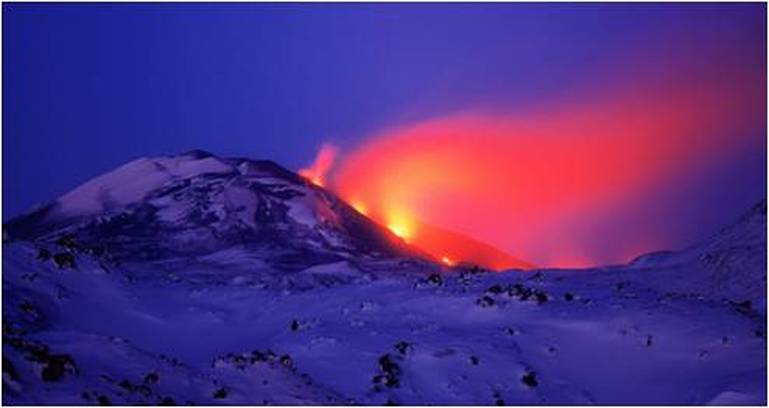
The fires of Hekla
III.Cum aliquandō per cūriōsitātem rescissō sacculō, quem māter ignara vēndēbat,
When once out-of curiosity having-been-cut bag which mother unaware was-trying-to-sell
herbīsque et linteīs ^16, quae acū picta variōs praeferēbant charactērēs, explicātīs,
and-with-herbs and linen-strips which with-needle embroidered various carried symbols spilled-out
ipsam hōc lucellō fraudāssem:[1] māter īrā succēnsa mē locō sacculī nauclērō
her out-of-this little-profit I-had-cheated mother with-anger on-fire me in-place of-sack to-captain
proprium addīxit, ut ipsa pecuniam retinēret. Atque is postrīdiē ex īnspērātō solvēns
as-his-own bound so-that she-herself money might-retain and he next-day from unexpected setting-sail
ē portū, secundō ventō quasī Bergās[2] Nordwegiae tendēbat ^17. Post aliquot diēs
from port with-favourable wind roughly to-Bergen of-Norway was-heading after some days
boreā surgente ^18 inter Nordwegiam et Angliam dēlātus Dāniam petiit
with-north-wind arising between Norway and England carried-down Denmark made-for
frētumque ēmēnsus, cum habēret literās episcopī islandicī^19, trādendās Tychōnī
and-strait having-passed-through since he-had letter of-bishop of-Iceland for-being-handed-over to-Tycho
Brahe Dānō, quī in īnsulā Wenā[3] habitābat,[4] ego vērō vehementer aegrōtārem ex
Brahe the-Dane who in island Hven lived I indeed immensely was-ill from
jactātiōne et aurae tepōre insuētō ^20, quippe quatuordecim annōrum adolescēns: nāvī
the-tossing and of-air warmth unfamiliar in-as-much-as fourteen of-years adolescent with-ship
ad lītus appulsā mē apud piscātōrem insulānum ^21 exposuit cum literīs et spē reditūs
to shore driven me with fisherman belonging-to-island put-ashore with letter and hope of-return
factā[5] solvit.
made set-sail
IV. Literīs trāditīs Braheus valdē exhilarātus coepit ex mē multa quaerere ^22, quae
With-letter handed-over Brahe greatly delighted began from me many-things to-enquire which
ego linguae imperītus nōn intellēxī, paucīs verbīs exceptīs ^23. Itaque negōtium suīs
I with-language unacquainted not understood with-few words excepted and-so task to-his
dedit studiōsīs, quōs magnō numerō alēbat ^24, utī mēcum crebrō loquerentur,
he-gave students whom in-great number he-supported that with-me frequently they-should-talk
factumque līberālitāte Brahei ^25, et paucārum septimānārum exercitiō, ut mediōcriter
and-brought-about by-generosity of-Brahe and of-a-few weeks by-training that fairly-well
Dānice loquerer. Nec minus ego promtus in nārrandō, quam illi erant in quaerendō.
in-Danish I-could-talk and-not less I was-ready in-telling than they were in questioning
[1] fraudāssem = fraudāvissem, pluperfect subjunctive of fraudō (1). Cheat, defraud.
[2] Both Berga (singular) and Bergae (plural) were used for Bergen in medieval Latin.
[3] The island of Hven (Danish) or Ven (Swedish), halfway between Denmark and Sweden, was the site of Tycho Brahe’s observatory and Kepler, who had been Brahe’s apprentice, may have himself spent time there. The island was under Danish control until 1658 when it passed to Sweden.
[4] A word like et is really needed here as ego…adolēscēns is also part of the long cum clause starting in the line above.
[5] i.e. after promising to return
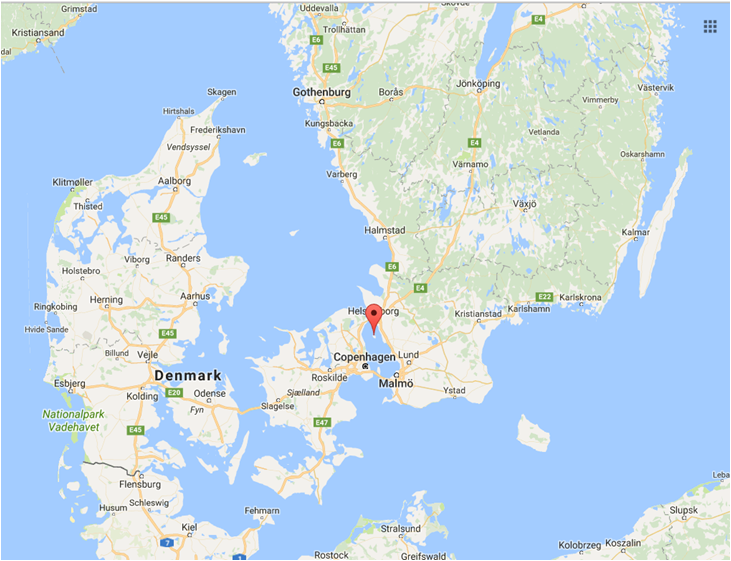
Location of the island of Hven
Multa quippe īnsuēta mīrābar, multa mīrantibus ex meā patriā nova recēnsēbam.
Many-things for unfamiliar I-marveled-at many-things to-them-marvelling from-my country new I-recounted
Dēnique reversus nāvis magister mēque repetēns repulsam tulit,[1] valdē mē gaudente
Finally having-returned of-ship captain and-me asking-back rebuff he-bore greatly with-me rejoicing
^26. Mīrum in modum mihi arrīdēbant astronomica exercitia, quippe studiōsī et
Marvellous in manner me were-delighting astronomical exercises for the-students and
Braheus mīrābilibus māchinīs tōtīs noctibus[2] intendēbant Lūnae sīderibusque ^27,
Brahe with-marvellous machines for-whole nights were-focussed on-moon and-stars
quae mē rēs admonēbat mātris, quippe et ipsa assiduē cum Lūnā solita erat colloquī
which me thing reminded of-mother for also she assiduously with moon accustomed was to-speak
^28. Hāc igitur occāsiōne ego patriā semibarbarus, conditiōne egentissimus, in
By-this therefore chance I by-country half-barbarian by-condition very-poor into
dīvīnissimae scientiae cognitiōnem vēnī; quae mihi ad majōra viam parāvit.
of-most-divine science knowledge came which for-me to greater-things way prepared
[1] repulsam tulit: i.e. Brahe refused to let the boy go.
[2] tōtīs noctibus: perhaps meaning `for the whole of each night
Many-things for unfamiliar I-marveled-at many-things to-them-marvelling from-my country new I-recounted
Dēnique reversus nāvis magister mēque repetēns repulsam tulit,[1] valdē mē gaudente
Finally having-returned of-ship captain and-me asking-back rebuff he-bore greatly with-me rejoicing
^26. Mīrum in modum mihi arrīdēbant astronomica exercitia, quippe studiōsī et
Marvellous in manner me were-delighting astronomical exercises for the-students and
Braheus mīrābilibus māchinīs tōtīs noctibus[2] intendēbant Lūnae sīderibusque ^27,
Brahe with-marvellous machines for-whole nights were-focussed on-moon and-stars
quae mē rēs admonēbat mātris, quippe et ipsa assiduē cum Lūnā solita erat colloquī
which me thing reminded of-mother for also she assiduously with moon accustomed was to-speak
^28. Hāc igitur occāsiōne ego patriā semibarbarus, conditiōne egentissimus, in
By-this therefore chance I by-country half-barbarian by-condition very-poor into
dīvīnissimae scientiae cognitiōnem vēnī; quae mihi ad majōra viam parāvit.
of-most-divine science knowledge came which for-me to greater-things way prepared
[1] repulsam tulit: i.e. Brahe refused to let the boy go.
[2] tōtīs noctibus: perhaps meaning `for the whole of each night
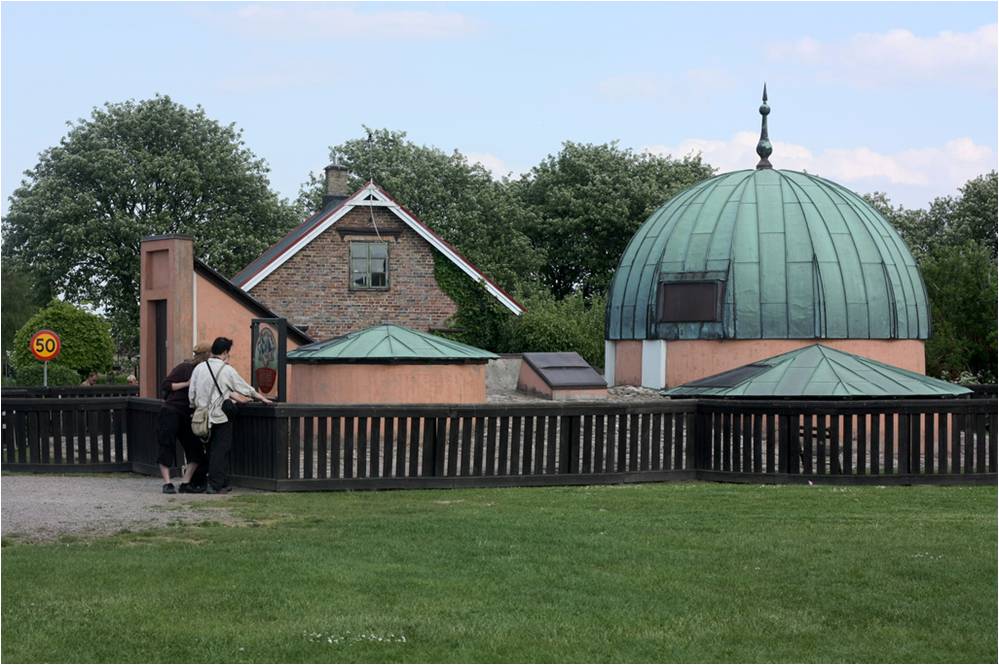
Reconstruction of Tycho Brae’s observatory on Ven island in the strait between Denmark and Sweden
V. Etenim exāctīs annīs aliquot in hāc īnsulā tandem mē cupiditās incessit
And-indeed spent years some in this island at-last me desire came-upon
revīsendae[1] patriae; rēbar enim nōn grave mihi futūrum ob acquīsītam scientiam,
of-being-revisited native-land I-was-thinking for not difficult to-me going-to-be because-of acquired knowledge
ēmergere ad aliquam in meā gente rudī[2] dignitātem. Salūtātō igitur patrōnō et
to-rise to some in my nation primitive dignity bade-farewell therefore with-patron and
veniā discessūs impetrātā vēnī Hafniam; nactusque sociōs itineris, quī mē
with-permission of-departure obtained I-came to-Copenhagen and-having-obtained companions of-journey who me
ob linguae et regiōnis cognitiōnem libenter in suum patrōcinium suscēpērunt, rediī in
because-of of-language and of-region knowledge willingly into their protection took I-returned into
patriam, quīntō postquam excesseram annō. Prīma meī reditūs fēlīcitās erat, quod
native-land in-fifth after I-had-left year first of-my return joy was that
mātrem invēnī adhūc spīrantem et eadem quae olim[3] factitantem, fīnemque eī
mother I-found still breathing and same which once keeping-on-doing and-end for-her
poenitūdinis diūturnae, ob āmissum temeritāte fīlium, vīvus et ōrnātus attulī. Vergēbat
of-punishment long-lasting because-of lost through-rashness son living and well-attired I-brought was-sinking
tunc annus in autumnum ^29, succēdēbantque deinceps noctēs illae nostrae longae,
then year into autumn and-were-coming-up in-a-series nights those of-us long
[1] revīsendae patriae is a gerundive phrase, literally `of fatherland being revisited’ but more idiomatically translated by an English gerund:`of revisiting my fatherland’, Latin can also use its gerund to express the same idea (revīsendī patriam) but this is considered less elegant
[2] Ablative singular of rudis, -e, so qualifying gente, not dignitātem
[3] quae olim is short for quae olim faciēbat
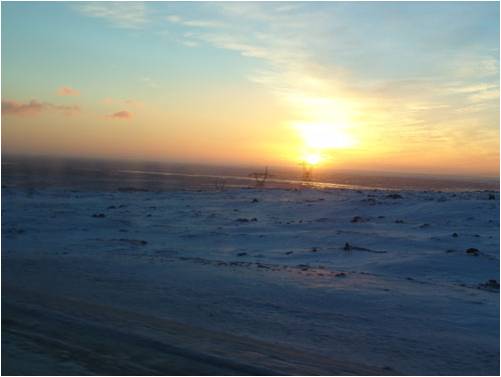
Mid-day winter sun in Iceland
http://www.olsoniniceland.com/Iceland2004/pages/DSC03936.htm
http://www.olsoniniceland.com/Iceland2004/pages/DSC03936.htm
quippe Nātālitiō Christi mēnse Sōl in merīdiē vīx parum ēmergēns ē vestīgiō[1]
for of-birth of-Christ in-month sun at mid-day scarcely too-little coming-out instantly
rūrsum conditur ^30.
again is-hidden
Ita māter per hanc vacātiōnem a suīs operīs mihi adhaerēre,[2] ā mē nōn discēdere,
Thus mother through this break from her work to-me continued-to-stick from me not to-depart
quōcunque mē cum commendātitiīs literīs recēpissem,[3] percontārī iam dē terrīs, quās
wherever myself with of-recommendation letters I-had-taken to-ask-questions now about lands which
adiissem, iam dē coelō, quam scientiam mē didicisse vehementissimē gaudēbat,
I-had-visited now about heavens which knowledge me to-have-learned very-greatly she-was-rejoicing
comparāre quae ipsa habēbat comperta[4] cum meīs nārrātīs ^31, exclāmāre, iam sē
to-compare what herself had found with my things-told to—exclaim now herself
promtam[5] esse ad moriendum, ut quae scientiae suae, quam sōlam possīdēret, fīlium
ready to-be for dying as one-who to-knowledge her which alone she-possessed son
haerēdem sit[6] relictūra ^32.
(as) heir is going-to-leave
VI Ego nātūrā cupidissimus perdiscendī nova quaesīvī vicissim ex ipsā de suīs
I by-nature very-desirous of-thoroughly-learning new-things asked in-turn of her about her-own
artibus et quōs eārum habuisset[7] magistrōs in gente tantum a cēterīs dīremtā.[8] Tunc
skills and what of-them she-had-had teachers in nation so-much from the-rest cut-off then
illa quōdam diē, spatiō ad loquendum sumtō[9], rem omnem ā prīmīs initiīs repetiit in
she on-certin day with-time for talking set-aside matter all from first beginnings recalled in
hunc fere modum:
this roughly way
Prōspectum[10] est, Duracōte fīlī, nōn cēterīs sōlum prōvinciīs, in quās vēnistī, sed
Sight is Duracotus son not other only for-provinces into which you-came but
[1] The phrase ē vestigiō (`instantly;, `forthwith’) literally means `from its tracks’)
[2] adhaerēre, discēdere, percontārī, comparāre and exclāmāre in this sentence are `historical infinitives’ used as an alternative to the imperfect tense to describe a past situation. This construction is quite common in classical Latin though not used by all authors..
[3] The subjunctives recēpissem and adiissem are not really necessary here but Kepler may possibly have felt they were needed with historical infinitives as they would be when infinitives are used in reported speech.
[4] habēbat comperta: an alternative in very late Latin to the classical pluperfect compererat
[5] A contraction of the commoner classical form promptam
[6] sit is subjunctive, either because it is in a relative clause within reported speech or because the clause is felt to be one of characteristic (`who was the kind of person who could leave..’ Because the historic infinitive is an equivalent of the imperfect tense, the imperfect subjunctive (esset) might have been expected here in classical Latin.
[7] Subjunctive is the indirect question quōs….dīremt.
[8] Contracted form of dīrempta
[9] Contraction of classical sumptō
[10] prōspectum presumably refers to a vision of the truth or to insight, less likely to possibilities or opportunities, a sense in which English would use the plural `prospects’.
nostrae etiam patriae. Etsī enim nōs urgent frīgora et tenebrae aliaque incommoda,
for-our also country although for us oppress cold and darkness and-other disadvantages
quae nunc dēmum sentiō, postquam ex tē fēlīcitatem intellēxī regiōnum cēterārum, at
which now finally I-perceive after from you happiness I-have-understood of-regions other yet
nōs in geniīs abundāmus ^33, nōbīs praesto sunt sapientissimī spīritūs ^34, quī tantam
we in talents abound for-us at-hand are very-wise spirits who so-great
lūcem regiōnum cēterārum strepitumque hominum perōsi nostrās appetunt umbrās et
light of-regions other and-noise of-people hating our seek-out shadows and
nōbīscum familiāriter conversantur.[1]
with-us in-familiar-manner converse
Sunt ex iīs praecipuī novem ^35; ex quibus ūnus ^36, mihi pecūliāriter nōtus et
There-are of them foremost nine from whom one to-me exceptionally well-known and
vel maxime omnium mītis atque innoxius[2] ^37, vīgintī et ūnō charactēribus
altogether most of-all mild and harmless twenty and one with-characters
ēvocātur ^38, cujus ope nōn rārō mōmento tempōria in aliās ōrās ^39, quās ipsī
is-evoked whose by-help not on-rare occasion temporarily to other shores which to-him
dīxerō, trānsportor, aut sī ab aliquibus longinquitāte absterreor ^40, quaerendō de iīs
I-will-have-said I-am-transported or if from some by-remoteness I-am-frightned-off by-questioning about them
tantum prōficio, quantum sī praesēns ibi essem ^41, quī plēraque eōrum, quae tū vel
as-much I-profit as if present there I-was he most of-those-things which you either
oculīs nōtāsti, vel fandō[3] accēpistī, vel ex librīs hausistī, eōdem quō tu modō mihi
with-eyes have-noted or by-saying have-learned or from books have-taken by-same in-which you manner to-me
recēnsuit. Imprīmīs ejus, dē quā totiēs mihi dīxit, regiōnis tē velim spectātōrem fierī,
recounted especially if-that about which so-often to-me he-spoke of-región you I-would-like observer to-become
mē comite, valdē enim mīra sunt, quae de eā nārrat. Levāniam:[4] indigitāvit ^42.
with-me companion greatly for wonderful are things-which about it he-tells Levania she-spoke-the-name
VII Nec mora cōnsentiō, ut magistrum illa suum accersat et consideō,[5] parātus
And-not delay I-agree that teacher she her should-summon and I-sit-down ready
ad audiendam[6] tōtam et itineris ratiōnem, et regiōnis dēscrīptiōnem.
for being-heard whole both of-journey account and of-region description
Tempus iam erat vernum, Lūnā crēscente in cornua, quae ut prīmum Sōle sub
time now was of-spring with-moon growing into horns which as first with-sun under
[1] conversor in earlier Latin means `associate with’ but Kepler may be using it here in the narrower English sense of `converse’.
[2] Kepler writes in his own notes 35 and 36 that he was definitely thinking of Urania, the Muse of astronomy, and that the number nine might have been suggested by the traditional list of nine Muses.
[3] fandō, literally `by saying’ (ablative of gerund from for, fārī, fātus sum), i.e. by word-of-mouth,
[4] Levānia was chose as an approximation to livana , one of the Hebrew words for `moon’ Kepler felt that Hebrew, being more exotic than Greek, conveys a greater air of mystery.
[5] This 2nd. conjugation verb appears to be an elsewhere unattested alternative to cōnsīdō, -ere, -sēdī, -sessum and was presumable formed on the analogy of the base verb sedeō.
[6] ad audiendam..ratiōnem et..dēscriptiōnem: another gerundive phrase (see note 21 above).
for of-birth of-Christ in-month sun at mid-day scarcely too-little coming-out instantly
rūrsum conditur ^30.
again is-hidden
Ita māter per hanc vacātiōnem a suīs operīs mihi adhaerēre,[2] ā mē nōn discēdere,
Thus mother through this break from her work to-me continued-to-stick from me not to-depart
quōcunque mē cum commendātitiīs literīs recēpissem,[3] percontārī iam dē terrīs, quās
wherever myself with of-recommendation letters I-had-taken to-ask-questions now about lands which
adiissem, iam dē coelō, quam scientiam mē didicisse vehementissimē gaudēbat,
I-had-visited now about heavens which knowledge me to-have-learned very-greatly she-was-rejoicing
comparāre quae ipsa habēbat comperta[4] cum meīs nārrātīs ^31, exclāmāre, iam sē
to-compare what herself had found with my things-told to—exclaim now herself
promtam[5] esse ad moriendum, ut quae scientiae suae, quam sōlam possīdēret, fīlium
ready to-be for dying as one-who to-knowledge her which alone she-possessed son
haerēdem sit[6] relictūra ^32.
(as) heir is going-to-leave
VI Ego nātūrā cupidissimus perdiscendī nova quaesīvī vicissim ex ipsā de suīs
I by-nature very-desirous of-thoroughly-learning new-things asked in-turn of her about her-own
artibus et quōs eārum habuisset[7] magistrōs in gente tantum a cēterīs dīremtā.[8] Tunc
skills and what of-them she-had-had teachers in nation so-much from the-rest cut-off then
illa quōdam diē, spatiō ad loquendum sumtō[9], rem omnem ā prīmīs initiīs repetiit in
she on-certin day with-time for talking set-aside matter all from first beginnings recalled in
hunc fere modum:
this roughly way
Prōspectum[10] est, Duracōte fīlī, nōn cēterīs sōlum prōvinciīs, in quās vēnistī, sed
Sight is Duracotus son not other only for-provinces into which you-came but
[1] The phrase ē vestigiō (`instantly;, `forthwith’) literally means `from its tracks’)
[2] adhaerēre, discēdere, percontārī, comparāre and exclāmāre in this sentence are `historical infinitives’ used as an alternative to the imperfect tense to describe a past situation. This construction is quite common in classical Latin though not used by all authors..
[3] The subjunctives recēpissem and adiissem are not really necessary here but Kepler may possibly have felt they were needed with historical infinitives as they would be when infinitives are used in reported speech.
[4] habēbat comperta: an alternative in very late Latin to the classical pluperfect compererat
[5] A contraction of the commoner classical form promptam
[6] sit is subjunctive, either because it is in a relative clause within reported speech or because the clause is felt to be one of characteristic (`who was the kind of person who could leave..’ Because the historic infinitive is an equivalent of the imperfect tense, the imperfect subjunctive (esset) might have been expected here in classical Latin.
[7] Subjunctive is the indirect question quōs….dīremt.
[8] Contracted form of dīrempta
[9] Contraction of classical sumptō
[10] prōspectum presumably refers to a vision of the truth or to insight, less likely to possibilities or opportunities, a sense in which English would use the plural `prospects’.
nostrae etiam patriae. Etsī enim nōs urgent frīgora et tenebrae aliaque incommoda,
for-our also country although for us oppress cold and darkness and-other disadvantages
quae nunc dēmum sentiō, postquam ex tē fēlīcitatem intellēxī regiōnum cēterārum, at
which now finally I-perceive after from you happiness I-have-understood of-regions other yet
nōs in geniīs abundāmus ^33, nōbīs praesto sunt sapientissimī spīritūs ^34, quī tantam
we in talents abound for-us at-hand are very-wise spirits who so-great
lūcem regiōnum cēterārum strepitumque hominum perōsi nostrās appetunt umbrās et
light of-regions other and-noise of-people hating our seek-out shadows and
nōbīscum familiāriter conversantur.[1]
with-us in-familiar-manner converse
Sunt ex iīs praecipuī novem ^35; ex quibus ūnus ^36, mihi pecūliāriter nōtus et
There-are of them foremost nine from whom one to-me exceptionally well-known and
vel maxime omnium mītis atque innoxius[2] ^37, vīgintī et ūnō charactēribus
altogether most of-all mild and harmless twenty and one with-characters
ēvocātur ^38, cujus ope nōn rārō mōmento tempōria in aliās ōrās ^39, quās ipsī
is-evoked whose by-help not on-rare occasion temporarily to other shores which to-him
dīxerō, trānsportor, aut sī ab aliquibus longinquitāte absterreor ^40, quaerendō de iīs
I-will-have-said I-am-transported or if from some by-remoteness I-am-frightned-off by-questioning about them
tantum prōficio, quantum sī praesēns ibi essem ^41, quī plēraque eōrum, quae tū vel
as-much I-profit as if present there I-was he most of-those-things which you either
oculīs nōtāsti, vel fandō[3] accēpistī, vel ex librīs hausistī, eōdem quō tu modō mihi
with-eyes have-noted or by-saying have-learned or from books have-taken by-same in-which you manner to-me
recēnsuit. Imprīmīs ejus, dē quā totiēs mihi dīxit, regiōnis tē velim spectātōrem fierī,
recounted especially if-that about which so-often to-me he-spoke of-región you I-would-like observer to-become
mē comite, valdē enim mīra sunt, quae de eā nārrat. Levāniam:[4] indigitāvit ^42.
with-me companion greatly for wonderful are things-which about it he-tells Levania she-spoke-the-name
VII Nec mora cōnsentiō, ut magistrum illa suum accersat et consideō,[5] parātus
And-not delay I-agree that teacher she her should-summon and I-sit-down ready
ad audiendam[6] tōtam et itineris ratiōnem, et regiōnis dēscrīptiōnem.
for being-heard whole both of-journey account and of-region description
Tempus iam erat vernum, Lūnā crēscente in cornua, quae ut prīmum Sōle sub
time now was of-spring with-moon growing into horns which as first with-sun under
[1] conversor in earlier Latin means `associate with’ but Kepler may be using it here in the narrower English sense of `converse’.
[2] Kepler writes in his own notes 35 and 36 that he was definitely thinking of Urania, the Muse of astronomy, and that the number nine might have been suggested by the traditional list of nine Muses.
[3] fandō, literally `by saying’ (ablative of gerund from for, fārī, fātus sum), i.e. by word-of-mouth,
[4] Levānia was chose as an approximation to livana , one of the Hebrew words for `moon’ Kepler felt that Hebrew, being more exotic than Greek, conveys a greater air of mystery.
[5] This 2nd. conjugation verb appears to be an elsewhere unattested alternative to cōnsīdō, -ere, -sēdī, -sessum and was presumable formed on the analogy of the base verb sedeō.
[6] ad audiendam..ratiōnem et..dēscriptiōnem: another gerundive phrase (see note 21 above).
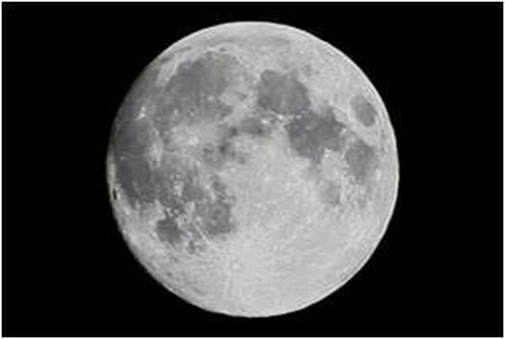
Levania
horīzontem conditō[1] coepit ēnitēre jūncta planētae Saturnō in Taurī signō^43, māter
horizon hidden began to-shine-forth joined to-planet Saturn in of-Taurus sign mother
seorsim[2] ā mē sē recipiēns ^44 in proximum bivium ^45, et pauculīs verbīs clāmōre
apart from me herself taking to nearest crossroads and with-a-few words with-shout
sublātō ēnūnciātīs[3] ^46, quibus petitiōnem suam prōpōnēbat, cēremōniīsque peractīs
raised pronounced with-which request her she-was-putting-forward and-with-rituals carried-out
revertitur ^47, praetēnsā dextrae manūs palmā silentium imperāns, propterque mē
returns with-extended of-right hand palm silence commanding and-next-to me
assidet ^48. Vix capita vestibus (ut conventum erat) involverāmus ^49, cum ecce
sits-beside hardly heads with-clothing as had-been-agreed had-we-wrapped when behold
screātus exoritur[4] blaesae et obtūsae vōcis ^50 et statim in hunc modurn, sed idiomāte
screeching arises of-stammering and unclear voice ad immediately in this way but in-language
Islandicō, infit.[5]
Icelandic begins-to-speak
[1] Ablative absolute (`with the sun having been buried,,’)
[2] Lewis & Short describe seorsim as an erroneous spelling of seorsum (separately, in seclusion)
[3] i.e ēnuūntiātīs (perfect participle of ēnūntiō (1))
[4] Although orior (orītī, ortus sum) and its compounds belong to the 4th conjugation, the vowel in the 3rd. person sing. of the present tense passive is regularly short.
[5] īnfit (`begins (to speak)) is a defective verb, normally only found in the 3rd. person singular of the present tense.
horizon hidden began to-shine-forth joined to-planet Saturn in of-Taurus sign mother
seorsim[2] ā mē sē recipiēns ^44 in proximum bivium ^45, et pauculīs verbīs clāmōre
apart from me herself taking to nearest crossroads and with-a-few words with-shout
sublātō ēnūnciātīs[3] ^46, quibus petitiōnem suam prōpōnēbat, cēremōniīsque peractīs
raised pronounced with-which request her she-was-putting-forward and-with-rituals carried-out
revertitur ^47, praetēnsā dextrae manūs palmā silentium imperāns, propterque mē
returns with-extended of-right hand palm silence commanding and-next-to me
assidet ^48. Vix capita vestibus (ut conventum erat) involverāmus ^49, cum ecce
sits-beside hardly heads with-clothing as had-been-agreed had-we-wrapped when behold
screātus exoritur[4] blaesae et obtūsae vōcis ^50 et statim in hunc modurn, sed idiomāte
screeching arises of-stammering and unclear voice ad immediately in this way but in-language
Islandicō, infit.[5]
Icelandic begins-to-speak
[1] Ablative absolute (`with the sun having been buried,,’)
[2] Lewis & Short describe seorsim as an erroneous spelling of seorsum (separately, in seclusion)
[3] i.e ēnuūntiātīs (perfect participle of ēnūntiō (1))
[4] Although orior (orītī, ortus sum) and its compounds belong to the 4th conjugation, the vowel in the 3rd. person sing. of the present tense passive is regularly short.
[5] īnfit (`begins (to speak)) is a defective verb, normally only found in the 3rd. person singular of the present tense.
VIII Quīnquāgintā mīllibus mīliārium Germānicōrum[1] ^53 in aetheris profundō sita ^54
Fifty thousand of-miles German in of-upper-air depth situated
est Levānia īnsula; iter ad eam hinc vel ex eā in hās Terrās rārissimē patet ^55, et
Is Levania island route to it from-here or from it into these lands very-rarely is-open and
cum patet, nostrae quidem gentī facile est ^56, hominibus vērō trānsportandīs plānē
when it-is-open to-our indeed race easy is for-humans indeed to-be-transported clearly
difficillimum et cum summō vītae periculo conjūnctum ^57. Nūllī ā nōbīs sedentāriī
very-difficult and with greatest to-life danger joined no by us desk-bound--people
adscīscuntur in hunc comitātum, nulli corpulenti, nūllī dēlicātī ^58, sed legimus eōs,
are-admitted into this fellowship no fat-people no delicate-ones but we-chose those
quī aetātem verēdōrum assiduō ūsū cōnsūmunt, aut quī nāvibus frequenter Indiās
who life of-swift-horses continual in-use spend or who in-ships frequently the-Indies
adeunt, pāne biscoctō,[2] alliō, piscibus dūrātis et cibīs abhorrentibus victitāre suētī
go-to on-bread double-cooked garlic fish dried and foods unappetizing to-live-on accustomed
^59. Inprīmīs nōbīs aptae sunt vetulae exsuccae ^60, quibus inde ā pueritiā trīta est
Especially for-uss suitable are old-women dried-up to-whom right from childhood common is
ratiō, hircōs nocturnōs, aut furcas, aut trīta pallia inequitandī trājiciendīque per
practice he-goats nocturnal or forked-sticks or worn-out cloaks of-riding-on and-of-traversing through
immānia terrārum spatia. Nūllī ē Germāniā virī aptī sunt, Hispānōrum sicca corpora
immense of-the-earth expanses No from Germany men suitable are of-Spaniards dry bodies
nōn respuimus ^61.
not we-spurn
IX Tōtum iter, quantum est, quattuor ad summum hōrārum spatiō absolvitur ^62.
Whole jopurnet great-as it-is four at most of-hours in-span is-completed
Neque enim nōbīs semper occupātissimīs anteā cōnstat dē tempore eundī ^63, quam
Not for with-us always very-busy before it-is-agreed about time of going than
Lūna ab orientis partibus coeperit dēficere;[3] quae ubi tōta lūxerit, nōbīs adhūc in
Moon from of-east regions will-have-begun to-be-eclipsed this when whole will-be-lit with-us still on
itinere haerentibus, irrita redditur nostra profectiō.Tam praeceps occāsio efficit, ut
journey stuck useless is-rendered our departure so short opportunity causes that
paucōs ex humānā gente, nec aliōs, nisi nostrī[4] observantissimōs comitēs habeāmus
few from human race and-not others except to-us those-most-devoted companions we-have
[1] The term German mile`(miliāre Germānicum) was used for several measure of distance but Kepler’s own note 53 explains he is using the `German geographical mile’, defined as 1/15 of a degree of longitude at the equator, or approximately 4.61 English miles. 50,000 of these units is equivalent to 230,545 miles, compared with the 238,855 mile actual average distance of the moon from the earth.
[2] The phrase pānis biscoctus is used by Marco Polo for wafers made by the inhabitants of the Arabian peninsula from salted fish but here presumably means `hardtack’, i.e biscuits or crackers made from flour and water, which were staple food for sailors at this time. Kepler himself lived very frugally and enjoyed gnawing on bones and hard crusts (see Rosen, Kepler’s Somnium, p.15, n.17).
[3] The conjunction antequam is here split between the two clauses and ante itself changed to anteā (afterwards). The whole sentence would most naturally be translated `As we are so busy, there is no agreement to go until a lunar eclipse has begun’ but `there is agreement not to go before the start of an eclipse’ makes better sense.’ During such an eclipse, the moon remains within the earth’s shadow for about four hours.
[4] nostrī is genitive of object. Only those most devoted to the demons can accompany them.
Fifty thousand of-miles German in of-upper-air depth situated
est Levānia īnsula; iter ad eam hinc vel ex eā in hās Terrās rārissimē patet ^55, et
Is Levania island route to it from-here or from it into these lands very-rarely is-open and
cum patet, nostrae quidem gentī facile est ^56, hominibus vērō trānsportandīs plānē
when it-is-open to-our indeed race easy is for-humans indeed to-be-transported clearly
difficillimum et cum summō vītae periculo conjūnctum ^57. Nūllī ā nōbīs sedentāriī
very-difficult and with greatest to-life danger joined no by us desk-bound--people
adscīscuntur in hunc comitātum, nulli corpulenti, nūllī dēlicātī ^58, sed legimus eōs,
are-admitted into this fellowship no fat-people no delicate-ones but we-chose those
quī aetātem verēdōrum assiduō ūsū cōnsūmunt, aut quī nāvibus frequenter Indiās
who life of-swift-horses continual in-use spend or who in-ships frequently the-Indies
adeunt, pāne biscoctō,[2] alliō, piscibus dūrātis et cibīs abhorrentibus victitāre suētī
go-to on-bread double-cooked garlic fish dried and foods unappetizing to-live-on accustomed
^59. Inprīmīs nōbīs aptae sunt vetulae exsuccae ^60, quibus inde ā pueritiā trīta est
Especially for-uss suitable are old-women dried-up to-whom right from childhood common is
ratiō, hircōs nocturnōs, aut furcas, aut trīta pallia inequitandī trājiciendīque per
practice he-goats nocturnal or forked-sticks or worn-out cloaks of-riding-on and-of-traversing through
immānia terrārum spatia. Nūllī ē Germāniā virī aptī sunt, Hispānōrum sicca corpora
immense of-the-earth expanses No from Germany men suitable are of-Spaniards dry bodies
nōn respuimus ^61.
not we-spurn
IX Tōtum iter, quantum est, quattuor ad summum hōrārum spatiō absolvitur ^62.
Whole jopurnet great-as it-is four at most of-hours in-span is-completed
Neque enim nōbīs semper occupātissimīs anteā cōnstat dē tempore eundī ^63, quam
Not for with-us always very-busy before it-is-agreed about time of going than
Lūna ab orientis partibus coeperit dēficere;[3] quae ubi tōta lūxerit, nōbīs adhūc in
Moon from of-east regions will-have-begun to-be-eclipsed this when whole will-be-lit with-us still on
itinere haerentibus, irrita redditur nostra profectiō.Tam praeceps occāsio efficit, ut
journey stuck useless is-rendered our departure so short opportunity causes that
paucōs ex humānā gente, nec aliōs, nisi nostrī[4] observantissimōs comitēs habeāmus
few from human race and-not others except to-us those-most-devoted companions we-have
[1] The term German mile`(miliāre Germānicum) was used for several measure of distance but Kepler’s own note 53 explains he is using the `German geographical mile’, defined as 1/15 of a degree of longitude at the equator, or approximately 4.61 English miles. 50,000 of these units is equivalent to 230,545 miles, compared with the 238,855 mile actual average distance of the moon from the earth.
[2] The phrase pānis biscoctus is used by Marco Polo for wafers made by the inhabitants of the Arabian peninsula from salted fish but here presumably means `hardtack’, i.e biscuits or crackers made from flour and water, which were staple food for sailors at this time. Kepler himself lived very frugally and enjoyed gnawing on bones and hard crusts (see Rosen, Kepler’s Somnium, p.15, n.17).
[3] The conjunction antequam is here split between the two clauses and ante itself changed to anteā (afterwards). The whole sentence would most naturally be translated `As we are so busy, there is no agreement to go until a lunar eclipse has begun’ but `there is agreement not to go before the start of an eclipse’ makes better sense.’ During such an eclipse, the moon remains within the earth’s shadow for about four hours.
[4] nostrī is genitive of object. Only those most devoted to the demons can accompany them.
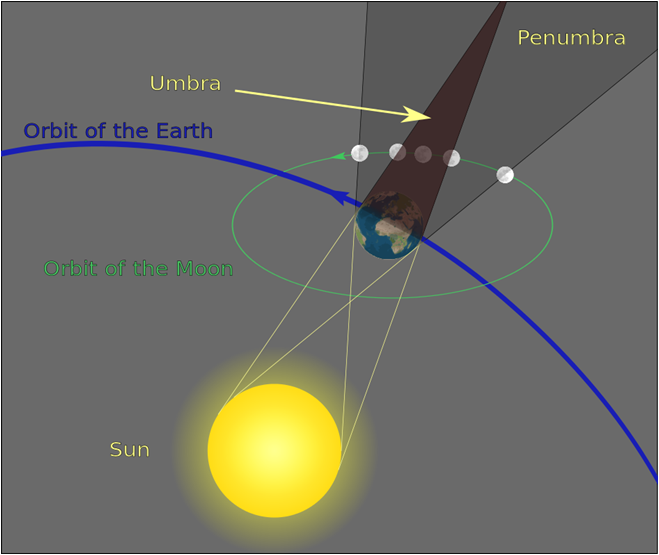
Lūnae dēfectus
https://en.wikipedia.org/wiki/Lunar_eclipse#/media/File:Geometry_of_a_Lunar_Eclipse.svg
https://en.wikipedia.org/wiki/Lunar_eclipse#/media/File:Geometry_of_a_Lunar_Eclipse.svg
^64. Ergō hominem aliquem hujusmodī agminātim invādimus omnēsque subtus
Therefore human some of-this-kind in-a-column we-rush-upon and-all from-below
nītentēs, in altum eum tollimus ^65. Prīma quaeque mōlītiō dūrissima ipsī accidit ^66,
pushing on high him we-lift first each take-off most-harsh to-man-himself happens
nec enim aliter torquētur ac sī pulvere bombardicō excussus montēs et maria trānāret
not for otherwise he-is-tormented than if by-powder explosive hurled-off mountains and seas he-flew-over
^67. Proptereā narcoticīs et opiātīs statim in prīncipiō sopiendus est ^68 et membrātim
For this reason with-narcotics and opiates at-once at start to-be-put-to-sleep he- is and limb-by-limb
explicandus ^69, ne corpus a pōdice, caput ā corpore gestētur, sed ut violentia in
to-be-spread-out lest body from buttocks head from body may-be-torn-away but so-that shock among
singula membra dīvidātur.[1] Tunc excipit nova difficultās, ingēns frīgus ^70, et
individual limbs may-be-divided then takes-over new difficulty immense cold and
prohibita respīrātiō ^71, quōrum illī ingenitā nobis vi ^72, huic vērō spongiīs
blocked breathing of-which former in-born in-us by-power latter indeed by-sponges
humectīs ad nārēs admōtīs obviam īmus[2] ^73.
damp to nostrils moved up-against we-go
[1] For this reason, the advice or someone trapped in a free-falling lift is to lie stretched out on the floor to minimise the effect of the impact at the bottom.
[2] i.e the demons deal with the first problem (the coldness of space) with their innate magic powers and with the latter (difficulty of breathing) by using sponges.
X Confectā prīmā parte itineris facilior redditur vectiō ^74. Tunc līberō āerī
With-finished first part of-journey easier is-rendered passage then to-open air
expōnimus corpora manūsque subtrahimus ^75. Atque illa in sēsē` conglobantur ut
we-expose (their) bodies and-hands we-take-away and those into themselves are-rolled-up as
arāneī, quae nōs sōlō fere nūtū[1] trānsportāmus ^76, adeō ut dēnique mōlēs corporea
spiders which we alone almost with-will we-transport so that finally mass bodily
sponte suā vergat in locum prōpositum ^77.Sed parum nōbīs est utilis haec ϱοπη quia
of-accord own proceeds to place proposed but too-little to-us is useful this ímpetus because
nimis tarda ^78, itaque nūtū ut dīxī accelerāmus et praecēdimus jam corpus, nē
too late and-so by-will as I-said we-speed-it-up and go-ahead-of now body lest
dūrissimō impactū in Lūnam damnī quid patiātur. Solent hominēs, cum
by-very-hard impact on moon of-harm anything it-may-suffer are-accustomed humans when
expergiscuntur, querī dē ineffābilī membrōrum omnium lassitūdine, ā quā sērō
they-wake-up to-complain about indescribable of-limbs all weariness from which later
[1] nūtus, -ūs m nod, will
Therefore human some of-this-kind in-a-column we-rush-upon and-all from-below
nītentēs, in altum eum tollimus ^65. Prīma quaeque mōlītiō dūrissima ipsī accidit ^66,
pushing on high him we-lift first each take-off most-harsh to-man-himself happens
nec enim aliter torquētur ac sī pulvere bombardicō excussus montēs et maria trānāret
not for otherwise he-is-tormented than if by-powder explosive hurled-off mountains and seas he-flew-over
^67. Proptereā narcoticīs et opiātīs statim in prīncipiō sopiendus est ^68 et membrātim
For this reason with-narcotics and opiates at-once at start to-be-put-to-sleep he- is and limb-by-limb
explicandus ^69, ne corpus a pōdice, caput ā corpore gestētur, sed ut violentia in
to-be-spread-out lest body from buttocks head from body may-be-torn-away but so-that shock among
singula membra dīvidātur.[1] Tunc excipit nova difficultās, ingēns frīgus ^70, et
individual limbs may-be-divided then takes-over new difficulty immense cold and
prohibita respīrātiō ^71, quōrum illī ingenitā nobis vi ^72, huic vērō spongiīs
blocked breathing of-which former in-born in-us by-power latter indeed by-sponges
humectīs ad nārēs admōtīs obviam īmus[2] ^73.
damp to nostrils moved up-against we-go
[1] For this reason, the advice or someone trapped in a free-falling lift is to lie stretched out on the floor to minimise the effect of the impact at the bottom.
[2] i.e the demons deal with the first problem (the coldness of space) with their innate magic powers and with the latter (difficulty of breathing) by using sponges.
X Confectā prīmā parte itineris facilior redditur vectiō ^74. Tunc līberō āerī
With-finished first part of-journey easier is-rendered passage then to-open air
expōnimus corpora manūsque subtrahimus ^75. Atque illa in sēsē` conglobantur ut
we-expose (their) bodies and-hands we-take-away and those into themselves are-rolled-up as
arāneī, quae nōs sōlō fere nūtū[1] trānsportāmus ^76, adeō ut dēnique mōlēs corporea
spiders which we alone almost with-will we-transport so that finally mass bodily
sponte suā vergat in locum prōpositum ^77.Sed parum nōbīs est utilis haec ϱοπη quia
of-accord own proceeds to place proposed but too-little to-us is useful this ímpetus because
nimis tarda ^78, itaque nūtū ut dīxī accelerāmus et praecēdimus jam corpus, nē
too late and-so by-will as I-said we-speed-it-up and go-ahead-of now body lest
dūrissimō impactū in Lūnam damnī quid patiātur. Solent hominēs, cum
by-very-hard impact on moon of-harm anything it-may-suffer are-accustomed humans when
expergiscuntur, querī dē ineffābilī membrōrum omnium lassitūdine, ā quā sērō
they-wake-up to-complain about indescribable of-limbs all weariness from which later
[1] nūtus, -ūs m nod, will
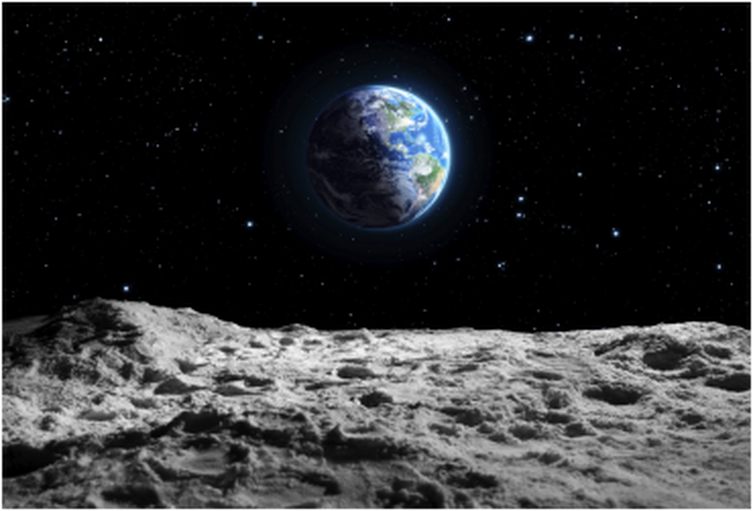
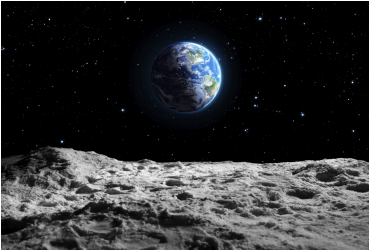
Tellūs ex Lūnā aspicitur
http://www.ibtimes.co.uk/strongest-evidence-lava-tubes-beneath-lunar-surface-announced-1551997
http://www.ibtimes.co.uk/strongest-evidence-lava-tubes-beneath-lunar-surface-announced-1551997
admodum sē recipiunt, ut ambulent[1] ^79. Multae praetereā occurrunt difficultātēs,
quite themselves they-recover so-that they can-walk many besides occur difficulties
quās longum esset recensēre. Nōbīs nihil admodum evenit malī. Tenebrās enim
which long it-would-be to-recount to-us nothing indeed happens of-evil shadows for
Tellūris, quam longae illae sunt, confertim inhabitāmus ^80, quae ubi Levāniam
of-earth as long they-are in-group we-inhabit which when Levania
attigerint, praestō sumus, quasi ex nāvī in terram exscendentēs ^81, et ibi nōs properē
will-have-touched at-hand we-are as-if from ship onto land disembarking and there ourselves quickly
in spēluncās et loca tenebrōsa recipimus ^82, nē nōs Sōl in apertō paulō post
into caves and places dark we-withdraw lest us sun in open a-little later
obrūtūrus optātō dīversōriō ējiciat umbramque discēdentem insequī cōgat ^83.
going-to-overwhelm from-chosen living-quarters may-eject and-shadow departing to-follow may-force
Dantur ibi nōbīs indūciae exercendōrum ingeniōrum ex animī sententiā, conferimus
is-given there to-us leisure of-being-exercised talents according-to of-mind feeling we-confer
cum eijus prōvinciae daemonibus inītāque societāte, ubi prīmum locus Sōle carēre
with of-that province demons and-with- entered-into alliance when first place from-sun to-be-free
coeperit [2]^84, jūnctīs agminibus in umbram exspatiāmur, et sī illa mucrōne suō,
will-have-begun with-united columns into shadow we-rush and if it with-apex its
quod plērumque fit[3]^85, Tellūrem feriat, Terrīs et nōs sociīs exercitibus incubimus,
which generally happens planet-earth should-strike upon-earth also we with-allied forces fall
quod non aliās nōbīs licet, quam cum Sōlem hominēs vīderint dēficere. Hinc ēvenit,
Which not otherwise to-us is-allowed than when Sun human will-have-seen be-eclipsed hence it-happens
ut dēfectūs Sōlis adeō metuantur ^86.
that eclipses of-sun so-much are-feared
[1] ut ambulent is a subjunctive result clause: `quite a bit later they recover to the extent that they can walk about.’
[2] Kepler explains in his own note that this event (lunar nightfall) occurs about a week after the lunar eclipse during which they arrive. For a lunar eclipse to occur the earth must be in exact alignment between moon and sun, which can only happen at full moon. i.e. when it is mid-day on the side of the moon facing earth.
[3] plērumque (generally, frequently ) seems an odd word to use of solar eclipses but Kepler’s note refer to these being more frequent than lunar eclipses.
quite themselves they-recover so-that they can-walk many besides occur difficulties
quās longum esset recensēre. Nōbīs nihil admodum evenit malī. Tenebrās enim
which long it-would-be to-recount to-us nothing indeed happens of-evil shadows for
Tellūris, quam longae illae sunt, confertim inhabitāmus ^80, quae ubi Levāniam
of-earth as long they-are in-group we-inhabit which when Levania
attigerint, praestō sumus, quasi ex nāvī in terram exscendentēs ^81, et ibi nōs properē
will-have-touched at-hand we-are as-if from ship onto land disembarking and there ourselves quickly
in spēluncās et loca tenebrōsa recipimus ^82, nē nōs Sōl in apertō paulō post
into caves and places dark we-withdraw lest us sun in open a-little later
obrūtūrus optātō dīversōriō ējiciat umbramque discēdentem insequī cōgat ^83.
going-to-overwhelm from-chosen living-quarters may-eject and-shadow departing to-follow may-force
Dantur ibi nōbīs indūciae exercendōrum ingeniōrum ex animī sententiā, conferimus
is-given there to-us leisure of-being-exercised talents according-to of-mind feeling we-confer
cum eijus prōvinciae daemonibus inītāque societāte, ubi prīmum locus Sōle carēre
with of-that province demons and-with- entered-into alliance when first place from-sun to-be-free
coeperit [2]^84, jūnctīs agminibus in umbram exspatiāmur, et sī illa mucrōne suō,
will-have-begun with-united columns into shadow we-rush and if it with-apex its
quod plērumque fit[3]^85, Tellūrem feriat, Terrīs et nōs sociīs exercitibus incubimus,
which generally happens planet-earth should-strike upon-earth also we with-allied forces fall
quod non aliās nōbīs licet, quam cum Sōlem hominēs vīderint dēficere. Hinc ēvenit,
Which not otherwise to-us is-allowed than when Sun human will-have-seen be-eclipsed hence it-happens
ut dēfectūs Sōlis adeō metuantur ^86.
that eclipses of-sun so-much are-feared
[1] ut ambulent is a subjunctive result clause: `quite a bit later they recover to the extent that they can walk about.’
[2] Kepler explains in his own note that this event (lunar nightfall) occurs about a week after the lunar eclipse during which they arrive. For a lunar eclipse to occur the earth must be in exact alignment between moon and sun, which can only happen at full moon. i.e. when it is mid-day on the side of the moon facing earth.
[3] plērumque (generally, frequently ) seems an odd word to use of solar eclipses but Kepler’s note refer to these being more frequent than lunar eclipses.
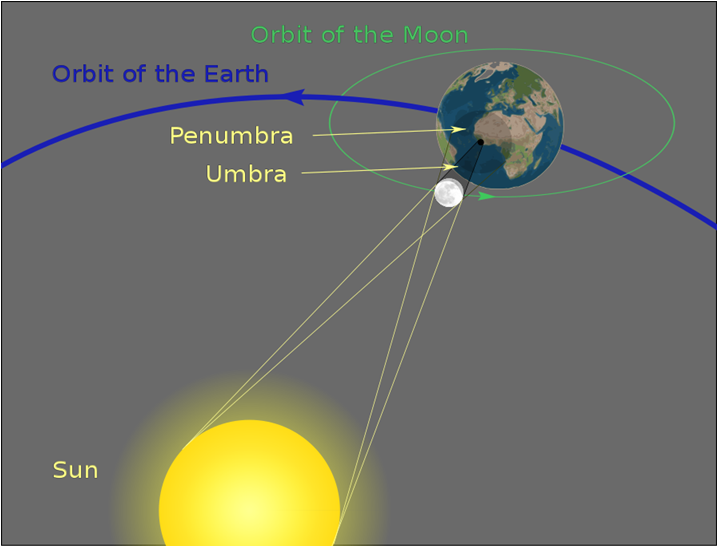
Dēfectus Sōlis
https://en.wikipedia.org/wiki/Solar_eclipse#/media/File:Geometry_of_a_Total_Solar_Eclipse.svg
https://en.wikipedia.org/wiki/Solar_eclipse#/media/File:Geometry_of_a_Total_Solar_Eclipse.svg
XI Atque haec dē itinere in Levāniam dicta sunto.[1] Sequitur, ut dē ipsīus prōvinciae
And these-things about journey to Levania said let-have-been it-follows that about itself of-province
fōrmā dīcam, exorsus mōre geōgraphōrum ab iīs, quae coelitus illī ēveniunt. Etsī
form I-will-say having-started in-manner of-geographers from those-things which in-heavens to-it happen although
sīderum fīxōrum aspectūs tōta Levānia habet nōbīscum eōsdem ^87, mōtūs tamen
of-stars fixed view whole-of Levania has with-us same movements however
planētārum et quantitātēs ab iīs, quās nōs hīc vidēmus, observat dīversissimās, adeō ut
of-planets and sizes from them which we here see observes very-different so-much-so that
plāne alia sit totīus apud ipsōs astronomiae ratiō.
cleearly other is of-whole among them astronomy system
Quemadmodum igitur gēographī nostrī orbem Terrae dīvidunt in quīnque zōnās
In-which-manner therefore geographers our globe of-earth divide into five zones
propter phaenomena coelestia, sīc Levānia ex duōbus cōnstat hemisphaeriīs ^88, ūnō
on-account-of phenomena celestial thus Levania of two consists hemispheres one
subvolvārum, alterō prīvolvārum[2] ^89, quōrum illud perpetuō fruitur suā volvā quae
of-the-Subvolvans second of-the-Privolvans of-which the-former perpetually enjoys its Volva which
est illīs vice nostrae Lūnae, hoc vērō Volvae cōnspectū in aeternum prīvātur ^90. Et
is to-them in-place of-our moon the-latter indeed of-Volva from-sight for ever is-separated and
circulus hemisphaeria dīvidēns instar nostrī colūrī[3] sōlstitiōrum per polōs mundī
circle hemispheres dividing similar to-our colour of-solstices though poles of-world passes
trānsit appellāturque dīvīsor ^91.
passes and-is-called divider
Quae igitur utrīque sunt commūnia hemisphaeriō, prīmō locō explicābō. Itaque
What-things therefore to-vboth are common hemispheres in-first place I-will-explain and-so
Levānia tōta vicissitūdinēs sentit diēī et noctis ut nōs ^92, sed carent illī hāc nostrā
Levania whole alternations perceives of-day and of-night as us but lack they this our
annuā variētāte tōtō annō ^93. Per tōtam enim Levāniam aequantur diēs fere noctibus,
anual variation in-whole year through whole for Levania are-equal days almost to-nights
nisi quod prīvolvīs rēgulāriter omnīs diēs est brevior suā nocte, subvolvīs longior ^94.
except that for-Privilvans regularly every day is shorter than-its night for-Subvolvans longer
Quid autem per circuitum annōrum 8 variētur, infrā erit dīcendum.
What however through cycle of-years 8 is-varied below will-be needing-to-be-said
[1] i.e. `Let this be enough about the journey.’
[2] The Subvolvans (`those under Volva [i.e. the earth as seen in the lunar sky]’) are the inhabitants of the side of the moon always turned towards earth and the Privolvans (`those deprived of Volva) live on the far side. Kepler explains in his notes that he chose the name `Volva’ because, unlike the moon itself in our sky, the earth as seen from the moon is turning (volvere) continually.
[3] The solstitial colure is an imaginary circle around the earth passing over the poles and through the points on the zodiac at which the sun appears to be at the winter and summer solstices. This intersects at right angles at the poles a similar circle through the apparent locations of the sun at the vernal and autumnal equinoxes
And these-things about journey to Levania said let-have-been it-follows that about itself of-province
fōrmā dīcam, exorsus mōre geōgraphōrum ab iīs, quae coelitus illī ēveniunt. Etsī
form I-will-say having-started in-manner of-geographers from those-things which in-heavens to-it happen although
sīderum fīxōrum aspectūs tōta Levānia habet nōbīscum eōsdem ^87, mōtūs tamen
of-stars fixed view whole-of Levania has with-us same movements however
planētārum et quantitātēs ab iīs, quās nōs hīc vidēmus, observat dīversissimās, adeō ut
of-planets and sizes from them which we here see observes very-different so-much-so that
plāne alia sit totīus apud ipsōs astronomiae ratiō.
cleearly other is of-whole among them astronomy system
Quemadmodum igitur gēographī nostrī orbem Terrae dīvidunt in quīnque zōnās
In-which-manner therefore geographers our globe of-earth divide into five zones
propter phaenomena coelestia, sīc Levānia ex duōbus cōnstat hemisphaeriīs ^88, ūnō
on-account-of phenomena celestial thus Levania of two consists hemispheres one
subvolvārum, alterō prīvolvārum[2] ^89, quōrum illud perpetuō fruitur suā volvā quae
of-the-Subvolvans second of-the-Privolvans of-which the-former perpetually enjoys its Volva which
est illīs vice nostrae Lūnae, hoc vērō Volvae cōnspectū in aeternum prīvātur ^90. Et
is to-them in-place of-our moon the-latter indeed of-Volva from-sight for ever is-separated and
circulus hemisphaeria dīvidēns instar nostrī colūrī[3] sōlstitiōrum per polōs mundī
circle hemispheres dividing similar to-our colour of-solstices though poles of-world passes
trānsit appellāturque dīvīsor ^91.
passes and-is-called divider
Quae igitur utrīque sunt commūnia hemisphaeriō, prīmō locō explicābō. Itaque
What-things therefore to-vboth are common hemispheres in-first place I-will-explain and-so
Levānia tōta vicissitūdinēs sentit diēī et noctis ut nōs ^92, sed carent illī hāc nostrā
Levania whole alternations perceives of-day and of-night as us but lack they this our
annuā variētāte tōtō annō ^93. Per tōtam enim Levāniam aequantur diēs fere noctibus,
anual variation in-whole year through whole for Levania are-equal days almost to-nights
nisi quod prīvolvīs rēgulāriter omnīs diēs est brevior suā nocte, subvolvīs longior ^94.
except that for-Privilvans regularly every day is shorter than-its night for-Subvolvans longer
Quid autem per circuitum annōrum 8 variētur, infrā erit dīcendum.
What however through cycle of-years 8 is-varied below will-be needing-to-be-said
[1] i.e. `Let this be enough about the journey.’
[2] The Subvolvans (`those under Volva [i.e. the earth as seen in the lunar sky]’) are the inhabitants of the side of the moon always turned towards earth and the Privolvans (`those deprived of Volva) live on the far side. Kepler explains in his notes that he chose the name `Volva’ because, unlike the moon itself in our sky, the earth as seen from the moon is turning (volvere) continually.
[3] The solstitial colure is an imaginary circle around the earth passing over the poles and through the points on the zodiac at which the sun appears to be at the winter and summer solstices. This intersects at right angles at the poles a similar circle through the apparent locations of the sun at the vernal and autumnal equinoxes
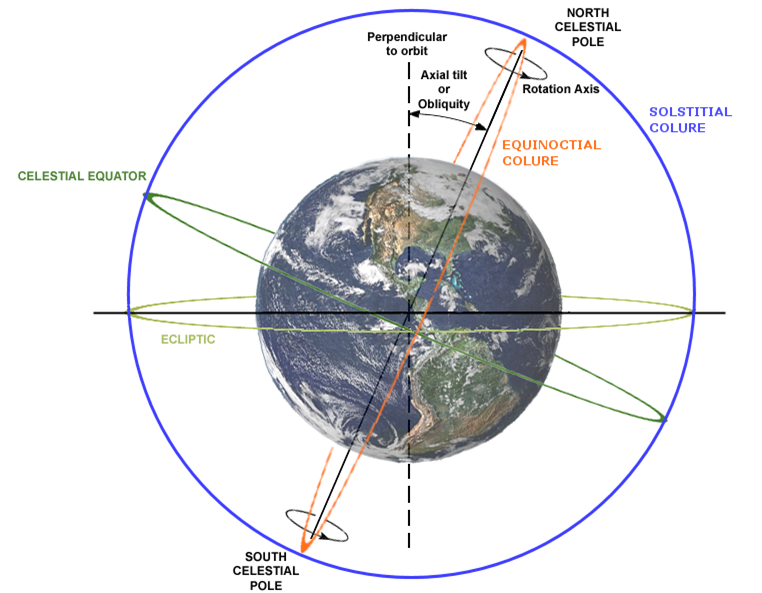
XII Sub utrōque vērō polōrum in compēnsātiōnem noctis Sōl dīmidius tegitur,
Under both indeed of-poles in compensation of-night sun half is-concealed
dīmidius lūcet, montēs circulō circumiēns ^95. Nec enim minus Levānia suīs incolīs
half shines mountains in-circle going-round and-not for less Levania to-own inhabitants
immōta stāre vidētur, currentibus astrīs, quam Terra nostra nōbīs hominibus ^96.
motionless to-stand seems moving with-stars than earth our to-us men g
Nox et diēs jūncti aequant ūnum ex nostrātibus mēnsibus: quippe Sōle oritūrō māne
Night and day jointly equal one from our months as with-sun about-to-rise in-morning
integrum fere zōdiacī signum postrīdiē plūs apparet quam prīdiē ^97.
whole about of-zodiac sign on-next-day more appears than on-prevvious
Et ut nōbīs in ūnō annō 365 Sōlēs et 366 sphaerae fīxārum, seu praecīsius in 4 annīs
And as for-us in one year 365 Suns and 366 spheres of-fixed-stars or more-precisely in 4 years
1461 Sōlēs, sed 1465 sphaerae fīxārum volvuntur, sīc illīs in ūnō annō Sōl duodeciēs,
1461 suns but 1465 spheres of-fixed-stars are-turned thus for-then in one year sun twelve-times
sphaera fīxārum tredeciēs seu praecīsius in 8 annīs Sol 99 iēs , sphaerae fīxārum
sphere of-fixed-stars thirteen-times or more-precisely in 8 years sun 99-times spheres of-fixed-stars
centiēs septiēs circumit. Sed familiārior est ipsīs circulus annōrum 19. Etenim in tot
one-hundred seven-times goes-around but more-familiar is to-themselves cycle of-years 19 for in so-many
annīs Sol oritur ducentiēs triciēs quīnquiēs, fīxae vērō ducentiēs quinquagiēs
year sun rises two-hundred thirty- five-times fixed-stars indeed two-hundred fifty
quater ^98.[1] Oritur Sōl subvolvarum mediīs seu intimīs, quandō nōbīs apparet ultima
four-times rises sun of-Subvolvans for-middle or innermost when for-us appears last
quadra, prīvolvārum vērō intimīs tunc, quandō nōbīs est prīma quadra.[2] Quae autem
quarter of-Privolvans indeed innermost then when for-us is first quarter what moreover
dē meditulliīs dīcō, dē tōtīs semicirculīs intelligenda sunt per polōs et meditullia
about middle-sections I-say about whole semicircles to-be-understood are though poles and middle-section ductīs, ad dīvisōrem rēctīs, quōs semicirculōs medivolvānī appellāre possīs ^[3]99.
drawn to divisor at-right-angles which semicircles ``Medivolvans’ call you-could
[1] The different figures Kepler gives are for solar and sidereal time respectively, the latter varying slightly from the former because of the shifting position of the earth’s axis. Discovery of the distinction and of the consequent shift in the date of the equinoxes is usually attributed to the 2nd. Century B.C. Greek astronomer Hipparchus.
[2] Kepler has somehow got this the wrong way round. Sunrise for the Subvolvans occurs when the sun begins to illuminate their side of the moon (i.e. at the first quarter) and for the Privolvans at the last quarter.
[3] Kepler explains in his own note 99 that these lines correspond to earth’s meridians (i.e. lines of longitude) but he has in mind only the two lines down the centre of the two hemispheres (viz the side of the moon facing the earth and the one opposite it.
XIII Est autem circulus aliquis inter polōs intermedius, vicem gerēns nostrī aeqātōris
There-is moreover circle some between poles half-way role playing of-our equator
terrestris, quō etiam nōmine indigetābitur, bifāriam secāns tam dīvīsōrem, quam
terrestrial by-ch also name it-will-be-called in-two cutting both the-divisor and
medivolvānum in punctīs oppositīs, cui quaecunque loca subsunt, eōrum verticem Sōl
the `medivolvan’ on points opposite on-which whatever places are-located of-them point-overhead
quam proximē quotidiē et praecīsē quidem diēbus duōbus oppositīs in annō trānsit
very most-nearly everyday and exactly indeed on-days two opposing in year transits
in punctō merīdiēī. Cēterīs, quī versus polōs utrinque habitant, in merīdiē Sōl dēclinat
at point of-midday for-others who towards poles on-each-side live ar midday sun is-lower
ā vertice[1] ^100
than overhead
Habent in Levāniā et nōnnūllam vicissitūdinem aestātis et hiemis, sed eam nec
They-have on Levania also some alternation of-summer and of-winter but this neither
comparandam varietāte cum nostrā, nec ut nōs semper iīsdem in locīs, eōdem annī
to-be-compared variety with our nor as us always same in places at-same of-year
tempore. Fit enim decem annōrum spatiō, ut aestās illa migret ab ūnā parte annī
time it-happens for ten of-years in-space that suumer the shifts from one part of-year
sīdereī in partem oppositam, eōdem locō suppositō;[2] quippe circulō annōrum 19
sidereal to part opposite with-same place supposed since in-circle of-years 19
sīdereōrum seu diērum 235 versus polos vīciēs fit aestās tōtiēsque hiems, sub
sidereal or of-days 235 towards poles twenty-timese occurs summer and-as-many-times winter at
aequātōre quadrāgiēs ^101; suntque apud illōs quotannīs sex diēs aestīvī, reliquī
equator forty-times and-are among them[3] every-year six days of-summer rest
hiemālēs, ut apud nōs mēnsēs[4] ^102.
of-winter as among us months
[1] i.e. the sun is precisely overhead at the lunar equator on the moon’s mid-summer and mid-winter days. The inclination of the moon’s axis to the plane of the elliptic is only 1.5° compared with the earth’s 23.5° (https://www.space.com/55-earths-moon-formation-composition-and-orbit.html) so the apparent north-south movement of the overhead sun through the year is only 3° as against 47° on earth and the difference between seasons is minimal, as Kepler notes in the next paragraph.
[2] i.e. in any one place the apparent position of the sun against the zodiac at mid-summer will shift by 180° over ten years.
[3] Referring to the moon-dwellers
[4] Because the moon revolves only once a month.
Ea vicissitūdō vix sentītur circā aequātōrem, quia Sōl nōn ultrā 5° iīs locīs rūrsum
This alternation scarcely is-perceived around quator because sun not beyond 5° in-those places back
prōrsumque ad latera vagātur. Magis sentītur juxtā polōs, quae loca Sōlem alternīs
and-forth to sides wanders more it-is-felt near poles which places Sum in-alternate
semestribus habent aut nōn habent, uti penes nōs in Terrīs iī, quī sub alterutrō
six-month-periods have or not have as among us on Earth those who under one-or-other
polōrum habitant.
of-poles inhabit
Itaque etiam Levāniae globus in quīnque zōnās abit, terrestribus nostrīs quōdammodo
And-so also of-Levania globe into five zones divides to-terrestrial-ones out in-a-way
respondentēs ; sed torrida vix habet 10 gradūs, ut et frīgidae; tōtum reliquum cēdit
corresponding but tropical-one scarcely has 10 degrees as also arctic-ones whole-of rest yields
temperātārum nostrārum analogis[1] ^103. Et trānsit torrida per meditullia
of-temperate-ones our to-analogies and passes tropical-one through middle
hemisphaeriōrum, semissis scīlicet longitūdinis per subvolvānōs, reliquus semissis per
of-spheres half namely of-longtiude through Subvolvans other half through
prīvolvās.
privolva
Ex sectiōnibus circulōrum aequātōris et zodiacī existunt etiam quatuor puncta
From intersections of-circles of-equator and of-zodiac exist also four points
cardinālia, ut sunt apud nos aequinoctia et sōlstitia, et ab iīs sectiōnibus initium est
cardinal as there-are for us equinoxes and solstices and from those intersections beginning is
zodiaci circulī ^104. Sed valde vēlōx est mōtus stellārum fīxārum ab hoc initiō in
of-zodiac of-circle but very swift is motion of-stars fixed from this beginning in
consequentiā, quippe annīs vīgintī tropicīs, id est ūnā aestāte et ūnā hieme dēfīnītīs,
consequence for in-years twenty tropical that is with-one summer and one winter defined
tōtum zodiacum trānseunt, quod fit apud nōs vix annīs 26000 ^105. Atque haec dē
whole zodiac they-go-over which happens with us scarcely in-years 26000[2] And these about
mōtū prīmō.
primary motion
[1] The actual figure is only 3° (see note 1 onthe section before indicator ^100 above).
[2] i.e. whilst the cyclical progression of the equinoxes takes 2,600 years to complete for the earth, the figures on the moon is only about 19 years. It is not clear why Kepler thinks this difference is a consequence of the moon having equinoxes and solstices analogous to the earth’s
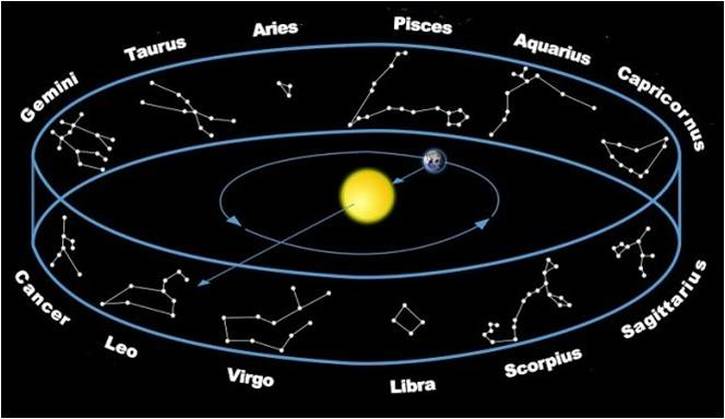
XIV Secundōrum mōtuum ratiō nōn minus dīversa est illīs ab eīs, quae nōbīs appārent,
of-secondary motions system not less different is for-them than those which to-us appear
multōque magis quam penes[1] nōbīs intricāta. Quippe omnibus planētīs sex, Saturnō,
and-much more than among us complicated since for-all planets six, Saturn
Iovī, Martī, Solī, Venerī, Mercuriō, praeter tot quālitātēs, quae sunt nōbīs cum illīs
Jupiter Mars the-Sun Venus Mercury apart-from so-many qualities which are for-us with them
commūnēs, trēs aliae accidunt apud illōs, duae longitūdinis, ūna diurna, altera per
common three others occur among them two of-longtitude one daily another over
circuitum annōrum 8½, tertia lātitūdinis, per circuitum annōrum 19. Nam mediī
cycle of-years 8½ a-third of-latitude over cycle of-years 19 for those-in-middle
prīvolvārum Sōlem in merīdiē suō cēterīs paribus maiōrem, subvolvae minōrem
of-Privolva sun at mid-day their-own with-other-thongs equal larger the Subvovans small
quam sī is oriātur 106)[2]: utrīque iūnctim existimant, Sōlem aliquot minūtīs ab
than if it was-rising both similarly believe Sum some by-minutes from
eclipticā rūrsum prōrsumque dēclināre iam apud hās, iam apud illās fīxās 107); et
the-ecliptic back and-forth to-deviate now among these now among those fixed stars
haec nūtāmenta spatiō 19 annōrum ut dīxī restituuntur in prīstina vestīgia. Plūsculum
these fluctuations in-space 19 of-years as I-have-said are-restored into former tracks a-little-more
tamen occupat haec ēvagātiō prīvolvīs, minus aliquantō subvolvīs 108) Et quamvīs
however takes this deviation for-Privolvans less to-some-extent for-Subvolvans but although
mōtū prīmō Sōl et fixae pōnantur aequābiliter circā Levāniam incēdere, Sōl tamen
by-motion primary sun and fixed-stars may-be-assujmed equally around Levania to-advance sun however
prīvolvīs in merīdiē pēne[3] nihil sub fīxīs prōmovet, subvolvīs celerrimus est in
for-Privolvans mid-day almost nothing under fixed-stars advances for-Subvolvans fastest is at
merīdiē, contrārium teneātur dē mediā nocte. Adeōque Sōl vidētur sub fīxās
mid-day opposite may-be-held concerning middle-of night hence sun is-seen relative-to fixed-stars
quasi quōsdam saltūs facere, singulōs diēbus singulīs[4] 109)
as-if certain jumps to-make separate-ones on-days separate
[1] penes (`in the possession of, among’) is used here with the ablative, but in classical Latin with the accusative.
[2] Kepler explains in his note that as the moon’s distance from the earth is one 59th of the earth’s from the sun, at midday for the Privolvans (which occurs when the moon is new and directly between earth and sun) they were that much nearer to the latter than at sunrise and sunset when the moon is at its quarters as it crosses the earth’s orbit. The Subvolvans, on the other, experience midday at full moon, when the earth is between moon and sun and they are thus at further away from the latter than is the earth. The actual ratio is approximately 389:1 not 59:1 (Kepler’s figure for the distance from earth to moon was nearly correct but he drastically underestimated the earth’s distance from the sun.)
[3] Clasical spelling: paene.
[4] At new moon (midday for the Privolvans) the moon’s orbital motion is in precisely the opposite direction to the earth’s so it’s speed relative to the sun is at minimum. In contrast, at the Subvolvan mid-day, which occurs at full noon, the moon and earth are moving in the same direction so speed relative to the sun is at a maximum.
of-secondary motions system not less different is for-them than those which to-us appear
multōque magis quam penes[1] nōbīs intricāta. Quippe omnibus planētīs sex, Saturnō,
and-much more than among us complicated since for-all planets six, Saturn
Iovī, Martī, Solī, Venerī, Mercuriō, praeter tot quālitātēs, quae sunt nōbīs cum illīs
Jupiter Mars the-Sun Venus Mercury apart-from so-many qualities which are for-us with them
commūnēs, trēs aliae accidunt apud illōs, duae longitūdinis, ūna diurna, altera per
common three others occur among them two of-longtitude one daily another over
circuitum annōrum 8½, tertia lātitūdinis, per circuitum annōrum 19. Nam mediī
cycle of-years 8½ a-third of-latitude over cycle of-years 19 for those-in-middle
prīvolvārum Sōlem in merīdiē suō cēterīs paribus maiōrem, subvolvae minōrem
of-Privolva sun at mid-day their-own with-other-thongs equal larger the Subvovans small
quam sī is oriātur 106)[2]: utrīque iūnctim existimant, Sōlem aliquot minūtīs ab
than if it was-rising both similarly believe Sum some by-minutes from
eclipticā rūrsum prōrsumque dēclināre iam apud hās, iam apud illās fīxās 107); et
the-ecliptic back and-forth to-deviate now among these now among those fixed stars
haec nūtāmenta spatiō 19 annōrum ut dīxī restituuntur in prīstina vestīgia. Plūsculum
these fluctuations in-space 19 of-years as I-have-said are-restored into former tracks a-little-more
tamen occupat haec ēvagātiō prīvolvīs, minus aliquantō subvolvīs 108) Et quamvīs
however takes this deviation for-Privolvans less to-some-extent for-Subvolvans but although
mōtū prīmō Sōl et fixae pōnantur aequābiliter circā Levāniam incēdere, Sōl tamen
by-motion primary sun and fixed-stars may-be-assujmed equally around Levania to-advance sun however
prīvolvīs in merīdiē pēne[3] nihil sub fīxīs prōmovet, subvolvīs celerrimus est in
for-Privolvans mid-day almost nothing under fixed-stars advances for-Subvolvans fastest is at
merīdiē, contrārium teneātur dē mediā nocte. Adeōque Sōl vidētur sub fīxās
mid-day opposite may-be-held concerning middle-of night hence sun is-seen relative-to fixed-stars
quasi quōsdam saltūs facere, singulōs diēbus singulīs[4] 109)
as-if certain jumps to-make separate-ones on-days separate
[1] penes (`in the possession of, among’) is used here with the ablative, but in classical Latin with the accusative.
[2] Kepler explains in his note that as the moon’s distance from the earth is one 59th of the earth’s from the sun, at midday for the Privolvans (which occurs when the moon is new and directly between earth and sun) they were that much nearer to the latter than at sunrise and sunset when the moon is at its quarters as it crosses the earth’s orbit. The Subvolvans, on the other, experience midday at full moon, when the earth is between moon and sun and they are thus at further away from the latter than is the earth. The actual ratio is approximately 389:1 not 59:1 (Kepler’s figure for the distance from earth to moon was nearly correct but he drastically underestimated the earth’s distance from the sun.)
[3] Clasical spelling: paene.
[4] At new moon (midday for the Privolvans) the moon’s orbital motion is in precisely the opposite direction to the earth’s so it’s speed relative to the sun is at minimum. In contrast, at the Subvolvan mid-day, which occurs at full noon, the moon and earth are moving in the same direction so speed relative to the sun is at a maximum.
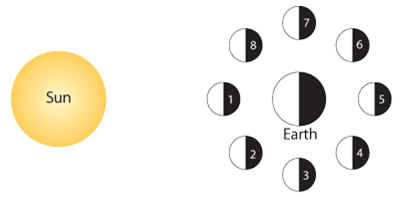
Phases of the moon (https://stardate.org/nightsky/moon)
Eadem vēra sunt in Venere, Mercuriō, et Marte; in Jove et Saturnō pēne
Same-things true are in-case-of Venus Mercury and Mars in-case-of Jupiter and Saturn almost
īnsēnsibilia sunt ista. 110)
imperceptible are these
Atquī nē aequālis quidem sibī ipsī[1] est mōtus iste diurnus omnium diērum hōrīs
However not equal indeed to-itself is motion that daily of all days at-hours
cōnsimilibus, sed lentior aliquandō, tam Sōlis quam fīxārum omnium, vēlōcior in
similar but slower sometimes both of-sun and of-fixed-stars all swifter in
parte annī oppositā in cōnsimilī hōrā diēī 111) Et tarditās ista per diēs annī ambulat,
part of-year opposite at same hour of-day and retardation that through days of-year shifts
ut nunc aestīvam occupet, nunc hibernam, quae aliō annō celeritātem sēnserat,
so-that now summer-one occupies now winter-one which in-another year acceleration had-experienced
circuitū absolūtō per spatium annōrum paulō minus novem 112). Itaque iam diēs fit
with-cycle completed over space of-years a-little less-than nine and-so sometimes day becomes
longior (natūrālī tarditāte, nōn ut apud nōs in Terrīs sectiōne inaequālī circulī diēī
longer by-natural retardation not as among us on earth by-division unequal of –circle of-day
natūrālis) iam vicissim nox. 113)
natural sometimes in-turn night
Quodsi tarditās privolvīs in noctis medium incidit, cumulātur ejus excessus suprā
But-if retardation for-Priviolvans in of-night middle falls is-increased its excess over
diem, sīn in diem, tunc exaequantur magis nox et diēs, quod in annīs 9 fit semel;
day but-if in day then are-made-equal more night and day which in years 9 happens once
permūtātim apud subvolvānōs 114).[2]
conversely among Subvolvans
Tantum igitur dē iīs, quae quodammodo commūniter hemisphaeriīs ēveniunt.
So-much therefore about those-things which in-a-certain-way in-common to-the-hemispheres happen
[1] sibī and ipsī are both normally translated `to self’ (in reflexive and emphatic senses respectively) and when combined mean `to actual self’.
[2] Both the Latin of Kepler’s note and the geometry involved are very complex, but the point seems to be that sun’s apparent speed as the moon revolves varies with the change in the moon’s distance from the earth between perigee and apogee. Because the moon’s revolution on its own axis keeps in step with its revolution round the earth, its speed will vary with it’s orbital velocity, which in turn varies with it’s distance from earth.
Same-things true are in-case-of Venus Mercury and Mars in-case-of Jupiter and Saturn almost
īnsēnsibilia sunt ista. 110)
imperceptible are these
Atquī nē aequālis quidem sibī ipsī[1] est mōtus iste diurnus omnium diērum hōrīs
However not equal indeed to-itself is motion that daily of all days at-hours
cōnsimilibus, sed lentior aliquandō, tam Sōlis quam fīxārum omnium, vēlōcior in
similar but slower sometimes both of-sun and of-fixed-stars all swifter in
parte annī oppositā in cōnsimilī hōrā diēī 111) Et tarditās ista per diēs annī ambulat,
part of-year opposite at same hour of-day and retardation that through days of-year shifts
ut nunc aestīvam occupet, nunc hibernam, quae aliō annō celeritātem sēnserat,
so-that now summer-one occupies now winter-one which in-another year acceleration had-experienced
circuitū absolūtō per spatium annōrum paulō minus novem 112). Itaque iam diēs fit
with-cycle completed over space of-years a-little less-than nine and-so sometimes day becomes
longior (natūrālī tarditāte, nōn ut apud nōs in Terrīs sectiōne inaequālī circulī diēī
longer by-natural retardation not as among us on earth by-division unequal of –circle of-day
natūrālis) iam vicissim nox. 113)
natural sometimes in-turn night
Quodsi tarditās privolvīs in noctis medium incidit, cumulātur ejus excessus suprā
But-if retardation for-Priviolvans in of-night middle falls is-increased its excess over
diem, sīn in diem, tunc exaequantur magis nox et diēs, quod in annīs 9 fit semel;
day but-if in day then are-made-equal more night and day which in years 9 happens once
permūtātim apud subvolvānōs 114).[2]
conversely among Subvolvans
Tantum igitur dē iīs, quae quodammodo commūniter hemisphaeriīs ēveniunt.
So-much therefore about those-things which in-a-certain-way in-common to-the-hemispheres happen
[1] sibī and ipsī are both normally translated `to self’ (in reflexive and emphatic senses respectively) and when combined mean `to actual self’.
[2] Both the Latin of Kepler’s note and the geometry involved are very complex, but the point seems to be that sun’s apparent speed as the moon revolves varies with the change in the moon’s distance from the earth between perigee and apogee. Because the moon’s revolution on its own axis keeps in step with its revolution round the earth, its speed will vary with it’s orbital velocity, which in turn varies with it’s distance from earth.
Dē Hemisphaeriō prīvolvārum
XV Iam quod singula hemisphaeria seorsim attinet, ingēns inter ea est dīversitās.
Now [as-to]-what single hemispheres separately belongs huge between them is difference
Neque enim tantum praesentia et absentia Volvae dissimillima exhibet[1] spectācula,
And-not for only presence and absence of-Volva very-different displays appearances but
Sed haec ipsa commūnia phaenomena dīversissimōs habent effectūs hinc et inde, adeō
these themselves ordinary phenomena very-different have affects on-this-side and that so
ut rectius fortasse prīvolvārum hemisphaerium dīcī potest intemperātrum,
that more-correctly perhaps of-Privolvans hemisphere to-be-called is-able intemperate-one
subvolvārum temperātrum. Nam apud prīvolvās nox est nostrōs 15 vel 16 diēslonga,
of-Subvollvans temperate for among Privolvans night is our 15 or 16 days long
perpetuīs[2] horrida tenebrīs, quantae apud nōs sunt[3] nocte illūnī, quippe nūllīs
perpetual terrible darkness as-much among us it-is on-night moonless for by-no
Volvae radiīs nē illa quidem illustrātur umquam; itaque omnia rigent gelū et pruīnīs
Of-Volva no t it indeed is-illustrated ever and-so all-things are-stiff with-ice and frosts
115) insuperque et ventīs rigidisssimīs et validissimīs 116); succēdit diēs, 14 nostrōs
In-addition and with-winds most-numbing and very-strong there-follows day 14 (of) ours
longa vel eō paulō minus 117), quibus[4] et Sōl maior118) et sub fīxīs tardus 119) et
long or than-that a-little less on-which both Sun greater and relative-to fixed-stars slow and
ventī nūllī 120). Itaque immēnsus aestus. Atque sīc spatiō nostrātis mēnsis seu diēī
winds none and—so immensde heat and thus in-space of-our month or of-day
Levānicī ūnō eōdemque locō et aestus est quīndeciēs ferventior āfricānō nostrō, et
Levanian in-one and-same place both heat is fifteen-times more-intense thn-African[wind] our and
gelū intolerābilius Quivirānō.[5]
cold more-intolerable than the-Quiviran
Pecūliāriter nōtandum , quod planēta Mars iīs, quī in meditulliō prīvolvārum sunt,
Specially to-be-noted that planet Mars to-them who in middle of Privolvan-region are
nocte mediā, cēterīs in suō cuique noctis articulō, pēne duplō maior interdum
at-night middle to-other[Privolvans] at own each of-night part almost doubly bigger sometimes
cernitur quam nōbīs.
is-seen than for-us
[1] Anomalous singular verb with plural subject
[2] The alative endings show that the adjective perpetuīs qualifies tenebrīs. The nominative horrida goes with nox.
[3] Literally `are’ as the subject is the grammatically plural noun tenebrae (darkness)
[4] Plural should be singular to agree with singular antecedent diēs.
[5] The Quiverans were an Indian tribe in what is now Kansas who murdered a missionary in 1541. Either their territory was regarded as exceptionally cold in winter or the reference is to something completely different.
XV Iam quod singula hemisphaeria seorsim attinet, ingēns inter ea est dīversitās.
Now [as-to]-what single hemispheres separately belongs huge between them is difference
Neque enim tantum praesentia et absentia Volvae dissimillima exhibet[1] spectācula,
And-not for only presence and absence of-Volva very-different displays appearances but
Sed haec ipsa commūnia phaenomena dīversissimōs habent effectūs hinc et inde, adeō
these themselves ordinary phenomena very-different have affects on-this-side and that so
ut rectius fortasse prīvolvārum hemisphaerium dīcī potest intemperātrum,
that more-correctly perhaps of-Privolvans hemisphere to-be-called is-able intemperate-one
subvolvārum temperātrum. Nam apud prīvolvās nox est nostrōs 15 vel 16 diēslonga,
of-Subvollvans temperate for among Privolvans night is our 15 or 16 days long
perpetuīs[2] horrida tenebrīs, quantae apud nōs sunt[3] nocte illūnī, quippe nūllīs
perpetual terrible darkness as-much among us it-is on-night moonless for by-no
Volvae radiīs nē illa quidem illustrātur umquam; itaque omnia rigent gelū et pruīnīs
Of-Volva no t it indeed is-illustrated ever and-so all-things are-stiff with-ice and frosts
115) insuperque et ventīs rigidisssimīs et validissimīs 116); succēdit diēs, 14 nostrōs
In-addition and with-winds most-numbing and very-strong there-follows day 14 (of) ours
longa vel eō paulō minus 117), quibus[4] et Sōl maior118) et sub fīxīs tardus 119) et
long or than-that a-little less on-which both Sun greater and relative-to fixed-stars slow and
ventī nūllī 120). Itaque immēnsus aestus. Atque sīc spatiō nostrātis mēnsis seu diēī
winds none and—so immensde heat and thus in-space of-our month or of-day
Levānicī ūnō eōdemque locō et aestus est quīndeciēs ferventior āfricānō nostrō, et
Levanian in-one and-same place both heat is fifteen-times more-intense thn-African[wind] our and
gelū intolerābilius Quivirānō.[5]
cold more-intolerable than the-Quiviran
Pecūliāriter nōtandum , quod planēta Mars iīs, quī in meditulliō prīvolvārum sunt,
Specially to-be-noted that planet Mars to-them who in middle of Privolvan-region are
nocte mediā, cēterīs in suō cuique noctis articulō, pēne duplō maior interdum
at-night middle to-other[Privolvans] at own each of-night part almost doubly bigger sometimes
cernitur quam nōbīs.
is-seen than for-us
[1] Anomalous singular verb with plural subject
[2] The alative endings show that the adjective perpetuīs qualifies tenebrīs. The nominative horrida goes with nox.
[3] Literally `are’ as the subject is the grammatically plural noun tenebrae (darkness)
[4] Plural should be singular to agree with singular antecedent diēs.
[5] The Quiverans were an Indian tribe in what is now Kansas who murdered a missionary in 1541. Either their territory was regarded as exceptionally cold in winter or the reference is to something completely different.
Dē hemisphaeriō subvolvārum
XVI Trānsitūrus ad hoc incipiō ab ejus līmitāneīs, quī circulum dīvīsōrem inhabitant.
About-to-move-over to this I-begin from its edge-dwellers who circle divider inhabit
Iīs enim hoc peculiāre est, ut dīgressiōnēs Veneris et Mercuriī ā Sōle observant multō
for-them for this peculiarity is that digressions of-Venus and of-Mercury from sun they-observe much
majōrēs quam nōs 122) Iīsdem et Venus certīs temporibus duplō appāret major
greater than we for-same-people also Venus at-certain times two-times appears bigger
quam nōbīs 123), praesertim iīs quī sub polō septentriōnālī habitant,
than to-us especially to-those who under pole north live
Omnium vērō jūcundissima in Levāniā speculātiō Volvae suae, cujus illī fruuntur
Of-all indeed pleasantest on Levania spectacle of-Volva their of-which they enjoy
cōnspectū in compēnsātiōnem Lūnae nostrae, quae cum ipsī, tum et prīvolvae
sight in compensation for-moon our which both they-themselves and also Privolvans
carent penitus.125) Et ā Volvae hujus perennī praesentiā, regiō ea dēnōminātur
lack utterly and from Volva’s this never-ending presence region this is-termed
subvolvāna, sīcut reliqua ab ejus absentiā prīvolvārum dīcitur, quod sint prīvātī
Subvolvan as remainder from its absence of-Privolvans is-called because they-are deprived
cōnspectū Volvae.
of-sight of--Volva
XVII Vōbīs terrārum incolīs Lūna nostra, cum plēna est exoriēns superque domōs
To-you of-earth inhabitants Moon our when full it-is rising and-over houses
longinquās ingrediēns, dōliī circulō vidētur adaequārī, ubi in medium coelī ascenderit,
distant coming-in of-barrel to-circle seems to-be-equal-in-size when into middle of-sky it-will-have-risen
vix hūmānī vultūs lātitūdinem repraesentat.[1] Subvolvīs vērō Volva sua in ipsō coelī
scarcely of-human face breadth represents for-the-Subvolvans indeed Volva their in actual of-sky
mediō (quem situm obtinet apud eōs, quī habitant in meditulliō seu umbilicō hujus
middle which position it-obtains among those who live in middle-section or umbilical of-this
hemisphaeriī) paulō minus quadruplō longiōrī diamētrō cernitur, quam nōbīs nostra
hemisphere a-little less-than four-times longer with-diameter is-seen than for-us our
Luna, adeō ut discōrum īnstitūtā comparātiōne quindecuplō major sit illōrum Volva
Moon so-much that of-disks arranged with-comparison fifteen-times greater is of-them Volva
Lūnā nostrā. Quibus vērō Volva horīzontī perpetuō inhaeret, iīs ēminus montis ignītī
Than-Moon our for-whom indeed Volva to-horizon perpetually clings for-them in-distancance of-mountain on-fire
speciem exhibet.
appearance it-exhibits
Quemadmodum igitur nōs regiōnēs distinguimus per ēlevātionēs polī majōrēs
In-which-way therefore we regions distinguish by elevations of-pole larger
minōrēsque, licet polum ipsum oculīs nōn cernāmus, sīc illīs eīdem ūsuī servit altitūdō
and-smaller although p ole itself with-eyes not we-see thus for-them same use serves altitude
Volvae, semper cōnspicuae, dīversīs locīs dīversa.
of-Volva always visible in-different places different
Quōrundam enim, ut dīxī, verticibus imminet, aliīs locīs juxtā circulum
of-certain-ones for as I-said the-zenith s it-hangs-over for-other places near circle
horīzontem dēpressa vidētur, reliquīs ā vertice versus horīzontem dēclinat, quōlibet
horizon depressed it-seems for-rest from zenith towards horizon it-deviates in-any
locō cōnstantem perpetuō altitūdinem ostentāns.127)
place constant perpetually altitude displaying
[1] The moon appears to be larger when on the horizon but this is in fact merely an illusion. See http://www.skyandtelescope.com/observing/moon-illusion-confusion11252015/
XVI Trānsitūrus ad hoc incipiō ab ejus līmitāneīs, quī circulum dīvīsōrem inhabitant.
About-to-move-over to this I-begin from its edge-dwellers who circle divider inhabit
Iīs enim hoc peculiāre est, ut dīgressiōnēs Veneris et Mercuriī ā Sōle observant multō
for-them for this peculiarity is that digressions of-Venus and of-Mercury from sun they-observe much
majōrēs quam nōs 122) Iīsdem et Venus certīs temporibus duplō appāret major
greater than we for-same-people also Venus at-certain times two-times appears bigger
quam nōbīs 123), praesertim iīs quī sub polō septentriōnālī habitant,
than to-us especially to-those who under pole north live
Omnium vērō jūcundissima in Levāniā speculātiō Volvae suae, cujus illī fruuntur
Of-all indeed pleasantest on Levania spectacle of-Volva their of-which they enjoy
cōnspectū in compēnsātiōnem Lūnae nostrae, quae cum ipsī, tum et prīvolvae
sight in compensation for-moon our which both they-themselves and also Privolvans
carent penitus.125) Et ā Volvae hujus perennī praesentiā, regiō ea dēnōminātur
lack utterly and from Volva’s this never-ending presence region this is-termed
subvolvāna, sīcut reliqua ab ejus absentiā prīvolvārum dīcitur, quod sint prīvātī
Subvolvan as remainder from its absence of-Privolvans is-called because they-are deprived
cōnspectū Volvae.
of-sight of--Volva
XVII Vōbīs terrārum incolīs Lūna nostra, cum plēna est exoriēns superque domōs
To-you of-earth inhabitants Moon our when full it-is rising and-over houses
longinquās ingrediēns, dōliī circulō vidētur adaequārī, ubi in medium coelī ascenderit,
distant coming-in of-barrel to-circle seems to-be-equal-in-size when into middle of-sky it-will-have-risen
vix hūmānī vultūs lātitūdinem repraesentat.[1] Subvolvīs vērō Volva sua in ipsō coelī
scarcely of-human face breadth represents for-the-Subvolvans indeed Volva their in actual of-sky
mediō (quem situm obtinet apud eōs, quī habitant in meditulliō seu umbilicō hujus
middle which position it-obtains among those who live in middle-section or umbilical of-this
hemisphaeriī) paulō minus quadruplō longiōrī diamētrō cernitur, quam nōbīs nostra
hemisphere a-little less-than four-times longer with-diameter is-seen than for-us our
Luna, adeō ut discōrum īnstitūtā comparātiōne quindecuplō major sit illōrum Volva
Moon so-much that of-disks arranged with-comparison fifteen-times greater is of-them Volva
Lūnā nostrā. Quibus vērō Volva horīzontī perpetuō inhaeret, iīs ēminus montis ignītī
Than-Moon our for-whom indeed Volva to-horizon perpetually clings for-them in-distancance of-mountain on-fire
speciem exhibet.
appearance it-exhibits
Quemadmodum igitur nōs regiōnēs distinguimus per ēlevātionēs polī majōrēs
In-which-way therefore we regions distinguish by elevations of-pole larger
minōrēsque, licet polum ipsum oculīs nōn cernāmus, sīc illīs eīdem ūsuī servit altitūdō
and-smaller although p ole itself with-eyes not we-see thus for-them same use serves altitude
Volvae, semper cōnspicuae, dīversīs locīs dīversa.
of-Volva always visible in-different places different
Quōrundam enim, ut dīxī, verticibus imminet, aliīs locīs juxtā circulum
of-certain-ones for as I-said the-zenith s it-hangs-over for-other places near circle
horīzontem dēpressa vidētur, reliquīs ā vertice versus horīzontem dēclinat, quōlibet
horizon depressed it-seems for-rest from zenith towards horizon it-deviates in-any
locō cōnstantem perpetuō altitūdinem ostentāns.127)
place constant perpetually altitude displaying
[1] The moon appears to be larger when on the horizon but this is in fact merely an illusion. See http://www.skyandtelescope.com/observing/moon-illusion-confusion11252015/
XVIII Cum autem et ipsī suōs habeant polōs 128), quī nōn apud illās fīxās sunt, ubi nōbīs
Since moreover also themselves own have poles which not among those fixed-stars are where for-us
sunt polī mundī 129), sed circā aliās, quae sunt nōbīs indicēs polōrum eclipticae, quī
are poles of-world but around others which are for-us signs of-poles of-ecliptic which
lūnārium polī spatiō 19 annōrum[1] sub stellīs Dracōnis et oppositīs Xiphiae (Dorado)
lunar poles in-space 19 of-years under constellations of-Draco and opposed Xiphias (Dorado) and
et Passeris (Piscis volantis) et Nūbēculae majōris circellōs parvōs circā polōs
and of-Passer Piscis Volans and Magellanic-Cloud greater little-circles small around poles
Eclipticae ēmētiuntur 130)[2],cumque hī polī quadrante circulī distent ab ipsōrum Volvā,
of-the-ecliptic trace-out and-since these poles by-quarter of-a-circle are-distant from of-them Volva
ut ita dēscrībī possint regiōnēs et secundum Volvam131),[3] patet quantā ipsī
so that be-described can regions also according to-Volva it-is-clear by-how-much they
commoditāte nōs vincant; longitūdinem enim locōrum signant per Volvam suam
advantage us they-surpass longitude for of-places designate by Voilva their
immōbilem132), lātitūdinem et per suam Volvam et per polōs133), cum nōs prō
stationary latitude both through their Volva and through poles when we for
longitūdinibus nihil habeāmus, nisi contemtissimam illam et vix internoscibilem
longitudes nothing have except most-contemptible that and scarcely detectable
dēclinātiōnem magnētīs134).[4]
deviation of-a-magnet
[1] Kepler is here referring to the moon’s own poles (i.e the ends of its axis of rotation) whose position relative to the ecliptic poles changes over a 19-year cycle, contrasting with the 26,000 years that the earth’s poles take to complete a similar cycle. The word lūnārium is normally the gentive plural of lūnāris, -e (lunar) but Kepler seems to use lūnāria as a plural noun meaning the moon, so quī lūnārium polī means `these lunar polie’.
[2] The ecliptic (orbital) poles of a heavenly body are the imaginary points where a line drawn through its centre perpendicular to the plane of its orbit meet the circle of fixed stars (see the diagram on page 14 and https://en.wikipedia.org/wiki/Orbital_pole). The axis of rotation is normally at an angle to this line (23.5° in the case of the earth, 1.5° (not 5° as Kepler thought) for the moon). The orbital plane (`the ecliptic’) is virtually identical for all the planets of ther solar system as well as the moon and so their northern ecliptical poles are all in the constellation of Draco and the southern ones near the other constellations Kepler mentions The name Xiphias (swordfish) was used in Kepler’s 1627edition of Tycho Brahe’s star list for the constellation also known as Dorado (Portuguese for Xiphias), the name universally used today (https://en.wikipedia.org/wiki/Dorado ). Passer was an early name for the constellation later known as Piscis Volans and, since 1844, simply as Volans (see https://en.wikipedia.org/wiki/Volans Nubecula referred both to nebulae in general and particularly to the Large and Small Magellanic Clouds, galaxies now known to be in orbit around the Milky Way (our own galaxy).
[3] The point seems to be that Volva was overhead at the moon’s equator and thus separated by 90° from the lunar pole.
[4] Latitude on earth can be determined by measuring the declination of the sun at midday or of the pole star. In Kepler’s day there was no reliable method of determining longitude; the technique he describes was to measure the deviation of magnetic north from true north but knowledge of local variations in this was not sufficient to guarantee an accurate result. As the earth remains in a fixed position relative to the lunar surface, it could be used for calculation of both longitude and latitude on the moon.
Since moreover also themselves own have poles which not among those fixed-stars are where for-us
sunt polī mundī 129), sed circā aliās, quae sunt nōbīs indicēs polōrum eclipticae, quī
are poles of-world but around others which are for-us signs of-poles of-ecliptic which
lūnārium polī spatiō 19 annōrum[1] sub stellīs Dracōnis et oppositīs Xiphiae (Dorado)
lunar poles in-space 19 of-years under constellations of-Draco and opposed Xiphias (Dorado) and
et Passeris (Piscis volantis) et Nūbēculae majōris circellōs parvōs circā polōs
and of-Passer Piscis Volans and Magellanic-Cloud greater little-circles small around poles
Eclipticae ēmētiuntur 130)[2],cumque hī polī quadrante circulī distent ab ipsōrum Volvā,
of-the-ecliptic trace-out and-since these poles by-quarter of-a-circle are-distant from of-them Volva
ut ita dēscrībī possint regiōnēs et secundum Volvam131),[3] patet quantā ipsī
so that be-described can regions also according to-Volva it-is-clear by-how-much they
commoditāte nōs vincant; longitūdinem enim locōrum signant per Volvam suam
advantage us they-surpass longitude for of-places designate by Voilva their
immōbilem132), lātitūdinem et per suam Volvam et per polōs133), cum nōs prō
stationary latitude both through their Volva and through poles when we for
longitūdinibus nihil habeāmus, nisi contemtissimam illam et vix internoscibilem
longitudes nothing have except most-contemptible that and scarcely detectable
dēclinātiōnem magnētīs134).[4]
deviation of-a-magnet
[1] Kepler is here referring to the moon’s own poles (i.e the ends of its axis of rotation) whose position relative to the ecliptic poles changes over a 19-year cycle, contrasting with the 26,000 years that the earth’s poles take to complete a similar cycle. The word lūnārium is normally the gentive plural of lūnāris, -e (lunar) but Kepler seems to use lūnāria as a plural noun meaning the moon, so quī lūnārium polī means `these lunar polie’.
[2] The ecliptic (orbital) poles of a heavenly body are the imaginary points where a line drawn through its centre perpendicular to the plane of its orbit meet the circle of fixed stars (see the diagram on page 14 and https://en.wikipedia.org/wiki/Orbital_pole). The axis of rotation is normally at an angle to this line (23.5° in the case of the earth, 1.5° (not 5° as Kepler thought) for the moon). The orbital plane (`the ecliptic’) is virtually identical for all the planets of ther solar system as well as the moon and so their northern ecliptical poles are all in the constellation of Draco and the southern ones near the other constellations Kepler mentions The name Xiphias (swordfish) was used in Kepler’s 1627edition of Tycho Brahe’s star list for the constellation also known as Dorado (Portuguese for Xiphias), the name universally used today (https://en.wikipedia.org/wiki/Dorado ). Passer was an early name for the constellation later known as Piscis Volans and, since 1844, simply as Volans (see https://en.wikipedia.org/wiki/Volans Nubecula referred both to nebulae in general and particularly to the Large and Small Magellanic Clouds, galaxies now known to be in orbit around the Milky Way (our own galaxy).
[3] The point seems to be that Volva was overhead at the moon’s equator and thus separated by 90° from the lunar pole.
[4] Latitude on earth can be determined by measuring the declination of the sun at midday or of the pole star. In Kepler’s day there was no reliable method of determining longitude; the technique he describes was to measure the deviation of magnetic north from true north but knowledge of local variations in this was not sufficient to guarantee an accurate result. As the earth remains in a fixed position relative to the lunar surface, it could be used for calculation of both longitude and latitude on the moon.
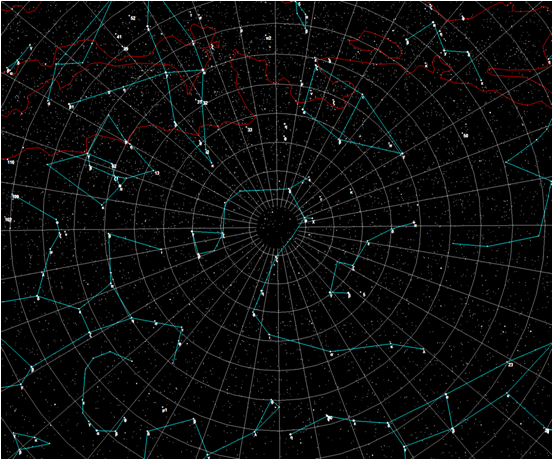
The north ecliptic pole in the constellation of Draco
https://en.wikipedia.org/wiki/Orbital_pole#/media/File:North_ecliptic_pole.png
https://en.wikipedia.org/wiki/Orbital_pole#/media/File:North_ecliptic_pole.png
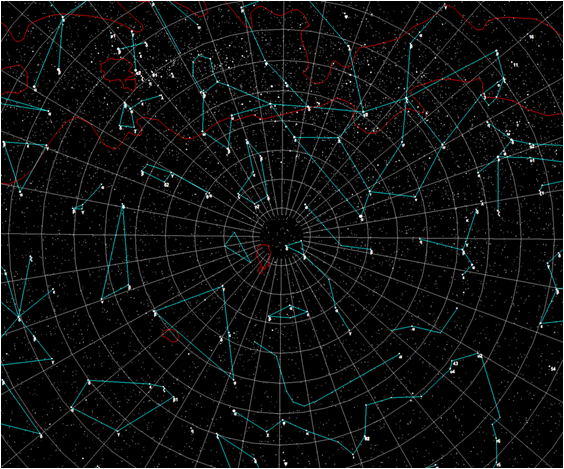
The southern ecliptic pole with the constellations Volans and Dorado at 11 o’clock and 4 o’clock respectively
https://en.wikipedia.org/wiki/Orbital_pole#/media/File:South_ecliptic_pole.png
https://en.wikipedia.org/wiki/Orbital_pole#/media/File:South_ecliptic_pole.png
XIX Stat igitur illīs sua Volva quasi clāvō[1] coelīs esset affīxa, immōbilis quoad
Stands therefore for-them their Volva as-if by-nail to-heavens it-had-been fixed immobile as-for
locum, superque eam sīdera cētera ipseque adeō Sōl ab ortū in occāsiōnem
place and-above it stars other and-itself especially Sun from rising to setting
trānseunt135), nec ūlla nox est, in quā nōn aliquae ex stellīs fīxīs, quae sunt in zōdiacō,
go-across and-not any night is in which not some out-of stars fixed which are in zodiac
post hanc Volvam sēsē recipient eque contrāriā plagā[2] rūrsum ēmergant 135). At nōn
behind this Volva themselves take-back equally from-opposite side again emerge but not
omnibus noctibus eaedem hoc faciunt137), sed permūtant vicēs inter sē omnes
on-all nights same (stars) this do but they-change turns among themselves all
illae, quae sunt ab eclipticā remōtae ad 6 vel 7 gradūs 138), fitque circuitus annōrum
those [stars]which are from ecliptic removed up-to 6 or 7 degrees and-occurs cycle of--years
novendecim, quō exactō reditur ad prīmās.[3]
nineteen with-which finished there-is-return to first-ones
[1] clāvus, ī m: this word clearly here means nail but it can elsewhere refer to the embroidered border of a toga or to a rudder.
[2] Distinguish plaga (tract, open expanse) from plāga (blow, wound). The latter developed the sense of `pestilence’ by the time of St. Jerome and has the English derivative `plague.’
[3] Volva appears stationary in the lunar sky but the moon’s own orbiting around the earth means that every month the latter appears to make a complete circuit through the stars aligned with the ecliptic. The pattern does not, however, remain the same every month because of the shifting position of the moon’s own axis of rotation.
Stands therefore for-them their Volva as-if by-nail to-heavens it-had-been fixed immobile as-for
locum, superque eam sīdera cētera ipseque adeō Sōl ab ortū in occāsiōnem
place and-above it stars other and-itself especially Sun from rising to setting
trānseunt135), nec ūlla nox est, in quā nōn aliquae ex stellīs fīxīs, quae sunt in zōdiacō,
go-across and-not any night is in which not some out-of stars fixed which are in zodiac
post hanc Volvam sēsē recipient eque contrāriā plagā[2] rūrsum ēmergant 135). At nōn
behind this Volva themselves take-back equally from-opposite side again emerge but not
omnibus noctibus eaedem hoc faciunt137), sed permūtant vicēs inter sē omnes
on-all nights same (stars) this do but they-change turns among themselves all
illae, quae sunt ab eclipticā remōtae ad 6 vel 7 gradūs 138), fitque circuitus annōrum
those [stars]which are from ecliptic removed up-to 6 or 7 degrees and-occurs cycle of--years
novendecim, quō exactō reditur ad prīmās.[3]
nineteen with-which finished there-is-return to first-ones
[1] clāvus, ī m: this word clearly here means nail but it can elsewhere refer to the embroidered border of a toga or to a rudder.
[2] Distinguish plaga (tract, open expanse) from plāga (blow, wound). The latter developed the sense of `pestilence’ by the time of St. Jerome and has the English derivative `plague.’
[3] Volva appears stationary in the lunar sky but the moon’s own orbiting around the earth means that every month the latter appears to make a complete circuit through the stars aligned with the ecliptic. The pattern does not, however, remain the same every month because of the shifting position of the moon’s own axis of rotation.
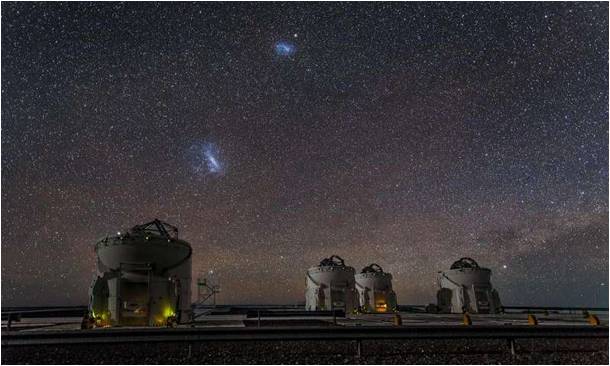
Small and Large Magellanic Clouds seen over the Paranal Observatory in Chile
https://phys.org/news/2016-11-magellanic-clouds.html
https://phys.org/news/2016-11-magellanic-clouds.html
XX Nec minus crēscit illōrum Volva dēcrēscitque, quam nostra Lūna ^140; causa
Nor less grows their Volva and-diminishes than our moon cause
utrobīque eadem. Sōlis praesentia vel dīgressiō ab illā, tempus etiam, si nātūram
in-both-cases the-same Sun’s presence or departure from it time also if nature
spectēs, idem, sed aliter illī numerant, aliter nōs; illī ūnum diem et ūnam noctem
you-look-at the-same but one-way they count another-way we they one day and one night
putant, intrā quod spatium omnia Volvae suae incrēmenta et dēcrēmenta absolvuntur
think within which period all of-Volva their increases and decreases are-completed
quod spatium nōs mēnsem appellāmus. Nunquam fere nē novivolviō[1] quidem Volva
which period we month call never almost not at-new-volva indeed Volva
latet apud Subvolvānōs propter magnitūdinem et clāritātem^141, praesertim ad polārēs,
is-hidden among Subvolvans because-of size and brightness especially at poles
Sōle ad tempus carentēs, quibus Volva in ipsō intervolviō tempore merīdiē cornua
Sun at time[s[ lacking for-which Volva in actual intervolvian time at-midday horns
sūrsum vertit^142. Nam in ūniversum inter Volvam et polōs habitantibus sub circulō
upwards turns for in general between Vovla and poles for-those-living along circle
medivolvānō novivolvium est merīdiēī signum, prīma quadra vesperae, plēnivolvium
medivolvan new-volva is of-midday sign first quarter of-evening full-volva
noctis aequās partēs discrīminat, ultima quadra Sōlem redūcit.[2]^143 Quī vērō Volvam
of-night equal parts separates last quarter sun brings-back those-who indeed Volva
[1] novivolvium ( -ī n), literally `neo-earth’, is a word coined by Kepler for the time when the earth is between moon and sun and so only the earth’s dark side is visible from the moon. The expression intervolvium tempus two lines below refers to the same time. This would be around subvolvan mid-day but Kepler believed that earth would still be visble as a slim crescent (`uptutned horns’) from the lunar poles.
[2] The meridian down the centre of the subvolvan region (medivolvānum) has the earth directly overhead all the time and the sun directly above (i.e. mid-day) when earth and sun are in line at novivolvium.
Nor less grows their Volva and-diminishes than our moon cause
utrobīque eadem. Sōlis praesentia vel dīgressiō ab illā, tempus etiam, si nātūram
in-both-cases the-same Sun’s presence or departure from it time also if nature
spectēs, idem, sed aliter illī numerant, aliter nōs; illī ūnum diem et ūnam noctem
you-look-at the-same but one-way they count another-way we they one day and one night
putant, intrā quod spatium omnia Volvae suae incrēmenta et dēcrēmenta absolvuntur
think within which period all of-Volva their increases and decreases are-completed
quod spatium nōs mēnsem appellāmus. Nunquam fere nē novivolviō[1] quidem Volva
which period we month call never almost not at-new-volva indeed Volva
latet apud Subvolvānōs propter magnitūdinem et clāritātem^141, praesertim ad polārēs,
is-hidden among Subvolvans because-of size and brightness especially at poles
Sōle ad tempus carentēs, quibus Volva in ipsō intervolviō tempore merīdiē cornua
Sun at time[s[ lacking for-which Volva in actual intervolvian time at-midday horns
sūrsum vertit^142. Nam in ūniversum inter Volvam et polōs habitantibus sub circulō
upwards turns for in general between Vovla and poles for-those-living along circle
medivolvānō novivolvium est merīdiēī signum, prīma quadra vesperae, plēnivolvium
medivolvan new-volva is of-midday sign first quarter of-evening full-volva
noctis aequās partēs discrīminat, ultima quadra Sōlem redūcit.[2]^143 Quī vērō Volvam
of-night equal parts separates last quarter sun brings-back those-who indeed Volva
[1] novivolvium ( -ī n), literally `neo-earth’, is a word coined by Kepler for the time when the earth is between moon and sun and so only the earth’s dark side is visible from the moon. The expression intervolvium tempus two lines below refers to the same time. This would be around subvolvan mid-day but Kepler believed that earth would still be visble as a slim crescent (`uptutned horns’) from the lunar poles.
[2] The meridian down the centre of the subvolvan region (medivolvānum) has the earth directly overhead all the time and the sun directly above (i.e. mid-day) when earth and sun are in line at novivolvium.
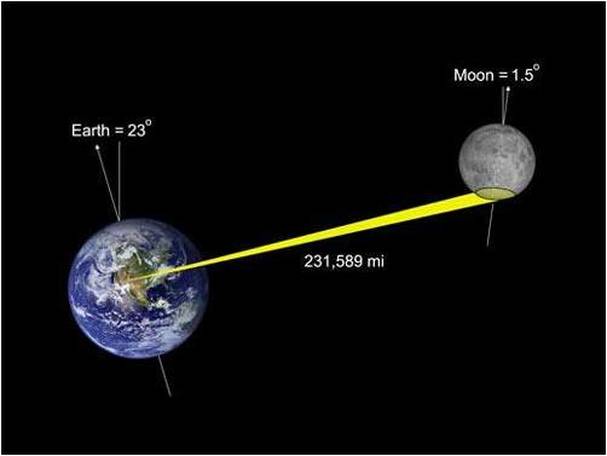
Axial inclinations of earth and moon
https://www.newscientist.com/article/dn13388-moons-south-pole-revealed-in-dramatic-new-3d-map/
https://www.newscientist.com/article/dn13388-moons-south-pole-revealed-in-dramatic-new-3d-map/
et polōs habent in horizonte sitōs, habitantēs sub sectiōne aequātōris cum dīvīsōre, iīs
and poles have on horizon situated hiving at inter-section of-equator with divisor for-them
fit in novivolviō et plēnivolviō manē vel vespera, in quadrīs mediātiō diēī vel noctis.[1]
occurs at new-volva and at-full-volva morning or evening at the-quarters middle of-day or of-night
Ex hīs jūdicium sūmātur et dē eīs, quī interjectī sunt^144
From this judgement let-be-taken also abut those who positioned-between are
XXI Et dē diē quidem hōc pactō distinguunt hōrās aliīs atque aliīs Volvae suae
And about day indeed in-this way they-distinguish hours by-other and other of-Volva theirs
phāsibus: ut quantō propius coëunt Sōl et Volva, tantō propius īnstet illīs merīdiēs,
phases since as- nearer go-together Sun and Volva proportionately closes comes-on the-former midday
hīs vespera vel occāsus Sōlis.[2] Dē nocte vērō, quae rēgulāriter 14 nostrātēs diēs
on-the-latter evening of setting of-sun about night indeed which regularly 14 our days
noctēsque longa est, multō sunt īnstructiōrēs ad dīmetienda tempora quam nōs.
and-nights long is much they-are better-equipped for measuring times than us
Etenim praeter illam successiōnem phāsium Volvae, quārum plēnivolvium mediae
For apart-from that succession of-phases of-Volva of-which full-volva of-middle
noctis indicium esse dīximus suō medivolvānō, et jam sua ipsīs Volva per sē ipsum
of-night sign to-be we-have-said to-its medivolvan-region and now their-own for-them Volva through self actual
distinguit hōrās. Etsī enim locō nēquāquam movērī cernitur^145, intrā tamen locum
distinguishes hours although for from-place in-no-way to-be-moved it-is-seen within however place
suum contrā quam nostra Lūna gȳrātur^146 et admīrābilem maculārum varietātem
own in-contrast to our moon it-revolves and marvellous of-markings variety
successīvē explicat, assiduē ab ortū in occāsum trānslātīs maculīs^147. Ūna igitur tālis
in-succession it-unfolds continuously from `east’ to `west’ carried-across with-markings one therefore such
revolūtiō, quandō eaedem maculae redeunt^148, subvolvānīs habētur prō ūnā hōrā
revolution when same markings return for-Subvolvans is-considered as one hour
temporālī^149, aequat autem paulō quid amplius, quam ūnum diem et ūnam diem
of-time it-equals moreover a-little something more than one say and one day
nostrātem^150.[3] Estque haec sōla aequābilis mēnsūra temporis^151. Suprā enim dictum
of-ours and-is this sole constant measure of-time above for said
est, Sōlem et astra lūnicolīs diētim circumīre inaequāliter, quod vel maximē[4] haec
has-been sun and stars for-moon-dwellers daily to-go-round irregularly which most-specially this
turbinātiō Volvae prōdit, sī cum eā comparēs ēlongātiōnēs fīxārum ā Lūnā^152 [5]
rotation of-Volva reveals if with it you-compare distances of-fixed-stars from moon
[1] Those living along the divide (dīvīsor) between the near and far-sides of the moon will have the sun on the horizon when it is right overhead along the medivolvānum, which is directly opposite earth.
[2] As already seen, when the sun is in line with the earth as seen from the moon, it will be `new earth’ (i.e. the earth’s surface will not appear illuminated) and also midday along the medivolvānum.
[3] Any one point on the earth’s surface takes a lttle longer than one earth day (about 25 hours by Kepler’s calculation) to return to the same position relative to an observer on the moon because the moon itself is moving ahead in its orbit whilst the earth completes one rotation
[4] vel is here used with the superlative maximē as an intensifier.
[5] prōdit is pobably from prōdō (prōdere, prōdidī, prōditum), `publish, make known, betray’, meaning that the irregularity of the observed motion of other heavenly bodies is made apparent by the regularity of Volva’s. However this verb is identical in the 3rd. person singular with prōdeō (prōdīre, prōdiī, prōditum), `go forward.’.
and poles have on horizon situated hiving at inter-section of-equator with divisor for-them
fit in novivolviō et plēnivolviō manē vel vespera, in quadrīs mediātiō diēī vel noctis.[1]
occurs at new-volva and at-full-volva morning or evening at the-quarters middle of-day or of-night
Ex hīs jūdicium sūmātur et dē eīs, quī interjectī sunt^144
From this judgement let-be-taken also abut those who positioned-between are
XXI Et dē diē quidem hōc pactō distinguunt hōrās aliīs atque aliīs Volvae suae
And about day indeed in-this way they-distinguish hours by-other and other of-Volva theirs
phāsibus: ut quantō propius coëunt Sōl et Volva, tantō propius īnstet illīs merīdiēs,
phases since as- nearer go-together Sun and Volva proportionately closes comes-on the-former midday
hīs vespera vel occāsus Sōlis.[2] Dē nocte vērō, quae rēgulāriter 14 nostrātēs diēs
on-the-latter evening of setting of-sun about night indeed which regularly 14 our days
noctēsque longa est, multō sunt īnstructiōrēs ad dīmetienda tempora quam nōs.
and-nights long is much they-are better-equipped for measuring times than us
Etenim praeter illam successiōnem phāsium Volvae, quārum plēnivolvium mediae
For apart-from that succession of-phases of-Volva of-which full-volva of-middle
noctis indicium esse dīximus suō medivolvānō, et jam sua ipsīs Volva per sē ipsum
of-night sign to-be we-have-said to-its medivolvan-region and now their-own for-them Volva through self actual
distinguit hōrās. Etsī enim locō nēquāquam movērī cernitur^145, intrā tamen locum
distinguishes hours although for from-place in-no-way to-be-moved it-is-seen within however place
suum contrā quam nostra Lūna gȳrātur^146 et admīrābilem maculārum varietātem
own in-contrast to our moon it-revolves and marvellous of-markings variety
successīvē explicat, assiduē ab ortū in occāsum trānslātīs maculīs^147. Ūna igitur tālis
in-succession it-unfolds continuously from `east’ to `west’ carried-across with-markings one therefore such
revolūtiō, quandō eaedem maculae redeunt^148, subvolvānīs habētur prō ūnā hōrā
revolution when same markings return for-Subvolvans is-considered as one hour
temporālī^149, aequat autem paulō quid amplius, quam ūnum diem et ūnam diem
of-time it-equals moreover a-little something more than one say and one day
nostrātem^150.[3] Estque haec sōla aequābilis mēnsūra temporis^151. Suprā enim dictum
of-ours and-is this sole constant measure of-time above for said
est, Sōlem et astra lūnicolīs diētim circumīre inaequāliter, quod vel maximē[4] haec
has-been sun and stars for-moon-dwellers daily to-go-round irregularly which most-specially this
turbinātiō Volvae prōdit, sī cum eā comparēs ēlongātiōnēs fīxārum ā Lūnā^152 [5]
rotation of-Volva reveals if with it you-compare distances of-fixed-stars from moon
[1] Those living along the divide (dīvīsor) between the near and far-sides of the moon will have the sun on the horizon when it is right overhead along the medivolvānum, which is directly opposite earth.
[2] As already seen, when the sun is in line with the earth as seen from the moon, it will be `new earth’ (i.e. the earth’s surface will not appear illuminated) and also midday along the medivolvānum.
[3] Any one point on the earth’s surface takes a lttle longer than one earth day (about 25 hours by Kepler’s calculation) to return to the same position relative to an observer on the moon because the moon itself is moving ahead in its orbit whilst the earth completes one rotation
[4] vel is here used with the superlative maximē as an intensifier.
[5] prōdit is pobably from prōdō (prōdere, prōdidī, prōditum), `publish, make known, betray’, meaning that the irregularity of the observed motion of other heavenly bodies is made apparent by the regularity of Volva’s. However this verb is identical in the 3rd. person singular with prōdeō (prōdīre, prōdiī, prōditum), `go forward.’.
Pieter van den Keere’s 1608 map of the world showing `Magellanica’ in the south
http://www.nationsonline.org/oneworld/map/antique-world-map.htm
http://www.nationsonline.org/oneworld/map/antique-world-map.htm
XXII In ūniversum Volva ista, quod superiōrem septentriōnālem partem attinet, duās
In general Volva that as-far-as upper northern part concerns two
vidētur habēre medietātēs^153, alteram obscūriōrem et continuīs quasī maculīs
seems to-have halves one less clear and with-continual as-it-were marks
obductam^154, alteram paulō clāriōrem^155, interfūsō prō discrīmine ūtrīusque cingulō
covered the-other a-little brighter poured-between for distinguishing of-both a-belt
lūcidō septentriōnetenus.[1] Figūra difficilis est explicātū^156. Parte tamen
shining running-north shape difficul is to-explain in-part however
orientāliōrī^157 cernitur īnstar protomēs[2] capitis hūmānī, axillārum tenus resectī^158,
more-eastern it-appears like bust of-head human shoulders as-far-as cut-off
admoventis ad ōscula puellulam^159 cum veste longā^160, quae extentā retrōrsum
moving towards mouth little-girl with garment long who with-extended backwards
manū^161 fēlem assultantem^162 prōvocet. Maior tamen et lātior maculae pars^163 sine
hand cat attacking challenging greater however and broader of-marking part without
ēvidentī formā versus occidentem prōcurrit.^164 In alterā medietāte Volvae lātius
clear form towards `west’ extends. In other half of-Volva broader
diffunditur splendour^165 quam macula^166. Effigiem dīcerēs campanae^167 dē fūne
is-spread splendour than blemish likeness you-would-say of-bell from rope
dēpendentis^168 et in occidentem^169 jactātae.[3] Quae suprā^170 infrāque sunt^171,
hanging-down and towards `west’ projecting what above and-below are
assimiliārī inqueunt)[4]^172
to-be-compared are-unable
[1] Kepler explains in his own notes that the two halves are the Old World (Asia, Europe and Africa) and the New (North and South America), whilst the Atlantic Ocen and the waters stretching eastwards are the `shining belt.’ He describes the Americas as `brighter’ because the proportion of sea to land is greater there. but explains in his notes that after writing the story he was convinced by Galileo that the oceans would in fact appear darker than land when viewed from space (for the real view, see pg.11).
[2] protomē (-ae f), still used as a technical term in architecture, means a bust or miniature head added as decoration. The description is actually of the western side of the `Old World’, which Kepler characterises as `more easterly’( orientior) because the Latin word’s basic meaning is `rising’ and, as the earth rotates from west to east features on its surface `rise’ (oriuntur) from the western edge and `set’ (occidunt) on the eastern one. He therefore similarly states that East Asia versus occidentem prōcurrit `extends `westwards’ (i.e. eastwards!). This reversal of the nomal meanings is explained in Kepler’s notes which also reveal the human head is Africa, the girl about to be kissed [western] Europe, her dress eastern Europe, the extended hand Britain and the leaping cat Scandinavia. In Strabo’s 1st cent. A.D. geography, land east of the River Don, whose mouth is close to the Crimean Peninsulat east of the Crimean peninsula was not regarded as part of Europe proper and Kepler himself seems to exclude the whole region north of the Black Sea, thus extending northwards the dividing line running through Constantinople which has always been regarded as separating Europe and Asia in the south. The term’s extension to include everything up to the Urals only became accepted in the 19th century (see https://en.wikipedia.org/wiki/Europe)
[3] The `bell’ is Brazil, which juts out eastwards (`westwards’ from the Levanian perspective) into the Atlantic, and the rope the Isthmus of Panama,
[4] Kepler’s own notes are a little confusing here but suprā seems to refer to South America and infrā to the hypothetical continent of `Magellanica’. Named after the Portuguese explorer Magellan, this supposedly occupied a much larger proportion of the then relatively unexplored Southern Hemisphere than is actually covered by Antarctica. The notes explain that uncertainty about this land mass led him to confine detailed description to more northerly areas.
XXIII Nec satis ut hōc pactō Volva illīs distinguat hōrās diēī, quīn etiam annī partium
Nor enough that in-this way Volva for-them distinguishes hours of-day rather also of-year of-parts
nōn obscūra documenta dat, sī quis attendat aut sī quem ratiō fīxārum fugiat.[1]
not obscure evidence it-gives if anyone should-pay-attention or if anyone ratio of-fixed-stars should-elude
Etiam quō tempore Sōl Cancrum obtinet[2]^173, Volva polum septentriōnālem suae
Also at-which time Sun Cancer is-in Volva pole north of-its
turbinātiōnis manifestē ostentat. Est enim parva quaedam et obscūra macula^174
rotation clearly displays there-is for small certain and dark marking
[1] I.e. close attention to the patterns observable on Volva, together with the difficulty in using the more irregular apparent movements of other heavenly bodies, make Volva the best choice for distinguishing the parts of the year.
[2] i.e. at mid-summer.
Nor enough that in-this way Volva for-them distinguishes hours of-day rather also of-year of-parts
nōn obscūra documenta dat, sī quis attendat aut sī quem ratiō fīxārum fugiat.[1]
not obscure evidence it-gives if anyone should-pay-attention or if anyone ratio of-fixed-stars should-elude
Etiam quō tempore Sōl Cancrum obtinet[2]^173, Volva polum septentriōnālem suae
Also at-which time Sun Cancer is-in Volva pole north of-its
turbinātiōnis manifestē ostentat. Est enim parva quaedam et obscūra macula^174
rotation clearly displays there-is for small certain and dark marking
[1] I.e. close attention to the patterns observable on Volva, together with the difficulty in using the more irregular apparent movements of other heavenly bodies, make Volva the best choice for distinguishing the parts of the year.
[2] i.e. at mid-summer.
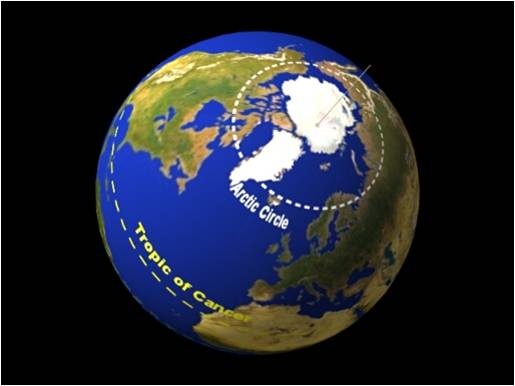
Summer path of Iceland (here at centre of globe) as seen from the moon. The Arctic Circle should really be shown touching the outer edge of the earth’s face and the intersection would be at the top of the picture on mid-summer day.
http://astronomy.swin.edu.au/cosmos/A/Arctic+Circle
http://astronomy.swin.edu.au/cosmos/A/Arctic+Circle
suprā effiigem puellae in mediam clāritātem inserta^175, quae ā summā et extrēmā
above likeness of-girl into middle-of clearness inserted which from highest and extreme
Volvae parte^176 versus orientem et hinc dēscēnsū in discum factō versus occidentem
of-Volva part towards `east’ and from-there with-descent into disk made towards `west’
movētur^177, ā quō extrēmō rursus in summitātem Volvae versus orientem concēdit
is-moved from which extreme again into top of-Volva towards east retreats
atque sīc tunc perpetuō apparet[1]^178. At Sōle Capricornum tenente nuspiam[2] haec
and thus then perpetually appears but with-sun Capricorn occupying nowhere this
macula cernitur, tōtō circulō cum polō suō post Volvae corpus abditō.[3] Et hīs quidem
marking is-seen with-whole circuit with pole its behind Volva’s body hidden and at-these indeed
duābus partibus annī maculae rēcta petunt occidentem^179, intermediīs vērō
two parts of-year markings directly make-for the west at-intermediate indeed
temporibus, Sōle in oriente vel Librā cōnstitūtō,[4] maculae nōnnihil īnflexā līneā vel
times with-sun in east or Libra positioned markings somewhat in-bending line either
dēscendunt trānsversim vel ascendunt. Quō argumentō cognōscimus, polōs
descend at-a-slant or ascend from-which evidence we-learn poles
circumīre in circulō polārī circā polum illōrum semel in annō[5]^180.
to go-round on circle polar around pole their once in year
[1] The mark is Iceland, homeland of the narrator, which is on the Arctic Circle and, when the northern hemisphere is fully inclined towards the sun, moves approximately in the circular path shown in the illustration. The meanings of oriēns and occidēns are reversed as explained in fn. 92 and the girl is Scandinavia (ibid.).
[2] nuspiam is a rarer alternative for nusquam
[3] At mid-winter, when the earth’s north pole is pointingdirectly away from the sun, no part of the Arctic Circle would be visible from the moon during the subvolvan night.
[4] The reference is to the time of the equinoxes, when the sun is in Aries (spring) or in Libra (autumn). Consequently oriente here seems a copyist’s error for Ariete
[5] i.e. because of the inclination of the earth’s axis, the position of the poles as observed from space will appear to shift through the year relative to a line perpendicular to the earth’s orbit. This line appears to be what Kelper refers to with the singular polum. At the solstices, when the earth’s poles are pointing directly towards and away from the sun, the axis will appear as lying along the perpendicular to the elliptic for an observer in line with the sun and earth. At the equinoxes, however, the full deviation of 23.5 degrees will be visible.
XXIV. Notant et hoc dīligentiōrēs, nōn semper hanc Volvam retinēre eandem
Notice also this the-more-diligent not always this Volva to-retain same
magnitūdinem. Iīs enim diēī hōrīs, quibus astra sunt velōcia, Volvae diametrum esse
size at-those for of-day hours at-which stars are swift of-Volva diameter to-be
multō majōrem, ut tunc omnīnō excēdat quadruplum nostrae Lūnae.[1]^181
much larger so-that then altogether it-exceeds four-times of-our moon
[1] Under Kepler’s second law of planetary motion, any body orbiting another sweeps out an equal area in an equal length of time and so must move more quickly when nearer the other, as illustrated on this page.The moon’s orbit itself roatates about the earth’s orbit and so perigee (being at the closest point to the earth) can occur at any time during a lunar month. When perigee coincide with full moon, the result is a `Super Moon’, i.e. maximum apparent size,
above likeness of-girl into middle-of clearness inserted which from highest and extreme
Volvae parte^176 versus orientem et hinc dēscēnsū in discum factō versus occidentem
of-Volva part towards `east’ and from-there with-descent into disk made towards `west’
movētur^177, ā quō extrēmō rursus in summitātem Volvae versus orientem concēdit
is-moved from which extreme again into top of-Volva towards east retreats
atque sīc tunc perpetuō apparet[1]^178. At Sōle Capricornum tenente nuspiam[2] haec
and thus then perpetually appears but with-sun Capricorn occupying nowhere this
macula cernitur, tōtō circulō cum polō suō post Volvae corpus abditō.[3] Et hīs quidem
marking is-seen with-whole circuit with pole its behind Volva’s body hidden and at-these indeed
duābus partibus annī maculae rēcta petunt occidentem^179, intermediīs vērō
two parts of-year markings directly make-for the west at-intermediate indeed
temporibus, Sōle in oriente vel Librā cōnstitūtō,[4] maculae nōnnihil īnflexā līneā vel
times with-sun in east or Libra positioned markings somewhat in-bending line either
dēscendunt trānsversim vel ascendunt. Quō argumentō cognōscimus, polōs
descend at-a-slant or ascend from-which evidence we-learn poles
circumīre in circulō polārī circā polum illōrum semel in annō[5]^180.
to go-round on circle polar around pole their once in year
[1] The mark is Iceland, homeland of the narrator, which is on the Arctic Circle and, when the northern hemisphere is fully inclined towards the sun, moves approximately in the circular path shown in the illustration. The meanings of oriēns and occidēns are reversed as explained in fn. 92 and the girl is Scandinavia (ibid.).
[2] nuspiam is a rarer alternative for nusquam
[3] At mid-winter, when the earth’s north pole is pointingdirectly away from the sun, no part of the Arctic Circle would be visible from the moon during the subvolvan night.
[4] The reference is to the time of the equinoxes, when the sun is in Aries (spring) or in Libra (autumn). Consequently oriente here seems a copyist’s error for Ariete
[5] i.e. because of the inclination of the earth’s axis, the position of the poles as observed from space will appear to shift through the year relative to a line perpendicular to the earth’s orbit. This line appears to be what Kelper refers to with the singular polum. At the solstices, when the earth’s poles are pointing directly towards and away from the sun, the axis will appear as lying along the perpendicular to the elliptic for an observer in line with the sun and earth. At the equinoxes, however, the full deviation of 23.5 degrees will be visible.
XXIV. Notant et hoc dīligentiōrēs, nōn semper hanc Volvam retinēre eandem
Notice also this the-more-diligent not always this Volva to-retain same
magnitūdinem. Iīs enim diēī hōrīs, quibus astra sunt velōcia, Volvae diametrum esse
size at-those for of-day hours at-which stars are swift of-Volva diameter to-be
multō majōrem, ut tunc omnīnō excēdat quadruplum nostrae Lūnae.[1]^181
much larger so-that then altogether it-exceeds four-times of-our moon
[1] Under Kepler’s second law of planetary motion, any body orbiting another sweeps out an equal area in an equal length of time and so must move more quickly when nearer the other, as illustrated on this page.The moon’s orbit itself roatates about the earth’s orbit and so perigee (being at the closest point to the earth) can occur at any time during a lunar month. When perigee coincide with full moon, the result is a `Super Moon’, i.e. maximum apparent size,
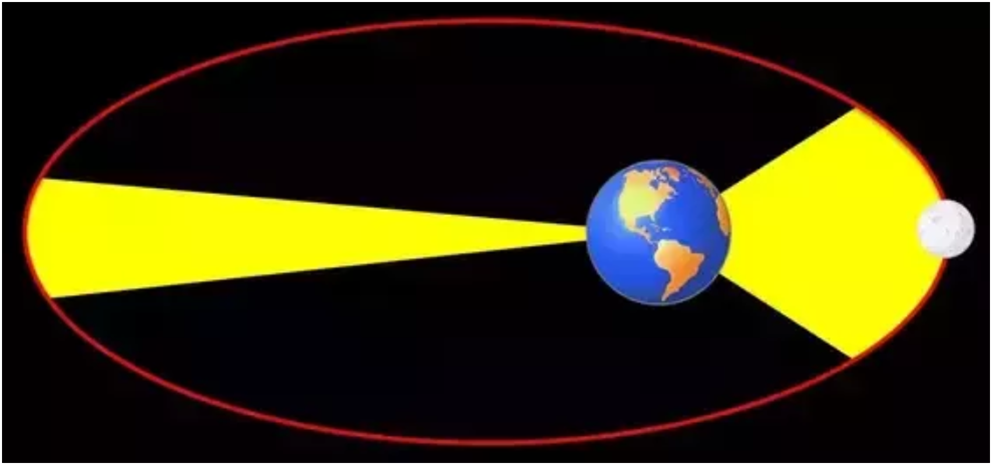
Moon’s orbit (not to scale) showing greater speed when nearest to the earth
https://www.quora.com/Does-the-moons-orbital-speed-change-during-its-orbit
XXV Quid vērō nunc dē eclīpsibus Sōlis et Volvae dīcam, quae et ēveniunt in Levānia What indeed now about eclipses of-sun and of-Volva should-I-say which both occur on Levania
et iīsdem momentīs ēveniunt, quibus hīc in Tellūris globō eclīpsēs Sōlis et Lūnae,
and at-the-same times occur at-which here on Earth’s globe eclipses of-Sun and of-Moon
ratiōnibus tamen oppositīs plānē. Quandō enim nōbīs vidētur dēficere Sōl tōtus,
with-systems however opposite clearly when for to-us is seen to-be-eclipsed Sun whole
dēficit ipsīs Volva, quandō vicissim dēficit nōbīs nostra Lūna, dēficit apud ipsōs Sōl.
is-eclipsed for-them Volva when in-turn is-eclipsed for-us our Moon is-eclipsed among them the-Sun
^181 Neque tamen omnia quadrant. Partiālēs enim Sōlis dēfectūs ipsī crēbrō vident,
And not however all-things match partial for of-sun eclipses themselves frequently they-see
quandō nōbīs dē Lūna nihil dēest,^183 et contrā immūnēs sunt ab eclīpsibus Volvae nōn
when for-us from Moon nothng is-missing and conversely immune are from eclipses of-Volva not
rārō, quandō nōs partiālēs habēmus Sōlis dēfectūs.[1]^184 Volvae dēfectūs apud ipsōs in
rarely when we partial have of-sun eclipses of-Volva eclipses among them at
plēnivolviīs, ut apud nōs Lūnae in plēnilūniīs, Sōlis vērō in novivolviīs, ut apud nōs in
full-volvas as among us of-Moon at full-mmons of-Sun indeed at new-volvas as among us at
novilūniīs. ^185 Cumque diēs et noctēs habeant adeō longās, crēberrimās experiuntur
new-moons and-since days and nights they-have so long very-frequent they-experience
tenebrātiōnēs utrīusque sīderis.[2] Prō eō enim, quod[3] penes nōs magna dēfectuum
darkening of-both heavenly-bodies because-of this for that among us great of-eclipses
pars trānsit ad nostrōs antipodes, illōrum contrā antipodes, quippe prīvolvae, nihil
part goes-across to our antipodes of-them in-contrast antipodes i.e. the-privolvans nothing
penitus hōrum vident, ipsī subvolvae sōlī omnia.
at-all of-these sees themselves the-subvolvans alone [see] all
[1] Kepler explains in his own notes that in a partial eclipse enough light often still reaches the other body to produce a dimming rather than a total obscuration of part of the disc.
[2] utrīusque sīderis, literally `of each[out-of-two] star’, referring to the sun and earth. Because the moon’s rotation takes as long as its revolution around the earth, the earth is always above the Subvolvan side of the moon so all eclipses, which involve the earth itself obscuring the sun or being obscured by the moon’s shadow, must be visible to the Subvolvans not the Privolvans. The antipodes means the opposite side of the earth or of any heavenly body and any one point on earth will see only half of the eclipses that occur.
[3] Prō eo enim quod: equivalent to `Since for the reason that’
https://www.quora.com/Does-the-moons-orbital-speed-change-during-its-orbit
XXV Quid vērō nunc dē eclīpsibus Sōlis et Volvae dīcam, quae et ēveniunt in Levānia What indeed now about eclipses of-sun and of-Volva should-I-say which both occur on Levania
et iīsdem momentīs ēveniunt, quibus hīc in Tellūris globō eclīpsēs Sōlis et Lūnae,
and at-the-same times occur at-which here on Earth’s globe eclipses of-Sun and of-Moon
ratiōnibus tamen oppositīs plānē. Quandō enim nōbīs vidētur dēficere Sōl tōtus,
with-systems however opposite clearly when for to-us is seen to-be-eclipsed Sun whole
dēficit ipsīs Volva, quandō vicissim dēficit nōbīs nostra Lūna, dēficit apud ipsōs Sōl.
is-eclipsed for-them Volva when in-turn is-eclipsed for-us our Moon is-eclipsed among them the-Sun
^181 Neque tamen omnia quadrant. Partiālēs enim Sōlis dēfectūs ipsī crēbrō vident,
And not however all-things match partial for of-sun eclipses themselves frequently they-see
quandō nōbīs dē Lūna nihil dēest,^183 et contrā immūnēs sunt ab eclīpsibus Volvae nōn
when for-us from Moon nothng is-missing and conversely immune are from eclipses of-Volva not
rārō, quandō nōs partiālēs habēmus Sōlis dēfectūs.[1]^184 Volvae dēfectūs apud ipsōs in
rarely when we partial have of-sun eclipses of-Volva eclipses among them at
plēnivolviīs, ut apud nōs Lūnae in plēnilūniīs, Sōlis vērō in novivolviīs, ut apud nōs in
full-volvas as among us of-Moon at full-mmons of-Sun indeed at new-volvas as among us at
novilūniīs. ^185 Cumque diēs et noctēs habeant adeō longās, crēberrimās experiuntur
new-moons and-since days and nights they-have so long very-frequent they-experience
tenebrātiōnēs utrīusque sīderis.[2] Prō eō enim, quod[3] penes nōs magna dēfectuum
darkening of-both heavenly-bodies because-of this for that among us great of-eclipses
pars trānsit ad nostrōs antipodes, illōrum contrā antipodes, quippe prīvolvae, nihil
part goes-across to our antipodes of-them in-contrast antipodes i.e. the-privolvans nothing
penitus hōrum vident, ipsī subvolvae sōlī omnia.
at-all of-these sees themselves the-subvolvans alone [see] all
[1] Kepler explains in his own notes that in a partial eclipse enough light often still reaches the other body to produce a dimming rather than a total obscuration of part of the disc.
[2] utrīusque sīderis, literally `of each[out-of-two] star’, referring to the sun and earth. Because the moon’s rotation takes as long as its revolution around the earth, the earth is always above the Subvolvan side of the moon so all eclipses, which involve the earth itself obscuring the sun or being obscured by the moon’s shadow, must be visible to the Subvolvans not the Privolvans. The antipodes means the opposite side of the earth or of any heavenly body and any one point on earth will see only half of the eclipses that occur.
[3] Prō eo enim quod: equivalent to `Since for the reason that’
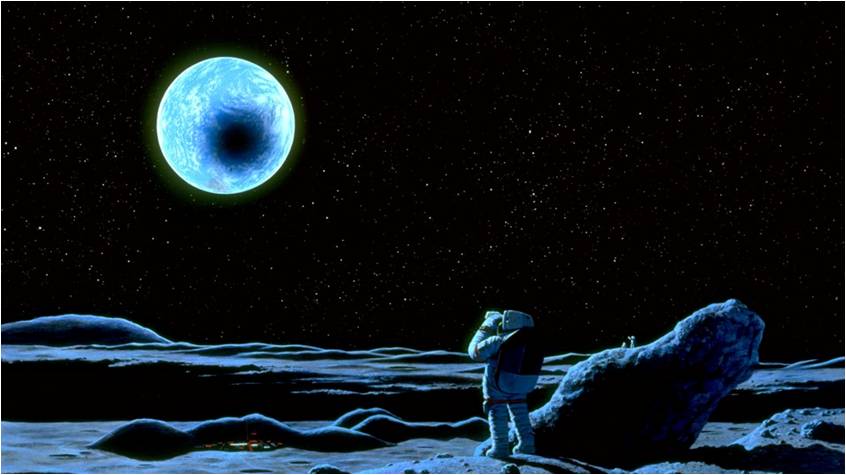
Artist’s impression of a Volvan eclipse (coinciding with a solar eclipse on earth)
https://www.theatlantic.com/science/archive/2017/08/solar-eclipse-from-the-moon/537339/
XXVI Eclīpsin tōtālem Volvae nōn vident umquam.^186, sed trānsit ipsīs per corpus
Eclipse total of-Volva not see ever but goes-across for-them though body
Volvae macula quaedam parva^187 rubicunda in extrēmīs^188, in mediō nigra^189,
of-Volva marking a-certain small reddish at edges in middle black
factōque ingressū ab oriente Volvae, exit per occidentālem ōram ^190, eandem quidem
and-made entrance from `east’ of-Volva exits through `western’ rim same indeed
viam cum maculīs Volvae nātīvīs, praeveniēns tamen eās celeritāte. ^191 Dūratque
path with markings of-Volva native exceeding however them in-speed and-lasts
sextam hōrae suae partem seu quattuor hōrās nostrātēs.[1]^192
sixth of-hour own par t or four hours of-ours
[1] Kepler defines a lunar hour as one complete revolution of Volva, ie. 24 earthly hours. There are thus approximately 28 lunar hours in one lunar day, which corresponds to the earth’s lunar month.
https://www.theatlantic.com/science/archive/2017/08/solar-eclipse-from-the-moon/537339/
XXVI Eclīpsin tōtālem Volvae nōn vident umquam.^186, sed trānsit ipsīs per corpus
Eclipse total of-Volva not see ever but goes-across for-them though body
Volvae macula quaedam parva^187 rubicunda in extrēmīs^188, in mediō nigra^189,
of-Volva marking a-certain small reddish at edges in middle black
factōque ingressū ab oriente Volvae, exit per occidentālem ōram ^190, eandem quidem
and-made entrance from `east’ of-Volva exits through `western’ rim same indeed
viam cum maculīs Volvae nātīvīs, praeveniēns tamen eās celeritāte. ^191 Dūratque
path with markings of-Volva native exceeding however them in-speed and-lasts
sextam hōrae suae partem seu quattuor hōrās nostrātēs.[1]^192
sixth of-hour own par t or four hours of-ours
[1] Kepler defines a lunar hour as one complete revolution of Volva, ie. 24 earthly hours. There are thus approximately 28 lunar hours in one lunar day, which corresponds to the earth’s lunar month.
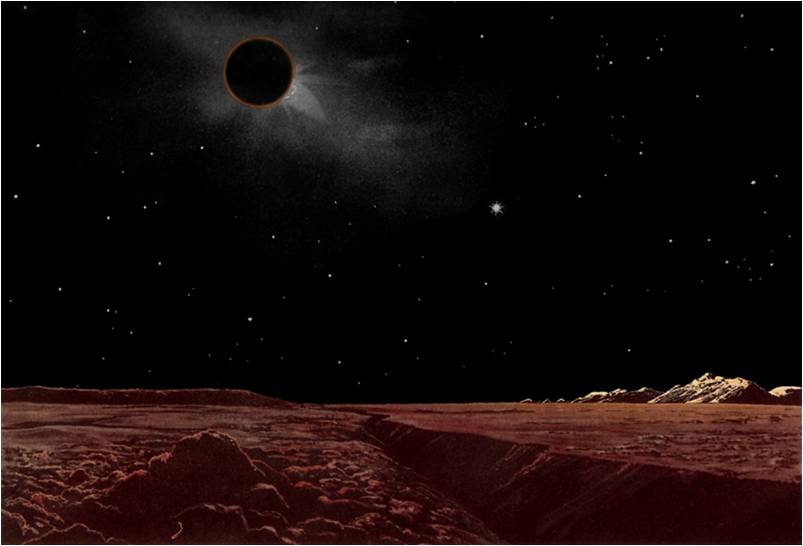
Eclipse of the sun seen from the moon (corresponding to a lunar eclipse for the earth)
https://en.wikipedia.org/wiki/Solar_eclipses_on_the_Moon#/media/File:Eclipse_from_moon.jpg
XXVI Sōlāris dēliquiī causa fit ipsīs sua Volva, plānē ut nōbīs nostra Lūna; quae Volva
Solar of-eclipse cause becomes for-them their Volva clearly as for-us our Moon which Volva
cum dīmētientem habeat quadruplō majōrem Sōle, fierī nōn potest quīn[1] Sōl ab
since diameter has four-times larger than-sun to-become not is-able that-not Sun from
oriente per meridiem pōne Volvam immōbile, in occidentem trānsiēns, creberrimē
east through meridian beyond Volva stationary to west transiting very-frequently
post Volvam abeat et sīc ab eā seu pars seu tōtum corpus Sōlis occultētur. Est autem,
behind Volva go-away and thus by it either part or whole body of-Sun be-hidden is however
licet frequēns, valdē tamen notābilis tōtīus corporis Sōlis occultātiō, quia aliquot
although frequent strongly however remarkable of-whole body of-sun concealment because several
hōrās nostrātēs dūrat^193 et lūmen utrumque Sōlis et Volvae simul extinguitur, quod
hours of-ours it-lasts and light both of-Sun and of-Volva at-same-time is-extinguished which
apud subvolvās quidem magnum quid est, quippe quī aliās habent noctēs haud multō
among subvolvans indeed significant something is in-as-much-as they at-other-times have nights not much
obscūriōrēs diēbus propter Volvae perpetuō praesentis splendōrem et magnitūdinem,
darker than-days because-of of-Volva never-endingly present splendour and size
cum in eclīpsī Sōlis utrumque ipsīs lūmināre sit exstinctum, Sōl et Volva.
since in eclipse of-Sun each for-them luminary is extinguished Sun and Volva
[1] fierī nōn potest quīn with the subjunctive, meaning `inevitably’, is a common idiom in classical Latin.
https://en.wikipedia.org/wiki/Solar_eclipses_on_the_Moon#/media/File:Eclipse_from_moon.jpg
XXVI Sōlāris dēliquiī causa fit ipsīs sua Volva, plānē ut nōbīs nostra Lūna; quae Volva
Solar of-eclipse cause becomes for-them their Volva clearly as for-us our Moon which Volva
cum dīmētientem habeat quadruplō majōrem Sōle, fierī nōn potest quīn[1] Sōl ab
since diameter has four-times larger than-sun to-become not is-able that-not Sun from
oriente per meridiem pōne Volvam immōbile, in occidentem trānsiēns, creberrimē
east through meridian beyond Volva stationary to west transiting very-frequently
post Volvam abeat et sīc ab eā seu pars seu tōtum corpus Sōlis occultētur. Est autem,
behind Volva go-away and thus by it either part or whole body of-Sun be-hidden is however
licet frequēns, valdē tamen notābilis tōtīus corporis Sōlis occultātiō, quia aliquot
although frequent strongly however remarkable of-whole body of-sun concealment because several
hōrās nostrātēs dūrat^193 et lūmen utrumque Sōlis et Volvae simul extinguitur, quod
hours of-ours it-lasts and light both of-Sun and of-Volva at-same-time is-extinguished which
apud subvolvās quidem magnum quid est, quippe quī aliās habent noctēs haud multō
among subvolvans indeed significant something is in-as-much-as they at-other-times have nights not much
obscūriōrēs diēbus propter Volvae perpetuō praesentis splendōrem et magnitūdinem,
darker than-days because-of of-Volva never-endingly present splendour and size
cum in eclīpsī Sōlis utrumque ipsīs lūmināre sit exstinctum, Sōl et Volva.
since in eclipse of-Sun each for-them luminary is extinguished Sun and Volva
[1] fierī nōn potest quīn with the subjunctive, meaning `inevitably’, is a common idiom in classical Latin.
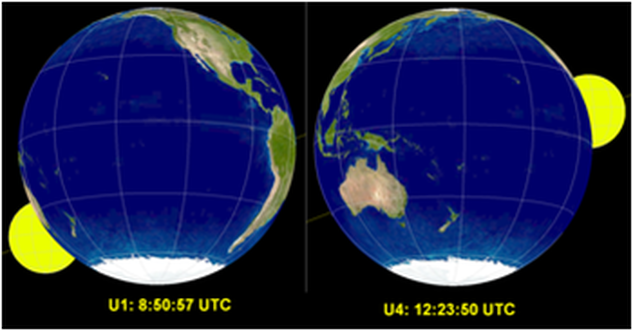
A simulation of the start and end of the August 28, 2007 lunar eclipse, seen from the center of the moon.
(the outlines of the continents would not actually be visible)
https://en.wikipedia.org/wiki/Solar_eclipses_on_the_Moon#/media/File:Lunar_eclipse_from_moon-07aug28.png
XXVII Habent tamen apud ipsōs eclīpsēs Sōlis hoc singulāre, quod frequenter admodum fit,
Have however among them eclipses of-Sun this peculiarity which frequently quite occurs
ut Sōle vix post corpus Volvae abditō ā parte oppositā oriātur splendor, quasī Sōle
that with-sun hardly behind body ofVolva hidden from side opposite arise brightness as-if with-sun
distentō et tōtum Volvae corpus amplexō, cum tamen tot partibus Sōl minor appāreat
extended and whole of-Volva body having-embraced while however so-many by-parts Sun smaller appears
quam Volva[1] ^194. Itaque merae tenebrae nōn semper fīunt, nisi et centra corporum
than Volva and-so pure darkness not always occurs unless both centres of-bodies
prope admodum jungantur^195 et mediī diaphanī dispositiō cōnsentiat[2]^196. Sed nec
near quite are-joined and of-middle transparent-medium is-suitable but nor
Volva sīc subitō exstinguitur, ut penitus cernī nōn possiit^197, quamvīs nisi tantum in
Volva thus suddenly is-extinguished so-that at-all to-be-seen not is-able although except just in
mediō dēfectiōnis maximae articulō^198. In prīncipiō vērō tōtālis dēfectiōnis in
middle of-eclipse total moment at beginning indeed of-total eclipse in
quibusdam locīs dīvīsōris[3] Volva adhūc albet, quasi exstinctā flammā[4] superstes
certain places of-divisor Volva still is-white as-if extinguished with-flame surviving
carbō vīvus; quā albēdine etiam exstinctā, medium est dēfectūs māximī (nam in nōn
coal living with-which whiteness also extinguished middle it-is of-eclipse total for in not
maximō nōn exstinguitur haec albēdō[5]), redeunte vērō albēdine Volvae (in oppositīs
total [one] not is-extinguished this whiteness returnin indeed with-whiteness of-Volva at opposite
locis dīvīsōris circulī) etiam Sōlis cōnspectus appropinquat; ut ita utrumque lūmināre
places of-divisor of-circle also of-Sun sight approacheds that thus each luminary
quodammodō exstinguātur simul in mediō dēfectūs maximī,^199.
to-a-certain-extent is-extinguished at-same-time in middle of-eclipse total
[1] Kepler’s note explains that this is caused by refraction of the sun’s rays.
[2] Kepler believed that air itself (which he wrongly believed to be present on the moon as well as on earth) could sometimes produce light of its own.
[3] The divisor is the circle separating the dark from the bright side of the moon, from where Volva appears just on the horizon.
[4] exstinctā flammā: ablative absolute (literally `with the flame extinguished’) which in more idiomatic English would be `after a flame is extinguished’. The comparison refer to a lump of coal which continues to glow red after a fire has been put out.
[5] albēdō, albet etc. could also be translated as `shining’, as preferred by Rosen
(the outlines of the continents would not actually be visible)
https://en.wikipedia.org/wiki/Solar_eclipses_on_the_Moon#/media/File:Lunar_eclipse_from_moon-07aug28.png
XXVII Habent tamen apud ipsōs eclīpsēs Sōlis hoc singulāre, quod frequenter admodum fit,
Have however among them eclipses of-Sun this peculiarity which frequently quite occurs
ut Sōle vix post corpus Volvae abditō ā parte oppositā oriātur splendor, quasī Sōle
that with-sun hardly behind body ofVolva hidden from side opposite arise brightness as-if with-sun
distentō et tōtum Volvae corpus amplexō, cum tamen tot partibus Sōl minor appāreat
extended and whole of-Volva body having-embraced while however so-many by-parts Sun smaller appears
quam Volva[1] ^194. Itaque merae tenebrae nōn semper fīunt, nisi et centra corporum
than Volva and-so pure darkness not always occurs unless both centres of-bodies
prope admodum jungantur^195 et mediī diaphanī dispositiō cōnsentiat[2]^196. Sed nec
near quite are-joined and of-middle transparent-medium is-suitable but nor
Volva sīc subitō exstinguitur, ut penitus cernī nōn possiit^197, quamvīs nisi tantum in
Volva thus suddenly is-extinguished so-that at-all to-be-seen not is-able although except just in
mediō dēfectiōnis maximae articulō^198. In prīncipiō vērō tōtālis dēfectiōnis in
middle of-eclipse total moment at beginning indeed of-total eclipse in
quibusdam locīs dīvīsōris[3] Volva adhūc albet, quasi exstinctā flammā[4] superstes
certain places of-divisor Volva still is-white as-if extinguished with-flame surviving
carbō vīvus; quā albēdine etiam exstinctā, medium est dēfectūs māximī (nam in nōn
coal living with-which whiteness also extinguished middle it-is of-eclipse total for in not
maximō nōn exstinguitur haec albēdō[5]), redeunte vērō albēdine Volvae (in oppositīs
total [one] not is-extinguished this whiteness returnin indeed with-whiteness of-Volva at opposite
locis dīvīsōris circulī) etiam Sōlis cōnspectus appropinquat; ut ita utrumque lūmināre
places of-divisor of-circle also of-Sun sight approacheds that thus each luminary
quodammodō exstinguātur simul in mediō dēfectūs maximī,^199.
to-a-certain-extent is-extinguished at-same-time in middle of-eclipse total
[1] Kepler’s note explains that this is caused by refraction of the sun’s rays.
[2] Kepler believed that air itself (which he wrongly believed to be present on the moon as well as on earth) could sometimes produce light of its own.
[3] The divisor is the circle separating the dark from the bright side of the moon, from where Volva appears just on the horizon.
[4] exstinctā flammā: ablative absolute (literally `with the flame extinguished’) which in more idiomatic English would be `after a flame is extinguished’. The comparison refer to a lump of coal which continues to glow red after a fire has been put out.
[5] albēdō, albet etc. could also be translated as `shining’, as preferred by Rosen
XXVIII Atque haec dē apparentiīs in Levāniae hemisphaeriō utrōque tam subvolvānō
And these-things about phenomena in of-Levania hemisphere each both subvolvan
quam prīvolvānō. Ex quibus nōn est difficile vel mē tacente jūdicāre, quantum in
and privolvan from which not is difficult even with-me being-silent to-judge how-much in
cēterīs conditiōnibus subvolva ā prīvolvīs different.
other conditions subvolvan-things from privolvan differ
Nōx enim subvolvārum etsī nostrātia 14 νυχθημερα[1] longa sit, Volvae tamen
Night for of-subvolvans although of-ours 14 full-days long is of-Volva however
praesentiā Terrās illūstrat et ā frīgore custōdit. Tanta quippe mōlēs, tantus splendor
presence land illuminates and from cold guards so-great indeed mass so-great splendour
nōn potest nōn calefacere[2].^200.
not is-able not to-warm
[1] Kepler uses the Greek word nyktemera (literally night-day to make clear he is referring to a full 24 hours rather than just the sunlit period, a distinction which both Latin diēs and English day obscure.
[2] The earth in fact has only a very slight effect on the temperature on the moon, resulting from a `wobble’ induced by earth’s gravitational pull rather than from directly radiated heat (see https://www.quora.com/What-impact-does-Earths-gravity-have-on-the-Moon-Does-it-heat-the-Moon). The wobble is illustrated (in exaggerated form) at https://en.wikipedia.org/wiki/Orbit_of_the_Moon#mediaviewer/File:Lunar_libration_with_phase2.gif
And these-things about phenomena in of-Levania hemisphere each both subvolvan
quam prīvolvānō. Ex quibus nōn est difficile vel mē tacente jūdicāre, quantum in
and privolvan from which not is difficult even with-me being-silent to-judge how-much in
cēterīs conditiōnibus subvolva ā prīvolvīs different.
other conditions subvolvan-things from privolvan differ
Nōx enim subvolvārum etsī nostrātia 14 νυχθημερα[1] longa sit, Volvae tamen
Night for of-subvolvans although of-ours 14 full-days long is of-Volva however
praesentiā Terrās illūstrat et ā frīgore custōdit. Tanta quippe mōlēs, tantus splendor
presence land illuminates and from cold guards so-great indeed mass so-great splendour
nōn potest nōn calefacere[2].^200.
not is-able not to-warm
[1] Kepler uses the Greek word nyktemera (literally night-day to make clear he is referring to a full 24 hours rather than just the sunlit period, a distinction which both Latin diēs and English day obscure.
[2] The earth in fact has only a very slight effect on the temperature on the moon, resulting from a `wobble’ induced by earth’s gravitational pull rather than from directly radiated heat (see https://www.quora.com/What-impact-does-Earths-gravity-have-on-the-Moon-Does-it-heat-the-Moon). The wobble is illustrated (in exaggerated form) at https://en.wikipedia.org/wiki/Orbit_of_the_Moon#mediaviewer/File:Lunar_libration_with_phase2.gif
XXIX Vicissim etsī diēs apud subvolvās molestam habeat Sōlis praesentiam per nostra
in-turn although day among the subvolvans troublesome has of-sun presence throughout our
vel 15 vel 16 νυχθημερα, Sōl tamen minor nōn adeō infestis est vīribus[1]^201, et
either 15 or 16 full-days sun however smaller not so-much troublesome is with-strength and
lūmināria juncta prōliciunt aquās omnēs in illud hemisphaerium^202, terrīs obrūtīs, ut
luminaries conjoined attract waters all into that hemisphere with-land overwhelmed so-that
plānē parum dē iīs exstet^203, ārente contrā et frīgente hemisphaeriō prīvolvānō,
clearly very-little out-of it protrudes being-dry in-contrast and cold hemisphere privolvan
quippe subtractīs omnibus aquīs[2]^204. Nocte autem subeunte apud subvolvās, diē[3]
in-as-muc-as drawn-away all waters with-night however approaching among subvolvans by-day
apud privolvās cum hemisphaeria inter sē dīvīsa habeant lūmināria, dīviduntur et
among pivolvans since hemispheres among themselves divided have luminaries are-divided also
aquae, et subvolvīs quidem nūdantur agrī, prīvolvīs vērō ad exiguum sōlātium aestūs
waters and for-subvolvans indeed are-denuded fields for-privolvans indeed to small-degree consolation for-heat
suppeditātur humor.^205
is-supplied liquid
[1] As day for the Subvolvan region is the period when the moon is outside the earth’s own orbit round the sun, the earth is then closer to the sun than is the moon so the sun’s size as it appears from the moon is less than for an observer on earth.. During the Privolvan day (Subvolvan night), in contrast, the moon is inside the earth’s orbit and thus even closer to the sun than earth is. However, the ratio of the earth’s distance from the sun (which Kepler underestimated – see n. 66) to its distance from the moon is so great (approximately 489:1) that the influence on the sun’s apparent size and the heat received at the terrestrial or lunar surface would be hardly perceivable.
[2] The belief at this time that much of the moon’s surface is covered with water is reflected in 17th century astronomers’ use of the term maria (seas) for the dark areas now known to be basaltic plains. If there were actual seas on the moon, the combined tidal effect of Volva and sun would indeed affect the distribution of the water, though not so dramatically as Kepler imagines. The sun’s tidal effect on earth is about 44% of the moon’s (see http://hyperphysics.phy-astr.gsu.edu/hbase/tide.html ) and higher (`spring’) tides are produced when the two effects are aligned and lower (`neap’) tides when they counteract each other. However, even the highest tide does not pull all water to one side of the planet,
[3] i.e during day on the dark-side of the moon, when the sun is in the privolvan sky and Volva, of course, remains stationary above the subvolvans,
in-turn although day among the subvolvans troublesome has of-sun presence throughout our
vel 15 vel 16 νυχθημερα, Sōl tamen minor nōn adeō infestis est vīribus[1]^201, et
either 15 or 16 full-days sun however smaller not so-much troublesome is with-strength and
lūmināria juncta prōliciunt aquās omnēs in illud hemisphaerium^202, terrīs obrūtīs, ut
luminaries conjoined attract waters all into that hemisphere with-land overwhelmed so-that
plānē parum dē iīs exstet^203, ārente contrā et frīgente hemisphaeriō prīvolvānō,
clearly very-little out-of it protrudes being-dry in-contrast and cold hemisphere privolvan
quippe subtractīs omnibus aquīs[2]^204. Nocte autem subeunte apud subvolvās, diē[3]
in-as-muc-as drawn-away all waters with-night however approaching among subvolvans by-day
apud privolvās cum hemisphaeria inter sē dīvīsa habeant lūmināria, dīviduntur et
among pivolvans since hemispheres among themselves divided have luminaries are-divided also
aquae, et subvolvīs quidem nūdantur agrī, prīvolvīs vērō ad exiguum sōlātium aestūs
waters and for-subvolvans indeed are-denuded fields for-privolvans indeed to small-degree consolation for-heat
suppeditātur humor.^205
is-supplied liquid
[1] As day for the Subvolvan region is the period when the moon is outside the earth’s own orbit round the sun, the earth is then closer to the sun than is the moon so the sun’s size as it appears from the moon is less than for an observer on earth.. During the Privolvan day (Subvolvan night), in contrast, the moon is inside the earth’s orbit and thus even closer to the sun than earth is. However, the ratio of the earth’s distance from the sun (which Kepler underestimated – see n. 66) to its distance from the moon is so great (approximately 489:1) that the influence on the sun’s apparent size and the heat received at the terrestrial or lunar surface would be hardly perceivable.
[2] The belief at this time that much of the moon’s surface is covered with water is reflected in 17th century astronomers’ use of the term maria (seas) for the dark areas now known to be basaltic plains. If there were actual seas on the moon, the combined tidal effect of Volva and sun would indeed affect the distribution of the water, though not so dramatically as Kepler imagines. The sun’s tidal effect on earth is about 44% of the moon’s (see http://hyperphysics.phy-astr.gsu.edu/hbase/tide.html ) and higher (`spring’) tides are produced when the two effects are aligned and lower (`neap’) tides when they counteract each other. However, even the highest tide does not pull all water to one side of the planet,
[3] i.e during day on the dark-side of the moon, when the sun is in the privolvan sky and Volva, of course, remains stationary above the subvolvans,
A supposed moon-dweller from (doctored?) NASA footage
https://www.youtube.com/watch?v=t8Su37Qzw2g
XXX Cumque tōta Levānia nōn ultrā mille et quadringenta millāria germānica pateat
And-although whole Levania not more-than 1,000 and 400 miles German extends
in circuitum, quod est quārta dēmum Tellūris nostrae pars[1]^206, montēs tamen habet
in circumference which is fourth just of-earth our part mountains however has
altissimōs^207, vallēs profundissimōs et prōlixās^208 adeōque multum Tellūrī nostrae
very-high valleys very-deep and broad and-so greatly to-Earth our
in perfectiōne rotunditātis concēdit.[2] Porōsa interim tōta est et cavernīs
in perfection of-roundness is-inferior porous meanwhile whole is and with-caverns
spēluncīsque perpetuīs quasi perfossa^209, maximē per prīvolvānōs tractūs^210, quod
and-caves eternal as-if pierced-through especially through privolvan regions which
praecipuum incolīs remedium est contrā aestum et frīgora^211.
principal for-inhabitants remedy is against heat and cold
[1] Kepler’s figure for the circumference of the moon is 6,454 miles implying 25,816 for the earth. The actual equatorial circumferences of moon and earth are 6,780 and 24,900 miles respectively.
[2] This is essentially correct. The highest known point on the moon is approximately 35,000 feet above the mean radius, compared to Mt. Everest at 29,00 feet above sea level. However, Everest is immensely more spectacular as it rises from a much narrower base. See https://www.nasa.gov/mission_pages/LRO/mul timedia/lroimages/lroc-20101027-highest.html
XXXI Quicquid vel terrā nāscitur vel super terram ingreditur^212, mōnstrōsae
Whatever either from-land is-born or onto land comes monstrous
magnitūdinis est. Incrēmenta fīunt celerrima; brevis vītae sunt omnia, cum ad tam
of-size is increases happen very-fast of-short life are all-things since to such
immānem corporum mōlem adōlēscant^213. Nūllus prīvolvīs certus nidus, nūlla
huge of-bodsies mass they-grow no for-privolvans fixed resting-place no
habitātiō stata; tōtum globum ūnīus suae diēī spatiō agminātim pervagantur, pars
abode stationary whole globe of-one own day in-period in-columns they-roam some
pedibus, quibus longissimē camēlōs nostrōs praevertunt, pars pennīs, pars nāvibus
on-feet with-which by-great-margin camels our they-outstrip some on-wings some in-ships
fugientēs aquās cōnsectantur, aut sī mora plūsculōrum diērum est necessāria, tunc
fleeing waters go-towards or if halt of-a-few-more days is necessary then
spēluncās perreptant, prout cuique nātūra est. Ūrīnātōrēs[1] sunt plūrimī, omnia
tunnels crawl-into according-as to-each nature is divers are very-many all-thingd
nātūrāliter animantia spīritum trahunt lentissimē, sub aquīs igitur dēgunt in profundō,
naturally breathing breath draw very-slowly under waters therefore they-live at depth
nātūram arte adjuvantēs^214. Ajunt enim in illīs altissimīs aquārum sinubus[2]
nature with-skil helping they-say for in those deepest of-waters recesses
frīgidam perdūrāre,[3] ferventibus ā Sōle superiōribus undīs[4]^215, in superficiē
cold to-last being-very-hot from Sun upper waters to surface
quicquid haeret,id ēlīxātur ā Sōle in meridiē fitque pābulum adventantibus
whatever clings It is-boiled by Sun at midday and-becomes food for-arriving
[1] Agent noun from the verb ūrīnor (dive). Both this and ūrīna, -ae f (urine) derive from a root meaning `water.’
[2] The original 4th declension dative/ablative plural ending in-ubus was occasionally used in classical Latin, though –ibus had become the standard form.
[3] Accusative and infinitive:`that cold [water] lasts’
[4] Ablative absolute phrase with present participle: `while the upper waters were very hot from the sun.’
peregrīnantium colōnōrum[1] exercitibus^216. Nam in ūniversum subvolvānum
wondering of-inhabitants hosts for in general subvolvan
hemisphaerium nostrīs pāgīs et opppidīs et hortīs aequiparātur, prīvolvānum nostrīs
hemisphere to-our villages and towns and gardens is-comparable privolvan to-our
agrīs[2] et silvīs et dēsertīs . Quibus respīrātiō magis est necessāria, iī ferventēs aquās
open-country and woods and deserts for-whom breathing more is necessary these boiling waters
angustō canālī in spēluncās admittunt, ut longō meātū in intima receptae paulātim
by-narrow canal into caves they-admit so-that in-long course into inner-areas received gradually
refrīgēscant. Ibi sē potiōrī diēī parte continent eōque pōtū ūtuntur, vesperā adveniente
they-may-grow-cold there themselves in-greater part of-day they-keep and-that drink use with-evening approaching
prōdeunt pabulātum[3]^217. In stirpibus corticēs, in animālibus cutis, aut sī quid eius
they-go-out to-seek-food in plants the-rinds in animals the-ski n or if anything its
vicem obtinet, majōrem partem corporeae mōlis absolvit fungōsumque et porōsum
place takes greater part bodily of-mass takes-up and-spongy and porous
est; ac sī quid dēprehēnsum in diē fuerit,[4]in summitāte indūrātur et adūritur, vesperā
is and if anything caught in day will-have-been on top it-is-hardened and scorched with-evening
succēdente dēglūbitur^218. Terrā nāscentia, licet in montium jūgīs pauca sint,
coming it-is dehusked from-earth things-born although on of-mountains ridges a-few there-are
plērumque eōdem diē et creantur et ēnecantur, novīs quotīdiē succrēscentibus.
Generally on-same day both are-born and die with-new-ones daily growing-up
[1] The original meaning of colōnus is a tiller, but it also came to denote a tenant farmer, a settler in a new foundation established by a distant city or just an inhabitant.
[2] `Open country’ (following Rosen) is better here as `field’ implies settled cultivation.
[3] Supine of deponent verb pabulor (1), `feed’, `forage’, used to express purpose after a verb of motion.
[4] This seems to refer to anything that happens to be exposed to the full heat of the sun rather than to living things caught by the inhabitants. Simliarly, the rind or skin presumably drops off naturally rather than being stripped off
https://www.youtube.com/watch?v=t8Su37Qzw2g
XXX Cumque tōta Levānia nōn ultrā mille et quadringenta millāria germānica pateat
And-although whole Levania not more-than 1,000 and 400 miles German extends
in circuitum, quod est quārta dēmum Tellūris nostrae pars[1]^206, montēs tamen habet
in circumference which is fourth just of-earth our part mountains however has
altissimōs^207, vallēs profundissimōs et prōlixās^208 adeōque multum Tellūrī nostrae
very-high valleys very-deep and broad and-so greatly to-Earth our
in perfectiōne rotunditātis concēdit.[2] Porōsa interim tōta est et cavernīs
in perfection of-roundness is-inferior porous meanwhile whole is and with-caverns
spēluncīsque perpetuīs quasi perfossa^209, maximē per prīvolvānōs tractūs^210, quod
and-caves eternal as-if pierced-through especially through privolvan regions which
praecipuum incolīs remedium est contrā aestum et frīgora^211.
principal for-inhabitants remedy is against heat and cold
[1] Kepler’s figure for the circumference of the moon is 6,454 miles implying 25,816 for the earth. The actual equatorial circumferences of moon and earth are 6,780 and 24,900 miles respectively.
[2] This is essentially correct. The highest known point on the moon is approximately 35,000 feet above the mean radius, compared to Mt. Everest at 29,00 feet above sea level. However, Everest is immensely more spectacular as it rises from a much narrower base. See https://www.nasa.gov/mission_pages/LRO/mul timedia/lroimages/lroc-20101027-highest.html
XXXI Quicquid vel terrā nāscitur vel super terram ingreditur^212, mōnstrōsae
Whatever either from-land is-born or onto land comes monstrous
magnitūdinis est. Incrēmenta fīunt celerrima; brevis vītae sunt omnia, cum ad tam
of-size is increases happen very-fast of-short life are all-things since to such
immānem corporum mōlem adōlēscant^213. Nūllus prīvolvīs certus nidus, nūlla
huge of-bodsies mass they-grow no for-privolvans fixed resting-place no
habitātiō stata; tōtum globum ūnīus suae diēī spatiō agminātim pervagantur, pars
abode stationary whole globe of-one own day in-period in-columns they-roam some
pedibus, quibus longissimē camēlōs nostrōs praevertunt, pars pennīs, pars nāvibus
on-feet with-which by-great-margin camels our they-outstrip some on-wings some in-ships
fugientēs aquās cōnsectantur, aut sī mora plūsculōrum diērum est necessāria, tunc
fleeing waters go-towards or if halt of-a-few-more days is necessary then
spēluncās perreptant, prout cuique nātūra est. Ūrīnātōrēs[1] sunt plūrimī, omnia
tunnels crawl-into according-as to-each nature is divers are very-many all-thingd
nātūrāliter animantia spīritum trahunt lentissimē, sub aquīs igitur dēgunt in profundō,
naturally breathing breath draw very-slowly under waters therefore they-live at depth
nātūram arte adjuvantēs^214. Ajunt enim in illīs altissimīs aquārum sinubus[2]
nature with-skil helping they-say for in those deepest of-waters recesses
frīgidam perdūrāre,[3] ferventibus ā Sōle superiōribus undīs[4]^215, in superficiē
cold to-last being-very-hot from Sun upper waters to surface
quicquid haeret,id ēlīxātur ā Sōle in meridiē fitque pābulum adventantibus
whatever clings It is-boiled by Sun at midday and-becomes food for-arriving
[1] Agent noun from the verb ūrīnor (dive). Both this and ūrīna, -ae f (urine) derive from a root meaning `water.’
[2] The original 4th declension dative/ablative plural ending in-ubus was occasionally used in classical Latin, though –ibus had become the standard form.
[3] Accusative and infinitive:`that cold [water] lasts’
[4] Ablative absolute phrase with present participle: `while the upper waters were very hot from the sun.’
peregrīnantium colōnōrum[1] exercitibus^216. Nam in ūniversum subvolvānum
wondering of-inhabitants hosts for in general subvolvan
hemisphaerium nostrīs pāgīs et opppidīs et hortīs aequiparātur, prīvolvānum nostrīs
hemisphere to-our villages and towns and gardens is-comparable privolvan to-our
agrīs[2] et silvīs et dēsertīs . Quibus respīrātiō magis est necessāria, iī ferventēs aquās
open-country and woods and deserts for-whom breathing more is necessary these boiling waters
angustō canālī in spēluncās admittunt, ut longō meātū in intima receptae paulātim
by-narrow canal into caves they-admit so-that in-long course into inner-areas received gradually
refrīgēscant. Ibi sē potiōrī diēī parte continent eōque pōtū ūtuntur, vesperā adveniente
they-may-grow-cold there themselves in-greater part of-day they-keep and-that drink use with-evening approaching
prōdeunt pabulātum[3]^217. In stirpibus corticēs, in animālibus cutis, aut sī quid eius
they-go-out to-seek-food in plants the-rinds in animals the-ski n or if anything its
vicem obtinet, majōrem partem corporeae mōlis absolvit fungōsumque et porōsum
place takes greater part bodily of-mass takes-up and-spongy and porous
est; ac sī quid dēprehēnsum in diē fuerit,[4]in summitāte indūrātur et adūritur, vesperā
is and if anything caught in day will-have-been on top it-is-hardened and scorched with-evening
succēdente dēglūbitur^218. Terrā nāscentia, licet in montium jūgīs pauca sint,
coming it-is dehusked from-earth things-born although on of-mountains ridges a-few there-are
plērumque eōdem diē et creantur et ēnecantur, novīs quotīdiē succrēscentibus.
Generally on-same day both are-born and die with-new-ones daily growing-up
[1] The original meaning of colōnus is a tiller, but it also came to denote a tenant farmer, a settler in a new foundation established by a distant city or just an inhabitant.
[2] `Open country’ (following Rosen) is better here as `field’ implies settled cultivation.
[3] Supine of deponent verb pabulor (1), `feed’, `forage’, used to express purpose after a verb of motion.
[4] This seems to refer to anything that happens to be exposed to the full heat of the sun rather than to living things caught by the inhabitants. Simliarly, the rind or skin presumably drops off naturally rather than being stripped off
XXXII Nātūra viperīna in ūniversum praevalet.[1] Mīrāculō enim sunt Sōlī sēsē
Nature serpentine in general prevails miraculously for there-are to-Sun themselves
in merīdiē expōnentēs quasī voluptātis causā, nōn tamen alibī, nisi pōne ōrificia
at-midday exposing as-if of-pleasure for-sake not however otherwise if-not behind openings
spēluncārum, ut tūtus et promtus sit receptus^219.
of-caves so-that safe and readily-available may-be retreat
Quibusdam per diēī aestum spīritus exhaustus vītaque exstincta per noctem
For-certain-things through day’s heat spirit exhausted nd-life extinguished by night
redeunt, contrāriā ratiōne quam apud nōs muscīs^220. Passim per solum dispersae
return contrary in-system than among us for-flies everywhere over ground dispersed
mōlēs figūrā nucum pīneārum, per diem adustīs corticibus,[2] vesperī, quasī reclūsīs
objects with-shape of-cones of-pines through day scorched with-coverings in-evening as-if revealed
latebrīs,[3] animantia ēdunt^221
with-hiding-places living-things they-produce
Praecipuum aestūs lēnimentum in subvolvānō hemisphaeriō sunt continua nūbila
Especial of-heat relief in subvolvan hemisphere are continual cloudy-skies
et pluviae^222, quae aliquandō per dīmidiam regiōnem aut eō plūs obtinent^223
and rain which sometimes through half region or than-that more prevail.
[1] The reference is to snakes and other reptiles habit of basking in the sun.
[2] Ablative absolute: `after their coverings have been scorched’
[3] Ablative absolute: `as if their hiding places have been revealed’.
Nature serpentine in general prevails miraculously for there-are to-Sun themselves
in merīdiē expōnentēs quasī voluptātis causā, nōn tamen alibī, nisi pōne ōrificia
at-midday exposing as-if of-pleasure for-sake not however otherwise if-not behind openings
spēluncārum, ut tūtus et promtus sit receptus^219.
of-caves so-that safe and readily-available may-be retreat
Quibusdam per diēī aestum spīritus exhaustus vītaque exstincta per noctem
For-certain-things through day’s heat spirit exhausted nd-life extinguished by night
redeunt, contrāriā ratiōne quam apud nōs muscīs^220. Passim per solum dispersae
return contrary in-system than among us for-flies everywhere over ground dispersed
mōlēs figūrā nucum pīneārum, per diem adustīs corticibus,[2] vesperī, quasī reclūsīs
objects with-shape of-cones of-pines through day scorched with-coverings in-evening as-if revealed
latebrīs,[3] animantia ēdunt^221
with-hiding-places living-things they-produce
Praecipuum aestūs lēnimentum in subvolvānō hemisphaeriō sunt continua nūbila
Especial of-heat relief in subvolvan hemisphere are continual cloudy-skies
et pluviae^222, quae aliquandō per dīmidiam regiōnem aut eō plūs obtinent^223
and rain which sometimes through half region or than-that more prevail.
[1] The reference is to snakes and other reptiles habit of basking in the sun.
[2] Ablative absolute: `after their coverings have been scorched’
[3] Ablative absolute: `as if their hiding places have been revealed’.
Frankfurt besieged by the Swedish army in 1631, the year after Kepler’s death
https://www.alamy.com/stock-photo-the-swedish-siege-of-frankfurt-main-thirty-years-war-17th-century-76763991.html
XXXIII Hūcusque cum pervēnissem somniandō, ventus ortus cum strepitū pluviae
This-far when I-had-reached in-dreaming wind risen with noise of-rain
somnum mihi dissolvit ūnāque librī Francofurtī allātī[1] extrēma abolēvit. Ipse itaque
sleep for-me dissolved and-also of-book in-Frankfurt bought last-part destroyed Self therefore
relictis Daemone nārrante et audītōribus,[2] Duracōtō fīliō cum mātre Fiolxhildī, ut
left with-Demon narrating and listeners Duracotus son with mother Fiolxhildid as
errant obvolūtīs capitibus, ad mē reversus, vēre caput pulvinarī, corpus strāgulīs
they-wander wrapped with-heads to myself returned indeed head with-pillow body with-blankets
obvolūtum dēprehendi.
wrapped I-found
[1] This participle (from afferō, afferre, attulī, allātum) would normally means `brought (to a place)’ but its use with the locative Frankfurtī makes bought’ or `acquired’ (Rosen) a beter transnlation.
[2] Another ablative absolute: `leaving the Demon narrator and his listeners Duracotus..and Fiolxhildis'
https://www.alamy.com/stock-photo-the-swedish-siege-of-frankfurt-main-thirty-years-war-17th-century-76763991.html
XXXIII Hūcusque cum pervēnissem somniandō, ventus ortus cum strepitū pluviae
This-far when I-had-reached in-dreaming wind risen with noise of-rain
somnum mihi dissolvit ūnāque librī Francofurtī allātī[1] extrēma abolēvit. Ipse itaque
sleep for-me dissolved and-also of-book in-Frankfurt bought last-part destroyed Self therefore
relictis Daemone nārrante et audītōribus,[2] Duracōtō fīliō cum mātre Fiolxhildī, ut
left with-Demon narrating and listeners Duracotus son with mother Fiolxhildid as
errant obvolūtīs capitibus, ad mē reversus, vēre caput pulvinarī, corpus strāgulīs
they-wander wrapped with-heads to myself returned indeed head with-pillow body with-blankets
obvolūtum dēprehendi.
wrapped I-found
[1] This participle (from afferō, afferre, attulī, allātum) would normally means `brought (to a place)’ but its use with the locative Frankfurtī makes bought’ or `acquired’ (Rosen) a beter transnlation.
[2] Another ablative absolute: `leaving the Demon narrator and his listeners Duracotus..and Fiolxhildis'



