| linguae |
|
VIDES UT ALTA STET NIVE CANDIDUM
(Horace Odes I.9)
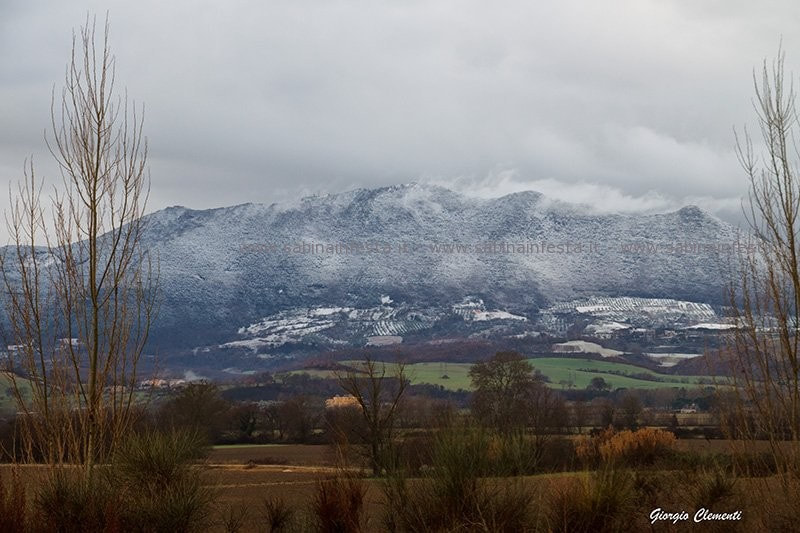
Soracte in winter
http://www.sabinainfesta.it/en/stimigliano-di-giorgio-clementi/soratte-neve-giorgio-clementi/
http://www.sabinainfesta.it/en/stimigliano-di-giorgio-clementi/soratte-neve-giorgio-clementi/
Vidēs ut altā stet nive candidum
Soracte nec iam sustineant onus
silvae labōrantēs gelūque
flūmina constiterint acūtō?
Dissolve frīgus ligna super focō 5
largē repōnēns atque benignius
dēprōme quadrīmum Sabīnā,
ō Thaliarche, merum diōtā.
Permitte dīvīs cētera, quī simul
strāvēre ventos aequore fervidō 10
dēproeliantīs, nec cupressī
nec veterēs agitantur ornī.
Quid sit futūrum crās, fuge quaerer(e), et
quem fors diērum cumque dabit, lucrō
adpōne nec dulcīs amōrēs
sperne, puer, neque tū chorēās, 15
dōnec virentī cānitiēs abest
mōrōsa. Nunc et Campus et āreae
lēnēsque sub noctem susurrī
compositā repetantur hōrā,
nunc et latentis prōditor intumō 20
grātus puellae rīsus ab angulō
pignusque dēreptum lacertīs
aut digitō male pertinācī.
The poem is in Horace’s favourite metre, consisting of two Alcaic hendecasyllables (ᵒ - ᵕ - - - ᵕ ᵕ - ᵕ-), an iambic dimeter plus one syllable ( ᵒ - ᵕ - ᵒ - ᵕ - -) and an Alcaic decasyllable (- ᵕ ᵕ - ᵕ ᵕ - ᵕ - -). The final syllable of a line can be a short one `long by position’.
Soracte nec iam sustineant onus
silvae labōrantēs gelūque
flūmina constiterint acūtō?
Dissolve frīgus ligna super focō 5
largē repōnēns atque benignius
dēprōme quadrīmum Sabīnā,
ō Thaliarche, merum diōtā.
Permitte dīvīs cētera, quī simul
strāvēre ventos aequore fervidō 10
dēproeliantīs, nec cupressī
nec veterēs agitantur ornī.
Quid sit futūrum crās, fuge quaerer(e), et
quem fors diērum cumque dabit, lucrō
adpōne nec dulcīs amōrēs
sperne, puer, neque tū chorēās, 15
dōnec virentī cānitiēs abest
mōrōsa. Nunc et Campus et āreae
lēnēsque sub noctem susurrī
compositā repetantur hōrā,
nunc et latentis prōditor intumō 20
grātus puellae rīsus ab angulō
pignusque dēreptum lacertīs
aut digitō male pertinācī.
The poem is in Horace’s favourite metre, consisting of two Alcaic hendecasyllables (ᵒ - ᵕ - - - ᵕ ᵕ - ᵕ-), an iambic dimeter plus one syllable ( ᵒ - ᵕ - ᵒ - ᵕ - -) and an Alcaic decasyllable (- ᵕ ᵕ - ᵕ ᵕ - ᵕ - -). The final syllable of a line can be a short one `long by position’.
___________________________________________________________________________________
Vides ut alta stet nive candidum Soracte…
Posted on December 8, 2013 by M J Mann
https://thesecondachilles.com/2013/12/08/vides-ut-alta-stet-nive-candidum-soracte/
Vides ut alta stet nive candidum Soracte…
Posted on December 8, 2013 by M J Mann
https://thesecondachilles.com/2013/12/08/vides-ut-alta-stet-nive-candidum-soracte/
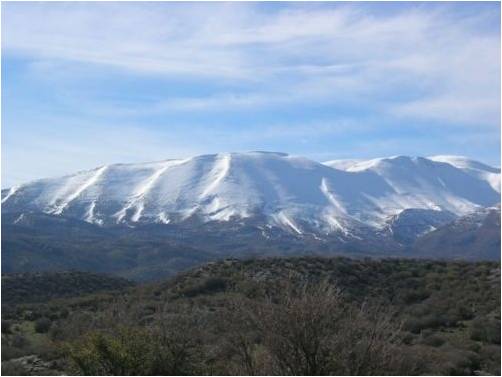
Mt Ida
Translation by Patrick Fermor Leigh
See Soracte’s mighty peak stands deep in virgin snow
And soon the heavy-laden trees their white load will not know,
When the swiftly rushing rivers with the ice have ceased to flow.
Pile, O Thaliarchus, pile the good logs on the fire!
Fetch up some crusty four-year wine in cobwebbed Sabine jar!
Thus we’ll drive away Jack Frost, with his biting cold so dire!
Care-free, all other matters among the gods we’ll keep
They when they’ve checked the battling wind upon the boiling deep
Untossed about the cypress and the old ash tree may sleep.
Seek not to know what changes to-morrow may be found
But count as gain whatever lot the change of days brings round;
Spurn not, young friend, sweet love-making, nor yet the dances round,
While withered age is distant from thy youth frequent the plain,
The throned lawns, each fashionable haunt, a crowded lane,
And at the trysting hour, e’en night-fall, softly whispered love’s refrain.
Now doth a roguish laugh our hiding girl betray
From her dark cover, where love’s token, perforce, is snatched away,
And her ill-withstanding finger but feebly bids him nay.
From Leigh Fermor's account of taking the kidnapped German commander in Crete over the mouintains with the German army in pursuit:
During the lull in the pursuit, we woke up among the rocks just as a brilliant dawn was breaking over the crest of Mount Ida. We had been toiling over it, through snow and then rain, for the last two days. Looking across the valley at this flashing mountain-crest, the general murmured to himself:
Vides ut alta stet nive candidum
Soracte…
It was one of the ones I knew! I continued from where he had broken off:
nec jam sustineant onus
Silvae laborantes, geluque
Flumina constiterint acuto,
and so on, through the remaining five stanzas to the end. The general’s blue eyes had swivelled away from the mountain-top to mine – and when I’d finished, after a long silence, he said: “Ach so, Herr Major!” It was very strange. As though, for a long moment, the war had ceased to exist. We had both drunk at the same fountains long before; and things were different between us for the rest of our time together.
(Patrick Leigh Fermor A Time of Gifts)
Details of the operation are at:
https://thesecondachilles.com/2013/06/02/the-abduction-of-general-kreipe/
________________________________________________________________________________
Poem of the week: Horace: The Odes, Book One, IX, translated by John Dryden
Dryden shows his enjoyment of translating Horace, 'paraphrasing' his verse with brilliant wordplay
https://www.theguardian.com/books/2012/jul/30/poem-horace-odes-dryden
Carol Rumens
For this last half-year I have been troubled with the disease (as I may call it) of translation … " Thus John Dryden begins the preface to his volume, Sylvae, or the Second Part of Poetical Miscellanies (1685). It marks his emergence, relatively late in life, as a translator, containing work by various Greek and Latin authors: Theocritus, Lucretius, Horace, Ovid among them. Despite that "disease", encompassing a nagging "un-ease" about the fidelity of his method, Dryden enjoyed translating Horace – and it shows. See, for example, the magnificent Ode 29 from Book Three presented by Dryden as his own imitation of "Pindarique Verse". Its famous eighth stanza ("Happy the man, and happy he alone, / He who can call today his own … ") is treasured by readers still – as poetry and as advice on living. For this week's poem, however, I've picked a smaller jewel: the wonderfully elegant version of Ode Nine, Book One.
Dryden described his method as paraphrase. The original author's words were not as "strictly followed as his sense". The sense could be amplified, and even altered. This was a practical and, in some ways, obvious technique. Horace's word-order, for example, has to be altered to make sense in a non-inflected language. In taking further liberties, the justification is that the translator is himself making a poem. Dryden tried to create a work the author could have produced "if he were living and an Englishman". He sets the standard for poetry translation as fidelity to the receiving language, and sets a further standard: he is honest with the reader about his strategies.
Horace didn't think of these verses as Odes. The Renaissance gave them that title. To the author, they were songs, or "carmina". Ode one/nine is written in Alcaics, a four-lined, largely dactylic strophe named after the Greek poet Alcaeus: it's the commonest verse-form in the Odes, a flexible form-for-all-seasons. Using iambic tetrameter chiefly, with the rhyme-scheme A B A B C C (C), Dryden expands the quatrain, in the first four stanzas to six lines and in the last two to seven. The bold move works. The statelier English verse occupies its space comfortably. There's no padding, no rigidity.
Dryden's poem sometimes generalises, of course. He loses the address to Thaliarchus, master of the feast. He doesn't mention Mount Soracte or name the trees. In the last stanza, there's no reference to the girl's ring. Yet he avoids dull exegesis or moralising. Like Horace, he balances his showing and telling.
Dryden enjoys some subtly brilliant word-play. In the first stanza, the mountains of line one are elevated in the next by "mounts of snow", a linguistic effect and a snapshot revealing the snow itself as mountainous. There's a wonderful gravitational pull in the rest of the stanza, from the "labouring woods" (suggesting more tonnage of snow on the trees) to the stream, imagined as a prisoner, fettered, benumbed, "cramp'd to solid ground". The ensuing indoors scene introduces a contrasting glow and vivacity, with the heaped logs replacing the snow-heaps outside. The mood is merry and defiant, a mixture of Epicurean and stoic. It's tempting to imagine the Restoration (1660) as Dryden's political subtext here.
God now comes on stage in a somewhat Jovian manner, playful, not wholly reliable. He will provide, "if 'tis worth His care", but there's no knowing what so stormy, windy and capricious a deity might do next (think 17th-century politics again, perhaps?). The scene is set perfectly for that sound, pragmatic advice to seize the moment – "Nor love, nor love's delights, disdain … " Dryden works Horace into some sharp-suited epigrams, as in the final couplet of this stanza and the last line of the next (fifth): "The best is but in season best."
It's such a cohesive, tight little ship of a poem, yet the tone is relaxed. There is an ease of movement in the argument, so it never seems heavy-handed. All the stanzas work separately, and all work together in forming an overall architecture. There's a satisfying balance of concrete and abstract. Dryden leaves out some of Horace's specific details, but compensates with a focus on language.
In the wonderful last stanza, notice how appropriately he picks up the tercet's rhyme-sounds ("feign/again/ordain") from the fourth stanza's couplet about the delights of love ("disdain/gain"). That extra room now allows him to present the courtship drama as a complete narrative-in-miniature. The faint sexual frisson is judged to perfection, and not a word is misplaced. Horace's brevity is magical, here, but Dryden's amplification works in another way. He closes with a line of hexameter, straightforward and serious: "These, these are joys the gods for youth ordain." Do we hear the regretful tone of middle-age? Perhaps, and this may be another reason why Dryden's English lives. He's true to his own feelings.
Dryden was a great literary all-rounder. He is "the father of modern criticism" and a glorious prose-stylist. He's no longer remembered as a playwright, perhaps unfairly. I recently read one of his comedies (An Evening's Love), dipping my toe for the first time, and found it a highly entertaining piece of Spanish sitcom. But Dryden himself feared he had wasted his energies among "the steaming ordures of the stage".
In 1685, of course, he was still to produce his great allegorical poems and the brilliant satires such as Mac Flecknoe (1682), and still to tackle his translation masterpiece, Virgil's Aeneid. The Sylvae represent no less an achievement, showing Dryden in a perhaps unusual light – that of graceful poetic lyricist.
Horace's original, with an interesting modern American translation and helpful commentary by William Harris, is here.
Horace: The Odes, Book One, IX, translated by John Dryden
Behold yon mountain's hoary height
Made higher with new mounts of snow:
Again behold the winter's weight
Oppress the labouring woods below'
And streams with icy fetters bound
Benumbed and cramped to solid ground.
With well-heaped logs dissolve the cold
And feed the genial hearth with fires;
Produce the wine that makes us bold,
And spritely wit and love inspires;
For what hereafter shall betide
God (if 'tis worth His care) provide.
Let Him alone with what He made,
To toss and turn the world below;
At His command the storms invade,
The winds by His commission blow;
Till with a nod He bids them cease
And then the calm returns and all is peace.
Tomorrow and its works defy;
Lay hold upon the present hour,
And snatch the pleasures passing by
To put them out of Fortune's power;
Nor love nor love's delights disdain –
Whate'er thou getts't today, is gain.
Secure those golden early joys
That youth unsoured with sorrow bears,
Ere with'ring time the taste destroys
With sickness and unwieldy years.
For active sports, for pleasing rest.
This is the time to be posesst;
The best is but in season best.
Th'appointed hour of promised bliss,
The pleasing whisper in the dark,
The half-unwilling willing kiss,
The laugh that guides thee to the mark,
When the kind nymph would coyness feign
And hides but to be found again –
These, these are joys the gods for youth ordain.
